
You Have 75 Points. The Minimum Is 65. Software Engineers Need 95. Your Migration Agent in Shanghai Charges ¥50,000 But Cannot Tell You Why the ACS Just Deleted Four Years of Your Tencent Experience or Why the PTE Algorithm Keeps Scoring Your Perfect English at 72.
You have a computer science degree from a 985 university. You have five years at a major tech company — Alibaba, ByteDance, Huawei, or one of the Shenzhen startups that run at the same pace. Your English is fluent. Your GitHub has more stars than most Australian developers you will compete against. You ran the Department of Home Affairs points calculator and scored 75. The pass mark is 65. You assumed you were competitive.
Then you checked the actual invitation data. Software Engineers: invited at 95 points. ICT Business Analysts: 95. Accountants: 100. Your 75-point Expression of Interest is not borderline. It is invisible. It will sit in SkillSelect for twelve months and expire without ever appearing on a case officer's screen.
Then the ACS skills assessment result arrived. You submitted five years of software engineering experience. The ACS deducted two years because your degree was classified as "ICT Major — Closely Related." If your degree had been classified as "ICT Minor," the deduction would have been four to six years. A developer with five years at Tencent now has three years of claimable experience for points purposes. A developer with three years has one. And the ACS letter does not explain that claiming those deducted years on your EOI is not just a mistake — it is grounds for visa refusal under PIC 4020, the Public Interest Criterion for fraud and misrepresentation.
Then the CSSD verification. The Australian Computer Society requires your Chinese degree to be verified through CSSD (学信网), formerly known as CHSI or CDGDC. You assumed this was a formality. It took seven weeks because the verification report must be sent electronically from CSSD directly to the ACS, and a single mismatch between the name on your degree certificate (学位证书), your graduation diploma (毕业证书), and your transcripts (成绩单) triggers a manual review. If your degree is from a 自考 (self-study) or 成人教育 (adult education) pathway, the ACS maps it against the Australian Qualifications Framework with additional scrutiny on whether the curriculum content qualifies as "highly relevant" ICT. Seven weeks became twelve. Your EOI Date of Effect slipped. Candidates who submitted after you now sit above you in the queue.
Then the PTE Academic. You scored 72 across all bands. You need 79 for Superior English — the 20-point swing that separates a 75-point EOI from a 95-point invitation. Your spoken English is better than half the Australians you will work with. But the PTE algorithm does not score comprehension. It scores waveform clarity. And Mandarin speakers carry three phonological patterns that the algorithm systematically penalizes: the n/l merge (pronouncing "night" as "light," especially common for speakers from Sichuan and Hubei), the consonant cluster collapse (adding a vowel to final consonants — "fit-uh" for "fit," "start-uh" for "start"), and the th substitution (replacing /θ/ with /s/ and /ð/ with /d/). These are not errors in any meaningful sense of English communication. They are artifacts of Mandarin phonology that the AI scoring engine treats as fluency deficiencies. Your migration agent told you to "practise more." The guide tells you exactly which sounds to over-articulate for the algorithm and which PTE task strategies exploit the 2026 scoring update.
Then the NAATI CCL. Five "free" points for interpreting between English and Mandarin — a test specifically designed for bilingual speakers. Native Mandarin speakers fail it at a rate that would surprise anyone who assumes fluency equals competence. The test penalizes translation-by-sound (confusing "advice" with "advise"), number transposition (swapping 50 for 15), positive-negative flips ("is allowed" becoming "is not allowed"), and agent omission (losing track of who performed the action). These are not English errors. They are interpreting errors that native speakers make precisely because they are too fluent to slow down and parse each segment technically. The $800 test fee and the three-month rebooking window mean a single overconfident attempt costs you both money and calendar time you cannot recover.
And through all of this, the SAFE $50,000 annual foreign exchange quota sits in the background. You do not need $800,000 like an EB-5 investor. But you need enough for the $4,640 visa application charge, the skills assessment fee, the PTE and NAATI costs, the health examination, the police clearances, and the settlement funds that some states require for 190 and 491 nominations. Converting RMB to AUD through your Chinese bank account triggers the June 2025 "Travel Rule" requiring detailed payer/payee verification on international transfers. Your parents want to help. Their transfers add a second layer of SAFE documentation. Nobody at the Shanghai agency mentioned that the Department of Home Affairs now cross-references your declared salary against your Individual Income Tax (个人所得税) records — and if your IIT shows tax paid on 10,000 RMB per month while your reference letter claims 30,000 RMB, the entire employment claim is rejected as non-genuine.
The China Points Acceleration System
This is the operational manual for Chinese professionals navigating the Subclass 189 from the specific position of having a Chinese degree, Chinese work experience, Mandarin as a first language, and funds sitting in Chinese banks under SAFE regulations. Not a generic explanation of how the 189 points system works — the Department of Home Affairs website covers that. This is the China-specific playbook for the five problems no other resource in the market addresses simultaneously: getting a positive skills assessment without losing half your experience to ACS deductions, cracking the PTE algorithm's bias against Mandarin phonology, capturing 5 NAATI CCL points without falling into the native speaker traps, assembling employment evidence that survives the "elevated scrutiny" applied to Chinese applications, and timing your EOI submission to a quarterly invitation calendar where the difference between 90 and 95 points is the difference between an invitation and an eighteen-month wait.
Migration agents in China charge ¥30,000 to ¥60,000 for 189 application management. MARA-registered agents in Australia charge $3,300 to $7,950 AUD. Both handle compliance — filling forms, certifying documents, lodging the application. Neither delivers the strategic layer: which ACS deduction category applies to your specific degree classification, which PTE pronunciation drills close the gap from 72 to 79 for a Mandarin speaker, when a Date of Effect reset helps your queue position and when it destroys it, or whether your occupation's Tier 4 ceiling makes the 189 statistically improbable and the 491's +15 points the only realistic path to permanent residency.
What Is Inside
ACS Year-Deduction Calculator and Defence Strategy
The ACS deducts 2 years for Chinese degrees classified as "ICT Major — Closely Related," 4 years for "ICT Minor," and up to 6 years for degrees with no ICT content. The guide maps each deduction category to common Chinese degree programs — computer science, software engineering, information management, electronic engineering — and shows you exactly which years are legally claimable on your EOI after the deduction. It covers the critical PIC 4020 risk: if you claim 5 years of experience on your EOI when the ACS letter only recognizes 3, the case officer does not simply reduce your points. They refuse your visa for misrepresentation. The guide includes the RPL (Recognition of Prior Learning) pathway for applicants whose degree does not map cleanly to an ACS-recognized ICT qualification, and the project report structure that turns a negative assessment into a positive one.
CSSD/CDGDC Verification Workflow
Australian assessing authorities — ACS, Engineers Australia, CPA Australia, VETASSESS — require Chinese degrees to be verified through CSSD (学信网). The guide provides the step-by-step verification process: which reports to order (学历认证报告 for the graduation diploma, 学位认证报告 for the degree certificate), how to ensure the English-language verification report is sent directly to the assessing body, the common name-mismatch issues that trigger manual review (simplified vs. traditional characters, maiden name vs. married name, Pinyin transliteration inconsistencies), and the realistic timeline — 4 to 12 weeks depending on the university's response speed. For graduates of 自考 or 成人教育 programs, it covers the additional AQF mapping documentation that prevents a "not comparable" outcome.
PTE Academic Strategy for Mandarin Speakers
Moving from Proficient English (PTE 65) to Superior English (PTE 79+) delivers a 10-point swing — the single highest-leverage points move for most Chinese applicants. The guide identifies the three Mandarin-specific pronunciation patterns that the 2026 AI scoring engine penalizes most heavily: the alveolar n/l merge, final consonant cluster deletion, and th-sound substitution. It provides targeted drilling sequences for each pattern, the "chunking" strategy for Read Aloud that replaced the deprecated "one-line" hack after Pearson's template detection update, and the microphone positioning technique that prevents the algorithm from misreading Mandarin-accented vowels as hesitation markers. For applicants stuck in the 72-78 band, the guide includes the specific task-by-task strategy — Describe Image, Retell Lecture, Summarize Written Text — calibrated to the August 2025 scoring weight redistribution.
NAATI CCL Mandarin: The Native Speaker Trap
The NAATI CCL test awards 5 points for community-level interpreting between English and Mandarin. Native Mandarin speakers consistently underperform because they treat it as a conversation rather than a technical exam. The guide covers the four "Fatal Distortions" that account for most Chinese candidate failures — translation-by-sound, number transposition, positive-negative flips, and agent omission — with Mandarin-specific examples drawn from the healthcare and immigration dialogue topics that appear most frequently. It includes a note-taking symbol system designed for Mandarin-English pairs, the "meaning-first" interpreting framework that prevents word-for-word translation, and the 5-second segment pacing strategy that keeps you within the chime window without rushing into errors.
Employment Evidence Architecture for Chinese Companies
The Department of Home Affairs applies "elevated scrutiny" to Chinese employment claims. A reference letter from your HR department is no longer sufficient on its own. The guide structures the "Triad of Evidence" that Chinese applicants must assemble: a Statement of Service (matching ANZSCO-dictionary duties, not your internal job title), corresponding bank statements showing salary credits from the employer's registered corporate name, and bilingual Individual Income Tax records downloaded from the 个人所得税 app. It covers the tax-to-claim alignment check that catches the discrepancy between your actual salary and your declared taxable income — the single most common reason Chinese employment claims are rejected. For applicants from companies where HR refuses to issue custom reference letters (common at large SOEs and multinationals), the guide provides statutory declaration templates with the specific format requirements that case officers accept.
Points Matrix Optimizer with China-Specific Levers
The 65-point pass mark is a legislative fiction. Real invitations for Chinese IT professionals require 85-95 points. The guide maps every available lever — age, English, work experience (after ACS deduction), education, Australian study, specialist education, NAATI CCL, partner skills, Professional Year, state nomination — with the specific interaction effects and sequencing that maximize your total. It includes the four-tier occupation prioritization model introduced in 2025/2026, the FOI-disclosed ceiling formula that determines how many invitations your ANZSCO code receives per quarterly round, and the Date of Effect mechanics that decide whether submitting at 90 now beats waiting for 95 later.
PSB Police Certificate and Document Authentication
The Chinese 无犯罪记录证明 (No Criminal Record Certificate) from the Public Security Bureau is valid for 12 months — but many Chinese applicants obtain it too early, causing it to expire before the visa decision. The guide covers the Hukou-based application process (with separate clearances required for each city where you held registration), the notarization step through the Gong Zheng Chu, and the optimal timing window relative to your expected invitation date. Since China's 2023 accession to the Apostille Convention, the old three-step MFA chain has been replaced with a simplified Hague Apostille process — but skills assessment bodies like ACS and Engineers Australia still require specific "certified true copies" that follow a different workflow. The guide maps both pathways so you do not waste time or money on unnecessary consulate appointments.
The 189/190/491 Parallel Strategy
Relying solely on the 189 is strategically negligent for Tier 3 and Tier 4 occupations. The guide structures concurrent EOIs for the Subclass 190 (state nomination, +5 points) and Subclass 491 (regional, +15 points) as parallel campaigns. NSW allocated 2,100 places for the 190 — but operates opaque selection-based cut-offs favouring onshore residents. Victoria offers 2,700 places but prioritizes sector-specific ROI. Western Australia has 2,350 regional places with a preference for onshore workers. The guide maps the state-by-state dynamics, explains how to manage separate EOIs without one undermining another, and covers the 491-to-191 permanent transition pathway. For Chinese applicants, the 491's +15 points often makes the difference between an invitation at 80 and an indefinite wait at 80 for a 189 that needs 95.
SAFE Transfer and Settlement Fund Planning
The 189 visa does not require proof of settlement funds, but some state nominations for the 190 and 491 do — Queensland and South Australia both mandate a liquidity declaration. The guide covers the $50,000 annual foreign exchange quota, the "Migration Property Transfer" (个人财产对外转移) pathway available once you hold PR or a provisional visa, the June 2025 Travel Rule requiring detailed payer/payee verification on international transfers, and the documentation chain that prevents your family support transfers from triggering Anti-Money Laundering flags in the Australian banking system. It includes the IIT app download procedure for obtaining the bilingual tax records that the Department of Home Affairs now cross-references against every Chinese salary claim.
12-Month Action Plan
The 189 process from China follows a defined but overlapping sequence: skills assessment and CSSD verification (months 1-4), PTE and NAATI preparation running in parallel (months 2-5), EOI submission and quarterly round monitoring (month 5 onward), and visa lodgment within 60 days of invitation. Each phase has specific milestones, parallel tasks, and the common delays that Chinese applicants face at each stage — the CSSD verification backlog, the ACS deduction appeal timeline, the PTE rebooking cadence, and the PSB police certificate validity window. The plan is calibrated to the 2025-2026 program year's quarterly invitation schedule.
Printable Tools
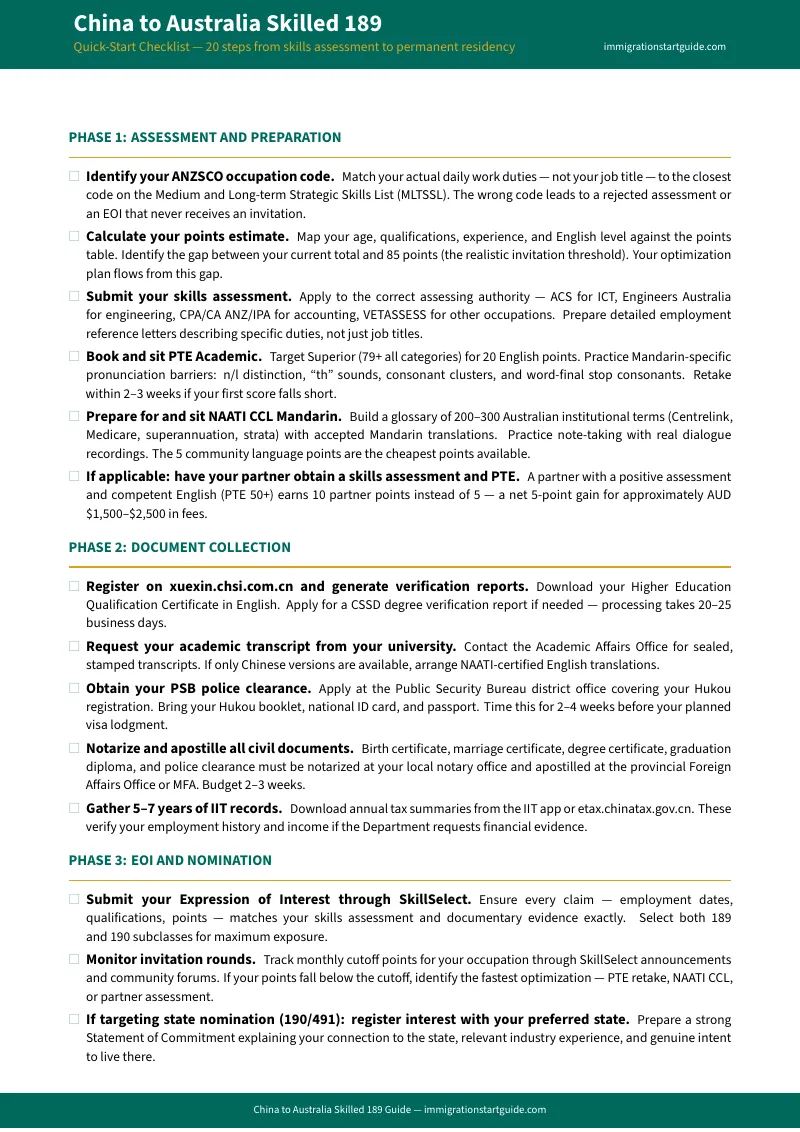
- Quick-Start Checklist — 20-item action sheet covering ANZSCO code verification, ACS deduction category identification, CSSD verification initiation, PTE/NAATI scheduling, employment evidence assembly, and EOI submission timing
- Points Calculator Worksheet — Fillable worksheet to calculate your real score after ACS deductions, identify your points gap, and prioritize the optimization moves that close it fastest
- ACS Deduction Reference Card — Degree classification to deduction mapping for common Chinese IT programs, with the claimable years formula and PIC 4020 warning
- Document Preparation Checklist — Every document across eight categories — CSSD reports, ACS outcome, PTE/NAATI scores, employment triad, PSB certificate, health examination, Form 80, partner evidence — with timing notes for the Chinese procurement timeline
Who This Is For
- Chinese IT professionals — software engineers, ICT business analysts, developer programmers, systems administrators — who need to understand how the ACS deduction applies to their specific degree, how many years they can legally claim on their EOI, and how to close the gap between 75 points and the 95 that their Tier 4 occupation actually requires
- Chinese engineers — who graduated from a CEEAA-accredited program after 2016 and qualify for the Engineers Australia Fast Track, or who graduated before 2016 and need the CDR (Competency Demonstration Report) with Career Episodes that articulate individual contributions within Chinese collective project environments
- Chinese accountants — who meet most CPA Australia competency areas through their Chinese qualification but need to complete the "Australian Taxation Law" and "Corporations Law" modules through distance education before lodging their assessment
- Mandarin speakers stuck in the PTE 72-78 band — who need the pronunciation-specific drills that close the gap to 79 for Superior English, targeting the exact phonological patterns that the AI scoring engine penalizes in Mandarin-accented speech
- Anyone who assumed the NAATI CCL would be easy — because they are a native Mandarin speaker, and now needs to understand why fluency is necessary but insufficient and how to approach the test as a technical exam rather than a casual conversation
- Chinese professionals whose employer will not issue custom reference letters — at SOEs, multinationals, or companies where HR only produces standard templates that do not match ANZSCO-dictionary duties, and who need the statutory declaration pathway with the specific format that case officers accept
Why Not Xiaohongshu, WeChat Groups, or a Shanghai Migration Agency?
Xiaohongshu and WeChat groups are the primary source of Australian migration advice for Chinese professionals — and they are dominated by migration agents posing as successful applicants. The "experience sharing" posts that recommend a specific agency are marketing content. The points calculations shared in 2024 threads were written before the four-tier occupation prioritization model replaced pure points-based ranking. The PTE advice from pre-August 2025 posts is based on a scoring algorithm that has since been updated with template detection. And the ACS assessment timelines quoted by agents in Guangzhou do not account for the CSSD verification backlog that adds four to twelve weeks for Chinese degree holders.
Migration agencies in Shanghai, Beijing, and Shenzhen charge ¥30,000 to ¥60,000 for 189 application management. MARA-registered agents in Australia charge $3,300 to $7,950 AUD. Their business model is compliance: they fill the forms, certify the documents, lodge the application. They do not tell you that your occupation's Tier 4 classification means the 189 is statistically improbable at your current score. They do not coach you through the specific PTE pronunciation drills that close the gap for Mandarin speakers. They do not calculate whether a Date of Effect reset helps or hurts your queue position. And they do not warn you that claiming ACS-deducted years on your EOI triggers a PIC 4020 refusal — because they earn the same fee regardless of whether your application succeeds or fails.
The Department of Home Affairs website publishes every rule. The points table is public. The occupation lists are available. The invitation round data is released quarterly. But the website does not tell you that Tier 4 software engineers need 95+ points while Tier 1 healthcare workers are invited at 65. The ACS assessment letter does not explain which years you can legally claim. The PTE score report does not identify the Mandarin-specific phonological patterns that kept you below 79. The system is designed to be navigated, not understood — and the China-specific complications make it exponentially harder.
The Free Checklist vs. The Full Guide
The free Quick-Start Checklist gives you the 20 critical action items — ANZSCO code verification, ACS deduction category, CSSD verification initiation, PTE/NAATI scheduling, employment evidence assembly, EOI submission timing — in the order you should tackle them. It is enough to see the full scope of the process, identify the long-lead-time items that need to start immediately, and calculate whether your current points profile is competitive for your occupation's tier.
The full guide gives you how: the ACS deduction calculator with PIC 4020 defence, the CSSD verification workflow with name-mismatch resolution, the PTE pronunciation drills targeting the three Mandarin-specific patterns the algorithm penalizes, the NAATI CCL technical framework with the four Fatal Distortions and meaning-first interpreting method, the employment evidence triad with IIT tax alignment, the points matrix optimizer with four-tier ceiling analysis, the 189/190/491 parallel strategy with state-by-state allocation data, the SAFE transfer planning, and the 12-month phased action plan with the 2025-2026 quarterly invitation calendar.
— Less Than One Hour of a Migration Agent's Time
A single consultation with a MARA-registered migration agent costs $150 to $400 AUD. Full-service 189 application management runs $3,300 to $7,950 AUD — ¥18,000 to ¥43,000 at current exchange rates. Your total Subclass 189 costs will exceed $8,000 AUD for a single applicant: the $4,640 visa application charge, $550 to $1,000 for the skills assessment, $350 to $415 per PTE attempt, $800 for the NAATI CCL, health examinations, police clearances, and certified translations. For a family, mandatory government fees alone exceed $15,000 AUD.
If the information in one chapter — the ACS deduction category that prevents you from overclaiming years and triggering a PIC 4020 refusal, the PTE pronunciation drill that moves you from 72 to 79 and delivers a 10-point swing, the NAATI preparation framework that prevents an $800 failed attempt, the Date of Effect calculation that determines whether submitting now or waiting produces an invitation, or the parallel 190/491 strategy that gives you a pathway when your 189 occupation ceiling makes an invitation statistically improbable — saves a single failed test attempt, a single visa refusal, or a single year of sitting in a SkillSelect queue, the guide has paid for itself before you finish the first section.
100% satisfaction guaranteed. If the guide does not meet your expectations, email [email protected] for a full refund.