
Your Application Was Returned. The Stamp Was Wrong.
You gathered every document on the checklist. Birth certificate, degree, police clearance, marriage certificate. You paid a notary. You paid for translations. You mailed the package with tracking. And six weeks later, your entire application came back with a form letter: "Documents do not meet authentication requirements."
No explanation of what was wrong. No guidance on how to fix it. Just a deadline that is now six weeks closer.
This is the most common preventable failure in immigration applications. Not a missing document — a document authenticated in the wrong order, by the wrong authority, or with the wrong type of stamp. Your birth certificate was apostilled, but your destination country is not a Hague Convention member, so it needed embassy legalization instead. Your degree was translated before it was apostilled, so the apostille does not cover the translation. Your police clearance was authenticated correctly, but it expired while you waited for your degree to clear the state department — and now you need a fresh one, which takes another eight weeks.
Every document has its own chain of authorities, its own sequencing rules, and its own expiration clock. Government websites explain their piece. None of them explain how those pieces connect across borders.
The Authentication Chain
The Document Authentication and Apostille Guide is built around one framework that no free resource provides: the complete origin-to-destination chain for every document type.
Government portals tell you how to get an apostille in your country. Agency blogs tell you to hire them. Reddit threads from 2023 still reference processes that changed when Canada and China joined the Hague Convention in 2024. None of them answer the question you actually need answered: "I have this document, issued in this country, and it needs to be accepted in that country — what is the exact sequence of steps, in what order, from which authorities, and how long will each one take?"
That is what The Authentication Chain maps. End to end. Origin to destination. For every document type, for both Hague and non-Hague countries, with the 2026 digital apostille rules that break half the advice currently online.
What's Inside
Origin-to-Destination Chain Maps
Step-by-step authentication sequences for the top origin-destination corridors — India to Canada, Philippines to UAE, Nigeria to UK, China to Australia, and more. Each chain shows every authority in order, the specific document each authority requires from the previous step, processing times, fees, and the exact point where most applicants make the sequencing mistake that gets their application returned.
Parallel Processing Strategy
Most applicants process documents one at a time, waiting for each to complete before starting the next. A typical family PR application has 6-8 documents — sequential processing takes 5-6 months. The guide maps which documents can be triggered simultaneously across multiple authorities and countries, compressing that timeline to 8-12 weeks. You will know exactly which documents to start on Day 1, which to start on Day 14, and which ones must wait for a predecessor.
Translation Sequencing Rules
The single most expensive mistake in document authentication is getting the translation done at the wrong point in the chain. Translate before apostille, and the apostille does not cover the translation — your destination country rejects it. Translate after apostille but use the wrong accreditation body, and you get a Request for Further Information that delays your case by months. The guide provides country-specific translation sequencing for every major destination: NAATI for Australia, ATIO for Canada, ATA for the US, sworn translators for Germany — including which destinations require a second apostille on the translation itself.
DIY vs. Agency Cost Breakdown
Authentication agencies charge $75-$500 per document, and a family application can involve 8 documents across 2-3 countries. That is $600-$4,000 in agency fees on top of the government costs. But some steps genuinely benefit from professional handling — an expedited FBI channeler, a walk-in service at the US Department of State, a BLS appointment for India MEA processing. The guide breaks down every cost component (government fee, agency fee, courier fee, translation fee) for each step, so you know exactly when $200 is a fair price for real value and when it is a markup on a $15 stamp.
Digital Apostille Pitfalls
India's e-Sanad, the Philippines' eApostille, and the UK's e-Apostille are transforming document authentication — but they have created an entirely new category of rejection. Print an eApostille PDF and the cryptographic signature breaks. Rename the file and the metadata verification fails. Submit a digital apostille to a country that only accepts physical stamps and your application stalls. The guide maps which countries accept digital apostilles, which require physical ones, and the specific handling rules that prevent you from accidentally invalidating a perfectly good document.
Document Expiration Timeline Planner
A police clearance is valid for 3-6 months. A birth certificate in Virginia must be issued within 12 months. A medical exam expires in 12 months but some countries count from the exam date, others from the submission date. When you are managing 6-8 documents with different expiration clocks, one slow step can cascade into having to redo documents that were already complete. The planner shows you the expiration window for each document type by destination country, so you can sequence your applications to keep everything valid through final submission.
6 Standalone Printable Tools
Every major framework in the guide is also available as a standalone PDF you can print and use at your desk: the Authentication Decision Flowchart (one-page pathway identifier), Country Authority Quick Reference (fees and processing times for 7 countries), Translation Requirements Reference (accreditation bodies and sequencing rules), Parallel Processing Planner (fillable timeline worksheet), Document Expiration Planner (validity window tracker), and DIY vs. Agency Cost Breakdown Worksheet (fillable cost comparison). Eight PDFs total — use them independently or alongside the main guide.
Who This Is Built For
- First-time immigration applicants who received a document checklist from IRCC, the Home Office, or USCIS and realized they do not know the difference between notarization, authentication, apostille, and legalization — or which ones they actually need
- Cross-border applicants — born in one country, educated in a second, working in a third — who cannot find a single resource that explains how to synchronize authentication across multiple jurisdictions simultaneously
- Family PR applicants managing 6-8 documents for multiple family members, where sequential processing means a 6-month timeline and one expired document forces a restart
- DIY applicants who got a $2,000+ agency quote and want to understand which steps they can handle themselves and which ones are genuinely worth paying a professional to expedite
Why Not Just Google It?
You can find every individual step online. The problem is not access to information — it is the gaps between sources.
Government websites explain how to get their stamp. The US Department of State tells you how to get a federal apostille. The Indian MEA tells you how to use e-Sanad. Neither tells you what happens when that document arrives at the Canadian or Australian immigration office — whether the format is accepted, whether the translation needs its own apostille, whether a digital version is valid or must be physical.
Reddit and immigration forums have real experience, but the top-voted answers reference processes from 2022 and 2023 — before Canada and China joined the Hague Convention, before the Philippines launched its fully digital apostille, before India terminated Alankit as an authorized MEA provider. Following outdated advice is worse than having no advice at all.
Agency blogs are written by companies that charge $75-$500 per document. Every article ends with "contact us for a free quote." They are not going to publish the information that would let you do it yourself.
The guide connects all three — government process, real-world experience, and professional knowledge — into one chain that runs from origin to destination without gaps.
The Math on Document Mistakes
A single document rejection does not cost $15. It costs the 6-12 weeks of reprocessing time, the $200-$300 rush fee to expedite the replacement, the expired police clearance that now needs to be reissued, and the cascading delays to every other document in your application. For applicants with job offers or university admissions on deadline, a document authentication error can mean losing the opportunity entirely.
The full Document Authentication and Apostille Guide costs . That is less than the government fee for a single expedited apostille at the US Department of State.
Your Purchase Is Protected
If the guide does not give you a clear, actionable authentication chain for your documents and destination country, email us at any time for a full refund. No questions asked.
Authenticate Once. Authenticate Right. Move Forward.
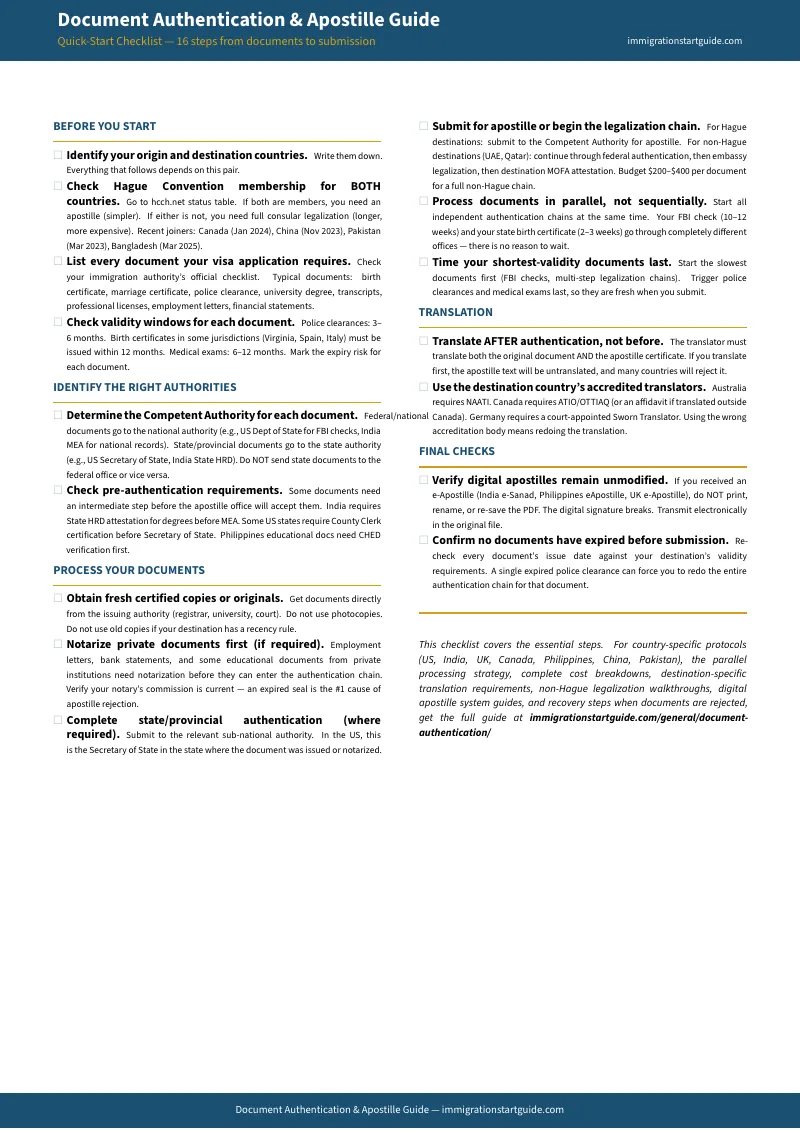
Download the free Quick-Start Checklist to identify which authentication pathway your documents require (Hague apostille or embassy legalization), check whether your origin and destination countries have any 2024-2026 rule changes that affect your chain, and flag the one sequencing mistake most likely to delay your specific application. When you are ready for the full Authentication Chain framework — the origin-to-destination maps, the parallel processing strategy, the translation sequencing rules, and the DIY cost breakdown — get the complete Document Authentication and Apostille Guide.