
You Use English Every Day. The Test Says You're Not Good Enough.
You write technical documentation at work. You lead meetings in English. You explain complex systems to international teams. But IELTS keeps scoring you 6.5 — and the immigration system needs 7.0. That half-band gap is not a language gap. It is a rubric gap. You are being scored on a system you have never been taught to decode.
Every retake costs $225+. Every failed attempt delays your immigration timeline by 2-3 months — and in points-based systems like Canada's Express Entry, those months cost you age points that never come back. A 30-year-old scores 110 CRS points. A 31-year-old scores 105. Five points vanish on your birthday whether your English improved or not.
The 0.5 band gap between 6.5 and 7.0 is not about speaking better English. It is about understanding what the examiner is scoring — and giving them exactly that.
The Score-to-Points Engine
This is the first IELTS guide built around a simple principle: every technique you practise should trace directly to immigration points. Not vague "improvement." Not "try harder." A direct, calculable connection between what you do in the test room and what appears on your immigration application.
The IELTS Preparation & Score Strategy Guide maps every 0.5-band increase to its exact CRS, EOI, and CEFR point value — so you know, before you study a single hour, exactly which section improvement gives you the highest immigration point return. For most applicants, that is Writing. For some, it is Speaking. The guide shows you which one, and why.
What's Inside
Immigration Points Calculator
Your Band 7.0 in Listening is not worth the same as Band 7.0 in Writing — not in immigration points. The guide maps CRS (Canada), EOI (Australia), and CEFR equivalences for every 0.5-band change across all four sections. You will know exactly which section to target for maximum point gain, and when "good enough" in one section means you should redirect all effort to another.
Writing: The 6.5-to-7.0 Transition
Band 6.5 writers make three systematic errors that examiners are trained to catch: mechanical linker usage ("Furthermore... Moreover... In addition..."), weak referencing (repeating nouns instead of using cohesive devices), and low-frequency collocation gaps. The guide provides the 15 highest-yield collocations that signal Band 7 writing, the referencing patterns that examiners look for at the 7.0 threshold, and a diagnostic that identifies which of the three errors is holding your score down.
Speaking: The Fluency Framework
Part 2 is where 6.5 speakers lose points — not because they lack vocabulary, but because they run out of material at 1:20 and fill the remaining 40 seconds with repetition. The Fluency Framework teaches controlled story fabrication (you do not need to tell the truth — you need to speak fluently for two minutes), Part 3 extension techniques that demonstrate the "abstract discussion" marker examiners score for, and self-correction strategies that count for you, not against you.
OSR Decision Matrix
Should you take Academic or General Training? Paper-based or computer-delivered? IELTS or PTE? The answer depends on your destination country, your target program, and your section-level weaknesses. Australia accepts PTE with a lower effective threshold for some visa subclasses. Canada accepts CELPIP but scores it differently. The UK does not accept PTE for settlement. The OSR matrix gives you the decision in under two minutes, based on your specific situation.
21-Day Professional Sprint
You work full-time. You have 1-2 hours per day, not 8. The Sprint is a 21-day study plan built for working professionals — 90 minutes per weekday, 2 hours on weekends. Each day targets a specific examiner criterion with a specific exercise. Day 1 is not "read about IELTS." Day 1 is a timed diagnostic that identifies your weakest criterion so every subsequent day compounds in the right direction.
Computer-Delivered Test Strategy
The computer-delivered IELTS is a different test in practice. You type instead of handwrite (which changes your Writing time management completely). You control your own Listening audio. The Reading interface requires different skimming techniques than paper. Over 70% of test centres now offer computer-delivered, but most preparation materials still assume paper. The guide covers the interface, the timing differences, and the specific strategies that only apply to the digital format.
Country Score Targets
Canada CRS awards 0 points for CLB 6 (Band 6.0) and 34 points for CLB 9 (Band 7.0) — a 34-point swing from a single band improvement. Australia's EOI awards 0 for "Competent" (Band 6.0) and 20 for "Superior" (Band 8.0), with a critical threshold at "Proficient" (Band 7.0) that unlocks 10 points. UK Skilled Worker requires Band 6.5 overall with no section below 6.0 — miss the section minimum by 0.5 and the entire application is rejected. The guide maps every country's thresholds so you know your exact numeric target before you open a textbook.
8 Printable Reference Cards
Every key framework from the guide is also extracted as a standalone printable — designed to pin above your desk or review before the test. You get the immigration points lookup table, the OSR decision matrix, a writing quick-reference with all 15 collocations and essay templates, the speaking framework with Part 2 timing, a reading strategy card with the T/F/NG decision tree, a listening signposts cheat sheet, the 21-day sprint planner with daily tracker, and country-specific score targets for Canada, Australia, UK, and New Zealand.
Who This Guide Is For
- The professional stuck at 6.5 — you have taken IELTS once or twice, scored 6.0-6.5, and need to break through to 7.0+ for Express Entry, Skilled Migration, or UK settlement
- The working engineer, developer, or nurse with limited study time — you cannot take 3 months off work to attend IELTS classes; you need a focused plan that fits around a full-time job
- The applicant who needs to choose between IELTS, PTE, and CELPIP — you want a clear answer based on your destination country and your section-level profile, not marketing material from each test provider
- The repeat test-taker spending $225+ per attempt — you have already invested $450-$675 in retakes and need a systematic change in approach, not another round of the same preparation
Why Not YouTube and Free Resources?
There are 50,000+ IELTS preparation videos on YouTube. Most of them are correct. The problem is not accuracy — it is integration. No free resource connects your Writing band improvement to your CRS point gain. No YouTube channel tells you whether to prioritise Listening from 7.0 to 7.5 or Writing from 6.5 to 7.0 for your specific immigration program. No blog post gives you the OSR decision matrix that accounts for country acceptance, section-level weakness, and test format preference simultaneously.
Free resources give you techniques in isolation. This guide gives you the decision framework that tells you which techniques to use, in what order, for how long — calibrated to your immigration destination and your current score profile.
The Math That Makes This Obvious
A single IELTS retake costs $225-$260 depending on your country. A tutor charges $80-$150 per hour. Four tutor sessions — one per IELTS section — costs $320-$600 and still does not give you the immigration point-mapping or the OSR decision framework.
The full IELTS Preparation & Score Strategy Guide costs . That is less than one retake fee. If the guide eliminates even one unnecessary attempt, it has paid for itself five times over — and saved you 2-3 months of immigration delay.
Your Purchase Is Protected
If the guide does not give you a clear, actionable path from your current score to your immigration target, email us at any time for a full refund. No questions asked.
Stop Retaking. Start Scoring.
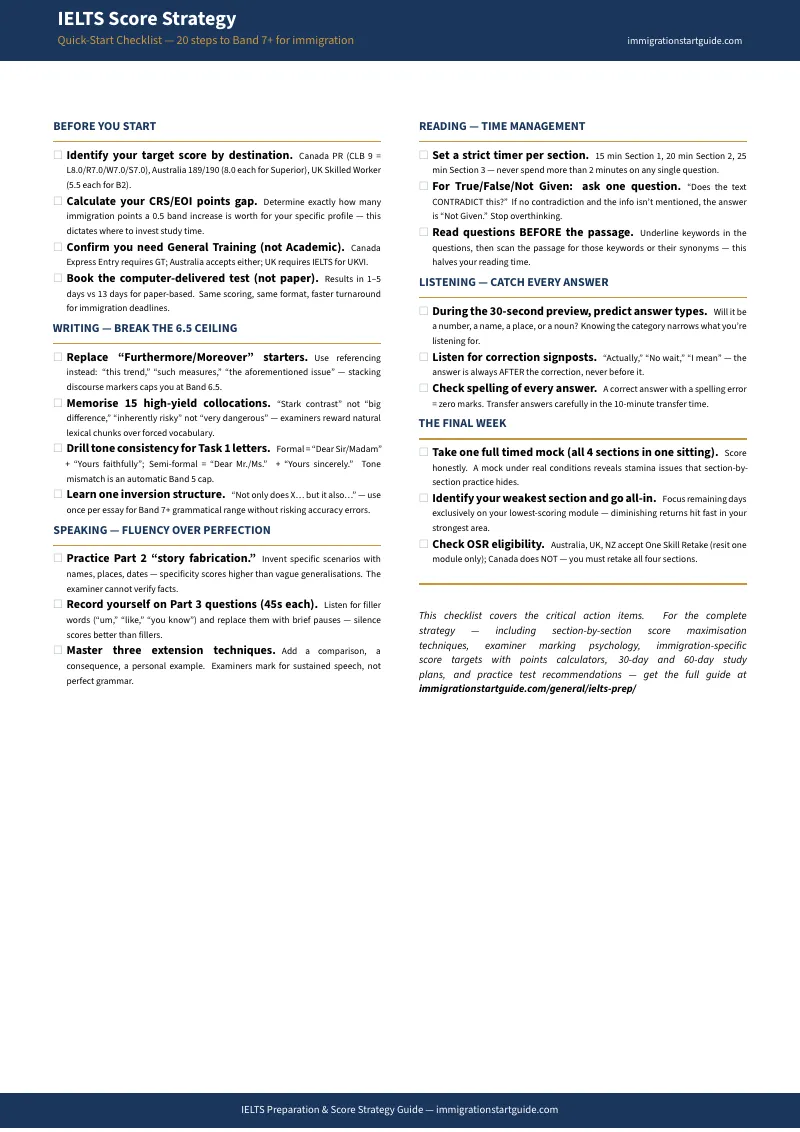
Download the free Quick-Start Checklist to identify your weakest scoring criterion, calculate your immigration point target, and make one high-yield change to your next practice essay tonight. When you are ready for the complete 21-Day Sprint, the OSR decision matrix, the full band descriptor breakdowns, and country-specific point calculations, get the full IELTS Preparation & Score Strategy Guide.