
You're About to Invest $50,000 in Study Abroad. Your Statement of Purpose Gets 3 Minutes of Reading Time.
You've spent months preparing — language tests, transcripts, financial documents. Now you're staring at a blank page that says "Statement of Purpose" and you realize: this single document determines whether your $50,000+ investment in education abroad actually happens, or whether you get a one-line rejection letter that says "unconvinced of genuine intent to study."
So you start researching. You watch YouTube videos that tell you to "show passion" and "be specific." You read sample SOPs on Reddit that were written for American domestic applicants who never had to prove they'd leave the country afterward. You find a $7 Etsy template that gives you formatting — an introduction, three body paragraphs, a conclusion — but nothing about the fact that your SOP is simultaneously being read by an admissions committee looking for academic fit AND an immigration officer looking for reasons to refuse you.
Here's what nobody explains: a Statement of Purpose for international students is not an admissions essay. It's a dual-audience document. The university wants to know why you belong in their program. The immigration officer wants to know why you'll leave when it ends. These two audiences have contradictory needs — and if you write for one while ignoring the other, you either don't get admitted or don't get your visa. In Canada, 76% of study permit refusals cite "not convinced the applicant will leave Canada." In Australia, Ministerial Direction 106 requires officers to weigh your "genuine intention to stay temporarily." In the US, every F-1 applicant is assumed to be a potential immigrant until their SOP proves otherwise under Section 214(b).
The Statement of Purpose Writing Toolkit is built around the Dual-Narrative Framework — the only affordable resource that teaches you how to satisfy both audiences in one document. Not a template you fill in. Not a list of "power words." A structured writing system with country-specific compliance modules that tells you exactly what each immigration authority is scanning for, so you can write a statement that gets you admitted AND approved.
What's Inside the Dual-Narrative Framework
The comprehensive guide plus standalone printable tools — everything you need to write a statement that survives both the admissions committee and the visa officer:
The Dual-Audience Challenge (Chapter 1)
Why international SOPs fail at 2-3x the rate of domestic personal statements — and why the standard "admissions essay" advice from American universities actively hurts your visa chances. The chapter maps the specific tension: admissions wants you to demonstrate lifelong commitment to your field (which sounds like you'll stay), while immigration wants evidence you'll return home (which sounds like you're not committed). The Framework resolves this tension with a narrative architecture that satisfies both simultaneously.
The Modular Narrative System (Chapter 2)
Your SOP isn't a creative writing exercise — it's an engineering problem. The Modular Narrative System breaks your statement into seven interchangeable blocks: Origin Story, Gap Identification, Program-Specific Fit, Research/Career Alignment, Return Plan, Country-Specific Compliance Hook, and Closing Synthesis. Each module has a specific job for a specific audience. You assemble the modules in different orders depending on which country you're applying to — because a UK UCAS personal statement has a completely different structure than a German Motivationsschreiben or a Canadian study plan.
Country-Specific Compliance Modules (Chapter 3)
Six countries, six completely different evaluation frameworks:
- Australia (Genuine Student test) — Ministerial Direction 106 requires officers to assess your genuine intention using specific criteria. The module maps exactly which sentences in your SOP address each criterion, so nothing is left to inference.
- Canada (Study Plan + Return Plan) — 76% of refusals cite "not convinced applicant will leave." The module shows how to construct a return plan that doesn't sound fabricated — using verifiable career market data, family ties, and economic conditions in your home country.
- USA (214(b) Presumption of Immigrant Intent) — Every F-1 applicant is legally presumed to be an intending immigrant. Your SOP must overcome this presumption without sounding defensive. The module covers the specific language patterns that consular officers flag versus the framing that resolves the presumption naturally.
- Germany (Motivationsschreiben) — German universities expect a structured, formal motivation letter with specific academic justification — not the narrative storytelling that works for American applications. The module covers structure, length, formality level, and the academic vocabulary that German admissions offices respond to.
- France (Campus France) — The Campus France interview evaluates your SOP against what you say in person. Inconsistencies between your written statement and verbal responses result in immediate red flags. The module prepares you to write an SOP you can defend orally.
- UK (UCAS Personal Statement) — 4,000 characters maximum. No room for filler. The module covers the specific structure UCAS readers expect and how to incorporate immigration compliance signals within the character limit.
Discipline-Specific Strategies (Chapter 4)
A STEM applicant writing about lab methodology has completely different credibility signals than an MBA applicant writing about leadership impact or a law student writing about legal philosophy. The chapter covers four discipline clusters — STEM, Business/MBA, Law/Social Sciences, and Arts/Humanities — with the specific evidence types, vocabulary, and narrative structures that admissions committees in each field respond to.
AI Detection Survival Guide (Chapter 5)
ESL writers are flagged by AI detection tools at 2-3x the rate of native English speakers — not because they used AI, but because grammatically correct English from non-native speakers triggers the same statistical patterns that detectors look for. The chapter covers how to write clearly in your second language without tripping detection algorithms, how to use AI as a brainstorming tool without producing detectable output, and what to do if you're falsely flagged.
Difficult Situations Playbook (Chapter 6)
Gaps in your academic timeline. A previous visa refusal. A career pivot that makes your study choice look inconsistent. Low grades in your bachelor's degree. The playbook covers twelve common difficult situations with specific framing strategies that address them honestly without self-sabotaging — because immigration officers are trained to spot evasion, and the worst strategy is pretending the gap doesn't exist.
Document Ecosystem Alignment (Chapter 7)
Your SOP doesn't exist in isolation. Immigration officers cross-reference it against your financial documents, your CV, your reference letters, and your study plan. If your SOP says you'll return home to join the family business but your financial documents show no family business income, you've just created an inconsistency that triggers a refusal. The chapter shows how to align every document in your application package so they tell a coherent, verifiable story.
Pre-Submission Audit (Chapter 9)
A 25-point self-review checklist that catches the errors applicants miss: passive voice that weakens agency claims, vague superlatives that signal template usage, country-compliance gaps, inconsistencies with supporting documents, and word count violations. Run it before you submit.
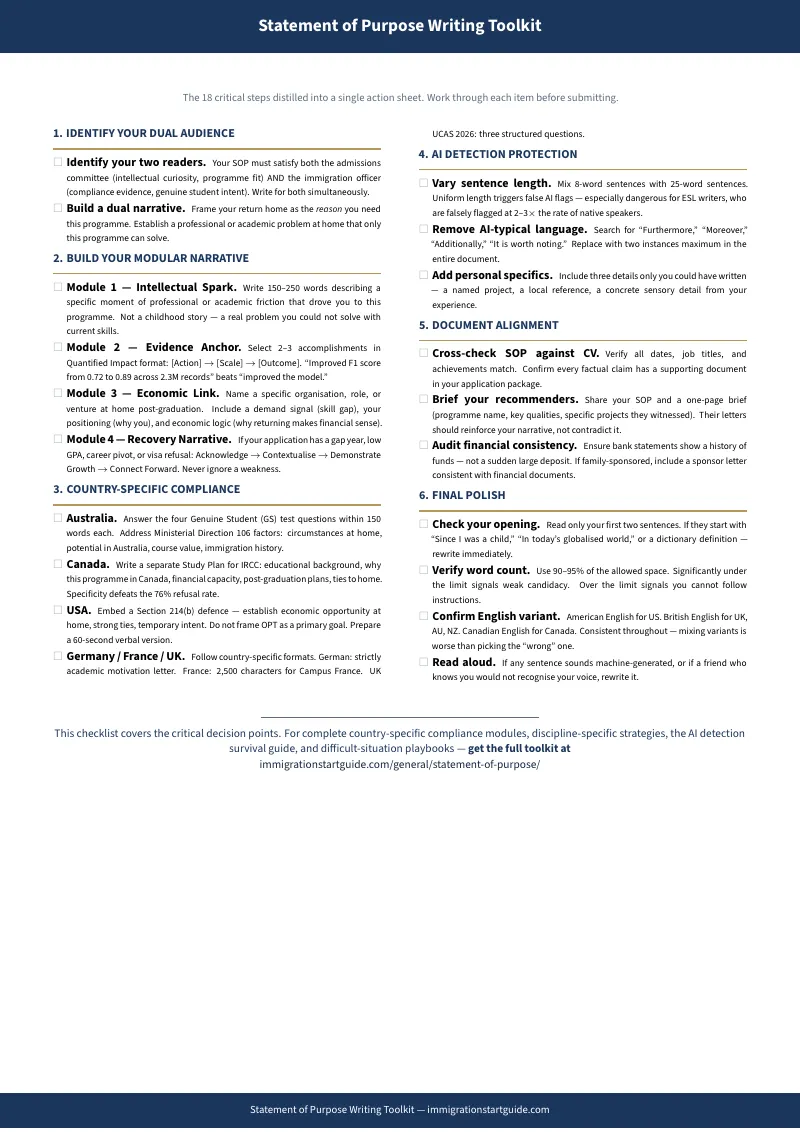
Quick-Start Checklist (free download)
An 18-item action plan across 6 phases: identify your dual-audience requirements, gather your narrative evidence, draft your modular blocks, customize for your target country, align your document ecosystem, and run the pre-submission audit. Enough structure to start writing tonight.
Standalone Printable Tools
Designed to work alongside the guide or pinned above your desk while you write:
- Country Compliance Quick-Reference — One page per country showing the exact criteria officers evaluate, the red-flag phrases to avoid, and the compliance signals to include
- Narrative Module Assembly Sheet — Visual planner for arranging your seven narrative blocks in the country-specific order
- Document Consistency Matrix — Cross-reference grid ensuring your SOP, CV, study plan, financial documents, and reference letters tell the same story
- Pre-Submission Audit Scorecard — The 25-point checklist in a printable format with pass/fail marking for each criterion
Who This Toolkit Is For
This toolkit is for international students and skilled workers writing personal statements, motivation letters, or study plans for visa applications who:
- Are applying to universities in Australia, Canada, the US, UK, Germany, or France and need their SOP to satisfy both the admissions committee and the immigration officer
- Have been refused a visa before and need to rewrite their statement to address the specific refusal reason without appearing defensive
- Are ESL writers concerned about AI detection flags on their legitimately self-written statement
- Have gaps, career pivots, or non-linear academic histories that standard SOP templates can't accommodate
- Cannot afford a $200-$500/hr admissions consultant but need more than a $7 template that provides format without strategy
- Are writing motivation letters for skilled worker visas (Germany, Netherlands) or points-tested visa applications (Australia) where the personal statement directly affects the outcome
Why Not Free Resources?
Free SOP advice is everywhere. Here's what it actually delivers:
- YouTube tutorials tell you to "show passion" and "be specific" — which is like telling a surgeon to "cut carefully." They cover the WHAT (include a research interest, mention a professor, explain your career goals) without addressing the HOW of writing for two audiences with contradictory needs. A statement that perfectly "shows passion" for staying in the field abroad is exactly the kind of statement that triggers a 214(b) refusal.
- Reddit sample SOPs are overwhelmingly from American domestic applicants or successful admits who had no immigration compliance requirement. Their statements work for admissions because they never had to prove they'd leave. Copy their structure and you'll nail the admissions side while handing the visa officer a reason to refuse you.
- $5-$20 Etsy and KDP templates give you a fill-in structure: introduction paragraph, three body paragraphs, conclusion. They don't address country-specific compliance, dual-audience tension, AI detection risks, or difficult situations. You get a format that looks professional but says nothing an immigration officer hasn't already read a thousand times — which is exactly why agencies that use templates get flagged for non-genuineness.
- University writing centers teach domestic personal statement writing. They have zero training in immigration compliance, visa refusal language, or the specific criteria that officers in different countries use to assess genuine temporary entrant status. Their advice is correct for domestic applicants and actively harmful for international ones.
- $200-$500/hr admissions consultants know the dual-audience problem. They also charge more than 95% of the global student population can afford — and many still use template-based approaches that immigration authorities have learned to recognize.
This toolkit fills the strategy gap — the space between "I know I need to write a good SOP" and "I know how to write one that gets me admitted AND approved." It gives you the framework that expensive consultants use, structured so you can execute it yourself.
— Less Than a Single Hour With an Admissions Consultant
Admissions consultants charge $200-$500 per hour. Most require 3-5 sessions to produce a finished SOP — that's $600 to $2,500 for a single document. Editing services charge $150-$300 per round of revision. And the consultant writes for admissions, not immigration — so you're still exposed to the dual-audience problem they don't address.
Your study abroad investment — tuition, living costs, application fees, language tests — will exceed $50,000 over the course of your program. The SOP is the single document that determines whether that investment produces a degree or a rejection letter. This toolkit costs less than a single consultation hour and covers the strategic dimension that even expensive consultants often miss.
Money-back guarantee, no time limit. If the Dual-Narrative Framework, country-specific compliance modules, and pre-submission audit don't make your statement stronger, you pay nothing.
Download the free Quick-Start Checklist to see the 18-item action plan and identify your country-specific compliance requirements tonight. When you're ready for the full Dual-Narrative Framework, modular writing system, AI detection guidance, and the complete pre-submission audit, the full toolkit is here.
Your qualifications got you this far. Now write the statement that gets you through the door.