
You're One Bad Envelope Away from Losing 6 Months
You've researched your destination, passed your language test, saved for application fees — and now everything hinges on a piece of paper your university may or may not send correctly to an organization you may or may not have chosen wisely.
The credential evaluation process punishes small mistakes with devastating consequences: at WES, an envelope that arrives open means the document cannot be accepted; unless customs opened it for inspection, you must ask the institution to reissue it. A missing reference number means your documents enter a black hole. Choosing WES when IQAS would have assessed your degree more generously can mean fewer CRS points for the ECA result in your profile. If you obtain another valid ECA, update your profile before you submit it.
Immigration consultants charge $500-$3,000 and often treat credential evaluation as a footnote. Free guides from evaluator websites only explain their own process — never comparing alternatives or explaining when their competitor is actually better for your specific situation.
The Evaluation Strategy System
This guide gives you the complete strategic layer that sits between your qualification and your immigration application. Not just how to apply, but how to compare evaluators by destination and purpose, what to consider for your degree and timeline, and how to avoid mistakes that delay applications.
Evaluator Comparison Matrix
The guide covers WES, IQAS, ICAS, CES, and ICES for Canada; NACES members for the US; ACS/VETASSESS/Engineers Australia for Australia; and UK ENIC/ZAB for Europe. The comparison matrix summarizes processing times, fees, and general best-fit notes for Canada, the US, and Australia.
The 3-Year Degree Playbook
Four proven strategies to maximize your immigration points when your bachelor's degree is only 3 years. With valid ECAs for both credentials and at least one credential from a program of three or more years, "Two or More Credentials" can add up to 8 CRS points (7 with an accompanying spouse) — often the difference between an invitation and another six-month wait.
Country-Specific Document Preparation
Step-by-step instructions for the five highest-volume source countries:
- India — DigiLocker/NAD electronic route vs. physical sealed envelope; autonomous college vs. awarding university distinction; NAAC accreditation requirements
- Nigeria — ETX-NG backlog workarounds; WAEC/NECO secondary verification; name mismatch resolution
- Philippines — PRC Certificate of Good Standing; license expiry timing coordination; CHED authentication
- Pakistan — HEC attestation procedure; IBCC intermediate verification; reference number placement
- China — CHSI electronic verification for post-secondary and secondary records through the CSSD–WES Portal Service
Australia Skills Assessment Navigator
How to identify your ANZSCO code and find its assessor among Australia's 30+ occupation-specific authorities, plus how ACS evaluates qualification relevance and work experience.
US NACES Strategy (H-1B, EB-2, Graduate School)
Document-by-Document vs. Course-by-Course selection, the 3-for-1 experience equivalency rule for H-1B petitions, and which report type each visa category actually requires.
Timeline Coordination Template
A parallel planning approach that coordinates your credential evaluation with your language test, police clearances, and immigration application — so nothing expires before the other pieces are ready.
The Troubleshooting Playbook
What to do when WES is stuck on "Document Review" for weeks, when your university refuses to cooperate, when your name doesn't match across documents, and when your evaluation result is lower than expected (including the "pivot" strategy of resubmitting to a different evaluator).
What You Get — 12 PDFs
- Complete Guide (47 pages) — 14 chapters covering every destination, evaluator, and country-specific challenge
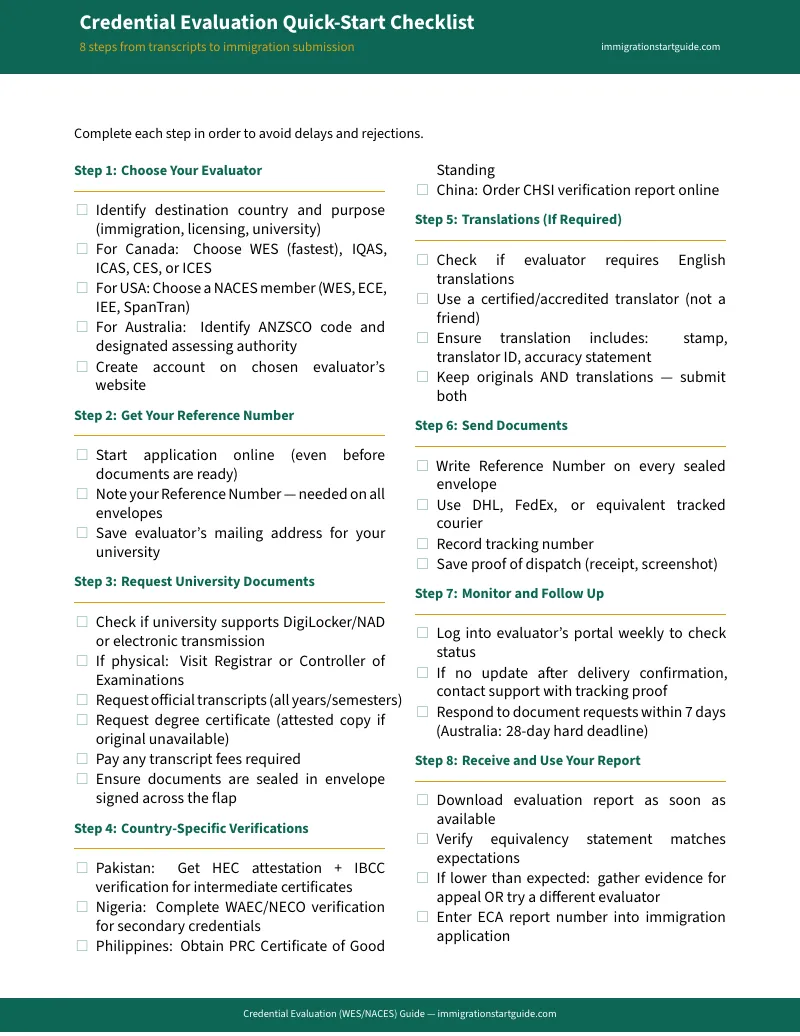
- Quick-Start Checklist — The 8-step document preparation sequence, designed to print and follow linearly
- Evaluator Comparison Matrix — Side-by-side reference card covering WES, IQAS, ICAS, CES, ICES, NACES members, and Australian authorities
- Document Checklist: India — One-page printable with DigiLocker, NAD, autonomous college, and NAAC requirements
- Document Checklist: Pakistan — One-page printable with HEC attestation and IBCC verification steps
- Document Checklist: Nigeria — One-page printable with ETX-NG, WAEC/NECO, and registrar visit workarounds
- Document Checklist: Philippines — One-page printable with PRC, CHED authentication, and license coordination
- Document Checklist: China — One-page printable with CHSI verification and the CSSD–WES Portal Service
- Timeline Coordination Template — Fillable worksheet to run your ECA, language test, and police clearances in parallel
- Cost & Budget Worksheet — Fillable planner for evaluation fees, courier costs, and university charges
- Evaluator Contacts Directory — One-page reference card with contact details for all major evaluators
- 3-Year Degree Playbook — Decision card with the four strategies to maximize points when your bachelor's is only 3 years
Who This Is For
- Professionals applying for Canadian Express Entry who need an ECA from a designated organization
- IT workers, engineers, nurses, and accountants needing an Australian skills assessment
- H-1B applicants and international students who need a NACES-member evaluation for the US
- Anyone with a 3-year bachelor's degree who wants to maximize immigration points instead of accepting a downgrade
- Applicants from India, Nigeria, Philippines, Pakistan, or China navigating country-specific document challenges
Why Not Just Follow the Evaluator's Website?
WES tells you what they need. They don't tell you that IQAS might assess your degree more generously. WES requires records from the degree-granting institution; for some autonomous colleges, that is the awarding university. They don't warn you that ETX-NG in Nigeria has a 6-12 month backlog and that visiting the registrar in person is faster.
Each evaluator's website is optimized for their administrative needs — not for your strategic outcome. This guide connects the dots between evaluators, countries, and immigration programs that no single website ever will.
Guarantee
If the guide doesn't save you at least one document re-submission or help you choose the right evaluator the first time, email [email protected] for a full refund. No questions, no time limit.
— Less Than a Single Courier Fee
A rejected transcript costs you another $50-$100 in courier fees, another $20-$100 in university transcript fees, and — worst of all — another 4-8 weeks of waiting. The guide costs less than one re-shipment and protects you from the mistakes that cause them.
Download the free Quick-Start Checklist to see how the system works, or get the complete 12-PDF Credential Evaluation Toolkit with full country-specific instructions, printable document checklists, the evaluator comparison matrix, fillable planning worksheets, and the troubleshooting playbook.
Frequently Asked Questions
What if the rules change after I buy?
We update the guide when the rules change. Email us any time, even years later, and we'll send you the current edition free.