
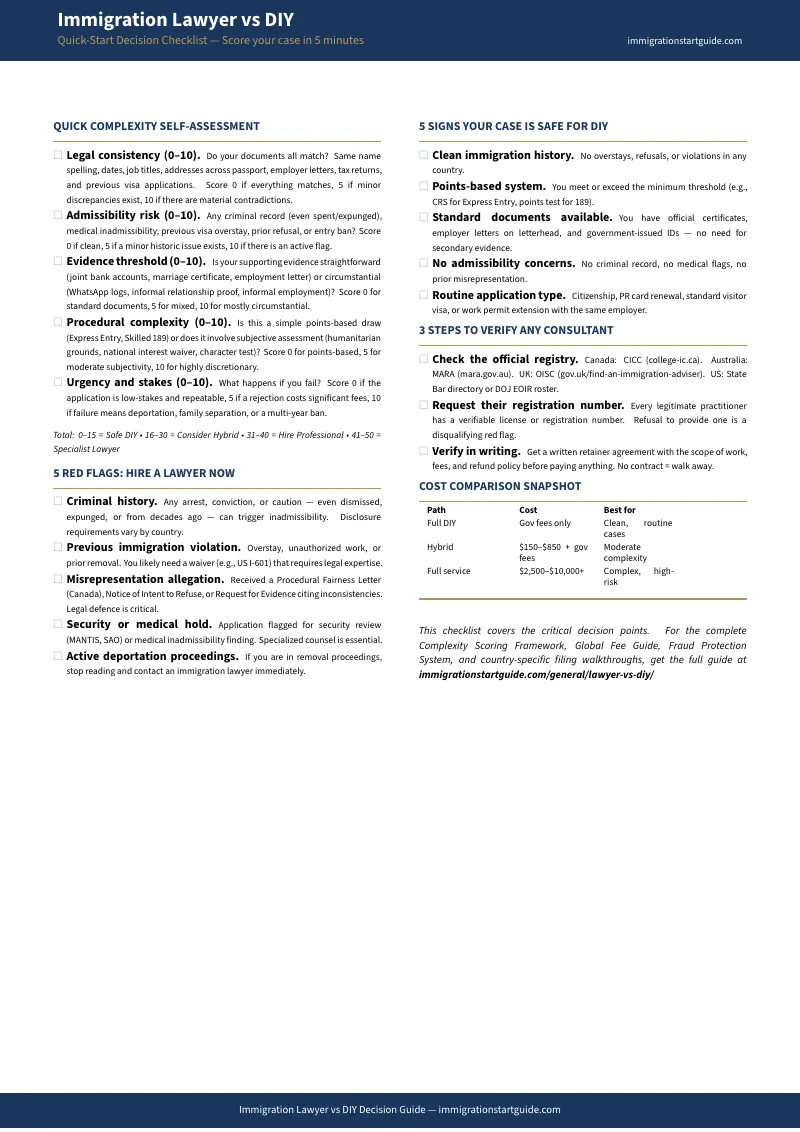
You're About to Spend $5,000 on an Immigration Lawyer. Or Risk Your Entire Application on a Reddit Thread. There's a Third Option.
You've been researching for weeks. You've read the government website. You've browsed Reddit threads where one person says "I did it myself, it was easy" and the next person says "I did it myself and got a five-year ban for an error I didn't know I made." You've sat through a free consultation where the lawyer spent thirty minutes explaining everything that could go wrong with your case and fifteen seconds mentioning that you could file it yourself. And now you're stuck in the same place where every immigration applicant gets stuck: the decision that determines whether you spend $3,000 to $10,000 on professional fees, or whether you bet your entire future on your own ability to navigate a system designed by bureaucrats, interpreted by officers with broad discretion, and explained by strangers on the internet with no liability for being wrong.
The problem isn't a lack of information. The problem is that everyone giving you advice has a financial incentive to steer you toward their answer. The immigration lawyer's "free consultation" is a sales pitch engineered to make your case sound complex enough to justify a $5,000 retainer. The Reddit poster who says "just DIY it" had a different case than yours — different criminal history, different document trail, different consulate — and their success tells you nothing about your risk. The tech platforms like Boundless and SimpleCitizen position themselves as the middle ground, but they're still selling their own $600-$1,300 service, not helping you figure out whether you need any service at all. Nobody in this ecosystem profits from telling you the truth: that some cases genuinely require a lawyer, some cases are safe to file yourself, and the difference between the two is not a mystery — it's a set of specific, scoreable risk factors that you can assess in an afternoon if someone gives you the framework.
That framework doesn't exist anywhere right now. Not on any government website, not in any $50 immigration book, not in any forum thread. Immigration lawyers benefit from the ambiguity — when "complexity" is undefined, every case becomes a reason to hire them. DIY advocates benefit from the ambiguity too — when risk is hand-waved away, every success story becomes a universal recommendation. The result is that applicants with straightforward cases overpay thousands for representation they don't need, while applicants with genuinely complex situations self-file and discover their mistake in a refusal letter that creates a permanent negative record in the immigration database.
The Immigration Lawyer vs DIY Decision Guide introduces the Case Complexity Audit — a structured scoring system that replaces gut feeling with a points-based assessment of your actual risk factors. Legal consistency across your application history. Admissibility risks like criminal records, medical issues, or previous overstays. Evidence thresholds for family cases where "bona fide relationship" is subjective. Procedural complexity that separates a straightforward points-based draw from a discretionary humanitarian argument. Each factor is scored. The total tells you where you fall: safe to self-file, safe with an unbundled document review, or genuinely in need of full legal representation. No opinion. No sales pitch. A system.
When you know your actual complexity score, the lawyer's quote becomes data instead of pressure. The Reddit advice becomes context instead of strategy. And the decision that's been paralyzing you for weeks becomes clear enough to act on tonight.
Start with the free Quick-Start Checklist — a one-page self-assessment you can complete tonight to identify where your case falls on the complexity spectrum. Or keep reading to see what the full guide covers.
What's Inside the Case Complexity Audit
A multi-chapter decision guide, a quick-start checklist, and a global fee and verification directory. Everything structured around one principle: the decision to hire a lawyer or self-file isn't a personality trait — it's a risk calculation with specific inputs, and once you have the inputs, the answer becomes obvious. Whether you're two weeks from filing or six months out, the framework works: score your case, identify your actual risks, then choose the representation level that matches your score — not the one someone is trying to sell you.
The Case Complexity Scoring System (Chapter 1)
The core of the guide. Four risk dimensions — legal consistency, admissibility risk, evidence threshold, and procedural complexity — each broken into specific, scoreable factors drawn from how immigration officers actually evaluate applications. A case where all prior visa applications align with your current claim, you have no criminal or medical flags, your evidence is standard and well-documented, and your pathway is a points-based system scores very differently from a case involving an old overstay, an employer letter that contradicts your previous visa category, and a pathway that requires a subjective "public interest" argument. The scoring system quantifies the difference so you can see it on paper instead of guessing.
When DIY Is Safe — and When It's Gambling (Chapter 2)
The specific case profiles where self-filing has a high success rate: clean immigration history, straightforward document trail, points-based or employer-backed pathways with clear eligibility criteria. Includes the procedural walkthrough for managing your own application — setting up government portal accounts, organizing document packages, tracking processing times, and the common administrative errors that cause refusals even in simple cases (uploading the wrong file format, missing a form field that isn't marked as required, submitting translations without the certification statement). The chapter that saves applicants with simple cases from spending $5,000 they don't need to spend.
When You Need a Lawyer — and What "Need" Actually Means (Chapter 3)
The specific case profiles where professional representation materially improves outcomes: prior refusals that created an adverse record, criminal inadmissibility requiring a waiver or rehabilitation application, complex family sponsorship involving children from multiple relationships, humanitarian and compassionate applications where the argument is narrative rather than documentary, and appeals where legal standing in a tribunal or court is the only path forward. For each profile, the chapter explains what a competent lawyer actually does that you cannot do yourself — so you're paying for expertise, not for someone to fill in forms you could have filled in yourself.
The Unbundled Path — DIY With Targeted Professional Help (Chapter 4)
The option that nobody in the industry talks about because it generates less revenue. Instead of a $5,000 retainer, you file the application yourself and hire a professional for specific, high-value tasks: a one-hour strategy consultation ($150-$350) to confirm your pathway before you invest in government fees, a document review ($425-$850) where a licensed consultant or lawyer audits your completed package for fatal errors, or targeted help with a Request for Evidence or Procedural Fairness Letter ($1,000-$3,000) when the government pushes back on something specific. You act as your own project manager and hire specialists for technical audits. The chapter covers how to find unbundled services, what to pay, and how to structure the engagement so you get real review and not just a rubber stamp.
The Global Fee Guide (Chapter 5)
What immigration professionals actually charge, by country, by service type, by complexity tier. Consultant fees versus lawyer fees in Canada. Attorney rates in the US where there's no regulated consultant middle-tier. Migration agent costs in Australia where a partner visa already costs AUD $9,365 in government fees before the agent adds their $4,000-$10,000. OISC advisor rates in the UK where a family of four's visa costs can exceed £25,000 including the Immigration Health Surcharge. The fee ranges, the red flags in pricing (too cheap means unqualified or fraudulent; too expensive means you're subsidizing the firm's downtown office), and the specific questions to ask about what's included so you don't discover at month four that "full representation" didn't actually include your biometrics appointment prep or your interview coaching.
Hiring Right — The Professional Vetting Framework (Chapter 6)
Licensed doesn't mean competent. Expensive doesn't mean thorough. This chapter gives you the verification tools and interview questions that separate a skilled practitioner from a skilled salesperson. The regulatory verification portals for every major destination — CICC in Canada, MARA in Australia, OISC in the UK, state bar associations and the DOJ EOIR roster in the US. The questions that reveal quality: "Will you be filing this, or will a junior clerk handle the data entry?" "Do you have experience with this specific pathway in the last twelve months?" "Will you give me the login credentials for my government portal?" (Refusal is a major red flag — it means they control your file and you can't see what's been submitted in your name.) The chapter also covers fee structures — flat fee versus hourly versus hybrid — and the retainer agreement clauses that protect you if the relationship goes wrong.
The Fraud Protection System (Chapter 7)
Ghost consultants. Fake agency websites. "Guaranteed approval" promises. The job-offer-with-visa scam that costs applicants in Nigeria, India, and the Philippines millions of dollars annually. This chapter is the scammer's playbook in reverse — every tactic, every red flag, every verification step you should take before paying anyone a single dollar. How to verify registration numbers in real time. How to distinguish a legitimate recruiter from a visa mill. What "guaranteed" means in immigration (nothing — no one can guarantee a government decision) and what happens to applicants who paid for a guarantee that was actually fraud. For applicants in high-risk corridors, this chapter alone is worth the price of the guide.
Firing Bad Representation and Switching Mid-Stream (Chapter 8)
You've already paid $2,000 and your consultant hasn't filed anything. You've been waiting three months for an update and can't reach anyone. You asked for your file and were told "it's with the government" when you know it hasn't been submitted. The sunk cost trap keeps applicants locked into bad representation long past the point where switching would have saved their case. This chapter covers the specific indicators that your representative is underperforming or fraudulent, the process for formally changing representatives without jeopardizing your active application, and how to recover your file — including your portal login credentials — when the transition isn't cooperative.
Who This Guide Is For
This guide is for anyone facing the lawyer-or-DIY decision for an immigration application who:
- Has received a lawyer quote of $3,000-$10,000 and isn't sure whether the complexity of their case actually justifies that fee — and wants to score their actual risk factors before deciding rather than relying on the lawyer's assessment of how much they should spend on a lawyer
- Is considering self-filing but can't tell whether their case is genuinely straightforward or has hidden risk factors — like a prior visa refusal, a gap in employment history, or an inconsistency between their current application and a previous one that they didn't realize counted as a discrepancy
- Has already hired a consultant or lawyer and suspects they're overpaying for form-filling — watching their representative do data entry they could have done themselves, unable to access their own government portal account, and wondering whether the $5,000 retainer is buying expertise or just administrative labor
- Is navigating immigration in a market where fraud is common — and needs the verification tools, red flag checklists, and regulatory body directories to distinguish licensed professionals from ghost consultants before money changes hands
- Wants the middle path — self-filing with targeted professional help for specific high-risk steps, but doesn't know how to structure an unbundled engagement or what to pay for a document review versus a full consultation
- Is applying to Canada, the US, the UK, Australia, Germany, or any major destination country — and needs a decision framework that accounts for the regulatory differences between these systems rather than generic "should I hire a lawyer?" advice that ignores the fact that a Canadian Express Entry application and a UK spouse visa have completely different risk profiles
Why Not Free Resources?
Free advice on the lawyer-versus-DIY question exists everywhere. Here's what it actually gives you:
- Reddit and immigration forums are full of people who successfully self-filed telling you it's easy and people who failed telling you to hire a lawyer. Neither group can tell you whether your case is more like theirs. Survivor bias dominates — successful DIY filers are loud about how simple it was, while people whose cases were refused often don't post about it at all. And advice from 2022 may constitute misrepresentation under 2025's AI-driven screening protocols. The guide replaces anecdote with a structured scoring system that accounts for your specific risk factors.
- Free consultations with immigration lawyers are sales conversations. The lawyer's financial incentive is to sign you to a retainer, not to tell you your case is simple enough to file yourself. They'll emphasize every risk, every complication, every worst-case scenario — because that's what justifies the fee. This guide has no incentive to steer you in either direction. If your complexity score says DIY, it says DIY. If it says hire a lawyer, it tells you exactly what kind and how much to pay.
- Immigration books like Nolo's "U.S. Immigration Made Easy" teach you how to file, assuming you've already decided to file yourself. They don't provide a framework for determining whether you should file yourself. They're country-specific, so an applicant deciding between Canada and Australia gets no comparative guidance. And they don't cover the fraud protection, consultant vetting, or mid-stream switching that applicants need when the decision involves hiring someone.
- Tech platforms like Boundless and SimpleCitizen position themselves as the answer to the lawyer-vs-DIY question, but they're selling their own service at $600-$1,300. They'll never tell you that your case is simple enough to file without any platform at all, because that's not a revenue-generating recommendation. They focus on US marriage green cards and don't cover Canada, Australia, the UK, or Germany.
- Government websites publish forms, fees, and eligibility criteria. What they don't publish is how to assess whether your specific combination of factors makes self-filing safe or risky, how to identify a competent professional if you need one, or how to structure an unbundled engagement that costs $400 instead of $5,000.
This guide fills the meta-decision gap — the space between "should I hire a lawyer?" and the answer that's actually calibrated to your case, your risk factors, your budget, and the specific regulatory environment of your destination country. That's the decision that determines whether you waste $5,000 on representation you didn't need, or gamble your application on confidence you didn't earn.
— The Cheapest Insurance You'll Buy for a Decision Worth Thousands
Immigration lawyers charge $200-$350 for an initial consultation — and that consultation is designed to sell you a $3,000-$10,000 retainer. Government application fees alone run $760 to $9,365 depending on your destination and visa type. A refusal doesn't just lose those fees — it creates a negative record that follows every future application, sometimes for years. And the total investment riding on your decision — application fees, language tests, medical exams, credential evaluations, document translations, relocation deposits — typically runs $5,000 to $25,000 before the lawyer's bill even enters the picture.
The Case Complexity Audit costs less than the application fee for even the simplest visa category, and it tells you whether the rest of that investment needs professional protection or whether you can safely manage it yourself. For applicants who score low on complexity, the guide saves thousands in unnecessary legal fees. For applicants who score high, it prevents the catastrophically expensive mistake of self-filing a case that needed representation — and shows you exactly how to hire the right professional at the right price.
Money-back guarantee, no time limit. If the Case Complexity Audit, global fee guide, professional vetting framework, and fraud protection system don't give you a clear, confident answer to the lawyer-or-DIY question, you get a full refund. No questions.
Printable Standalone Tools — Included
The guide comes with six printable tools you can use independently — at consultations, during your filing process, or anytime you need a quick reference:
- Complexity Scoring Worksheet — print it, score your case across four dimensions, get a clear recommendation
- Fee Comparison Guide — professional and government fees across five countries, so you know if a quote is market rate
- First Meeting Interview Script — seventeen questions to bring to your first consultation
- Practitioner Verification Directory — official registry URLs for every major destination country
- Case Management Tracker — track document expirations, evidence status, and application updates
- Fraud Red Flags Checklist — thirteen warning signs of ghost consultants and scams
Download the free Quick-Start Checklist to run a preliminary complexity assessment tonight and see where your case falls on the spectrum. When you're ready for the full Case Complexity Audit — the scoring system, fee guide, vetting framework, unbundled services playbook, fraud protection tools, and six printable standalone references — the complete guide is here.
Everyone in the immigration industry profits from your confusion. The lawyer profits from your fear. The forums profit from your engagement. The platforms profit from your indecision. This guide profits from your clarity — because once you see your actual complexity score, the right decision makes itself.