
Your CRS Score Is 460. The Last General Draw Cut Off at 520. Your 中介 Quotes CAD 8,000 to "Manage Your File." Their Entire Value-Add Is Submitting an Online Form You Could Fill Out Yourself — If Someone Showed You How to Get Your Degree Through CHSI Without the Three-Month Delay That Kills Your Timeline.
You have a bachelor's or master's from a 985 or 211 university. You have six years of experience as a software engineer or product manager in Shenzhen or Beijing. You earn enough to meet the settlement fund requirements twice over. On paper, you are exactly the kind of candidate Canada's Express Entry system was designed to attract.
Then you tried to get your degree verified. CDGDC, the agency everyone on Zhihu said to use, no longer handles new verifications — CHSI took over in late 2024 and half the forum advice is two years out of date. Your CHSI account binding failed because the university registered your name in ALL CAPS and you entered it in title case. The system gave you no error message. You submitted a support ticket and heard nothing for three weeks. Meanwhile, WES is waiting for an electronic verification report that CHSI has not generated, and your twelve-to-sixteen-week ECA clock has not started.
Then you looked at your CRS score. 460 with CLB 8 English, a bachelor's degree, and five years of experience. The last general draw cut off at 520. The STEM category draw was 490. You need sixty more points and your age penalty increases every birthday after 30. The 中介 in Shanghai suggested a master's degree — two years and CAD 40,000 in tuition to gain 25 CRS points. Nobody mentioned that NCLC 7 in French adds up to 50 points, qualifies you for French-language draws that cut off below 400, and can be achieved in twelve to eighteen months of focused study for a fraction of that cost.
Then the money. SAFE limits your foreign exchange to USD 50,000 per year. The settlement fund requirement is CAD 15,263 for a single applicant, CAD 33,528 for a family of four. The amount is within the quota, but your bank in Beijing asked for documentation of "purpose of use" before processing the wire, and Alipay's RMB 50,000 daily limit means you cannot simply convert and transfer the full amount through mobile. If your parents are gifting the funds, the audit trail between their account and yours needs to be clean — a lump sum deposit the month before you submit looks like borrowed money, and IRCC evaluates six months of bank history.
Then the documents nobody warned you about. The PSB police certificate requires a trip to the 派出所 where your Hukou is registered — which may be in a different province from where you live and work. The 公证处 notarization and the new Hague Apostille process replaced consular legalization in January 2024, but most Zhihu guides still describe the old three-step chain. Your birth certificate may not exist if you were born before the mid-1990s, and the 公证处 creates a notarial substitute from Hukou records — a process your 中介 will charge for but anyone can do.
And the question nobody talks about until it is too late: what happens to your Hukou, your 身份证, your social insurance, your 住房公积金, and your ability to use WeChat Pay and buy train tickets when you eventually take Canadian citizenship? Article 9 of the Nationality Law is unambiguous — naturalize abroad and you lose your Chinese nationality. Your Hukou gets revoked. Your Resident ID becomes invalid. Every digital system in China that relies on the 身份证 number treats you as a foreigner. The 中介 in Shanghai will not discuss this because their job ends when your PR is approved.
The Dual-Regulatory Playbook
This is the operational guide for Chinese professionals who want to handle Express Entry themselves — without paying CAD 5,000 to CAD 15,000 for an agent whose primary skill is submitting an online application form. It covers both sides of the Pacific simultaneously: the Chinese regulatory system (CHSI, SAFE, PSB, 公证处, Hukou) and the Canadian immigration system (CRS, ECA, ITA, NOC, PNP) in a single integrated playbook. No agent in Shanghai covers the Canadian technical details. No immigration lawyer in Toronto understands CHSI binding failures, SAFE transfer documentation, or PSB police certificate logistics. This guide bridges the gap.
Migration agents in China charge CAD 5,000 to CAD 15,000 for Express Entry. Their service consists of filling out the online profile, uploading the documents you gathered yourself, and answering questions you could have resolved with accurate instructions. The government fees, language tests, and ECA evaluation cost approximately CAD 3,000 total. For a process where the applicant does 90% of the work regardless of whether an agent is involved, this guide gives you the 10% of specialized knowledge that justifies the agent's fee — the CHSI binding sequence, the French bonus strategy, the SAFE-compliant transfer methods, the PSB-to-apostille chain, and the Hukou transition plan — without the markup.
What Is Inside
The CHSI-to-WES Credential Pipeline
The exact sequence for getting your Chinese degree evaluated through WES Canada, starting from CHSI account creation. This covers the binding step that fails when names do not match exactly (ALL CAPS vs. title case, simplified vs. traditional characters), the requirement to verify both your Graduation Certificate (学历) and Degree Certificate (学位) separately, the electronic transmission to WES that replaced physical mail, and the handling of non-standard credentials: Dazhuan (大专) three-year diplomas, Zikao (自考) self-taught examination degrees, adult education (成人教育) qualifications, and joint-program degrees issued by Chinese universities in partnership with foreign institutions. If your university registered your records under a different ID number than your current passport, the guide explains how to get the registrar to update the historical record — without which CHSI cannot locate your file.
CRS Score Optimization and Category-Based Draw Strategy
A full self-assessment framework showing where your points come from, where the gaps are, and the highest-ROI methods to close them. The guide maps out every draw type — general, STEM, healthcare, French-language, transport, agriculture — with historical cut-off scores and the specific criteria each draw requires. For Chinese tech professionals, the STEM category is the most natural fit, but its cut-offs still exceed 480. The French bilingual strategy section explains why NCLC 7 French is the single most powerful CRS lever available: up to 50 bonus points plus access to French-language draws that cut off below 400, versus the 25 points from a master's degree that takes two years and costs CAD 40,000.
The French Bilingual Bonus Strategy
A realistic roadmap for Mandarin speakers to reach NCLC 7 (B2 intermediate) in French within twelve to eighteen months. The guide covers exam selection (TEF Canada vs. TCF Canada), the specific skill areas where Chinese learners struggle most (listening comprehension and oral production), a study plan calibrated to working professionals who cannot take a year off, and the cost-benefit analysis that makes this the highest-ROI score improvement available. At 50 bonus points, French proficiency is worth twice as much as a master's degree in the CRS system, takes less time, and costs a fraction of the tuition. The guide also explains the bilingual draw mechanics — how having both CLB 5+ English and NCLC 7 French unlocks the lowest cut-off draws in the entire Express Entry system.
NOC Code Mapping for Chinese Job Titles
The NOC 2021 system does not map neatly to Chinese job titles. 软件开发工程师 could be NOC 21232 or 21231 depending on your actual duties. 产品经理 could be 21233 or 10019 depending on whether you manage people or products. 技术总监 could be 20012 or 20010 depending on the scope of the role. Choosing the wrong NOC code does not just reduce your score — it can result in an ineligibility determination if IRCC decides your work experience does not match the code you selected. The guide provides a mapping table for the fifty most common Chinese tech, engineering, finance, and management titles, with the corresponding NOC codes and the duty descriptions you need to match in your reference letters.
Employment Reference Letters That Survive Verification
IRCC requires reference letters from every employer in the past ten years, each on company letterhead with an official stamp (公章), listing your exact job title, employment dates, hours per week, salary, and a detailed description of duties matching your chosen NOC code. Chinese companies do not produce these letters voluntarily. HR departments provide 离职证明 (separation certificates) that omit most of the required information. The guide covers how to draft the letter yourself for HR to review and stamp, how to handle companies that have been acquired or dissolved, how to address the specific discrepancy between Chinese titles (which are often inflated) and the NOC duties (which must be accurate), and why the duties description — not the job title — is what IRCC actually evaluates.
SAFE-Compliant Settlement Fund Documentation
The proof of funds requirement is not just about having enough money — it is about demonstrating that the funds are genuinely yours and have been accessible for at least six months. The guide covers the exact documentation requirements for IRCC, the SAFE foreign exchange quota and how it interacts with the settlement fund amount, compliant remittance methods through ICBC, Bank of China, and international services like Wise, how to handle parental gifts with a clean audit trail (gift deeds, source documentation for the parent's funds, banking records showing the transfer chain), and the critical difference between a current balance statement and the six-month transaction history that IRCC actually evaluates. Large deposits in the final months before submission are a red flag — the guide explains the timing strategy that avoids this.
PSB Police Certificate, Notarization, and Apostille Chain
The complete three-step document procurement process for Chinese police certificates: PSB issuance at your Hukou 派出所, notarization at the local 公证处, and Hague Apostille at the Ministry of Foreign Affairs or provincial Foreign Affairs Office. The guide covers the "purpose of use" requirement that many PSB offices demand before issuing the certificate, the documentation you need to bring (身份证, 户口本, and in some jurisdictions a request letter), the validity window (typically six months — get it too early and you need a fresh one), timing the certificate to align with your ITA 60-day deadline, and handling the process remotely if you live in a different province from your Hukou registration. Also covers birth certificate notarization for pre-1990s births where no medical certificate exists, and marriage certificate notarization from the 结婚证 booklets.
Hukou Transition Planning
What happens to your Chinese identity when you become a Canadian permanent resident — and eventually a citizen. Canadian PR does not revoke your Chinese nationality. But Article 9 of the Nationality Law means that naturalization as a Canadian citizen triggers automatic loss of Chinese nationality and mandatory Hukou revocation. The guide covers the practical consequences: loss of the 身份证 and every digital system that depends on it (banking apps, WeChat Pay, Alipay identity verification, railway tickets, hotel check-in), the process for selling property as a former citizen (notarized identity link between your old 身份证 number and your Canadian passport), social insurance and pension withdrawal or transfer options (社保局 and 住房公积金), and the specific steps to take while you still hold your Chinese ID — consolidating bank accounts, clarifying pension status, and preparing the notarial documentation that links your two identities for future property transactions.
Provincial Nominee Program Strategy
A PNP nomination adds 600 CRS points — enough to guarantee an ITA regardless of your base score. The guide covers which provinces run Express Entry-linked streams that draw directly from the federal pool (Ontario Human Capital Priorities, British Columbia Skills Immigration, Alberta Express Entry), the eligibility criteria and occupation lists for each, and the strategic considerations: nominating for Ontario targets the Toronto tech market but has higher competition, while smaller provinces like Saskatchewan or Nova Scotia may offer faster processing with lower population thresholds. For Chinese applicants, the guide explains how to express interest in PNPs through your Express Entry profile and what triggers a provincial nomination notification.
Timeline, Costs, and the 12-Month Action Plan
Every government fee, test cost, and processing time from the first CHSI account creation to the Confirmation of Permanent Residence. The guide provides a phased 12-month action plan: Phase 1 (months 1-4) covers CRS assessment, CHSI/WES credential evaluation, language testing, and French study initiation. Phase 2 (months 3-5) covers PSB police certificate, notarization, apostille, settlement fund positioning, and medical exam. Phase 3 (month 5) covers Express Entry profile creation, NOC code selection, and PNP interest. Phase 4 (months 6-12) covers post-ITA document upload, biometrics, fee payment, and landing preparation. Parallel tasks are flagged — the ECA and French study run concurrently with document procurement, not sequentially.
Printable Tools
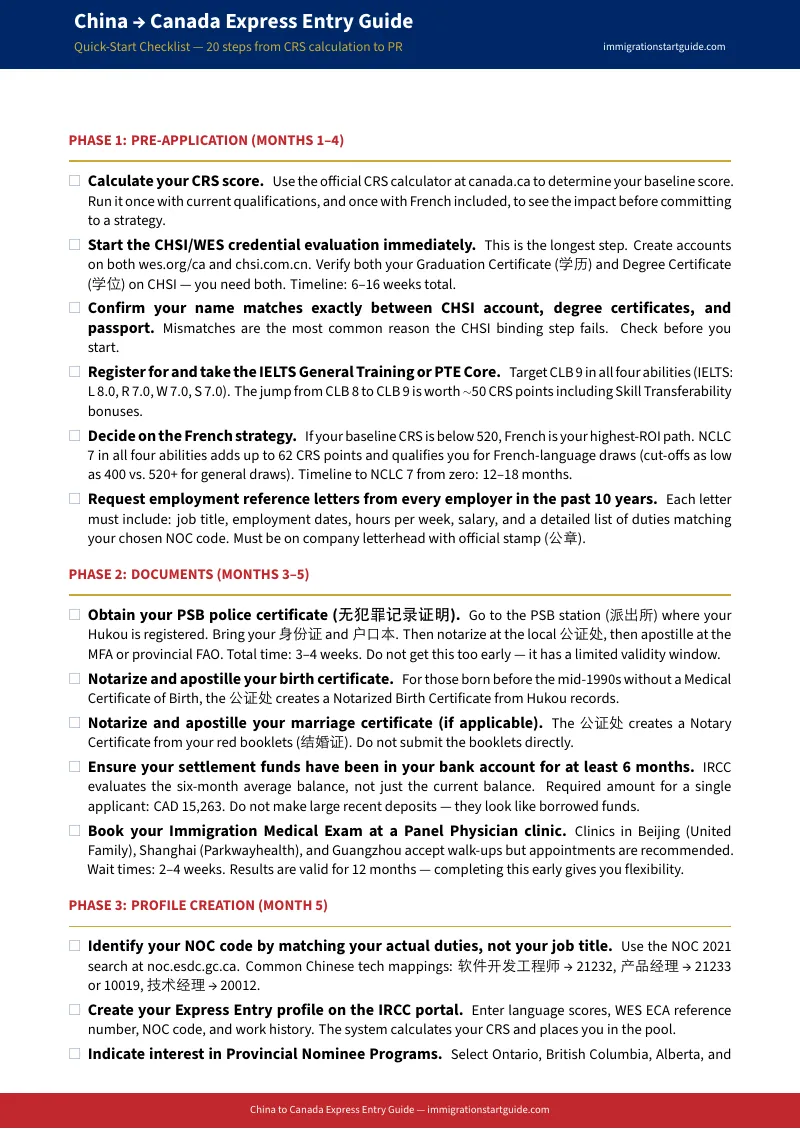
- Quick-Start Checklist — 20-item action sheet covering CHSI/WES credential evaluation, language testing, French strategy decision, PSB police certificate, settlement fund positioning, NOC code selection, Express Entry profile creation, and post-ITA document assembly, organized in the exact sequence to maximize parallel processing
- CRS Score Calculator Worksheet — Self-assessment template showing your current score breakdown by category (age, education, language, experience) with the specific point gains from each improvement option (French bonus, PNP nomination, Canadian work experience, additional education) so you can compare ROI before committing time and money
- Document Tracker — Every document required for the Express Entry profile and the post-ITA application, with the issuing authority, processing time, validity window, and the exact specifications IRCC requires — organized by the phase in which each document is needed, so nothing expires before submission
- Settlement Fund Planner — Six-month bank balance planning template showing the required amounts by family size, the SAFE quota interaction, remittance method options, and the deposit timing strategy that avoids the "recent large deposit" red flag
- NOC Code Mapping for Chinese Job Titles — Reference card mapping 软件开发工程师, 产品经理, 技术总监, 数据分析师, and other common Chinese titles to the correct NOC 2021 codes, with the key duties that must appear in your reference letter for each code
- CHSI-to-WES Pipeline Reference — Step-by-step reference card for the entire credential evaluation sequence, from WES account creation through CHSI degree binding to the final ECA report, with timeline estimates for each step
- PSB-to-Apostille Chain — The complete three-stage document authentication process on a single page: PSB issuance at the 派出所, notarization at the 公证处, and Hague Apostille at the MFA or provincial Foreign Affairs Office, with what to bring to each step
- 12-Month Action Plan — Phase-by-phase timeline with parallel task tracking, from CHSI account creation through post-ITA submission to COPR, with checkboxes for every action item so you can track progress across all four phases simultaneously
- Cost Breakdown — Every Express Entry expense itemized in both CAD and RMB, organized by phase (language testing, ECA, document authentication, medical/biometrics, government fees, optional French training) with totals for single applicants, couples, and families
Who This Is For
- Chinese tech professionals in Tier 1 cities — software engineers, product managers, data scientists, and engineering leads in Beijing, Shanghai, Shenzhen, or Hangzhou with CRS scores between 430 and 500 who need a concrete strategy to close the gap to an ITA, whether through the French bonus, STEM category draws, or a PNP nomination
- Applicants stuck in the CHSI verification process — who created an account, tried to bind their degree, got no error message and no confirmation, and are now watching their WES evaluation timeline slip by weeks while outdated Zhihu advice says to contact CDGDC, which no longer handles new verifications
- Professionals over 30 watching their CRS erode — who lose 5 CRS points per year to the age penalty and need the highest-ROI score improvement before the next birthday, not a two-year master's degree that adds half the points of a twelve-month French study plan
- Families needing to move settlement funds from China — who understand the SAFE annual quota but need the specific documentation their bank will require, the timing strategy for the six-month balance evaluation, and the audit trail for parental gifts that IRCC will scrutinize
- Applicants whose Hukou is in a different province from where they work — who need the PSB police certificate from their registered 派出所 in Henan or Sichuan while living in Shanghai, and cannot find clear instructions on whether to handle it in person, by proxy, or through a notarial intermediary
- Anyone considering a 中介 but unsure what they actually do — who wants to understand the full process before deciding whether CAD 5,000 to CAD 15,000 in agent fees buys expertise they cannot replicate, or whether it buys form-filling they could do themselves with the right instructions
Why Not Zhihu, Xiaohongshu, or a Migration Agent?
Zhihu and Xiaohongshu threads are the primary information source for Chinese applicants — and they are a minefield of outdated advice. The most-upvoted posts about CDGDC verification were written before CHSI became the sole portal in late 2024. The "experience shares" describing the old consular legalization process predate China's January 2024 Hague Apostille accession. The CRS score projections assume draw cut-offs from 2023, before category-based selection changed the competitive landscape. And the French strategy discussions, where they exist at all, describe the difficulty of reaching C1 when NCLC 7 (B2) is sufficient for the 50-point bonus. None of this information is malicious — it is simply stale, and in immigration, stale information causes six-month delays.
Migration agents (中介) charge CAD 5,000 to CAD 15,000 for Express Entry. Their service model is built on complexity — the more confusing the process seems, the more justified the fee appears. But Express Entry is an online application system. The agent fills in the same form you would fill in yourself. They upload the same documents you gathered yourself. They do not take your IELTS for you, they do not sit for your TEF Canada, they do not visit the PSB in your Hukou city, and they do not negotiate with your bank about the SAFE transfer. The 10% of the process where expert knowledge actually matters — CHSI binding failures, NOC code selection, reference letter specifications, settlement fund timing, French strategy ROI — is exactly what this guide covers. The other 90% is data entry.
Canadian immigration lawyers are essential if your case involves inadmissibility issues, prior refusals, or complex family situations. For a straightforward Express Entry application from a Chinese professional with a clean record, a strong CRS score, and proper documentation, a lawyer is an expensive substitute for accurate information. If you do retain a lawyer, this guide ensures you arrive with your Chinese-side documentation already complete — the CHSI evaluation transmitted to WES, the PSB certificate apostilled, the settlement funds properly documented — so the lawyer's time is spent on the Canadian filing, not explaining how CHSI works.
The Free Checklist vs. The Full Guide
The free Quick-Start Checklist gives you the 20 critical action items in the order you should tackle them — CHSI account creation, name verification, WES application, IELTS registration, French strategy decision, PSB police certificate, settlement fund positioning, NOC code selection, profile creation, and post-ITA document assembly. It is enough to see the full scope of the process, identify the long-lead-time items (ECA takes twelve to sixteen weeks, French takes twelve to eighteen months), and decide whether your timeline is realistic.
The full guide gives you how: the exact CHSI binding sequence with the name-matching rules and troubleshooting for failed bindings, the complete French strategy with study plan, exam selection, and ROI analysis versus a master's degree, the NOC mapping table for fifty Chinese job titles with duty descriptions, the SAFE-compliant settlement fund strategy with six-month timing, the PSB-to-apostille chain with remote handling options, the employment reference letter drafting guide, the Hukou transition checklist, the PNP strategy by province, and the phased 12-month action plan with parallel task tracking.
— Less Than a Single IELTS Registration Fee
The total cost of the Express Entry process from China — IELTS or PTE Core registration, TEF Canada if pursuing the French strategy, WES ECA evaluation, CHSI verification fees, government processing fees, biometrics, medical examination, and Right of Permanent Residence fee — exceeds CAD 3,000 for a single applicant. For a family of four, it approaches CAD 5,000. The 中介 fee adds another CAD 5,000 to CAD 15,000 on top of that.
If the information in one chapter — the CHSI binding sequence that prevents a three-month ECA delay, the French strategy that drops your required CRS by 120 points, the NOC mapping that prevents an ineligibility finding, the settlement fund timing that avoids a "recent deposit" flag, or the reference letter specifications that survive IRCC verification — prevents a single rejected application, a single missed draw, or a single year added to your timeline, the guide has paid for itself before you finish the first section.
100% satisfaction guaranteed. If the guide does not meet your expectations, email [email protected] for a full refund.