
Your Alibaba P8 Title Means Nothing to a London-Based Assessor Who Has Never Seen the Chinese Corporate Grading System. Your CNKI Citations Do Not Show Up on Web of Science. Your State S&T Progress Award Looks Like an Administrative Token Without Context. And If You Graduated from Beihang, the ATAS Rejection Rate for Chinese Applicants Has Risen Eightfold Since 2020.
You are a principal engineer at a BAT company. Or a materials scientist at a CAS institute. Or a startup founder who shipped a product to 120 million daily active users. You have the kind of career that the UK Global Talent visa was designed for. On paper, you are exactly the candidate the Home Office wants.
Then you tried to build your evidence portfolio. Your Alibaba P8 title, which placed you in the top 3% of 250,000 employees — the assessor sees an unfamiliar abbreviation from an unfamiliar company. Your fifteen publications in CAS Tier-1 journals, each one more selective than most international journals in the same field — the assessor checks Web of Science, finds nothing, and moves on. Your CNIPA invention patent, which took 24 months of substantive examination and is deployed in a system processing 300 million daily transactions — the assessor sees a foreign patent number with no commercial context. Your State Natural Science Award, conferred by the State Council to fewer than 50 projects per year across all of Chinese science — the assessor treats it as a participation certificate.
Then your recommendation letters arrived at the panel. Your CTO wrote that you are "a hardworking and talented engineer who always delivers excellent results." The assessor needed data: "She reduced transaction failure rates from 2.3% to 0.04% across a system processing 320 million daily transactions." The cultural gap between Chinese-style character testimonials and the data-driven specificity UK panels expect is the single most common reason Chinese applications fail at the endorsement stage. Your CTO is not the problem. The brief your CTO received is the problem.
Then you discovered the security question. Your PhD is from Harbin Institute of Technology — one of the "Seven Sons of National Defense" (国防七子). Since 2020, the ATAS rejection rate for Chinese nationals has climbed from 0.6% to 4.9%. Your research is entirely civilian. Your publications are in open journals. But without a carefully framed research statement that proactively demonstrates separation from military-linked projects, an ATAS flag can derail your application after you have already passed endorsement. The solicitor in London who charges £3,000 for "full application management" has never heard of the Seven Sons. The threads on Xiaohongshu say "just avoid mentioning it." Neither approach works.
And then the question nobody discusses until it is too late: what happens to your Hukou, your 身份证, your 住房公积金, your ability to buy train tickets and use WeChat Pay, if you eventually take British citizenship? Article 9 of Chinese Nationality Law is unambiguous — naturalize abroad and you lose your Chinese nationality. Your Hukou is cancelled. Your Resident ID becomes invalid. Every digital system in China that relies on the 身份证 number treats you as a foreigner. The solicitor's engagement ends when your visa is granted. Nobody walked you through the ILR-versus-citizenship decision that determines whether you keep or lose your Chinese identity permanently.
The Dual-System Endorsement Playbook
This is the operational guide for Chinese professionals who want to convert substantial Chinese achievements into a successful UK Global Talent endorsement — without paying £3,000-5,000 to an immigration solicitor whose primary skill is submitting forms, and whose China-specific knowledge stops at "please provide a translation." It covers both systems simultaneously: the Chinese institutional landscape (BAT corporate levels, CNKI publications, CNIPA patents, CAS journal rankings, State S&T Awards, the Seven Sons, SAFE transfer limits, Hukou) and the UK endorsement landscape (Tech Nation criteria, Royal Society routes, the 3-3-4 evidence structure, the personal statement framework, ATAS mitigation, the Earned Settlement model) in a single integrated playbook. No solicitor in London understands why your CHSI binding failed or how to frame a Guangdong Provincial S&T Award. No 中介 in Shanghai understands the difference between the Royal Academy of Engineering Route 3 and Route 4. This guide bridges the gap.
What Is Inside
BAT Corporate Level Translation Tables
The exact framing that converts "Alibaba P8" into language a London-based assessor understands. Mapping tables for Alibaba, Tencent, ByteDance, Huawei, and the broader Chinese tech ecosystem — from P6 to P9+ — with the UK-equivalent titles, the percentage of employees at each level, and the endorsement track each level maps to (Exceptional Talent versus Exceptional Promise). Not just the numbers — the explanatory paragraph you attach to your evidence that tells the assessor: "Alibaba Group operates a technical ladder from P4 to P11. Fewer than 3% of 250,000 employees reach P8. My role was equivalent to Director of Engineering at a Western firm."
CNKI Publication Framing for UK Panels
How to make Chinese-language publications count. For every CNKI publication in your evidence pack: the CAS journal tier ranking and what it means, the CSCD citation count with field-relative positioning, the impact factor comparison for journals that carry one, the explanation of 核心期刊 (core journal) status and its role in Chinese academic promotion. UK assessors recognise Nature and Science. They do not recognise a CAS Tier-1 journal that is more selective than the majority of international journals in your discipline — unless you explain it explicitly. This chapter teaches you how.
CNIPA Patent Presentation Strategy
The critical distinction between invention patents (发明专利) and utility model patents (实用新型专利), why it matters for endorsement evidence, and how to present each type. Invention patents undergo 18-36 months of substantive examination — this is credible evidence. Utility model patents are granted in 6-12 months with minimal review — weak evidence on their own. The guide covers grant status framing, commercial deployment documentation, licensing revenue presentation, and the certified translation specifications that prevent your patent evidence from being dismissed as incomplete.
Chinese Government Award Contextualisation
How to present State Natural Science Awards, State S&T Progress Awards, provincial S&T prizes, and Thousand Talents selections so UK assessors understand their actual prestige. The State Natural Science Award is conferred by the State Council to fewer than 50 projects per year from a national pool of thousands — that places recipients in the top 0.1% of Chinese researchers. The guide provides the exact framing language for each award tier, including the politically sensitive ones that require careful positioning around competitive metrics rather than programmatic context.
The 3-3-4 Evidence Portfolio Structure
You can submit 10 pieces of evidence. Every document must be from the past five years. The guide provides the optimal allocation — 3 items for the Mandatory Criterion, 3 for your strongest Optional Criterion, 4 for your second Optional — with specific evidence mixes for Chinese tech professionals (Digital Technology route) and Chinese researchers (Route 4 Peer Review). Each slot mapped to the specific evidence type that works best for Chinese institutional backgrounds, from DAU/MAU product impact documents to annotated GitHub contribution graphs to salary evidence from the State Taxation Administration.
Recommendation Letter Strategy for Chinese Referees
The five-element structure that UK panels expect, the cultural gap that causes Chinese recommendation letters to fail ("hardworking and talented" versus "reduced latency by 40% across 320,000 transactions per second"), the briefing document you give your CTO or VP before they write, the strategy for when referees ask you to draft the letter yourself (common with senior Chinese executives), how to vary voice across three letters so assessors do not notice a single author, and the Western recommender problem — where to find one if your entire career has been in China, and how to compensate with evidence if you cannot.
ATAS Security Vetting and Seven Sons Mitigation
What ATAS is, which CAH3 research codes trigger it, the specific risk profile for graduates of each of the seven defence-linked universities (Beihang, HIT, NWPU, NUAA, BIT, NJUST, HEU), and the five mitigation strategies that reduce your risk without hiding your background. The chapter covers research statement framing for civilian applications, how to demonstrate separation from military-linked projects through your publication record and funding sources, timeline expectations (4-8 weeks for high-scrutiny cases versus 1-3 weeks for standard), and the broader National Security and Investment Act context that shapes how the Home Office evaluates Chinese STEM professionals.
The Article 9 Dual Nationality Analysis
ILR versus British citizenship — the decision that determines whether you keep or lose your Chinese identity. The guide walks through the full implications of Article 9: Hukou cancellation, 身份证 invalidation, property ownership restrictions, banking complications, and the loss of every Chinese digital system tied to your Resident ID. It explains why ILR is strategically superior for most Chinese professionals (permanent UK residence without triggering nationality loss), the settlement timeline for each endorsement track (3 years for Talent, 5 years for Promise), and the pre-departure Hukou planning steps — bank account consolidation, 社保局 pension clarification, 住房公积金 review, property deed updates, and notarised power of attorney — that you must complete while you still hold your 身份证.
SAFE-Compliant Financial Transfer Strategy
The $50,000 annual foreign exchange limit, per person. How to plan transfers 12-18 months before departure so funds are available when you need a London housing deposit. HSBC Premier cross-border banking — opening a UK account from China with a linked RMB 500,000 account, free global transfers, and the bank reference that UK letting agents actually recognise. The Immigration Health Surcharge reality: £5,175 per person for a five-year visa, £20,700 for a family of four. Budget planning for the full cost stack — endorsement fee, visa fee, IHS, TB test, document translations (£1,000-2,500 for a full evidence pack), relocation, and first-quarter UK living expenses.
VFS Biometrics and Stage 2 Logistics in China
The eight VFS Global centres (Beijing, Shanghai, Guangzhou, Shenzhen, Chengdu, Wuhan, Nanjing, Hangzhou), booking timelines, peak-period delays, priority processing, TB testing at approved clinics, PSB police certificate procurement from your Hukou 派出所, notarization at the 公证处, and Hague Apostille through the MFA. The complete Stage 2 timeline from endorsement to visa-in-hand, with the critical sequencing that prevents documents from expiring before you can use them.
First 90 Days in the UK
Housing (Rightmove, Zoopla, what "unfurnished" means, typical costs by tech hub), banking (HSBC Premier transfer, Monzo/Starling as alternatives), National Insurance registration, GP registration, council tax, Right to Rent checks for dependants, school admission timelines for children, mobile phone contracts without UK credit history, and the 180-day absence limit that starts counting from day one of your ILR qualifying period.
Printable Standalone Tools
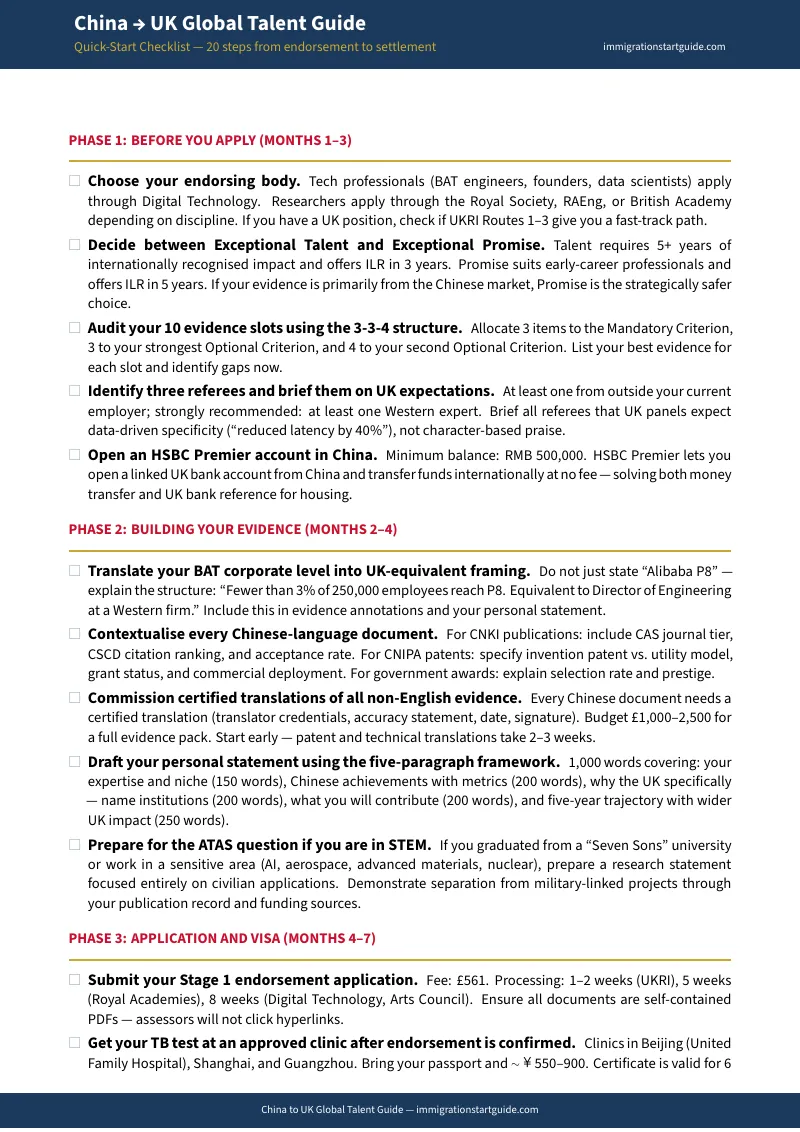
- Quick-Start Checklist — 20 action items across four phases covering endorsing body selection, evidence audit, referee briefing, HSBC Premier setup, BAT-level translation, CNKI/CNIPA evidence framing, certified translations, personal statement drafting, ATAS preparation, Stage 1 submission, TB testing, PSB police certificate, VFS biometrics, IHS payment, SAFE fund transfers, ILR-vs-citizenship decision, Hukou pre-departure planning, and first-90-days UK setup
- BAT Level Translation Table — Mapping tables for Alibaba (P6–P9), Tencent (T2–T4), ByteDance, and Huawei converting Chinese tech levels into UK-equivalent titles with employee percentiles and endorsement track mapping, plus the template paragraph you attach to every evidence document
- Evidence Portfolio Planner — The 3-3-4 allocation framework with 10 evidence slots for both the Digital Technology route and Research Route 4 Peer Review, with suggested evidence types mapped to Chinese institutional backgrounds
- Recommendation Letter Brief — The five-element letter structure UK panels expect, printed and shared with your CTO or VP before they write — with example language for each element and the ideal referee portfolio breakdown
- ATAS Mitigation Checklist — Risk profiles for each of the Seven Sons universities, five mitigation strategies, and research statement framing guidance for graduates in STEM fields facing heightened security vetting
- Article 9 Decision Matrix — ILR versus British citizenship side-by-side comparison showing what you keep and what you lose under Article 9, settlement timelines for each endorsement track, and the pre-departure Hukou planning checklist
- SAFE Transfer Planner — Annual quota tracker for each family member, a full UK cost budget for single applicants and families of four, and the HSBC Premier cross-border banking strategy
- Fee Schedule & Timeline — Every government fee and additional cost itemised for single applicants and families of four, plus the 9–12 month planning timeline with month-by-month actions
- Document Tracker — Stage 1 and Stage 2 document checklists with sources, processing times, and validity periods — covering endorsement evidence, VFS biometrics, TB testing, PSB police certificates, apostille, and ATAS clearance
Who This Is For
- Chinese tech professionals at BAT companies and major startups — software engineers, ML/AI engineers, data scientists, technical architects, product leaders, and CTOs at Baidu, Alibaba, Tencent, ByteDance, Huawei, JD.com, Meituan, Xiaomi, or venture-backed startups, who have substantial technical achievements at Chinese scale but need a strategy for making those achievements legible to UK endorsement panels that have never seen the Chinese corporate grading system
- Chinese researchers and academics — at CAS institutes, C9 universities, or any Chinese research institution, who hold publications in CNKI-indexed journals, CNIPA patents, and government awards that carry enormous domestic prestige but are invisible to UK assessors without explicit contextualisation — particularly those considering Route 4 Peer Review through the Royal Society, RAEng, or the British Academy
- Seven Sons graduates in STEM fields — who face heightened ATAS scrutiny not because of their personal research, which may be entirely civilian, but because of their institutional affiliation with Beihang, HIT, NWPU, NUAA, BIT, NJUST, or HEU — and need a mitigation strategy that reduces risk without concealing their background
- Chinese creative professionals — architects, fashion designers, industrial designers, filmmakers, and visual artists applying through Arts Council England, who need to secure at least one UK-based recommendation letter and contextualise Chinese design industry credentials for Western panels
- Professionals and families planning the financial transition from China — who need to move capital within SAFE limits, set up HSBC Premier cross-border banking, budget for the £21,000+ family IHS, and make the ILR-versus-citizenship decision that preserves or forfeits their Chinese nationality under Article 9
Why Not a Solicitor, Xiaohongshu, or Zhihu?
Immigration solicitors charge £1,000-5,000 for Global Talent applications. They handle the UK filing competently. What they do not handle: translating "Alibaba P8" into terms a panel understands, framing CNKI publications with CAS tier rankings, contextualising a State S&T Progress Award, briefing your Chinese CTO on the five-element letter structure UK panels expect, mitigating ATAS risk for Seven Sons graduates, or planning the Article 9 nationality implications. Their engagement begins with "please provide your documents" and ends with "your visa has been granted." The China-specific strategic layer — the layer that determines whether you pass or fail endorsement — is not part of the service.
Xiaohongshu and Zhihu threads are the primary information source for Chinese Global Talent applicants — and they are a patchwork of anecdotal experience shares written by people who succeeded with their specific profile, in their specific year, through their specific endorsing body. The advice to "just submit your best publications" does not explain how to frame CNKI citations for a panel that has never seen the Chinese Science Citation Database. The advice to "get a strong recommendation letter" does not explain the five-element structure or the cultural gap between Chinese and UK letter conventions. The tips on "avoiding ATAS problems" amount to "do not mention the Seven Sons" — which is exactly the wrong strategy when your degree certificate names the institution. And none of this advice updates when policy changes — the 2025 Earned Settlement model, the 2026 fee increases, the rising ATAS scrutiny rates.
This guide gives you the strategic layer that solicitors do not provide and that social media cannot maintain — the China-specific intelligence that converts a qualified Chinese professional into a successfully endorsed one.
— Less Than 10% of What a Solicitor Charges for the Same Outcome
The endorsement fee alone is £561. A five-year visa with IHS costs over £6,000 for a single applicant. A family of four exceeds £21,000 in government fees. The solicitor adds another £1,000-5,000. Document translations run £1,000-2,500. The total cost of getting your family to the UK approaches £30,000 before you pay a single month's rent.
If one chapter — the BAT-level translation table that makes your P8 title legible, the CNKI framing strategy that prevents your publications from being dismissed, the recommendation letter brief that transforms your CTO's "hardworking and talented" into evidence that passes endorsement, the ATAS mitigation template that prevents a security flag from derailing an otherwise strong application, or the Article 9 analysis that saves you from an irreversible nationality decision — prevents a single endorsement rejection, a single year of delay, or a single mistake that costs more than the guide itself, it has paid for itself before you finish the first chapter.
100% satisfaction guaranteed. If the guide does not meet your expectations, email [email protected] for a full refund.