
You Are About to Wire $800,000 Into a US Regional Center. Your Migration Agent in Shanghai Earns $200,000 If You Pick Their Recommended Project. Your US Attorney Charges $30,000 But Has Never Filed a SAFE Transfer or Prepared a Chinese-Language SOF Narrative. Nobody in This Transaction Works for You.
You have the capital. You sold the apartment in Pudong or Shenzhen, or you have fifteen years of retained earnings from a manufacturing business in Zhejiang. You have attended three EB-5 seminars in Shanghai. The Regional Center presentations were polished. The migration agent was persuasive. The attorney in New York said your case looked "straightforward."
Then you started doing the actual work. SAFE limits you to $50,000 per person per year in foreign exchange. Your $800,000 investment requires coordinating sixteen family members through the "ant migration" pooling method, each converting RMB to USD under their individual quota, each wire documented with gift letters, identity verification, and bank debit-credit slips that USCIS will scrutinize line by line. One missing transfer receipt from one cousin in Hangzhou, and your entire path-of-funds chain has a gap that triggers a Request for Evidence.
Then the source of funds. USCIS does not just want to know that you have $800,000. They want to know where the original RMB came from. If you sold property, they want the original purchase deed from 2006, the deed tax receipts, the sales contract, and proof of where the money came from to buy that property twenty years ago. If the down payment was a gift from your parents, your parents' source of funds must be documented too. The "seven-year rule" means five to seven years of individual income tax returns (个人所得税), and any gap between your declared income and your accumulated wealth becomes an RFE waiting to happen.
Then the CCP question. The June 2025 FAM update removed the "non-meaningful association" exception. If you joined the Party in university because it was expected for career advancement, you are now presumed to be a meaningful member. If you worked at a state-owned enterprise or a public university, the consular officer in Guangzhou is directed to treat that as "affiliation." The five-year resignation rule means you needed to have formally resigned before mid-2021 to qualify for an exception in 2026. Nobody at the Shanghai seminar mentioned any of this.
And the clock is running. The September 30, 2026 grandfathering deadline means any I-526E petition filed after that date has no statutory protection if the Regional Center program lapses. With source-of-funds documentation taking three to six months to assemble and the Guangzhou consulate running a six-to-twelve-month appointment backlog due to the staffing freeze, the practical filing window for new Chinese investors is measured in weeks, not months.
You do not have an information problem. You have a trust problem. Every entity in the EB-5 ecosystem profits from your investment decision, not from your investment outcome. The migration agent earns $150,000 to $200,000 in syndication fees regardless of whether the project returns your capital. The attorney handles your USCIS filing but has no expertise in SAFE regulations, Chinese banking documentation, or Guangzhou consular interview preparation. The Regional Center markets a "fast-track" green card but never explains the capital stack position that determines whether you see your $800,000 again.
The Capital Protection Playbook
This is the independent operational manual for Chinese investors navigating the EB-5 process from both sides of the Pacific. Not a generic explanation of how the EB-5 program works — the USCIS website covers that. This is the China-specific playbook for the three problems no other resource in the market addresses simultaneously: getting $800,000 out of China legally and with a clean audit trail, documenting the source of that money to a standard that survives USCIS Fraud Detection scrutiny, and preparing for a Guangzhou consular interview where the officer has been specifically trained to probe CCP membership and SOE employment history.
Migration agents in China charge $150,000 to $200,000 in commissions they rarely disclose upfront. US immigration attorneys charge $15,000 to $40,000 and focus exclusively on the American side of the equation. Neither covers the SAFE transfer logistics, the Chinese-language documentation chain, the CCP membership strategy, or the Regional Center due diligence framework that protects your capital. For an investor committing $900,000 or more in total outlay, this guide is the only resource in the market with zero financial stake in which project you choose.
What Is Inside
SAFE-Compliant Capital Transfer Strategies
The $50,000-per-person annual foreign exchange quota makes a direct $800,000 transfer impossible. The guide covers five legal transfer methods: family pooling with the exact documentation chain USCIS requires for each participant (gift letters, ID verification, individual bank debit-credit slips), offshore insurance liquidation for families with Hong Kong policies, WFOE dividend remittance for business owners with audited financials, asset-backed lending through international banks, and the new 2026 SAFE facilitations — integrated cash pooling for multinational operations and the "settle first, supplement later" property liquidation pathway. It also explains why underground banks (钱庄) and cryptocurrency are terminal risks that will get your petition denied.
Audit-Proof Source of Funds Templates
USCIS subjects Chinese applicants to the highest level of SOF scrutiny in the EB-5 program. The guide provides documentation frameworks for the four most common Chinese SOF scenarios: real estate sale (original purchase deed, 契税 receipts, sales contract, plus the "source of source" trace for the original purchase funds), accumulated salary (the seven-year IIT return requirement, employment contracts, bank deposit-to-income reconciliation), business dividends (business license 营业执照, audited financials, board resolutions, proof of dividend capacity), and gifts or inheritance (donor SOF documentation, notarized inheritance certificates). Each framework includes the bilingual Chinese-English documentation chain that prevents the translation gaps that trigger RFEs.
CCP Membership and SOE Employment Strategy
The June 2025 FAM revision fundamentally changed how the US evaluates Communist Party membership for visa applicants. The guide covers the three critical changes: the removal of the "non-meaningful association" exception, the new presumption of affiliation through SOE or public university employment, and the tightened standard for proving involuntary membership. It maps out the five-year resignation timeline, the documentation required to prove formal resignation (not just lapsed dues), the family-unity waiver pathway for applicants with US citizen or permanent resident relatives, and the pre-interview preparation strategy for Guangzhou that addresses party membership proactively rather than defensively.
Regional Center Due Diligence Framework
For a total outlay of $900,000 or more, choosing the wrong Regional Center is a financial catastrophe. The guide provides a six-factor evaluation framework: I-956F approval status (not just filing), job creation cushion (20% minimum above the ten-jobs-per-investor requirement), capital stack position (senior secured vs. subordinated equity), developer track record (Certificates of Occupancy from prior US projects, not renderings), fund administration independence, and I-829 completion history. It also covers the "Agency Bullshit Detector" — the specific questions that expose hidden commissions, undisclosed conflicts of interest, and the RIA-mandated promoter registration requirements that legitimate agents comply with and fraudulent ones ignore.
Reserved Category Strategy and the Retrogression Trap
The difference between choosing Rural TEA and Unreserved is the difference between a twelve-month timeline and a ten-year wait. The guide breaks down the post-RIA visa landscape: Rural (20% of visas, USCIS priority processing, currently no backlog), High Unemployment Area (10%, current but projected to retrogress in late 2026 or early 2027), Infrastructure (2%, current), and Unreserved (backlogged to September 2016 for China-born applicants). For families with children approaching 21, the Rural category is the only reliable pathway to prevent aging out under the August 2025 CSPA policy shift, which now calculates age exclusively from Chart A Final Action Dates.
CSPA Age-Out Protection Calculator
The Child Status Protection Act calculation changed in August 2025. USCIS now bases the age determination on Chart A Final Action Dates only, even when families file using Chart B Dates for Filing. If Chart A retrogresses after filing, the child's biological aging is not frozen. For a Chinese family with a seventeen-year-old, this means the Unreserved category — with its ten-year backlog — virtually guarantees the child ages out. The guide provides the CSPA calculation methodology, the age-lock strategy through Rural category selection, and the timeline modeling to determine whether your child is protected at current processing speeds.
Guangzhou Consular Interview Preparation
Every Chinese EB-5 applicant interviews at the US Consulate General in Guangzhou. The staffing freeze since 2021 means appointment wait times of six to twelve months even for applicants with current priority dates. The guide covers the complete document preparation: DS-260 filing, medical examination at authorized Chinese clinics, police certificate from the PSB (timed to avoid the six-month validity expiration), the Hague Apostille process (replacing the old three-step consular legalization since China's 2023 accession), and updated bank slips showing the final investment transfer. It includes the Section 221(g) administrative processing preparation — the DS-5535 extreme vetting questionnaire that requires fifteen years of travel history and five years of social media handles — and the interview response strategy for SOF and CCP questions.
Pre-Immigration Tax Planning
The moment you receive your green card, the IRS taxes your worldwide income. Chinese investors with rental properties in Beijing, dividends from A-shares, interests in private enterprises, or offshore trust structures face FBAR reporting requirements (any foreign accounts exceeding $10,000 aggregate), FATCA Form 8938 obligations, and potential Passive Foreign Investment Company classification on Chinese mutual funds. The guide covers the step-up in basis strategy that must be executed before your residency start date, the US-China Tax Treaty provisions that prevent double taxation, and the restructuring timeline for business interests and trust arrangements.
18-Month Action Plan
The EB-5 process from China follows a defined sequence: project selection and SOF compilation (months 1-6), capital transfer through SAFE-compliant channels (months 1-3, running in parallel), I-526E petition filing and USCIS adjudication (months 6-18 for Rural priority processing), NVC document submission and DS-260 filing (months 12-18), and Guangzhou interview scheduling (months 18-30). Each phase has specific milestones, parallel tasks, and the common delays at each stage. The plan is calibrated to the September 2026 grandfathering deadline for investors filing in Q2-Q3 2026.
Printable Tools
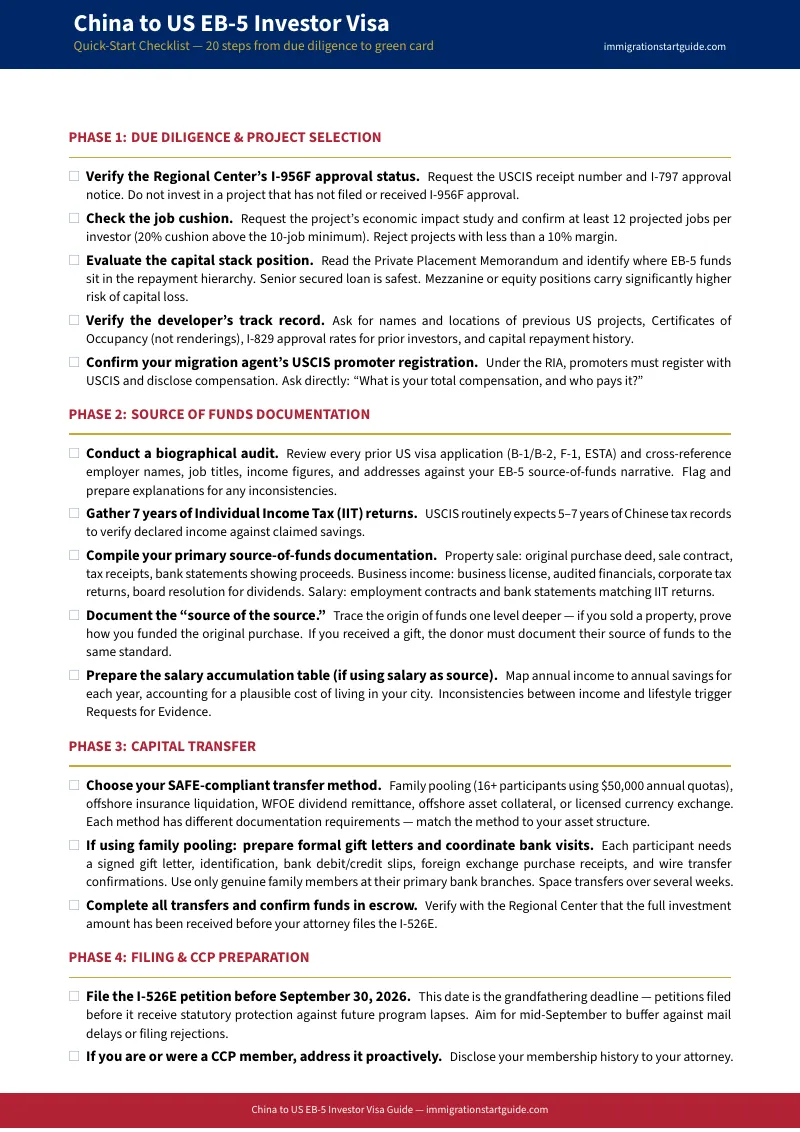
- Quick-Start Checklist — 20-item action sheet covering project selection criteria, SOF document assembly, SAFE transfer coordination, I-526E filing requirements, and Guangzhou consular preparation, with the September 2026 filing deadline marked
- Regional Center Evaluation Scorecard — Six-factor due diligence framework to evaluate any RC project independently of agent recommendations, covering I-956F status, job cushion, capital stack position, developer history, fund independence, and I-829 track record
- Path of Funds Tracker — Documentation tracking for every transfer in the family pooling chain: participant names, gift letter status, bank debit-credit slips, SAFE quota verification, and wire confirmation, organized to match USCIS audit sequence
- CSPA Age Calculator Worksheet — Calculate your child's protected age under the August 2025 policy, with timeline modeling for Rural vs. HUA vs. Unreserved processing speeds
Who This Is For
- Chinese business owners — with retained earnings, WFOE structures, or dividend income who need a SAFE-compliant transfer strategy and a corporate SOF documentation chain that satisfies both Chinese banking regulations and USCIS Fraud Detection standards
- Chinese families liquidating real estate — who sold property in a Tier-1 city and now need to trace the source of funds back to the original purchase, potentially twenty years ago, with deed tax receipts, purchase contracts, and the "source of source" narrative that USCIS demands for Chinese applicants
- Current or former CCP members — who joined the Party for career reasons and now face the June 2025 FAM tightening, including the removal of the non-meaningful association exception and the new presumption of affiliation through SOE employment
- Families with children approaching 21 — who cannot afford the Unreserved category's ten-year backlog and need the Rural TEA pathway with priority processing to lock in their child's age under the August 2025 CSPA calculation change
- Investors who have already been approached by migration agents — and want an independent framework to evaluate the project being pitched, verify the capital stack, check the agent's RIA-mandated registration, and calculate the real all-in cost including the commissions nobody discloses voluntarily
- Anyone coordinating a family pooling transfer — involving sixteen or more relatives' SAFE quotas, who needs the exact documentation chain (gift letters, ID verification, bank slips) that prevents a single missing receipt from collapsing the entire path-of-funds narrative
Why Not WeChat Groups, Zhihu, or a Shanghai Migration Agency?
WeChat groups and Zhihu threads are the largest source of EB-5 information for Chinese investors — and they are dominated by migration agents posing as fellow applicants. The "experience sharing" posts that recommend a specific Regional Center project are marketing content, not peer advice. The SAFE transfer methods described in 2023 threads were written before the January 2026 enhanced identity verification regulation, which introduced facial scanning for outbound remittances exceeding RMB 5,000. And the CCP membership advice from pre-June 2025 posts is based on a FAM interpretation that no longer exists.
Migration agencies in Shanghai, Beijing, and Shenzhen have dominated the Chinese EB-5 market for over a decade. Their business model is commission-based: the Regional Center pays the agent $150,000 to $200,000 per investor placed. This is not a consultation fee you pay. It is a success fee the project pays — which means the agent is incentivized to sell you the project that pays the highest commission, not the one with the strongest capital stack, the best job creation cushion, or the cleanest I-829 track record. Under the RIA, agents must register with USCIS and disclose compensation terms. Ask your agent for their USCIS registration number. If they hesitate, you have your answer.
US immigration attorneys are essential for the petition itself — the I-526E, the NVC filing, the I-829. But they charge $15,000 to $40,000 and their expertise ends at the US border. They do not understand SAFE regulations, they do not prepare Chinese-language SOF documentation, they do not coach you on the Guangzhou consular interview, and they do not evaluate Regional Center projects from the investor's perspective (many operate within referral networks tied to specific developers). You need an attorney. But you also need the operational layer between what the attorney files and what actually happens in China.
The Free Checklist vs. The Full Guide
The free Quick-Start Checklist gives you the 20 critical action items — project selection criteria, SOF document list, SAFE transfer sequence, filing requirements, and Guangzhou preparation steps — in the order you should tackle them. It is enough to see the full scope of the process, identify the long-lead-time items that need to start immediately, and assess whether the September 2026 grandfathering deadline is achievable for your situation.
The full guide gives you how: the five SAFE-compliant transfer strategies with exact documentation for each, the bilingual SOF templates for property sales, salary accumulation, business dividends, and gifts, the CCP membership strategy with the five-year resignation timeline and waiver pathways, the Regional Center due diligence scorecard, the CSPA age calculator, the Guangzhou interview preparation including Section 221(g) and DS-5535 handling, the pre-immigration tax planning chapter, and the 18-month phased action plan with parallel task tracking.
— One Ten-Thousandth of What You Are About to Invest
The total cost of the EB-5 process from China — $800,000 investment, $50,000 to $80,000 in Regional Center administrative fees, $15,000 to $40,000 in attorney fees, USCIS filing fees, medical examinations, document apostille, and Guangzhou travel — exceeds $900,000 for a single investor. For a family of four, it approaches $1,100,000. The migration agent's commission adds another $150,000 to $200,000, though you never see that line item because the project absorbs it.
If the information in one chapter — the SAFE transfer documentation chain that prevents a path-of-funds RFE, the SOF template that satisfies the seven-year rule, the capital stack analysis that steers you away from a subordinated equity position, the CCP strategy that avoids a Section 212(a)(3)(D) denial at Guangzhou, or the CSPA calculator that proves your child will age out in the Unreserved queue — prevents a single wasted fee, a single denied petition, or a single year added to your timeline, the guide has paid for itself before you finish the first section.
100% satisfaction guaranteed. If the guide does not meet your expectations, email [email protected] for a full refund.