
You Qualify for Express Entry. But Between You and a Canadian PR Card Is a WES Evaluation That Requires Five Stamps From Five Egyptian Offices in the Right Sequence, a Central Bank That Limits Your Credit Card to $500 of International Payments Per Month, and a +50 CRS Bonus for French That Nobody in the Facebook Group Has Mentioned.
You ran the CRS calculator. You scored 460. The latest draw was 481. And now you are trying to figure out how to close a 21-point gap that no amount of work experience or IELTS preparation can fill — because at 30 years old with a Master's degree, three years of experience, and CLB 9 in English, you have already maximized nearly every variable the system gives you. Meanwhile, you are staring at the WES application portal wondering whether your Cairo University transcript needs to go to the Ministry of Higher Education before or after the Ministry of Foreign Affairs, whether the envelope must be sealed by the Registrar at Shu'un al-Tullab or by the Dean's office, and whether anyone at WES will actually accept a document stamped by the Eagle Seal if it does not also carry the MOFA attestation. The last three people who asked in the Facebook group got three different answers.
You also need a police clearance from the Ministry of Interior — but you have been working in Dubai for four years, which means you need one from Egypt and one from the UAE. The Egyptian one requires fingerprinting at the consulate in Dubai, processing in Cairo, and a cycle that takes up to 120 days. If you start it after receiving your Invitation to Apply, your 60-day submission window may close before the certificate arrives. And every fee in this process — WES at $264 CAD, IELTS at 9,400 EGP, the Right of Permanent Residence Fee at $515 CAD — must be paid with an international credit card that your Egyptian bank caps at EGP 25,000 per month for foreign transactions. The Emirates NBD card you opened specifically for this purpose covers one payment. Not three.
You are not short on qualifications. You are short on a systematic method for navigating the Egyptian university apparatus, the Canadian points system, and the banking restrictions that sit between you and a completed application — all at the same time, in the right sequence, before the deadlines close.
The Cairo-to-Toronto Express Entry System
This is not a generic Express Entry explainer — you can find those on canada.ca. This is the Egypt-specific operational system for every step where the Canadian immigration process collides with Egyptian institutional reality: the WES attestation chain in the exact sequence that prevents rejection at each stage, from the Faculty Registrar at Shu'un al-Tullab through the Ministry of Higher Education in Nasr City to MOFA in Mohandessin, with the sealed envelope protocol that WES requires and Egyptian universities do not naturally provide. The CRS optimization strategy that identifies the 50-point French bonus hiding in your Lycee Francais du Caire or Sacre-Coeur transcript — a bonus that transforms a 469 into a 549 and qualifies you for French-language category draws with cutoffs 100 points below the general pool. The Gulf returnee documentation kit for Egyptians in the UAE and Saudi Arabia who need IRCC-compliant experience letters from employers whose HR departments only issue tenure certificates. The CBE payment workarounds that let you pay WES, IELTS, and IRCC fees when your Egyptian bank card cannot handle the transaction volume.
Immigration consultants charge $2,000 to $5,000 CAD for full-service representation. In the Egyptian context, that is EGP 100,000 to 250,000 — five to twelve months of a mid-career professional's salary. They know Canadian immigration law. They do not know which desk at Cairo University handles the sealed envelope, which MOFA branch processes educational documents, or that the Sacre-Coeur French you stopped speaking in 2011 is worth 50 CRS points if you score NCLC 7 on the TCF. This guide replaces the consultant's navigational knowledge with a step-by-step protocol you execute yourself, for a fraction of one month's WES processing fee.
What Is Inside
WES-Cairo University Attestation Map
The complete chain for getting your Egyptian degree evaluated by World Education Services: Faculty Registrar at Shu'un al-Tullab for English transcripts, payment at the Arab African International Bank in USD, the Eagle Stamp (Khatm al-Nasr), Ministry of Higher Education attestation in Nasr City, and MOFA attestation in Mohandessin. Each step with the exact office, the fee, the processing time, and the document you must already have from the previous step. The guide explains the sealed envelope protocol — the transcript must be signed across the seal by the Registrar, not just stamped — because WES rejects documents where the seal integrity is compromised on arrival in Canada, wasting weeks of processing and international courier fees. Covers Cairo University, Ain Shams, Alexandria University, AUC, GUC, Helwan, Mansoura, and Al-Azhar (which follows a different internal authentication path).
The French Advantage — +50 CRS Points
Egypt has a legacy of French-medium education: Lycee Francais du Caire, Sacre-Coeur, College de la Salle, and others. If you attended one of these schools, you may have B2 or C1 French skills collecting dust since graduation. Under current Express Entry rules, scoring NCLC 7 or higher on the TCF or TEF earns you a 50-point CRS bonus — and qualifies you for French-language category-based draws where cutoffs run 80 to 120 points below the general pool. The guide includes a self-assessment checklist to evaluate whether your school French is salvageable, the TCF vs. TEF comparison for Egyptian test-takers (TCF is generally preferred for those refreshing dormant skills — its receptive sections are multiple-choice and progress linearly from A1 to C2), and the test center locations in Cairo. You do not need to be fluent. You need NCLC 7. The difference between 469 points and 549 points is not another Master's degree — it is a language test you can prepare for in eight to twelve weeks.
Gulf Returnee Documentation Recovery Kit
If you have been working in Saudi Arabia, the UAE, or another GCC country, your Gulf employer's HR department likely issued you an "Experience Certificate" that states your title and tenure — nothing more. IRCC requires a letter with your job title, dates of employment, exact hours worked per week, and a detailed list of duties on official letterhead. The guide provides templates for requesting IRCC-compliant letters from Gulf HR departments, strategies for supplementing insufficient letters with employment contracts (translated), Social Insurance Office printouts from Gihaz al-Ta'minat for Egyptian employment periods, and bank statements showing regular payroll deposits in SAR, AED, or EGP. For applicants whose former employers in Cairo or the Gulf have gone out of business, the guide includes a Letter of Explanation template that addresses IRCC's "missing documentation" concern and the supporting evidence hierarchy that prevents rejection.
CBE Payment Workarounds
The Central Bank of Egypt limits international transactions on standard Egyptian credit cards to approximately EGP 25,000 per month — roughly $500 USD. A single WES payment of $264 CAD plus international shipping may consume your entire monthly limit, leaving no room for IELTS registration, biometrics fees, or the Right of Permanent Residence Fee. The guide maps the realistic cost of each payment in the Express Entry process, the bank-by-bank international limits (Emirates NBD, NBK Egypt, Credit Agricole, EBank), and the fintech workarounds — RedotPay, Elevate, and P2P transfer channels — that Egyptian professionals use to bypass CBE domestic limits for legitimate immigration payments. You are not just buying information. You are buying access to a payment system the Central Bank has partially locked you out of.
CRS Optimization Strategy
The CRS is not a fixed score — it is a system with levers. The guide maps every lever available to the Egyptian applicant: the French bonus (+50 points for NCLC 7), the sibling-in-Canada bonus (+15 points), the provincial nomination bonus (+600 points via PNP streams), the Canadian education credential bonus, and the LMIA-backed job offer bonus (+50 or +200 points). For each lever, the guide explains the eligibility criteria, the realistic timeline, and the cost — so you can calculate your personal ceiling and identify the fastest path to an ITA. The optimization is not theoretical. It starts with your current score and maps the specific actions that close the gap to the next draw cutoff.
Police Clearance Logistics — Domestic and Expat Paths
The MOI police certificate (Fesh w Tashbeh) is mandatory after receiving an ITA. For residents in Egypt: extraction at the local Qism or the Criminal Evidence Department in Abbassia, standard processing (3-7 days) versus express (24 hours), and the IRCC validity requirements. For Egyptians abroad — the Gulf, Europe, or elsewhere — the consular fingerprinting route that must be initiated before receiving the ITA, because the 90 to 120 day processing cycle does not fit inside the 60-day ITA submission window. If you have lived in any country for more than six months since age 18, you need a clearance from that country as well. The guide maps the parallel extraction strategy that ensures every clearance arrives before your submission deadline.
Military Service Implications
For Egyptian males between 18 and 30: you cannot board a plane from Cairo without proof of military status — exemption, deferral, or a Tassreeh Safar from the Department of Conscription and Mobilization. The guide covers exemption categories (only son, dual nationality, medical), the Gond forms and military triple number derived from your National ID, the travel permit process, and the status settlement mechanism for men over 30 who never served. This chapter is not optional reading if you are male and under 30 — it determines whether you can physically leave Egypt to attend your biometrics appointment or board the flight to Canada.
Complete Cost Breakdown in CAD and EGP
Every fee in the Express Entry process — WES evaluation, IELTS or CELPIP, TCF or TEF (if pursuing the French bonus), biometrics, medical examination, RPRF, police clearances (domestic and foreign), university attestation chain, courier fees — itemized in both CAD and EGP at current exchange rates. The guide shows the total cost of a single applicant versus a family application, the payment sequencing strategy that spreads costs across multiple monthly CBE limits, and the proof of funds requirement ($13,757 CAD for a single applicant in 2026) with the EGP conversion and timing strategy.
Who This Is For
- Egyptian STEM professionals — software engineers, data scientists, civil and mechanical engineers, IT specialists — who score between 440 and 490 on the CRS and need the Egypt-specific optimization strategy to close the gap to an ITA
- Healthcare professionals — doctors, nurses, pharmacists — who want Canadian PR through Express Entry and need the WES evaluation pathway for Egyptian medical and professional degrees
- Gulf returnees — Egyptians working in the UAE, Saudi Arabia, Qatar, or Kuwait who are applying from abroad and need the consular police clearance timeline, the Gulf employer documentation recovery strategy, and the proof of funds conversion plan
- French-school alumni — graduates of Lycee Francais du Caire, Sacre-Coeur, College de la Salle, or any French-medium school in Egypt who do not realize their dormant French is worth 50 CRS points and access to lower-cutoff category draws
- Anyone who has been sitting in the Express Entry pool for 6+ months with a score between 460 and 490, watching draw after draw pass them by, and needs a specific strategy — not more generic advice — to reach the cutoff
Why Not Free Blogs, YouTube, or a Consultant?
Free blogs and YouTube channels explain what Express Entry is. They do not explain how to get a sealed envelope from Shu'un al-Tullab that WES will accept, which MOFA branch handles educational documents, why the attestation chain fails if you skip the Ministry of Higher Education step, how to extract an IRCC-compliant experience letter from a Gulf HR department that only issues tenure certificates, or that your Sacre-Coeur French is the single fastest path from 469 to 549. The information is generic, undated, and written for a global audience that does not share your specific institutional, financial, and bureaucratic reality.
Facebook groups like "Egyptians in Canada" are where someone tells you WES processing takes "about a month" without mentioning the attestation chain, where another person says the police clearance can wait until after the ITA without calculating the 120-day consular processing cycle for Gulf residents, and where a third person has never heard of the French bonus because they attended an English-medium school. The advice is contradictory, anecdotal, and impossible to verify against current 2026 draw thresholds.
Immigration consultants charge $2,000 to $5,000 CAD for representation that covers the Canadian side of the process. They know IRCC inside and out. They do not know which desk at Cairo University seals the envelope, which bank branch accepts the WES verification fee in USD, how to recover documentation from a Gulf employer who went out of business, or that the CBE limits your international payments to $500 per month on a standard card. They navigate the Canadian system. They do not navigate the Egyptian system that feeds into it.
Printable Tools
The guide includes standalone tools designed to be printed and used throughout your application:
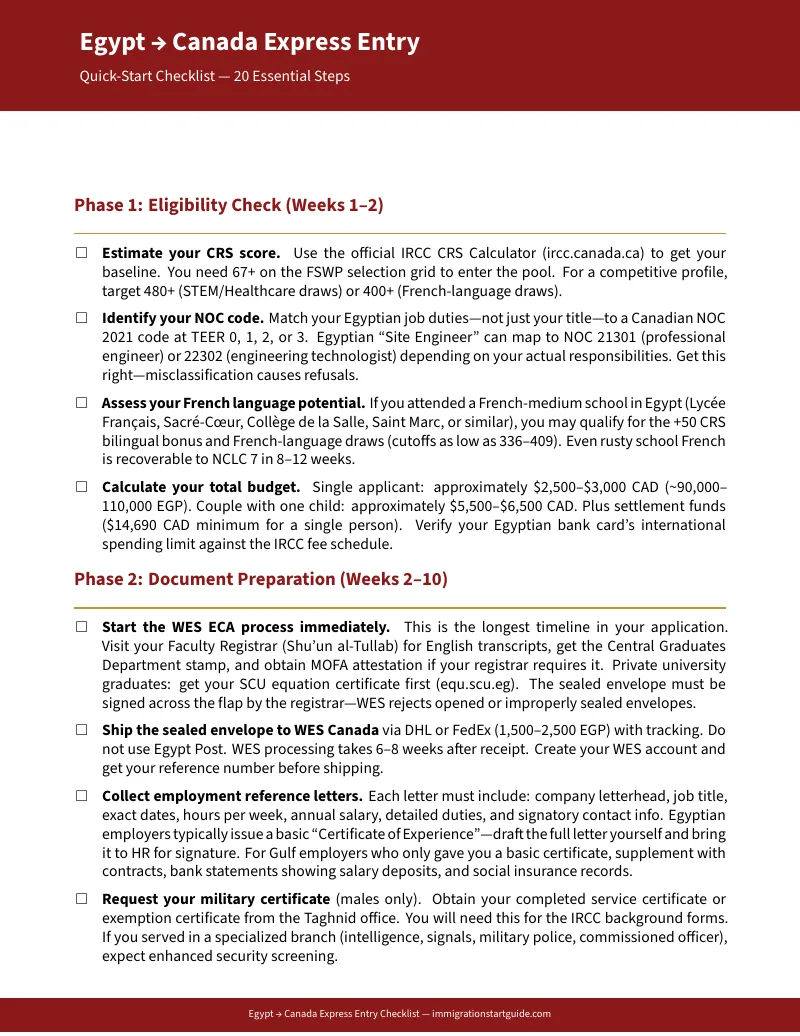
- Quick-Start Checklist — every step from CRS calculation to PR card, with the exact sequence, fees in CAD and EGP, processing times, and the parallel task structure that runs WES attestation, language testing, and police clearance simultaneously
- WES Attestation Tracker — status tracking for every document in the attestation chain with the issuing authority, required fee, expected processing time, and the stamp required before proceeding to the next step
- Cost Calculator Worksheet — every fee in both CAD and EGP for the complete process, from university attestation to landing in Canada, including the proof of funds requirement
- CRS Score Planner — your current score with the available point levers mapped out, so you can see exactly which actions close the gap to the next draw cutoff
The Free Checklist vs. The Full Guide
The free Quick-Start Checklist gives you the critical action items — every step in the WES attestation chain, the CRS optimization levers, the police clearance timeline, and the order to tackle them. It is enough to see the full scope of what stands between you and a Canadian PR card, and to identify the long-lead-time items (WES evaluation, consular police clearance for Gulf residents, TCF/TEF preparation) that need to start moving immediately.
The full guide gives you how: the WES-Cairo University attestation map with office locations, fees in EGP, and the sealed envelope protocol. The French Advantage with the self-assessment checklist, test comparison, and preparation timeline. The Gulf returnee documentation kit with IRCC-compliant letter templates and the "dead company" Letter of Explanation. The CBE payment workarounds with bank-by-bank limits and fintech solutions. The CRS optimization strategy with every available lever. The police clearance logistics for both domestic residents and Gulf expats. The military service implications for males under 30. The complete cost breakdown in CAD and EGP. And the four printable tools.
— Less Than a Single WES Courier Fee
The WES evaluation costs $264 CAD plus international courier fees. An IELTS sitting costs 9,400 EGP. A single immigration consultant charges $2,000 to $5,000 CAD — EGP 100,000 to 250,000 — for representation that covers the Canadian regulatory process but leaves you without the Egyptian attestation map, the Gulf documentation recovery kit, the CBE payment strategy, or the French Advantage analysis. The consultant navigates Ottawa. The guide builds your entire migration system from Cairo.
If the information in one chapter — the French bonus that lifts you from 469 to 549 and qualifies you for lower-cutoff draws, the sealed envelope protocol that prevents WES from rejecting your transcript after weeks of processing and courier delays, the Gulf documentation recovery strategy that prevents a rejection for "insufficient evidence of employment," the consular police clearance timeline that prevents your 60-day ITA window from expiring before your certificate arrives, or the CBE workaround that lets you actually pay WES when your bank card says no — saves you a single rejected application or a single month of delay, the guide has paid for itself before you finish the first section.
100% satisfaction guaranteed. If the guide does not meet your expectations, email [email protected] for a full refund.