
You Scored 80 Points. The SkillSelect Cutoff Is 90. The ACS Just Took 10.
You have eight years of software development experience. Your B.Tech is from VTU. You're 29, your English is strong, and you've been waiting for this — building the career and the credentials that should put permanent residency within reach. You open SkillSelect, run the numbers, and land at 80 points. Comfortable, you think. Then you get your ACS assessment back.
The ACS deducted four years. Not because your experience wasn't real — because your degree was classified as "ICT Major, not closely related" to your nominated ANZSCO code. Four years gone. Your eight years of verifiable, Form 16-documented, EPF-substantiated work experience has been reduced to four years of "skilled" experience in the ACS's eyes. That's 5 points for work experience instead of 15. You just lost 10 points to a classification rule you didn't know existed until it was too late to do anything about it.
Now you're at 70 points. The last 189 invitation round for ICT professionals cleared at 90. You're 20 points short. Your PTE score is 65 — "Proficient" English, worth 10 points. You need 79 for "Superior" and the 20-point boost, but you've taken the test twice and your Speaking score stalls at 62. Someone in a Telegram group mentions NAATI CCL Hindi for 5 extra points, but nobody can explain how the test actually works or whether it's worth the $814 AUD fee. You search YouTube and find seven conflicting videos about state nomination — three say Victoria is open for software engineers, two say it's closed, and the newest one is from 2024.
Meanwhile, your age clock is ticking. You turn 33 in fourteen months. That's when your age points drop from 30 to 25. Five more points you can't afford to lose. The total migration investment — ACS assessment ($1,498 AUD), PTE attempts (₹17,000 each), visa application fee ($4,640 AUD), health examination, police clearance, relocation — is approaching $12,000 AUD. And you're making decisions about how to spend it based on Reddit threads from 2023 and advice from an agent in Bangalore who quoted ₹2.5 lakhs for a "full-service package" that consists of filling out the same SkillSelect form you can fill out yourself.
The India → Australia Skilled 189 Guide is the Precision Migration System — the technical playbook that sits between your Indian qualifications and a successful SkillSelect invitation at 90+ points. It covers the ACS year deduction logic that costs Indian professionals 10 points before they even file their EOI, the PTE 79+ speaking strategy built for Indian accents, the NAATI CCL Hindi pathway that most applicants discover too late, the state nomination backup routes when 189 cutoffs climb above 95, and the India-specific document procurement timeline that prevents your police clearance from expiring before your visa is granted. This is not a generic Australian immigration overview. This is the India-specific points optimization layer that turns a stalled 70-point EOI into a 90+ invitation.
What's Inside the Precision Migration System
12 chapters covering the complete India-to-Australia Skilled 189 journey, plus a printable quick-start document checklist and 3 standalone worksheets you can print and use independently:
The ACS Year Deduction — How It Works and How to Minimize It (Chapter 1)
The ACS deduction is the single biggest points leak for Indian IT professionals, and most applicants don't understand it until after they've submitted. The deduction depends on two variables: whether your degree is classified as "closely related" or "not closely related" to your nominated ANZSCO code, and whether you're claiming experience from the last 10 years or anytime. A B.Tech in Computer Science from VTU nominating 261313 (Software Engineer) gets a 2-year deduction. The same degree nominating 261111 (ICT Business Analyst) gets a 4-year deduction — because ACS considers the role "not closely related" to the curriculum. This chapter maps common Indian degrees (B.Tech, B.E., MCA, BCA, B.Sc IT) to ANZSCO codes with the expected deduction for each combination, explains the "Requirement Met Date" that determines when your skilled experience begins counting, and provides the ANZSCO Mapping Worksheet so you can choose the occupation code that minimizes your deduction before you pay the $1,498 assessment fee.
Points Optimization to 90+ — The Indian Professional's Calculator (Chapter 2)
The 2025–2026 invitation cutoff for ICT professionals on the 189 pathway is 90–100 points. This chapter provides the complete points test breakdown calibrated for the typical Indian profile: age (25–32 is the sweet spot at 30 points), education (Bachelor's = 15, Master's = 15, PhD = 20), Australian study requirement (0 for offshore applicants), English (the difference between 10 and 20 points is your PTE strategy), work experience (after ACS deduction), partner skills, and NAATI CCL. It includes the Points Optimization Worksheet — fill in your current score, identify the gap, and see exactly which point sources are still available to you and the realistic timeline to claim each one.
PTE 79+ Speaking Strategy for Indian Accents (Chapter 3)
The PTE's AI scoring engine doesn't penalize Indian accents — it penalizes hesitation, self-correction, and inconsistent pacing. Indian test-takers who speak fluent English routinely score 55–65 on Speaking because they pause to think, restart sentences, and vary their intonation naturally. The PTE algorithm rewards a steady, unbroken rhythm and predictable pacing over native-like pronunciation. This chapter covers the Repeat Sentence technique (maintain flow over content accuracy — getting 60% of the words in a smooth delivery scores higher than 90% with hesitations), the Describe Image template (a structured 4-sentence formula that fills the 40 seconds without requiring you to actually analyze the image in real time), the Retell Lecture framework, and the Read Aloud pacing strategy. These are not English lessons. They are AI-optimization templates built for fluent speakers who are losing points to the machine's rhythm detector, not to their actual English ability.
NAATI CCL Hindi — The 5-Point Bonus Most Applicants Miss (Chapter 4)
The Credentialed Community Language test awards 5 bonus points for interpreting two dialogues between English and Hindi (or Punjabi, Tamil, or other Indian languages). The test is online, costs $814 AUD, and has a passing threshold of 63/90 with a minimum 29/45 per dialogue. For bilingual Indian professionals, this is the most accessible 5-point bonus in the entire points test — yet most applicants either don't know it exists or assume it requires professional interpreter training. It doesn't. This chapter covers the test format (community scenarios in healthcare, legal, and government settings), the retention technique for English technical terms that Indian candidates struggle with, the scoring breakdown (you lose marks for omission, not for accent or grammar), and the monthly scheduling strategy for Hindi, which has the highest availability of all community languages.
The Employer Reference Letter Problem — Indian HR Workarounds (Chapter 5)
ACS requires detailed reference letters listing specific roles, responsibilities, and technologies — on company letterhead, signed by an authorized person. Indian HR departments routinely refuse to issue such letters, offering only a generic "employment confirmation" that states dates and designation without duties. For applicants whose former employer has shut down (common in the Indian startup ecosystem), no letterhead exists at all. This chapter covers the Statutory Declaration pathway (stamp paper, notarized, signed by a former colleague or manager), the duties-wording strategy that aligns with ANZSCO definitions without directly copying them (which ACS flags as templated), and the payment evidence package — Form 16, salary slips, EPF passbook, and bank statements — that substantiates the employment claim when the reference letter alone is insufficient.
Indian University Transcripts — VTU, Anna, and State University Procurement (Chapter 6)
The ACS assessment requires official university transcripts, and Indian universities are not built for speed. VTU transcripts take 1–4 weeks through the centralized Belgaum office. Anna University processes requests from Chennai with similar timelines. State universities across India have their own procedures, fees, and backlogs. This chapter provides the university-by-university procurement guide for the major Indian institutions that produce the bulk of ACS applicants, the sealed-envelope protocol that ACS requires, the third-party transcript services (when to use them and when they're a waste of money), and the timeline planning that ensures your transcripts arrive before your ACS application window closes.
State Nomination Backup — Victoria, NSW, SA, and WA for Indian IT (Chapter 7)
When the 189 cutoff climbs to 95+ for your ANZSCO code, state nomination becomes the primary pathway. The Subclass 190 adds 5 points; the Subclass 491 adds 15. But each state has its own occupation list, ROI selection criteria, and priority sectors that change quarterly. This chapter covers the four states most accessible to Indian ICT professionals: Victoria (earnings-based selection, Digital Economy priority sector, 2,700 places for 190), New South Wales (sector-based at 4-digit ANZSCO level, unpredictable invitation rounds), South Australia (transparent invitation data, active ICT selections), and Western Australia (General Stream for experienced offshore applicants). It includes the State Comparison Matrix — eligibility criteria, current priority sectors, onshore vs. offshore accessibility, and the realistic points threshold for each state's 190 and 491 streams.
Police Clearance and Medicals — India-Specific Logistics (Chapter 8)
The Indian Police Clearance Certificate is issued by the Passport Seva Kendra or Regional Passport Office and involves a physical field inquiry by local police in every jurisdiction where you've lived. If you've moved between cities — Bangalore to Hyderabad to Pune, as many IT professionals do — the PCC can take weeks as each jurisdiction conducts its own verification. This chapter covers the PCC timing strategy (12-month validity means applying too early forces a rushed relocation timeline), the multi-jurisdiction field inquiry process, the medical examination at panel clinics in Indian cities, and the critical coordination between PCC expiry, medical expiry, and the "Initial Entry Date" that determines when you must arrive in Australia.
Partner Skills — The Double-Points Strategy for Indian Couples (Chapter 9)
If your spouse holds a positive skills assessment in an occupation on the same list and has Competent English, you gain 10 points. If they have Competent English only, you gain 5 points. Single applicants receive 10 points automatically. For Indian IT couples where both partners work in software or engineering, this chapter covers the "secondary partner" assessment strategy — which partner should be the primary applicant (based on age, experience after ACS deduction, and English score), when to invest in the partner's skills assessment before filing the EOI, and the de facto relationship evidence requirements that Indian couples often underestimate.
EOI Strategy and SkillSelect Mechanics (Chapter 10)
SkillSelect operates on quarterly invitation rounds in 2025–2026, with the "Date of Effect" determining priority among equal-scoring EOIs. This chapter covers the pro-rata occupation trap (Software Engineers, ICT Business Analysts, and Accountants face capped monthly allocations that extend wait times to 6–12 months even at 95 points), the EOI update strategy (updating your EOI resets the Date of Effect — when to update and when to leave it alone), the multiple-EOI approach (separate EOIs for 189, 190, and 491), and the invitation response protocol (60 days to lodge after ITA, with no extensions).
Financial Planning in INR — The True Cost of Australian PR (Chapter 11)
The total cost of migrating from India to Australia on the 189 pathway typically reaches $8,000–$12,000 AUD — roughly ₹4.5–6.7 lakhs at current exchange rates. This chapter provides the complete INR breakdown: ACS assessment ($1,498 AUD), PTE attempts (₹17,000 each), NAATI CCL ($814 AUD), visa application fee ($4,640 AUD for primary applicant), partner visa fee ($2,320 AUD), child visa fee ($1,160 AUD), health examination, police clearance, skills assessment for partner, and initial relocation costs (double rent, bond, flights). The Total Cost Calculator worksheet lets you build the full capital outlay for your household size so you can plan savings and forex conversion rather than discovering fees in stages.
Settlement Reality — The 2026 Australian Job and Housing Market (Chapter 12)
Permanent residency is the beginning, not the destination. The 2026 Australian rental market has a national vacancy rate of 1.1%, with median weekly rents exceeding $700 in Perth and $835 in Sydney. The IT job market has shifted from expansion hiring to precision hiring — employers want AI/ML specialists, cybersecurity engineers, and platform engineers over generalists. This chapter covers the realistic first-90-days plan: short-term accommodation strategy, the "hidden job market" where 50%+ of tech roles are filled through referrals, the commercial-awareness interview technique that Australian hiring managers expect, and the tax file number, Medicare, and superannuation setup that Indian professionals need to complete in the first week.
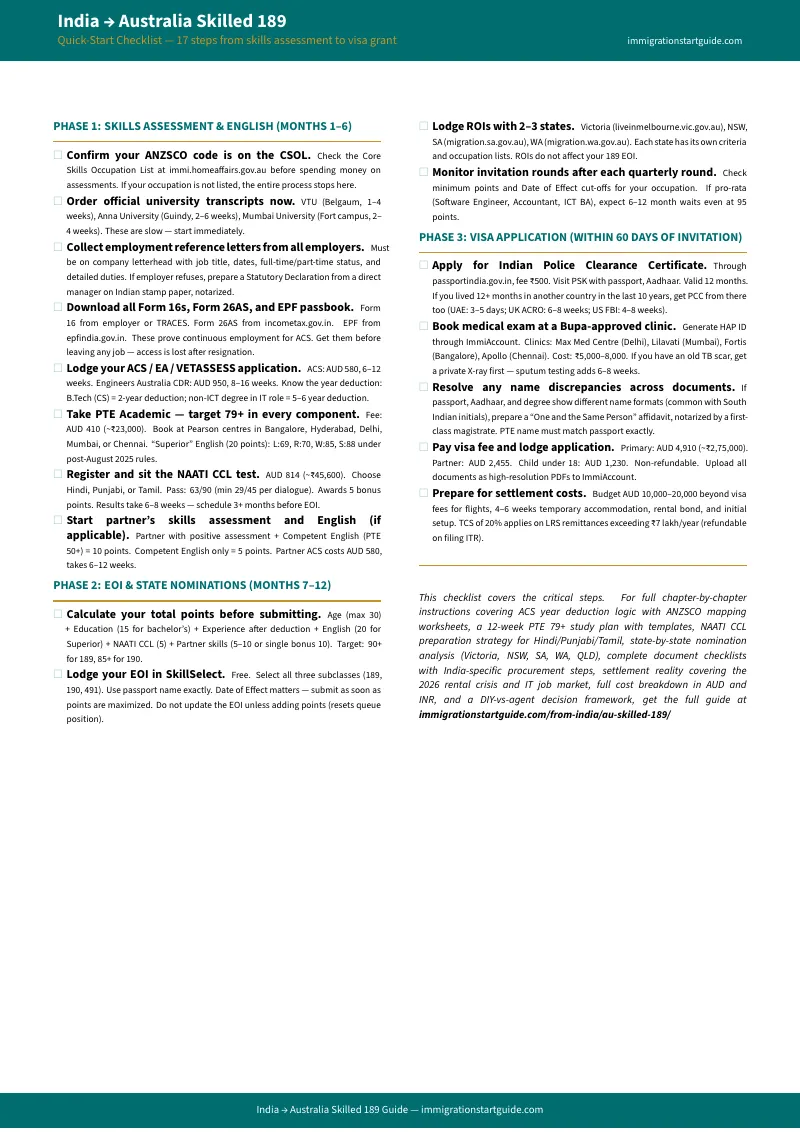
Quick-Start Document Checklist (free download)
Every India-specific document you need for your Subclass 189 application, distilled into a single printable checklist: ACS assessment requirements, English test scores, NAATI CCL documentation, EOI submission details, visa lodgement documents, partner evidence, financial records, police clearance, and medical examination. Enough to start organizing your files tonight.
Standalone Worksheets & Printables
Three standalone PDFs you can print and use independently — no need to read the full guide to start working on your points strategy:
- ANZSCO Mapping Worksheet — Map your Indian degree and work history to the ANZSCO occupation code that minimizes your ACS year deduction, with the deduction matrix for common Indian qualifications (B.Tech, B.E., MCA, BCA, B.Sc IT) and the "closely related" vs. "not closely related" classification for major tech roles
- Points Optimization Worksheet — Fill in your current score across all categories (age, education, English, experience, partner, NAATI CCL, state nomination) and see exactly where your gaps are, which bonuses are still claimable, and the realistic timeline to reach 90+
- Total Cost Calculator — Complete INR breakdown for every expense from ACS assessment to relocation, for singles, couples, and families — with forex conversion notes and the savings timeline based on typical Indian IT salaries
Who This Guide Is For
This guide is for Indian IT professionals, engineers, and skilled workers navigating the Subclass 189 from India — whether you're starting your skills assessment or you've been sitting in SkillSelect for months watching invitation rounds pass you by:
- You're a software engineer with 6–10 years of experience and a B.Tech from VTU, Anna University, or a state university — and you need to understand exactly how many years ACS will deduct before you pay the $1,498 assessment fee, because a 4-year deduction instead of a 2-year deduction costs you 10 points you can't recover
- You're stuck at PTE 65 and need 79 for Superior English — you've taken the test twice, your Reading and Listening are fine, but your Speaking score won't move past 62 because the AI penalizes your natural speech patterns, and you need the specific template strategy that exploits the algorithm's preference for rhythm over content
- You've heard about NAATI CCL in Telegram groups but nobody can explain whether Hindi CCL is realistic without interpreter training, what the test actually involves, or whether the 5 points are worth the $814 AUD fee and the preparation time
- Your EOI has been in SkillSelect for four months at 85 points and the last 189 round for your ANZSCO code cleared at 95 — you need to know whether state nomination is a realistic alternative or whether you're better off investing another three months in PTE attempts
- Your former employer in India shut down and you can't get a reference letter on company letterhead — you need the Statutory Declaration pathway and the payment evidence package that makes ACS accept your experience without the standard reference
- You're turning 33 in the next year and your age points are about to drop from 30 to 25 — you need the fastest realistic path to 90+ points before the birthday cutoff changes your entire calculation
- You and your spouse both work in IT and you're not sure which partner should be the primary applicant, whether it's worth investing in the second partner's ACS assessment, or how the partner skills points interact with the age and experience calculations
Why Not Free Resources?
Free information about the Australian Skilled 189 visa exists everywhere. Here's what it actually gives you:
- HomeAffairs.gov.au publishes the points test, the occupation lists, and the skills assessment requirements. It doesn't explain how ACS calculates the year deduction for Indian degrees, which ANZSCO code minimizes that deduction for your specific qualification, or why your PTE Speaking score keeps stalling at 62 despite fluent English. The official site describes the eligibility criteria. It doesn't tell you how to optimize for them from India.
- MARA-registered migration agents charge $2,000–$5,000 AUD for end-to-end service. For an offshore Indian applicant, that's ₹1.1–2.8 lakhs on top of the ₹4.5+ lakhs you're already spending on assessment fees, English tests, and the visa application. Many agents fill out the same SkillSelect EOI form you can complete yourself and provide generic points advice that doesn't account for the India-specific variables — ACS deduction logic for Indian degrees, PTE strategy for Indian speech patterns, NAATI CCL availability for Hindi speakers.
- YouTube immigration channels cover the 189 visa for applicants from all countries. They don't explain the ACS deduction matrix for B.Tech vs. MCA vs. BCA, the employer reference letter workaround when Indian HR refuses to list duties, the VTU transcript procurement timeline, or the PCC field inquiry process when you've lived in three Indian cities. The advice is directionally correct and operationally useless for the India-specific administrative layer.
- Telegram and Facebook groups (AustralianPR India, Australia Immigration India) contain real timeline data and personal experiences — mixed across years, visa types, ANZSCO codes, and individual circumstances. One poster says their ACS deduction was 2 years. Another with a similar degree says theirs was 4. Neither explains the "closely related" classification that determined the difference. The variable that separated their outcomes is absent from every reply.
- Non-MARA agents in India charge ₹50,000–₹2.5 lakhs for "PR processing" and have no regulatory accountability. They frequently overestimate points, underreport ACS deductions, and file EOIs at score levels that have zero chance of receiving an invitation — then blame the system when nothing happens for twelve months. The cheapest agents are often the most expensive in total cost, because a poorly prepared ACS submission costs you the $1,498 fee and months of waiting before you discover the mistake.
This guide fills the India optimization gap. It doesn't replace a MARA agent for complex cases (refusal history, character issues, onshore bridging visa situations). It handles the entire India-specific points strategy that generic guides ignore and agents charge ₹1–2.8 lakhs to manage: the ACS deduction logic for Indian qualifications, the PTE Speaking templates built for Indian speech patterns, the NAATI CCL Hindi pathway, the employer reference workarounds for Indian companies, and the state nomination backup strategy when 189 cutoffs put the visa out of reach at your current score.
— Less Than a Single PTE Attempt
A PTE exam costs ₹17,000 per attempt. A MARA agent charges ₹1.1–2.8 lakhs. And if you file your ACS assessment under the wrong ANZSCO code and get a 4-year deduction instead of a 2-year deduction, you've lost 10 points you can't recover, and you've paid $1,498 AUD for the privilege of learning what went wrong. If you take the PTE three times at 65 because nobody told you that the AI rewards steady pacing over natural speech, that's ₹51,000 and six months of your age clock. If you sit in SkillSelect at 85 points for a year because you didn't know NAATI CCL Hindi could give you the 5 points that cross the 90-point threshold, you've lost the year and the birthday you can't get back.
The guide doesn't replace a MARA agent. It handles the India-specific optimization layer that sits between your qualifications and a 90+ point EOI. It turns scattered Telegram advice and conflicting YouTube videos into a structured protocol built for Indian degrees, Indian employers, Indian speech patterns, and the administrative realities of procuring documents from Indian institutions.
Money-back guarantee, no time limit. If the guide doesn't give you a clearer path to 90+ points and a more confident ACS submission strategy, you pay nothing.
Download the free Quick-Start Checklist to see every India-specific document you need for the Subclass 189 application. When you're ready for the ACS deduction strategy, the PTE Speaking templates, the NAATI CCL Hindi pathway, and the complete points optimization system, the full guide is here.
Your qualifications got you this far. Your points strategy determines whether Australia lets you in.