
Your Sponsor Signed the CoS. Now India's Paperwork Has to Survive UKVI.
You got the offer. A UK employer is sponsoring you on the Skilled Worker route. Your Certificate of Sponsorship is live in the system, and your start date is three months away. You feel the momentum of something life-changing falling into place. And then the real process begins.
You go to book your VFS biometrics appointment in Bangalore. The calendar shows nothing available for six weeks. You try Mumbai — same story. You try Delhi and find a single slot at 7:30 AM on a Thursday. You take it, because the alternative is watching your CoS expiration date creep closer while VFS releases new slots in unpredictable batches that fill up within hours.
Meanwhile, your bank sends you a "Balance Certificate" — a one-page letter that says you hold ₹1,07,000. UKVI doesn't accept balance certificates. They want 28 consecutive days of transaction history showing the funds never dipped below the threshold. Your savings are split across an SBI savings account, an HDFC fixed deposit, and a PPF your father opened when you were eighteen. The FD needs a letter stating the funds are "immediately accessible." The PPF doesn't count at all. And the ₹3 lakh your parents transferred last week to help with the IHS payment? Without a Gift Deed linked to an NEFT transfer record, that deposit looks like borrowed money staged to inflate your balance — and that's a refusal.
Then there's the IHS. You knew about it in theory. You didn't know the number. For a five-year visa, it's £5,175 per adult — roughly ₹5.5 lakhs. For your spouse, another ₹5.5 lakhs. For your child, £776 per year — ₹4.1 lakhs over five years. Your family's upfront IHS bill alone could exceed ₹15 lakhs before you've paid the visa fee, the VFS service charges, the TB screening, or the Ecctis credential verification. Nobody told you the total. You're finding it out in pieces, each one larger than the last.
The India → UK Skilled Worker Guide is the India Filing Blueprint — the systematic protocol that sits between your signed Certificate of Sponsorship and a successful UKVI decision. It covers the financial documentation architecture that Indian bank accounts actually require, the VFS appointment strategy that works when slots are scarce, the Ecctis credential verification process that Indian universities routinely delay, and the total cost planning in INR that no official source provides in one place. This is not a generic UK visa overview. This is the India-specific layer that turns a strong sponsorship into an approved application.
What's Inside the India Filing Blueprint
15 chapters covering the complete India-to-UK Skilled Worker journey, plus a printable quick-start document checklist and 4 standalone reference cards you can print and use independently:
The 2026 Skilled Worker Framework and Salary Thresholds (Chapter 1)
The general salary threshold is now £38,700, moving toward £41,700 for many roles by late 2026. But "New Entrant" applicants — those switching from a student visa or under 26 — qualify for a reduced threshold of roughly 70% of the going rate. And the Immigration Salary List still offers discounted thresholds for shortage occupations in healthcare, engineering, and select IT roles. This chapter maps the SOC code system to common Indian professional roles, explains when the "going rate" for your specific occupation overrides the general threshold, breaks down the tradeable points for PhD holders and salary top-ups, and shows you exactly how to verify that your CoS salary clears the correct threshold before you submit. Because a salary that's £100 below the going rate for your SOC code results in an automatic refusal — no caseworker discretion, no appeal, no fee refund.
Certificate of Sponsorship — What to Verify Before You File (Chapter 2)
Your employer generates the CoS, but you bear the consequences of any errors on it. Indian professionals commonly discover mismatches between their CoS and their actual role: the wrong SOC code (especially when HR uses a generic "IT consultant" code instead of the specific developer or analyst code that matches the going rate), an incorrect start date that compresses your application window, or a salary figure that includes allowances UKVI doesn't count as base pay. This chapter provides the CoS Verification Checklist — every field you need to cross-reference against your offer letter and UKVI's going rate tables before you spend a single rupee on the application.
The ICT Trap — GBM vs. Skilled Worker Route (Chapter 3)
If you work for TCS, Infosys, Wipro, Cognizant, or HCL, your employer's HR team may push you toward the Global Business Mobility (Senior or Specialist Worker) route instead of the Skilled Worker visa. The GBM is cheaper for the company: no Immigration Skills Charge, no English test, faster onboarding. But it has no path to settlement. Time on a GBM visa does not count toward ILR. An Indian consultant who spends four years in London on a GBM visa and then switches to Skilled Worker needs another five years for Indefinite Leave to Remain — nine years total instead of five. This chapter compares the two routes side by side, explains when GBM makes strategic sense (short-term project, no settlement intent) and when Skilled Worker is the only rational choice, and gives you the specific talking points to bring to your HR team if they're defaulting to the wrong route.
Financial Documentation for Indian Bank Accounts (Chapter 4)
The 28-day maintenance fund rule is the single most common cause of financial-related refusals from India. Not because Indian professionals don't have the money — they do. Because they hold it in formats UKVI doesn't accept, or document it in ways that trigger caseworker scrutiny. This chapter covers the "immediately accessible" standard and which Indian instruments qualify (savings accounts, current accounts, FDs with the correct bank letter) and which don't (PPF, locked FDs, mutual funds, gold). It provides the Indian Bank Letter Template — the exact wording to give your branch manager so the letter satisfies Appendix Finance requirements. It explains the Gift Deed process for parental contributions: notarized deed, bank-to-bank NEFT/RTGS trail, parents' source-of-funds documentation. And it addresses the unexplained deposit problem — why a sudden ₹3-5 lakh transfer into your savings account without a documented source triggers a "genuineness" flag that can sink an otherwise clean application.
IHS and Total Cost Planning in INR (Chapter 5)
The Immigration Health Surcharge is £1,035 per year for adults and £776 per year for children. But the real cost is worse than the per-year figure suggests: any visa period exceeding six months within a year triggers a full annual charge. A three-year-and-one-day visa incurs four years of IHS. This chapter provides the complete household IHS calculator for 3-year and 5-year visa durations (single applicant through family of four), the full INR cost breakdown including visa fees, VFS service charges, TB screening, Ecctis verification, priority processing options, and flight costs, and the payment timing strategy — because the IHS is paid online before the VFS appointment while the visa fee can be split differently. For a family of three on a five-year visa, the total government fees alone can exceed ₹20 lakhs. You need to see the real number before you commit, not discover it in stages.
TB Screening — City-by-City Logistics (Chapter 6)
Every Indian applicant for a visa longer than six months must get a TB certificate from a Home Office-approved clinic. Standard hospital chest X-rays are rejected. There are approximately 40 approved centres across India, but they operate with different booking systems, fee structures, and result timelines. This chapter provides the city-wise clinic directory (Delhi, Mumbai, Bangalore, Chennai, Hyderabad, Ahmedabad, Lucknow, Ludhiana, and more) with fees, booking procedures, and expected turnaround. It covers the sputum test risk — if your X-ray is inconclusive, an 8-week sputum culture is mandated, which can destroy a tight application timeline. And it provides the preparation protocol that minimizes the chance of an inconclusive X-ray result.
Ecctis Credential Verification and the PSV Bottleneck (Chapter 7)
To meet the English language requirement without IELTS or PTE, you need an Ecctis statement confirming your degree was taught in English to a level comparable to CEFR B2. The problem is Primary Source Verification — Ecctis contacts your Indian university to confirm the degree is genuine, and many Indian state universities take weeks to respond. If the university doesn't respond within 20 days, Ecctis closes the application and you forfeit the fee. This chapter covers the Ecctis process end-to-end, explains the 3-year vs. 4-year degree benchmarking (your B.Tech maps to UK Bachelor Honours; your 3-year B.Com maps to UK Bachelor Standard — both are valid for Skilled Worker), and provides the University Registrar Pre-Notification Template you can send to your institution before Ecctis contacts them. This single step — giving your registrar advance notice and the reference number — prevents the most common failure mode in the entire Ecctis process.
VFS India — Appointments, Biometrics, and Premium Services (Chapter 8)
VFS Global manages biometrics collection in India, and they've built a business model around premium add-on services that many Indian applicants treat as mandatory. The Premium Lounge (₹3,840) adds comfort but doesn't affect processing speed. The Form Filling service (₹2,640) is essential for non-tech-savvy applicants but redundant if you've completed the online application correctly. The Priority service (₹63,819 for 5-day processing) is high value for urgent start dates. This chapter identifies which VFS services are worth paying for based on your specific situation, covers the appointment booking strategy for high-demand centres (Bangalore, Mumbai, Delhi), explains the slot release pattern and the cancellation-slot tactic, and provides the biometrics appointment checklist that prevents the most common reason applicants get turned away — a name mismatch between the VFS booking and the passport.
The ILR Path — 180-Day Rule and Settlement Strategy (Chapter 9)
If your goal is Indefinite Leave to Remain after five years, the Skilled Worker visa is the beginning, not the destination. The 180-day absence rule is the most dangerous pitfall for Indian families: absences from the UK are counted on a rolling 12-month basis, and a combination of wedding season travel, an elderly parent care trip, and a period of remote work from Bangalore can exceed 180 days in a rolling year — resetting your ILR clock to zero. This chapter covers the settlement eligibility criteria, the Absence Tracking Spreadsheet method, the Life in the UK test preparation, the salary threshold requirements at ILR stage, and the eVisa transition that affects how your entry and exit records are maintained.
English Language Requirements — B2 Standard from January 2026 (Chapter 10)
The English requirement for most new Skilled Worker applications has been raised from B1 to B2 level — equivalent to IELTS 5.5-6.5 across all modules. For Indian applicants whose degrees were taught in English, the Ecctis route (Chapter 7) is the preferred path. For those who need to take a Secure English Language Test, this chapter compares the approved SELT providers available in India, covers the IELTS for UKVI vs. standard IELTS distinction (they're different tests with different booking systems and higher fees), and provides the test centre booking strategy for Indian cities where slots fill weeks in advance.
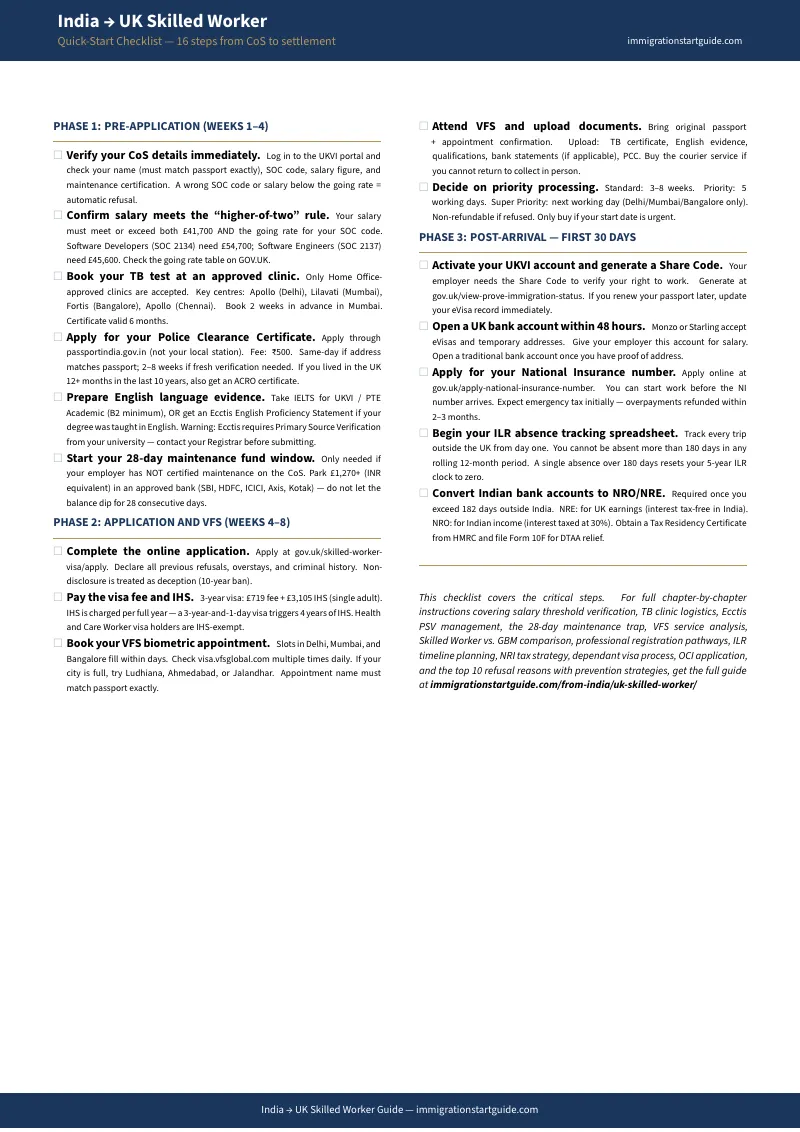
Quick-Start Document Checklist (free download)
Every India-specific document you need for your UK Skilled Worker application, distilled into a single printable checklist: CoS verification items, financial documentation, TB screening, Ecctis credentials, VFS appointment requirements, and dependant documents. Enough to start organizing your files tonight.
Standalone Reference Cards & Printables
Four standalone PDFs you can print and use independently — no need to carry the full guide to your bank, VFS appointment, or Ecctis application:
- Indian Bank Letter Template — The exact language to give your branch manager so the letter satisfies Appendix Finance "immediately accessible" requirements, plus the Gift Deed documentation process for parental contributions
- CoS Verification Checklist — Every field to cross-reference against your offer letter and UKVI going rate tables before filing, including SOC code validation, salary threshold calculation, and start date verification
- Total Cost Calculator — Complete INR breakdown for every expense from TB screening to IHS to VFS services, for singles, couples, and families on 3-year and 5-year visa durations
- TB Clinic Directory — City-wise approved clinics with fees, booking procedures, and turnaround times across India
Who This Guide Is For
This guide is for Indian professionals with a UK job offer navigating the Skilled Worker visa from India — whether you just received your Certificate of Sponsorship or you're mid-application and hitting roadblocks:
- You're an IT professional at TCS, Infosys, Wipro, Cognizant, or HCL and your HR team is pushing you toward the GBM/ICT route — you need to understand what that choice costs you in settlement eligibility before you agree, and you need the specific comparison and talking points to bring back to HR
- You're trying to meet the 28-day maintenance fund requirement but your savings are split across a savings account, a fixed deposit, and a PPF — and you need to know which instruments UKVI considers "immediately accessible," what letter your branch manager needs to write, and how to document a parental gift without triggering a genuineness flag
- You're a healthcare worker or engineer with a 3-year Indian degree and you're not sure whether it qualifies for the English language exemption through Ecctis — or whether you need to take an IELTS for UKVI at the new B2 standard
- You've calculated the visa fee and IHS separately but you haven't seen the total INR cost for your family in one place — and the number keeps growing every time you discover another mandatory fee
- You need a VFS biometrics appointment in Bangalore, Mumbai, or Delhi and the calendar shows nothing for weeks — you need the slot release pattern and the cancellation-slot tactic that applicants in Reddit threads mention but never explain
- Your Ecctis application has been open for two weeks and your university hasn't responded to the Primary Source Verification — you need to know exactly how to contact your registrar and what to say before Ecctis closes the case at day 20 and forfeits your fee
- You're bringing your spouse and child and the IHS bill for a family of three on a five-year visa is ₹15 lakhs — you need the payment timing strategy and the total cost calculation so you can plan the capital outlay rather than being ambushed by it
Why Not Free Resources?
Free information about the UK Skilled Worker visa exists everywhere. Here's what it actually gives you:
- GOV.UK publishes the official Skilled Worker requirements, fee tables, and approved TB clinic lists. It doesn't tell you which VFS add-on services are worth paying for, how to format an Indian bank letter for Appendix Finance compliance, or what happens when your Ecctis PSV stalls because your university registrar doesn't respond to emails. The official site describes the rules. It doesn't explain how to navigate them from India.
- Immigration solicitors charge ₹80,000 to ₹2.5 lakhs for end-to-end representation. That's on top of the ₹10-20 lakhs you're already paying in government fees, IHS, and VFS charges. For a sponsored professional whose employer has already done the heavy lifting on the CoS, you're paying solicitor rates for document formatting and form submission you can handle yourself — if you know what UKVI actually wants from Indian financial documents.
- YouTube immigration channels are useful for high-level overviews and policy updates. They cover the UK Skilled Worker route for applicants from all countries. They don't explain the Indian bank statement pitfalls, the city-wise TB clinic booking logistics, the Ecctis PSV timeline for Indian state universities, or the GBM vs. Skilled Worker settlement trap that specifically affects Indian IT professionals deployed by their employers.
- VFS Global's "Premium" services sell convenience and speed. The Premium Lounge gives you a comfortable waiting room. The Priority service gives you a faster decision. Neither helps you prepare the correct financial documentation, verify your CoS details, or avoid the submission errors that actually cause refusals. VFS processes your application. It doesn't improve your application.
- Reddit and immigration forums (r/ukvisa, r/SkilledWorkerVisaUK) contain real-world timelines and personal experiences — mixed across years, visa types, and countries of origin, with no way to filter for India-specific advice from 2026. One poster says their balance certificate was accepted. Another says theirs was rejected. Neither mentions whether their bank letter included transaction history or just a closing balance. The variable that determined the outcome is missing from every reply.
This guide fills the India documentation gap. It doesn't replace a solicitor for complex cases (refusal history, criminal record, unusual employment arrangements). It handles the entire India-specific administrative layer that generic guides ignore and solicitors charge ₹1-2.5 lakhs to manage: the financial documentation architecture for Indian bank accounts, the VFS appointment strategy when slots are scarce, the Ecctis PSV pre-notification that prevents your fee from being forfeited, and the total cost planning in INR that no official source provides in one place.
— Less Than a Single VFS Priority Appointment
A VFS Priority appointment costs ₹63,819. An immigration solicitor charges ₹80,000 to ₹2.5 lakhs. And if your application is refused because you submitted a balance certificate instead of a 28-day transaction history, or because your CoS salary was £100 below the going rate for your SOC code, or because your Ecctis verification closed at day 20 because nobody told your university to expect it — your visa fee, IHS payment, and VFS charges are gone. For a family, that's ₹15-20 lakhs in non-refundable government fees lost to a preventable documentation error.
The guide doesn't replace a solicitor. It handles the India-specific documentation strategy that sits between your signed Certificate of Sponsorship and a clean UKVI submission. It turns scattered Reddit advice and buried GOV.UK pages into a structured protocol built for Indian financial institutions, Indian universities, and the VFS appointment reality in Indian cities.
Money-back guarantee, no time limit. If the guide doesn't give you clearer control over the India-side documentation of your Skilled Worker application, you pay nothing.
Download the free Quick-Start Checklist to see every India-specific document you need for the Skilled Worker visa. When you're ready for the financial documentation templates, the CoS verification protocol, the VFS appointment strategy, and the complete INR cost breakdown, the full guide is here.
Your employer secured the sponsorship. Your Indian documents determine whether UKVI approves it.