
Your Attorney Files the Petition. Nobody Handles the Indian Bureaucracy.
You got selected in the H-1B lottery. Your employer hired an immigration attorney. The attorney will file your petition with USCIS. And then you discover the part nobody warned you about: the attorney doesn't call Anna University to chase your sealed transcripts. The attorney doesn't know which Passport Seva Kendra processes PCCs fastest. The attorney has never heard of the "jurisdictional delay" that strands people in their hometown for weeks waiting for police verification at an address they haven't lived at in years.
Between the legal filing and the actual approval stands an entire layer of Indian administrative reality that your attorney doesn't touch and that Reddit threads contradict each other about. Which credential evaluation agency accepts your 3-year B.Sc as a 4-year equivalent? How do you explain your Form 16 and CTC structure to a consular officer who has never seen Indian payroll? What do you do when your Mumbai consulate appointment is nine months out but Chennai has slots in three?
The India → US H-1B Visa Guide is the India Logistics Layer — the administrative playbook that sits between your attorney's legal work and the bureaucratic reality of getting documents out of India, through a U.S. consulate, and past USCIS adjudication. It covers the tasks your attorney won't do, the decisions Reddit can't agree on, and the India-specific logistics that generic H-1B guides don't know exist.
What's Inside the India Logistics Layer
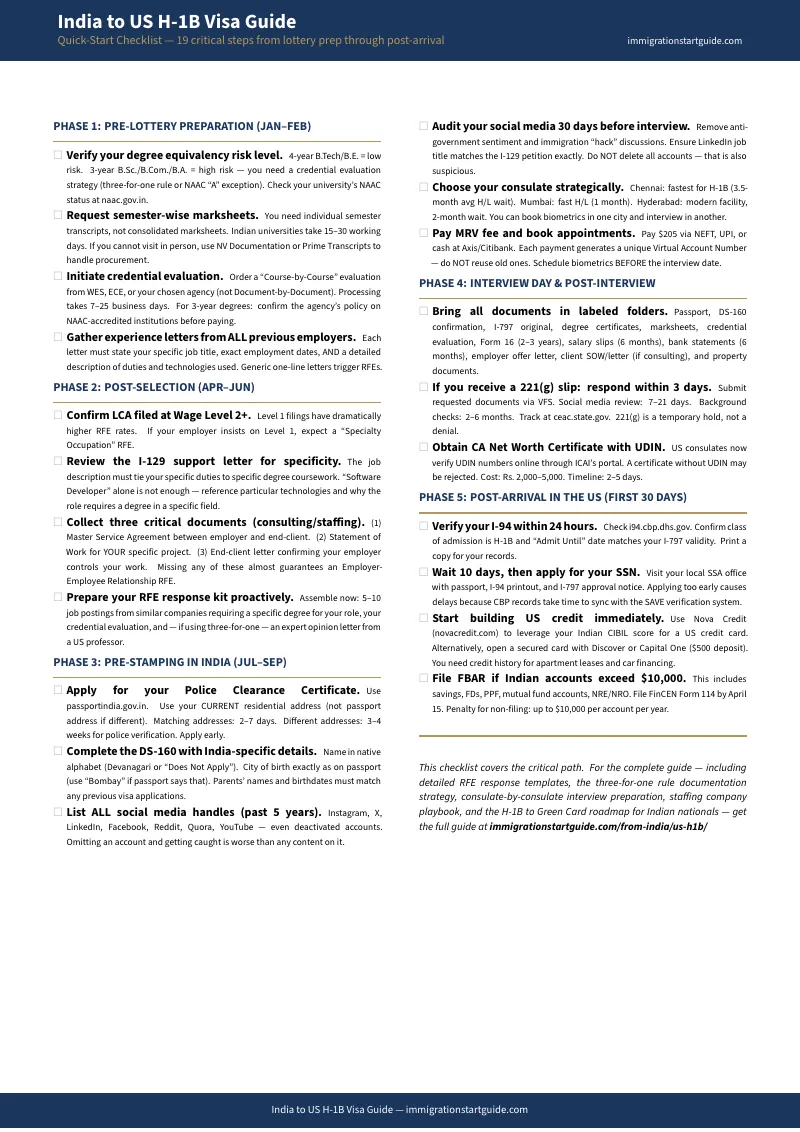
14 chapters covering the complete India-to-US H-1B journey, plus a printable quick-start document checklist:
The 3-Year Degree Resolution Framework (Chapter 3)
India's "10+2+3" education system gives you 15 years of total education. The US bachelor's standard is 16. If you hold a B.Sc, B.Com, or B.A., your credential evaluation may come back as "3-year undergraduate" — and your H-1B petition is dead on arrival. This chapter maps which evaluation agencies (WES, ECE, ERES) accept NAAC "A" and "A+" accredited 3-year degrees as full US equivalents, which require the Three-for-One Rule (3 years of progressive experience per missing year of education), and which specific combinations of degree type, university accreditation, and work history produce a clean evaluation. It includes a credential matrix for the 20 most common Indian degree types and templates for Professor Expert Opinion letters when work experience conversion is needed. Because the $200 evaluation is the cheapest part of your petition — the wrong agency choice costs you the entire case.
Indian Document Procurement Roadmap (Chapter 4)
Sealed transcripts from Anna University take 25-30 working days for verification plus another 15-20 for physical issuance. Mumbai University has its own timeline. And half the universities in India still don't support WES Gateway digital transmission. This chapter provides a university-by-university guide for the top 50 Indian institutions: which accept digital requests, which require in-person visits, which work with transcript services like NV Documentation and Prime Transcripts, and what the actual processing times are (not the published ones). It also covers provisional degree certificates versus final degrees, consolidated marksheets versus semester-wise transcripts, and which format each evaluation agency actually requires. The goal is to prevent the scenario where you're stuck in India for an extra month because your university registrar "lost" your request.
Passport Seva and PCC Logistics (Chapter 5)
Every H-1B holder going through consular processing needs a Police Clearance Certificate. The PCC process through Passport Seva is straightforward — until it isn't. You can now apply at any PSK in India regardless of your permanent address. But police verification still happens at the address listed in your application. If you've moved from Pune to Bangalore and apply at the Bangalore PSK with your parents' Pune address, the Pune police station verifies you — at an address where nobody recognizes you. This chapter maps the fastest PSK locations, the jurisdictional delay workaround, what to do when police verification stalls, and how to time your PCC application so it doesn't expire before your consulate appointment.
Consulate Strategy — Chennai vs. Mumbai vs. Hyderabad (Chapter 6)
Mumbai's B1/B2 wait is nine months. Chennai processes work visas faster than any other Indian post. Hyderabad handles first-time H-1B applicants as a centralized hub. And most applicants don't know they can book biometrics in one city and the consular interview in another. This chapter covers consulate-specific wait times, the "consulate hopping" strategy that lets you bypass multi-month backlogs, appointment booking tactics, and the day-of interview logistics for each of the five Indian posts. It includes the specific questions Indian consular officers are trained to ask H-1B applicants in 2026, the documents to have physically in your folder (not on your phone), and how to handle the "Why are you going to the US?" conversation when you work for a consulting firm.
Social Media Vetting Protocol (Chapter 7)
Since December 2025, social media vetting is mandatory for H-1B and H-4 applicants. Consular officers now ask during interviews whether your profiles are public. If they're private, you may get a 221(g) "Administrative Processing" slip requiring you to make them public and wait 7 to 21 days for manual review. For STEM professionals in sensitive technology areas, MANTIS security checks can extend this to months. This chapter provides a pre-interview social media audit protocol: what to review across LinkedIn, Twitter/X, Facebook, and Instagram before your appointment, what constitutes a red flag in 2026, how to handle the "make your profile public" instruction, and the realistic timeline expectations if you do receive a 221(g) white slip. Because a three-week delay becomes a three-month delay when your return flight was booked for next Tuesday.
The Staffing and Consulting Firm Shield (Chapter 8)
Indian IT consulting firms (TCS, Infosys, HCL, Wipro, and hundreds of mid-tier staffing companies) face denial rates of 2-8% — compared to less than 1% for US product companies. The primary trigger is the "Employer-Employee Relationship" requirement for third-party worksite placements. USCIS wants proof that your employer maintains "actual control" over your work, even though you sit at a client's office. This chapter provides the Third-Party Worksite Documentation Kit: templates for end-client letters that are legally soft enough for a client to sign but detailed enough for USCIS to approve, supervision plan frameworks, Master Service Agreement excerpts, and Statement of Work formatting that satisfies the "specialty occupation at a specific worksite" standard. It also covers the wage-level scrutiny that hits consulting firms hardest — why a Level 1 wage filing for a "complex" role is the fastest path to an RFE.
The Financial Translation Table (Chapter 9)
Indian salary structure confuses consular officers. "Net-in-hand" versus "gross CTC" versus "in-hand after TDS" — these don't map to a US W-2. Your Form 16 looks nothing like a 1040. And when the consular officer asks what you earn, answering in CTC versus take-home can create a perceived discrepancy that triggers follow-up questions. This chapter provides a direct translation table between Indian payroll documents and what a US consular officer or USCIS adjudicator expects to see: how to present your salary history, which Indian documents substitute for which US equivalents, and how to explain HRA, PF contributions, and variable pay in terms that don't raise eyebrows.
The 221(g) Risk Assessment Matrix (Chapter 10)
Going home to India for visa stamping used to be routine. In 2026, it's a calculated risk. If you get a 221(g) administrative processing slip, you could be stuck in India for weeks or months — while your US mortgage, your children's school, and your job continue without you. This chapter helps you decide: travel to India for consular stamping, or use the expanding domestic H-1B renewal pilot? It includes a risk scoring framework based on your employer type, job function, STEM classification, social media exposure, and prior visa history, plus contingency planning for what to do if you are stuck — remote work arrangements, leave of absence strategies, and the emergency expedite process.
RFE Response Architecture (Chapter 11)
A Request for Evidence costs $2,000+ in additional legal fees and 3-6 months of uncertainty. The most common RFE triggers for Indian applicants are specialty occupation proof (vague job descriptions), employer-employee relationship (consulting placements), educational equivalency (3-year degrees), and wage level justification. This chapter covers the anatomy of each RFE type, what evidence to assemble, response timelines, and how to work with your attorney to build a response that addresses the adjudicator's actual concern rather than restating the original petition.
90-Day India Document Timeline (Chapter 2)
A visual, week-by-week planner for the 90 days before your consular appointment or petition filing. When to order transcripts, when to apply for PCC, when to schedule credential evaluation, when to audit your social media, and when to book consulate appointments — with built-in buffer weeks for the delays that always happen. Start this timeline the day you're selected in the lottery and you arrive at your filing deadline with every document in hand instead of scrambling.
Quick-Start Document Checklist (free download)
Every India-specific document you need for your H-1B petition and consular processing, distilled into a single printable checklist: degree certificates, transcripts, credential evaluation, PCC, Form 16, employment letters, passport copies, photos, and DS-160 preparation items. Enough to start gathering documents tonight.
6 Standalone Printable Worksheets and Reference Cards
Every framework from the guide extracted as a standalone tool you can print and use immediately — the Credential Evaluation Decision Matrix for choosing the right agency for your degree type, the Consulate Comparison Card with wait times and strategies for all five Indian posts, the Social Media Audit Checklist for pre-interview profile review, the Financial Document Translation Table for salary presentation, the 90-Day Document Timeline Planner for tracking procurement deadlines, and the Third-Party Worksite Evidence Checklist for consulting firm applicants.
Who This Guide Is For
This guide is for Indian professionals navigating the H-1B process — whether you're in India preparing for your first petition or in the US planning a consulate trip home:
- You were selected in the H-1B lottery and your employer's attorney is filing the petition — but nobody has explained how to get sealed transcripts from your university, which credential evaluation agency handles your specific degree type, or what happens if your 3-year B.Sc doesn't evaluate as a US bachelor's equivalent
- You work for a consulting or staffing firm and you know the denial rates are higher for third-party placements — but you don't have the specific documentation templates that satisfy USCIS's "employer-employee relationship" requirement without requiring your end-client to sign anything legally uncomfortable
- You need to travel to India for visa stamping and you're trying to figure out whether to book Chennai, Mumbai, or Hyderabad — and whether the 221(g) risk makes the trip worth taking at all given the social media vetting changes
- You hold a 3-year degree (B.Sc, B.Com, B.A.) from an Indian university and the credential evaluation question is keeping you up at night — you've read contradictory advice on Reddit about whether your NAAC-accredited degree qualifies and you need a definitive answer before your attorney files
- Your consular interview is in six weeks and you haven't started gathering documents from India — you need a timeline that tells you exactly what to order this week, what can wait, and what to do when the university registrar stops answering
- You're an F-1 OPT student transitioning to H-1B and the administrative complexity of the Indian documentation layer is completely new to you
Why Not Free Resources?
Free information about the H-1B process is everywhere. Here's what it actually gives you:
- USCIS.gov explains the legal requirements for an H-1B petition. It says nothing about how to get a sealed transcript from Mumbai University in under 45 days, which PSK processes PCCs fastest, or why your CTC-based salary disclosure might confuse a consular officer.
- Immigration attorneys (Rajiv Khanna, Murthy Law, VisaPro) are excellent at the legal filing. They handle the I-129, the LCA, the RFE response. They do not help you call your university registrar, navigate Passport Seva, or figure out which credential evaluation agency will give your specific 3-year degree a favorable result. That's not what your employer pays them $3,000 to $7,000 to do.
- Reddit (r/h1b), Teamblind, and Trackitt are full of stamping experiences and RFE war stories — from 2021, 2023, and 2025, all mixed together with no way to tell which still applies after the social media vetting mandate. One commenter says WES rejected their B.Sc. Another says ECE accepted it. Neither mentions NAAC accreditation grade, which is the actual variable that determines the outcome.
- Generic H-1B guides on Amazon and immigration portals explain the petition process for all nationalities. They don't know the difference between a provisional degree certificate and a final degree, they've never heard of the Form 16, and they think "police clearance" is a simple one-step process.
This guide fills the India logistics gap. It doesn't replace your attorney — it handles the entire administrative layer your attorney doesn't touch. The document procurement, the credential evaluation strategy, the consulate selection, the social media preparation, and the consulting-firm documentation that sits between "your petition was filed" and "your visa was approved."
— Less Than a Single Credential Evaluation Fee
A credential evaluation costs $200 to $350. Choosing the wrong agency for your degree type means paying twice and losing weeks. An RFE triggered by a documentation gap costs $2,000+ in additional legal fees and 3-6 months of uncertainty. A botched consulate trip — wrong documents, 221(g) slip, stuck in India — costs months of lost US wages at a salary that could be $100,000 or more per year.
The guide doesn't replace your immigration attorney. It handles the India-specific administrative work that falls between your attorney's legal filing and the actual bureaucratic reality of getting documents out of Indian institutions, through a US consulate, and past USCIS adjudication. It turns months of contradictory Reddit research into a structured playbook you can execute in 90 days.
Money-back guarantee, no time limit. If the guide doesn't give you clearer control over the India-side logistics of your H-1B process, you pay nothing.
Download the free Quick-Start Checklist to see every India-specific document you need. When you're ready for the credential evaluation strategy, consulate comparison framework, social media protocol, and the complete 90-day document timeline, the full guide is here.
Your lottery selection expires if the petition isn't filed correctly. Every document you're missing is a delay you can't afford.