
You Have an S1 from ITB, Six Years of Software Engineering Experience, and an EOI Lodged at 70 Points. But the ACS Just Deducted Four Years of Your Work Experience Because Your Transcript Did Not Include Unit Descriptions Proving 33% ICT Content. Your Sarjana Was Classified "ICT Minor" Instead of "ICT Major." That Single Reclassification Cost You 15 Claimable Points and Dropped You Below the 85-Point Floor That SkillSelect Has Not Breached in Six Months.
You ran the points calculator. Age 29, Bachelor's degree, six years of experience, Proficient English. You should be at 80 points — close enough that a state nomination would push you over. But ACS came back with a Skill Met Date that erased four years of your career because your Sarjana transcript from Universitas Indonesia or ITS or Binus listed courses by Indonesian title without the English-language unit descriptions that ACS uses to determine whether 33% of your content was "ICT-professional." Your degree was classified as "ICT Minor." That classification costs you three additional years of experience deduction — from two years to five — and the 15 points that would have cleared the 85-point wall. The IDR 8.5 million assessment fee is gone. The 12 weeks of processing time are gone. And nobody in the "Pejuang PR Australia" WhatsApp group mentioned that you needed to request a detailed course syllabus in English from your university's academic office alongside your transcript.
Or you hold a D3 — a Diploma Tiga from a politeknik. You assumed it mapped to an Australian bachelor's degree because you studied for three years. It does not. A D3 with 108 SKS maps to AQF Level 6 — an Advanced Diploma, not a bachelor's. That means 10 points for education instead of 15. Combined with the ACS experience deduction, your points test collapses. A D4 or Sarjana Terapan with 144 SKS maps to AQF Level 7 and earns 15 points — but only if the awarding institution holds BAN-PT accreditation at "B" or higher. If your politeknik or university branch was accredited "C" by BAN-PT at the time of your graduation, the assessing body can downgrade the qualification entirely. This is the "D3 trap" that migration agents charge IDR 50-100 million to navigate — and that free online guides written for Indian or British applicants do not mention at all, because no other country uses the D3/D4/S1 credential structure mapped against BAN-PT accreditation tiers.
You need a police clearance. The official requirement says "national police authority." In Indonesia, that means an SKCK from Mabes Polri in Jakarta — specifically the national-level certificate required for overseas visa applications, not the local Polres-level SKCK used for domestic employment. The process has been digitized through the Polri Super App for pre-registration and payment via BRIVA, but applicants outside Jakarta still need to appear in person at Gedung Presisi II or arrange the process through a regional Polda that feeds into the national system. The SKCK is valid for six months. Generate it too early and it expires before your visa is granted. Generate it too late and your application stalls while you wait for the replacement.
You need your documents Apostilled. Indonesia acceded to the Hague Apostille Convention in 2022, which simplified the old multi-ministry legalization chain. But the Kemenkumham Apostille through the Ditjen AHU portal is not a rubber stamp. The system verifies the "public official" who signed your document — if the rector or dean who signed your ijazah is not registered in the AHU database, the application is rejected and you must get the document re-verified or notarized before resubmitting. The fee is modest (IDR 50,000-150,000), but the rejection-and-resubmission cycle can add weeks. Applicants who discover this at the last minute before a visa deadline lose time they cannot recover.
You need Superior English for maximum points. But you are caught between two tests: IELTS, where Indonesian speakers consistently struggle with the Writing band (formal register, hedging language, and essay structure that does not map to Bahasa Indonesia composition norms), and PTE Academic, where the AI-based scoring is more predictable but the 2025 threshold changes pushed Superior Speaking to 88 out of 90. The difference between Proficient English (10 points) and Superior English (20 points) is often the difference between an invitation and another six months in the SkillSelect queue. IELTS now offers the One Skill Retake — if you hit 8.0 in three bands but 7.0 in Writing, you retake only Writing within 60 days instead of paying IDR 3.4 million for a full retest. Nobody in the Kaskus immigration forum is discussing this strategically, because most advice there predates the rule change.
And then there is the state nomination question. The Subclass 189 allocation dropped 44% in 2024-2025 to just 16,900 places. The realistic pathway for most Indonesian professionals is now 190 (state-nominated, +5 points) or 491 (regional, +15 points). But which state? NSW has the deepest IT occupation list but the longest processing times. South Australia is aggressively inviting healthcare workers with 25-35 day visa grants. Victoria has a strong engineering list but requires existing Australian work experience for many occupations. Western Australia's WASMOL includes occupations that do not appear on the federal MLTSSL. Each state has its own nomination criteria, its own occupation list, its own documentation requirements — and making the wrong choice means your EOI sits uninvited while a different state would have nominated you within weeks.
You are not short on qualifications. You are short on a systematic method for navigating the Indonesia-specific credential evaluation, BAN-PT accreditation verification, SKS-to-AQF mapping, Polri SKCK process, Kemenkumham Apostille system, and state nomination strategy that no generic Australian skilled migration guide addresses — because these processes exist only for Indonesian applicants.
The Indonesia-to-Australia Migration Playbook
This is not a generic Australian immigration explainer. This is the Indonesia-specific operational playbook for every step where the Australian skilled migration process collides with Indonesian credential structures and administrative systems: the SKS-to-AQF mapping that determines whether your D3, D4, or S1 earns 10 or 15 education points. The BAN-PT accreditation verification that can upgrade or destroy your qualification assessment. The ACS "ICT Major vs Minor" classification strategy for Indonesian Sarjana transcripts — how to extract and present English-language course descriptions so ACS counts your electives and skripsi toward the 33% threshold. The VETASSESS documentation standards for Indonesian employment reference letters that satisfy ANZSCO duty descriptions. The Engineers Australia CDR (Competency Demonstration Report) writing framework for Indonesian engineering graduates. The SKCK process through Mabes Polri with Polri Super App pre-registration and BRIVA payment. The Kemenkumham Apostille through the Ditjen AHU portal — including the public official signature verification step that catches applicants whose rector or dean is not in the database. The PTE vs IELTS decision framework calibrated for Indonesian English speakers. The state nomination strategy for occupations in highest demand within the Indonesian professional community — IT, engineering, healthcare, and accounting. And the 12-month execution timeline that runs credential evaluation, skills assessment, SKCK, Apostille, English testing, and state nomination research in parallel instead of sequence.
Migration agents in Indonesia charge IDR 50-100 million for full-service visa management. For that fee, you get document preparation and portal submissions. What you rarely get is the Indonesia-specific credential strategy — the SKS mapping that prevents a D3 from being assessed as a bachelor's degree equivalent (or an S1 from being downgraded because of a BAN-PT "C" rating), the ACS transcript presentation that prevents an "ICT Minor" classification, the Kemenkumham Apostille workflow that prevents a rejection from an unregistered signatory, or the state nomination analysis that identifies the fastest pathway for your specific occupation and points score. The agent files your application. The playbook builds your entire migration system.
What Is Inside
Indonesian Credential Evaluation and AQF Mapping
Your visa application begins not at SkillSelect but at your ijazah and transkrip nilai. The guide provides the complete SKS-to-AQF mapping: a D3 (108 SKS, three years) maps to AQF Level 6 (Advanced Diploma, 10 education points). A D4 or Sarjana Terapan (144 SKS, four years) maps to AQF Level 7 (bachelor's equivalent, 15 points). An S1 Sarjana (144 SKS, four years) maps to AQF Level 7 — but only if the institution holds BAN-PT accreditation at "B" or higher at the time of graduation. The guide covers institution-by-institution BAN-PT status for the major Indonesian universities and politeknik: ITB, UI, UGM, ITS, Binus, Telkom University, Universitas Brawijaya, Universitas Diponegoro, and the Politeknik Negeri system. For institutions with "C" BAN-PT accreditation or accreditation that lapsed during your study period, the guide walks through the appeal and supplementary documentation strategy that can prevent a downgrade. One incorrect assumption about your AQF equivalency cascades through your entire points calculation — and by the time the skills assessment comes back negative, you have lost both money and months.
ACS Skills Assessment for Indonesian IT Professionals
The ACS assesses Indonesian IT professionals with a forensic focus on transcript content. The guide covers the "ICT Major vs Minor" classification: your S1 in Teknik Informatika or Sistem Informasi qualifies as an "ICT Major" only if at least 33% of the units are classified as ICT-professional content by ACS standards. Indonesian transcripts that list courses by Indonesian-language titles without English descriptions are routinely classified as "ICT Minor" — triggering a five-year experience deduction instead of two. The guide provides the course description extraction methodology: how to request an English-language detailed syllabus from your university, which courses count as ICT-professional vs ICT-minor content, how to present your skripsi and practicum toward the 33% threshold, and the common classification traps for cross-disciplinary degrees (Teknik Elektro graduates working in software, Sistem Informasi Bisnis graduates in data science). The ANZSCO code selection strategy — why choosing Software Engineer (261313) when your reference letter describes project management duties results in a "Not Closely Related" outcome. And the Statutory Declaration pathway for applicants whose Indonesian employers cannot or will not provide detailed reference letters on company letterhead.
VETASSESS and Engineers Australia Assessments
For Indonesian professionals outside IT, VETASSESS and Engineers Australia are the primary assessing bodies. VETASSESS requires at least one year of post-qualification employment at the required ANZSCO skill level — and Indonesian employer reference letters are the leading cause of negative outcomes. The guide covers the VETASSESS documentation standard: duty descriptions that align with ANZSCO task lists without triggering generic language flags, the company letterhead and supervisor signature requirements, and the supplementary evidence strategy for applicants whose employers provide only a Surat Keterangan Kerja without detailed duties. For engineers, the guide covers the Engineers Australia CDR pathway: three Career Episodes demonstrating applied engineering principles, the Summary Statement cross-referencing competency elements, the plagiarism detection system that flags AI-generated or template-copied episodes, and the Washington Accord recognition status of Indonesian engineering programs accredited by IABEE (the Indonesian Accreditation Board for Engineering Education) — which can exempt qualifying graduates from the CDR entirely.
SKCK Police Clearance via Polri Super App
The SKCK (Surat Keterangan Catatan Kepolisian) from Mabes Polri is mandatory for all Australian permanent visa applications. The guide covers the complete process: pre-registration through the Polri Super App or SKCK Online portal, required documents (KTP, Kartu Keluarga, birth certificate or ijazah, passport), payment of IDR 30,000 via BRIVA, in-person appearance at Mabes Polri (Gedung Presisi II, Jakarta Selatan) or delegation to a regional Polda, processing time of 15-30 minutes with pre-registration. The guide also covers the validity strategy: the SKCK is valid for six months, and Australian visa processing for Indonesian applicants typically takes four to eight months from EOI invitation to grant. If your SKCK was issued before your EOI invitation and expires during processing, you must obtain a renewal — the guide maps the renewal timing against the visa processing timeline so you generate the SKCK at the optimal moment, not too early and not too late.
Kemenkumham Apostille and Document Authentication
Since Indonesia's 2022 accession to the Hague Apostille Convention, academic documents, birth certificates, and marriage certificates for Australian visa purposes require an Apostille from the Directorate General of Legal Administrative Affairs (Ditjen AHU) under the Ministry of Law and Human Rights (Kemenkumham). The guide covers the end-to-end AHU Apostille process: account registration on the AHU portal, application submission with document details and the name of the "public official" who signed the document, online payment (IDR 50,000-150,000), and physical collection of the Apostille sticker at a Kemenkumham office. The critical step most applicants miss: the AHU system verifies the signatory's name against its database. If the rector, dean, or registrar who signed your ijazah or transkrip is not registered, the application is rejected. The guide covers the verification workaround — notarization, institutional re-verification, and the Kemenkumham office escalation path — and the documents that do and do not require Apostille for Australian visa purposes (academic documents: yes; SKCK: no, it is issued by Polri and verified separately; medical exam: no, conducted by an Australian panel physician).
English Test Strategy: PTE vs IELTS for Indonesian Speakers
Superior English (20 points) is the single largest controllable factor in the points test. The guide covers the Indonesian-specific diagnostic for choosing between PTE Academic and IELTS. PTE advantages for Indonesian speakers: AI-based scoring is consistent and "preparable," results in 48 hours, granular 10-90 scale shows exact distance to the next threshold. PTE disadvantages: the 2025 threshold changes pushed Superior Speaking to 88/90 and Writing to 85/90 — punishingly close to perfect. IELTS advantages: the One Skill Retake allows you to retake only the band you missed (typically Writing for Indonesian speakers) within 60 days, saving IDR 3.4 million and weeks of preparation. IELTS disadvantages: human-scored Speaking can feel less predictable, 0.5-band increments obscure how close you are to the threshold. The guide maps the Indonesian English speaker profile — common L1 transfer patterns in final consonant clusters, article usage, and formal register — to the test format that gives you the highest probability of Superior English in the fewest attempts. And the strategic decision framework: when is Proficient English (10 points) plus a state nomination (+5 or +15 points) a faster path to PR than spending three to six more months chasing Superior English?
State Nomination Strategy for Indonesian Professionals
With Subclass 189 places reduced to 16,900, state nomination through the 190 or 491 pathway is the most viable route for Indonesian professionals scoring between 65 and 80 points. The guide covers each major state's nomination program mapped to the occupations most common among Indonesian applicants: NSW for IT professionals (Software Engineers, ICT Business Analysts, Systems Analysts), South Australia for healthcare workers (registered nurses receiving invitations with 25-35 day visa grants), Victoria for engineers and accountants, Western Australia's WASMOL for occupations not listed on the federal MLTSSL, and the regional 491 pathway for professionals willing to commit to regional areas for three years in exchange for 15 bonus points. The guide provides the state-by-state comparison: nomination criteria, processing times, occupation lists, documentation requirements, and the commitment periods. For Indonesian professionals in competitive IT occupations, the guide covers the "regional pivot" strategy — when targeting a 491 regional nomination in South Australia or Tasmania delivers a visa grant months faster than waiting in the 189/190 queue for NSW or Victoria.
Points Optimization and EOI Strategy
The guide maps the realistic points landscape for Indonesian professionals in 2026. The age cliff at 33 — crossing this birthday drops you from 30 to 25 points, and at 40 it drops to 15. The partner points opportunity — if your spouse holds a positive skills assessment and Competent English, you claim 10 additional points (5 for assessment, 5 for English). The "Power Couple" strategy for Indonesian professional couples — an IT professional and a nurse, or two engineers in different ANZSCO codes — where swapping the primary and secondary applicant roles can change which state nominations are available. The Professional Year Program for applicants already in Australia on a student or temporary visa — worth 5 additional points. The NAATI credentialed community language (Bahasa Indonesia-English) translation credential — worth 5 points and uniquely accessible to Indonesian applicants because it tests translation ability in their native language. The guide provides a points scenario analysis for common Indonesian profiles: fresh S1 graduate with Proficient English, mid-career D4 holder with Competent English, senior software engineer with Superior English, and the action plan for each to reach the 85-point invitation floor.
12-Month Execution Timeline
The complete migration timeline from first BAN-PT verification to arriving at your Australian employer's door — calibrated for Indonesian processing realities, not generic estimates. Month 1: BAN-PT status check, AQF mapping, ACS/VETASSESS/EA application prepared, English test registered, NAATI assessment explored. Months 1-3: Skills assessment submitted, SKCK generated via Polri Super App, Kemenkumham Apostille initiated, English test taken. Months 3-5: Skills assessment result received, EOI lodged, state nomination applications submitted, English retake if needed (IELTS One Skill Retake or PTE resit). Months 5-8: EOI invitation received, visa application lodged with all supporting documents, medical exam at Australian panel physician, biometrics submitted. Months 8-12: Visa processing, grant notification, relocation planning. With the parallel task structure that runs credential evaluation, skills assessment, SKCK, Apostille, English testing, and state nomination research simultaneously instead of sequentially — saving three to five months compared to the serial approach most DIY applicants take.
Who This Is For
- Indonesian IT professionals — software engineers, systems analysts, ICT business analysts, data scientists, cybersecurity specialists — in Jakarta, Bandung, Surabaya, and Yogyakarta who need the ACS transcript strategy that prevents an "ICT Minor" classification and the experience deduction that silently erases years of claimable work
- D3 diploma holders from politeknik who need to understand that their qualification maps to AQF Level 6 (not Level 7) before they waste IDR 8.5 million on a skills assessment built on an incorrect points calculation — and the pathway strategy for D3 holders to reach the invitation threshold through Superior English, state nomination, and partner points
- S1 and D4 graduates from universities with BAN-PT "B" or "C" accreditation who need the accreditation verification and supplementary documentation strategy that prevents a qualification downgrade at the skills assessment stage
- Engineers — mechanical, civil, electrical, chemical — who need to know whether their Indonesian degree program is recognized under the Washington Accord through IABEE accreditation (exempting them from the CDR), or whether they must write three Career Episodes and a Summary Statement that passes Engineers Australia's plagiarism detection
- Healthcare professionals — registered nurses, pharmacists, physiotherapists — who need the AHPRA registration pathway and ANMAC assessment process mapped to Indonesian nursing and health science qualifications, with the clinical hours documentation strategy for Indonesian university transcripts
- Returnee alumni who previously studied at Australian universities on a Subclass 500 student visa, returned to Indonesia, and are now seeking permanent residency through the skilled migration pathway — with the Australian Study Requirement bonus (5 points) and the CRICOS institution verification that validates their claim
- DIY applicants who want to avoid paying IDR 50-100 million to a migration agent and need the procedural strategy that sits between a points calculator and a submitted visa application — covering the Indonesian credential, documentation, and administrative steps that generic guides and migration agents from other countries do not address
Why Not WhatsApp Groups, Free Guides, or the Home Affairs Website?
WhatsApp and Telegram groups — the "Pejuang PR Australia" channels with thousands of members — are where someone tells you the ACS assessment took "eight weeks" without mentioning they submitted a detailed English-language syllabus alongside their transcript that you do not have. Where another person says their D3 was assessed as a bachelor's equivalent without disclosing they actually held a D4 with 144 SKS, not a D3 with 108. Where a third person says the SKCK took "20 minutes" without mentioning they pre-registered on the Polri Super App and had every document ready in the exact format Mabes Polri requires. The advice is real but stripped of the context that makes it replicable. And the people posting are the ones whose applications succeeded — not the ones whose ACS assessment came back "ICT Minor" or whose Apostille was rejected because the signatory was not in the AHU database.
Free guides and the Home Affairs website explain the points test, the occupation lists, and the documents required. They do not explain the D3/D4/S1 mapping to the AQF. They do not explain that BAN-PT accreditation at "C" can trigger a qualification downgrade. They do not explain the ACS "ICT Major vs Minor" classification trap for Indonesian transcripts. They do not explain the Kemenkumham Apostille signatory verification step. They do not explain the SKCK process at Mabes Polri with Polri Super App pre-registration. They do not cover the NAATI Bahasa Indonesia-English credential as a five-point bonus uniquely available to Indonesian applicants. Official resources describe the rules for all nationalities. They do not describe the Indonesian starting point.
Migration agents in Indonesia charge IDR 50-100 million for application management. Many handle Indonesian cases the same way they handle cases from any other country — they do not know the BAN-PT accreditation verification, the ACS transcript presentation strategy for Indonesian degree structures, the Kemenkumham AHU signatory check, or the NAATI Bahasa Indonesia pathway. You are paying for portal submissions and document uploads. Whether you are paying for the Indonesia-specific credential strategy is a separate question.
Your Options
- DIY from free resources — WhatsApp groups, Kaskus, Reddit, Home Affairs website. Cost: zero. Risk: D3 assessed as bachelor's equivalent when it is not (10 points vs 15 points), BAN-PT "C" accreditation triggers a qualification downgrade you did not anticipate, ACS classifies your S1 as "ICT Minor" instead of "ICT Major" (five-year deduction vs two-year deduction), Kemenkumham Apostille rejected because signatory not in AHU database (weeks of resubmission), SKCK generated too early and expires during visa processing (renewal cycle adds weeks), wrong state nomination choice means your EOI sits uninvited while a different state would have nominated you in weeks. One wrong assumption costs IDR 8.5 million in a wasted skills assessment and three to six months of lost time.
- This guide — the complete Indonesia-to-Australia Migration Playbook. Cost: . Covers SKS-to-AQF credential mapping, BAN-PT accreditation verification, ACS/VETASSESS/Engineers Australia assessment strategy for Indonesian qualifications, SKCK via Polri Super App, Kemenkumham Apostille with AHU signatory verification, PTE vs IELTS decision framework for Indonesian speakers, NAATI Bahasa Indonesia-English points bonus, state nomination strategy mapped to Indonesian professional occupations, points optimization scenarios, and the 12-month parallel execution timeline.
- Migration agent — MARA-registered agent in Indonesia. Cost: IDR 50-100 million (approximately AUD 5,000-10,000). Covers application management and portal submissions, but typically does not include the credential evaluation strategy, BAN-PT verification, ACS transcript presentation methodology, Kemenkumham Apostille navigation, or state nomination analysis that determines whether you are nominated in weeks or wait for months.
What You Get
The guide includes everything designed for the Indonesian pathway to Australia — 8 printable PDFs:
- Complete Guide (guide.pdf) — 13 chapters covering Indonesian credential evaluation and AQF mapping (D3/D4/S1 with BAN-PT verification), ACS/VETASSESS/Engineers Australia assessment strategy for Indonesian qualifications, SKCK police clearance via Polri Super App, Kemenkumham Apostille through the AHU portal, PTE vs IELTS decision framework for Indonesian English speakers, state nomination strategy for IT, engineering, healthcare, and accounting occupations, points optimization with partner points and NAATI bonus, and the 12-month parallel execution timeline
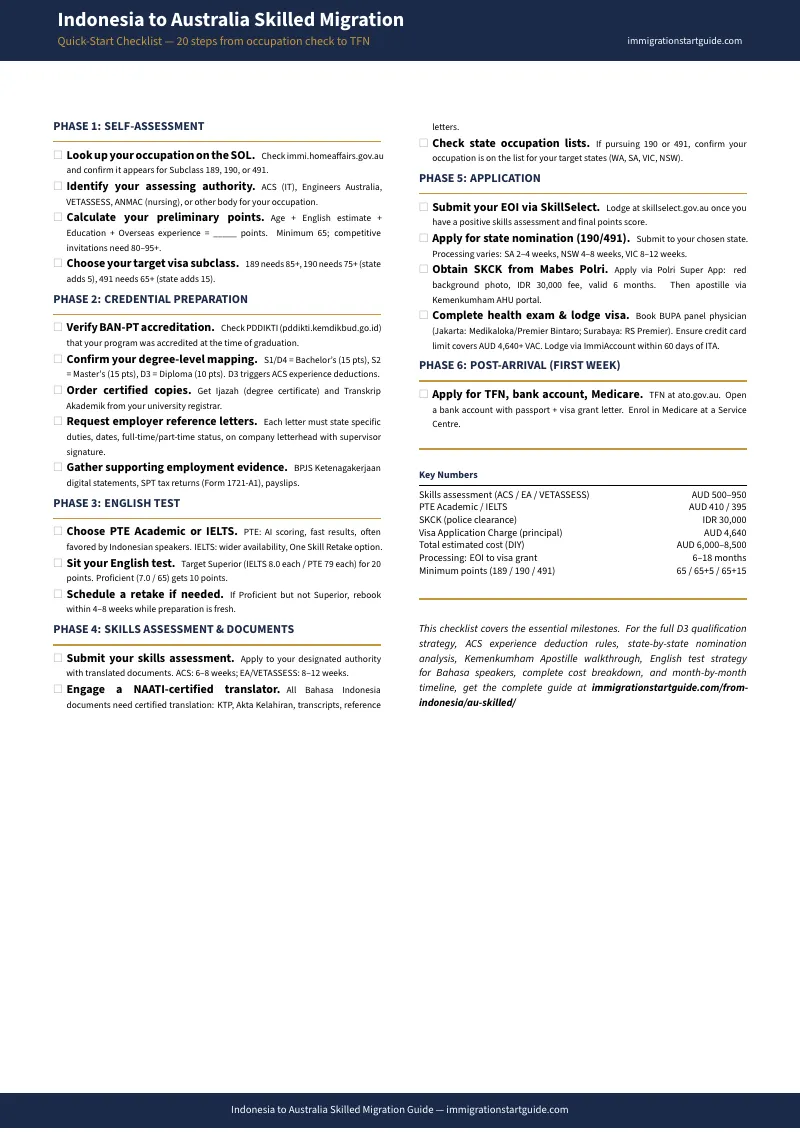
- Quick-Start Checklist (checklist.pdf) — every step from BAN-PT verification to visa grant, with the exact sequence, government fees, processing times, and the parallel task structure that runs credential evaluation, skills assessment, SKCK, Apostille, and English testing simultaneously
- Credential Mapping Worksheet (credential-worksheet.pdf) — fillable worksheet for mapping your D3, D4, or S1 to the AQF, checking your institution's BAN-PT accreditation status, and determining whether your qualification earns 10 or 15 education points before you spend money on a skills assessment
- ACS Transcript Preparation Guide (acs-prep.pdf) — the course description extraction methodology for Indonesian Sarjana transcripts, the 33% ICT-professional content threshold, the "ICT Major vs Minor" classification checklist, and the ANZSCO code selection decision tree
- Document Authentication Tracker (auth-tracker.pdf) — Kemenkumham Apostille status tracker for every document type (ijazah, transkrip nilai, akta kelahiran, akta nikah), SKCK validity window, and the signatory verification checklist
- State Nomination Comparison Card (state-card.pdf) — side-by-side comparison of NSW, Victoria, South Australia, Western Australia, and Tasmania nomination programs: occupation lists, criteria, processing times, and the commitment periods for 190 and 491 visas
- Points Calculator Worksheet (points-worksheet.pdf) — fillable points test with 189/190/491 comparison, partner points calculation, NAATI bonus eligibility check, and scenario analysis for common Indonesian professional profiles
- English Test Decision Card (english-card.pdf) — PTE vs IELTS comparison calibrated for Indonesian speakers, the One Skill Retake strategy, score threshold mapping, and the "Proficient + State Nomination" vs "Superior English" decision framework
The Free Checklist vs. The Full Guide
The free Quick-Start Checklist gives you the critical action items — every step from BAN-PT accreditation check through skills assessment, SKCK, Kemenkumham Apostille, English testing, and state nomination. It is enough to see the full scope of what stands between you and an Australian PR, and to identify the long-lead-time items (skills assessment at 8-12 weeks, English testing with potential retakes, state nomination processing) that need to start moving immediately.
The full guide gives you how — plus seven standalone printable tools you will use throughout the 12-month process: the Credential Mapping Worksheet that determines your AQF level and education points in fifteen minutes. The ACS Transcript Preparation Guide that prevents the "ICT Minor" classification. The Document Authentication Tracker with Kemenkumham Apostille status and SKCK validity windows. The State Nomination Comparison Card with occupation-specific recommendations. The Points Calculator Worksheet with partner points and NAATI bonus scenarios. The English Test Decision Card calibrated for Indonesian speakers. Eight PDFs total — the complete Indonesia-to-Australia Migration Playbook from BAN-PT verification to visa grant.
— Less Than One Percent of a Migration Agent's Fee
A MARA-registered migration agent in Indonesia charges IDR 50-100 million for application management that covers portal submissions but often leaves you without the credential evaluation strategy that determines whether your D3 earns 10 or 15 points, without the ACS transcript presentation that prevents an "ICT Minor" classification, without the Kemenkumham Apostille signatory verification that prevents a rejection, without the state nomination analysis that identifies the fastest pathway for your occupation, and without the NAATI Bahasa Indonesia-English credential that could add five points to your total. The agent files your application. The playbook builds your entire migration system — designed for the Indonesian credential structures and administrative processes that generic guides do not address.
If the information in one chapter — the BAN-PT verification that catches a "C" accreditation before you pay for a skills assessment built on a false assumption, the ACS transcript methodology that prevents an "ICT Minor" classification and saves three years of claimable experience, the Kemenkumham Apostille signatory check that prevents a rejection and weeks of resubmission, the state nomination analysis that reveals South Australia or Tasmania would have nominated you in weeks while you waited months in the NSW queue, or the NAATI Bahasa Indonesia pathway that adds five points you did not know existed — saves you a single failed assessment, a single rejected document, or a single month of avoidable delay, the guide has paid for itself before you finish the first chapter.
100% satisfaction guaranteed. If the guide does not meet your expectations, email [email protected] for a full refund.