
You Passed the JFT-Basic. You Passed the Prometric Skill Test. Your LPK Says the Total Cost Is IDR 65 Million. You Asked What the BP2MI Fee Cap Is. They Changed the Subject.
You studied Japanese for six months after work. You passed the JFT-Basic A2 at the test center in Surabaya. You passed the sector skills test on Prometric. You have your two golden tickets — the language certificate and the skills certificate that Japan requires for the Specified Skilled Worker visa. And now your LPK is quoting IDR 65 million for "processing, training, and placement." When you ask for an itemized breakdown, they give you a lump sum. When you ask whether the placement fee should be paid by the Japanese employer under Kepka No. 148/2023, they say "itu beda aturan." When you ask about the dana talang loan terms, they say you can pay it back from your salary in Japan — "potong gaji saja, gampang."
Meanwhile, the legitimate cost structure defined by BP2MI — medical check-up at IDR 902,000, psychological test at IDR 550,000, visa at IDR 400,000-582,000, BPJS PMI at IDR 370,000, and the service fee that Kepka No. 148/2023 explicitly assigns to the Japanese employer — adds up to IDR 15-30 million total, depending on whether you take the LPK training route or the Mandiri route. The IDR 30-50 million gap between what the law says you should pay and what your agency is charging is not a processing fee. It is the price of not knowing the regulation.
Or you arrive in Japan and discover that your contract includes a penalty clause: resign before two years and you owe IDR 50 million. You signed it in Indonesia because the LPK said it was standard. It is not standard. It is void. Article 16 of the Japanese Labor Standards Act explicitly prohibits predetermined damages for resignation. But you did not know that when you signed. And now your employer is deducting JPY 30,000 per month from your salary "for housing and management" — deductions that Article 24 of the same Act says must be agreed upon in a labor-management agreement, not unilaterally imposed. You work 55 hours a week but your pay stub shows 40 hours of regular time and no overtime premium, when Article 32 requires anything beyond 40 hours to be paid at 125% of base rate or higher.
You are not in Japan as a trainee anymore. The SSW visa replaced the old Technical Intern Training Program. You are classified as a professional employee with the same labor protections as a Japanese national. But labor protections only work if you know they exist. And nobody in the TikTok comments section or the "TKI Jepang" Facebook group is quoting the specific articles of the Labor Standards Act that make your employer's deductions illegal — because the people posting there did not know either.
The LPK did not tell you about the Mandiri route through Karirhub and SISKOP2MI where you can apply directly to Japanese employers without an agency. They did not tell you that BP2MI's Kepka No. 48/2023 caps placement costs. They did not tell you about your TSK (Registered Supporting Organization) — the entity your employer is legally required to provide, with a 24/7 consultation desk in Indonesian, that exists specifically to help you when something goes wrong. They did not tell you about the nenkin pension lump-sum withdrawal you can claim when you leave Japan. You are not short on qualifications. You passed both tests. You are short on the regulatory knowledge that determines whether your five years in Japan build wealth or service debt.
The Worker's Defense System
This is not a Japanese language textbook. This is not an LPK brochure that bundles information with a placement fee. This is the operational playbook for Indonesian workers navigating the Specified Skilled Worker visa — from LPK evaluation and the Mandiri direct-hiring pathway through SISKOP2MI registration, CoE processing, visa application, and your legal rights on the factory floor in Japan. It is the system that sits between passing your exams and arriving in Japan with the regulatory knowledge to protect your salary, verify your agency, and plan your financial future.
The guide covers the three pathways into Japan (LPK agency, Mandiri direct hiring, and government G-to-G) with itemized cost comparisons so you can see exactly where the IDR 30-50 million markup comes from. The LPK Evaluation Framework that cross-checks any agency's SISKOP2MI registration status, fee structure against BP2MI caps (Kepka No. 48/2023 and Kepka No. 148/2023), and contract terms against the red flags that indicate exploitation — dana talang schemes, passport confiscation, penalty clauses, and salary deduction agreements that violate Japanese law before you even board the plane. The complete Mandiri pathway workflow: Karirhub job search, employer interviews, SISKOP2MI registration as an individual migrant worker, CoE processing, and E-PMI issuance without paying a single rupiah in placement fees. The 14 SSW sectors mapped to Indonesian vocational qualifications: which Prometric tests are available in which cities, which sectors have the highest demand for Indonesian workers, and which ones offer the clearest path to SSW Type 2 and permanent residency. Your legal rights under the Japanese Labor Standards Act in plain language — the specific articles, what they mean for your paycheck, and exactly where to report violations. Financial planning for your first year: salary ranges by sector and prefecture, tax and social insurance deductions, living costs, realistic savings projections, remittance setup, and the nenkin pension lump-sum refund process. And the SSW 2 upgrade path — the advanced skills test, the language requirement, family reunion rights, and the permanent residency application that transforms a five-year work contract into a life in Japan.
What Is Inside
LPK Evaluation Framework and Agency Audit
The single most expensive decision in the SSW process is choosing your agency. The guide provides a step-by-step verification system: how to check any LPK or P3MI's registration on the SISKOP2MI portal, how to request and evaluate an itemized fee breakdown against BP2MI's Kepka No. 48/2023 and Kepka No. 148/2023 fee caps, how to identify the red flags that distinguish a legitimate placement agency from an exploitative one. Dana talang (bridge loan) schemes where the agency finances your upfront costs and then recovers them through salary deductions in Japan — often with undisclosed interest. Passport confiscation. Penalty clauses for early resignation. Contracts that assign the employer's service fee to the worker. Verbal promises without written confirmation. Agencies that cannot provide the name and contact details of their Japanese partner or the Registered Supporting Organization. The framework turns an opaque, high-pressure sales process into a structured audit you complete before signing anything — because the IDR 30-50 million difference between a legitimate agency and an exploitative one is decided before you leave Indonesia, not after you arrive in Japan.
The Mandiri (Direct Hiring) Pathway
Most Indonesian workers believe they must use an LPK to work in Japan. They do not. The Mandiri route is fully legal under current BP2MI regulations, and it eliminates the placement fee entirely — because you are matching directly with Japanese employers through Karirhub (karirhub.kemnaker.go.id) and registering on SISKOP2MI as an individual migrant worker. The guide covers the entire Mandiri workflow: creating your Karirhub profile, searching for SSW job openings, preparing for employer interviews (including the jikoshoukai self-introduction in Japanese), signing the employment contract (Koyo Keiyaku), registering on SISKOP2MI as a "Pekerja Migran Perseorangan," the CoE application process handled by your Japanese employer, BPJS PMI payment, pre-departure orientation (OPP) at your regional BP3MI office, and E-PMI issuance. The Mandiri route requires more administrative work from you. The guide makes that work systematic.
The Three Pathways Compared: LPK, Mandiri, and G-to-G
The guide provides a side-by-side cost comparison for all three routes into Japan. The LPK agency route: IDR 20-35 million through a legitimate agency, IDR 30-80 million through agencies that exceed BP2MI caps, with the placement fee that should legally be borne by the Japanese employer under Kepka No. 148/2023. The Mandiri direct-hiring route: IDR 15-30 million in self-funded preparation costs, zero placement fees. The government-to-government (G-to-G) program administered by BP2MI: the most secure and heavily subsidized route, particularly for healthcare workers entering Nursing Care (Kaigo) and Caregiving. Each pathway is broken down by cost component — language training, skills test fees, medical check-up, SKCK, Apostille, visa, BPJS PMI, airfare — with the legal responsibility for each cost under BP2MI regulation. You see exactly what you should be paying, who should be paying the rest, and where the markup enters the system.
Indonesian Document Preparation: SKCK, Apostille, and Medical
The SKCK (police clearance) from your local Polres. The medical check-up at a BP2MI-designated Sarkes clinic — including the sputum test for TB that Japan specifically requires. The Kemenkumham Apostille through the AHU portal for your ijazah and SKCK. Educational verification through Dikti's SIVIL portal for university graduates. The guide maps each document requirement with the specific government office, portal, fee, and processing time, and sequences them against the CoE timeline so you generate your SKCK at the right moment (it is valid for six months — generate it too early and it expires before your visa is granted).
JFT-Basic vs JLPT: Language Test Strategy
The SSW visa requires JLPT N4 or JFT-Basic A2. The JFT-Basic is computer-based and available almost daily in Jakarta, Surabaya, Bandung, Medan, and other major cities. The JLPT is paper-based and offered only in July and December. The guide covers the strategic choice: JFT-Basic for speed and flexibility (results available quickly, frequent test dates, lower scheduling risk), JLPT for prestige and broader recognition. For Indonesian speakers, the guide maps the linguistic distance between Bahasa Indonesia and Japanese — no shared roots, no cognates, an entirely new writing system — against a realistic 6-month preparation timeline that works around a full-time job, using Minna no Nihongo textbooks and the Japan Foundation's free Minato platform.
Your Rights in Japan: The Labor Standards Act
You are not a trainee. You are a professional employee. The guide translates the articles of the Japanese Labor Standards Act that protect SSW workers into plain language. Article 16: your employer cannot impose a penalty or fine for resigning — any contract clause that says otherwise is void. Article 24: your wages must be paid directly to you, in full, in currency — no "employer-held savings accounts," no unilateral deductions for housing or management fees without a proper labor-management agreement. Article 32: standard working hours are 40 per week, and any overtime must be compensated at 125% or more of base rate. The guide also covers your TSK (Registered Supporting Organization) — the entity your employer is legally required to arrange, which must provide 24/7 consultation in Indonesian, assist with housing and administrative registration, and serve as your first point of contact if your employer violates any of these protections. Plus the complaint channels: the Immigration Services Agency, the Labor Standards Inspection Office, and the free multilingual Foreign Workers Consultation Hotline (0120-76-2029).
Financial Planning and the Nenkin Pension Refund
Average SSW salary: JPY 180,000-250,000 per month, varying by sector and prefecture. After income tax, resident tax, health insurance, and pension contributions (approximately JPY 30,000-50,000 in deductions), and living expenses (JPY 50,000-70,000 for rent, utilities, food in a rural prefecture with employer-subsidized housing), realistic monthly savings: JPY 80,000-120,000 (IDR 8-12 million). Over five years of SSW 1: IDR 480-720 million in accumulated savings. The guide covers salary expectations by sector, the tax and insurance deduction structure, living cost estimates by region, and the remittance setup you should configure before leaving Indonesia while you still have easy phone and internet access. And the nenkin (pension) lump-sum withdrawal: when you leave Japan, you can claim a refund of pension contributions for up to five years — a substantial sum that many Indonesian workers do not know about until after the claim window has passed.
SSW 2 Upgrade and Permanent Residency
SSW Type 2 allows indefinite visa renewals, the right to bring your spouse and children to Japan, and a pathway to permanent residency (Eitaijuken). The sectors offering SSW 2 are expanding. The guide covers the advanced skills test requirements, the higher language proficiency threshold, the application process, and why an Indonesian worker who enters on SSW 1 today should be planning for SSW 2 from day one — because it transforms a five-year work contract into a permanent life in one of the world's safest, most developed countries.
Who This Is For
- SMK graduates in mechanical, electrical, automotive, construction, and food service programs — the vocational qualifications that align directly with Japan's highest-demand SSW sectors — who need the complete roadmap from exam registration through departure, with the agency evaluation framework that prevents them from paying IDR 40-80 million for a process that legitimately costs IDR 15-30 million
- D3 diploma holders in nursing, hospitality, and agriculture who need the sector-specific guidance for Nursing Care (Kaigo), Accommodation, and Agriculture pathways, including the G-to-G program administered by BP2MI for healthcare workers
- Workers currently studying Japanese who have started language preparation but need the procedural roadmap that turns "I passed the JFT-Basic" into "I have a CoE, a visa, and a plane ticket" — without being funneled into an overpriced LPK as the only option
- Workers who have been quoted IDR 40 million or more by an LPK and want to verify whether those fees are legitimate under BP2MI regulation before committing their family's savings to a placement agency whose pricing exceeds the legal cap
- Former TITP trainees who worked in Japan under the old technical intern system and are returning under the SSW framework — with the upgraded rights, employer mobility, and SSW 2 permanent residency pathway that TITP never offered
- Family members helping a worker navigate the process — parents, siblings, or spouses who need to understand the legitimate cost structure, the documents required, and the timeline, so they can distinguish between a trustworthy agency and one that is exploiting information asymmetry
Why Not TikTok, Facebook Groups, or Your LPK's Brochure?
TikTok and Facebook groups — the "TKI Jepang" and "SSW Indonesia" communities with tens of thousands of members — are where someone says "saya cuma bayar Rp 20 juta" without mentioning they went through a government G-to-G program that is only available for healthcare workers. Where another person says "LPK saya bagus, prosesnya lancar" without disclosing that IDR 15 million of their "agency fee" is being deducted from their salary in Japan over 18 months with interest. Where a third person says the Mandiri route is "ribet" (complicated) without having actually tried it — because their LPK told them it was not possible. The success stories are real. The cost breakdowns are missing. The legal context is absent. And the people who got overcharged, whose penalty clauses were enforced, whose salary deductions turned a JPY 180,000 paycheck into JPY 130,000 — they are not posting.
Scribd guides and free PDFs cover individual sectors — hospitality, nursing care, food service — without the cross-cutting regulatory knowledge that applies to every Indonesian SSW worker regardless of sector: the BP2MI fee caps, the LPK evaluation criteria, the Mandiri pathway, the Labor Standards Act articles, the financial planning for taxes and insurance and pension contributions, the nenkin refund process. They describe one slice of the process for one industry. They do not describe the regulatory and financial system that governs all 14 sectors.
Your LPK's information session covers the process as they deliver it — which includes their fee, their training, their partner companies in Japan, and their timeline. What it does not cover: whether their fee exceeds BP2MI caps. Whether the placement fee they are charging you should legally be paid by the Japanese employer. Whether the penalty clause in their contract is enforceable (it is not). Whether the salary deduction agreement complies with Article 24. Whether the Mandiri route would cost you IDR 30-50 million less. The LPK's job is to place you. The guide's job is to make sure you are not overpaying for that placement — or to show you the route that eliminates the placement fee entirely.
Your Options
- DIY from free resources — TikTok, Facebook groups, BP2MI website, scattered blog posts. Cost: zero. Risk: you pay IDR 40-80 million to an LPK when the legitimate cost is IDR 15-30 million because you did not know the BP2MI fee cap. You sign a contract with a penalty clause that is void under Japanese law but psychologically coercive when you are alone in a foreign country. You arrive in Japan not knowing that salary deductions for "management fees" violate Article 24. You work 55 hours a week and get paid for 40 because you did not know Article 32 requires overtime at 125%. You leave Japan after five years without claiming the nenkin pension refund because nobody told you it existed. The free information covers how to get to Japan. It does not cover how to protect yourself once you are there.
- This guide — the Indonesia to Japan Specified Skilled Worker playbook. Cost: . Covers the LPK Evaluation Framework with BP2MI fee cap verification, the Mandiri direct-hiring pathway through Karirhub and SISKOP2MI, three-pathway cost comparison (LPK vs Mandiri vs G-to-G), all 14 SSW sectors mapped to Indonesian vocational qualifications, JFT-Basic vs JLPT strategy, SKCK and Kemenkumham Apostille workflow, your legal rights under the Japanese Labor Standards Act (Art. 16, 24, 32), TSK support system and complaint channels, financial planning with savings projections and remittance setup, nenkin pension lump-sum refund process, and the SSW 2 upgrade path to permanent residency and family reunion.
- LPK agency — a registered Lembaga Pelatihan Kerja. Cost: IDR 20-80 million, depending on the agency. Covers language training, skills test preparation, job matching, and placement. Does not typically include: verification that their own fees comply with BP2MI caps, disclosure that the Mandiri route exists, an explanation of your labor rights under Japanese law, financial planning beyond "your salary will be JPY 180,000," or guidance on the nenkin pension refund. The LPK places you. Whether you arrive in Japan understanding the regulatory system that protects you is a separate question.
What You Get
The guide includes everything designed for the Indonesian pathway to Japan — 11 printable PDFs:
- Complete Guide (guide.pdf) — covering the SSW Type 1 and Type 2 framework, the 14 eligible sectors mapped to Indonesian vocational qualifications, the LPK Evaluation Framework with BP2MI fee cap cross-referencing (Kepka No. 48/2023 and No. 148/2023), the Mandiri direct-hiring pathway through Karirhub and SISKOP2MI, three-pathway cost comparison (LPK vs Mandiri vs G-to-G), JFT-Basic and JLPT language strategy for Indonesian speakers, sector-specific Prometric skill tests, SKCK and Kemenkumham Apostille document workflow, the Certificate of Eligibility and visa application process, your legal rights under the Japanese Labor Standards Act (Articles 16, 24, and 32), the TSK support system and complaint channels, financial planning with salary ranges by sector, tax and insurance deductions, living costs, savings projections, remittance setup, the nenkin pension lump-sum refund, and the SSW 2 upgrade path to permanent residency and family reunion
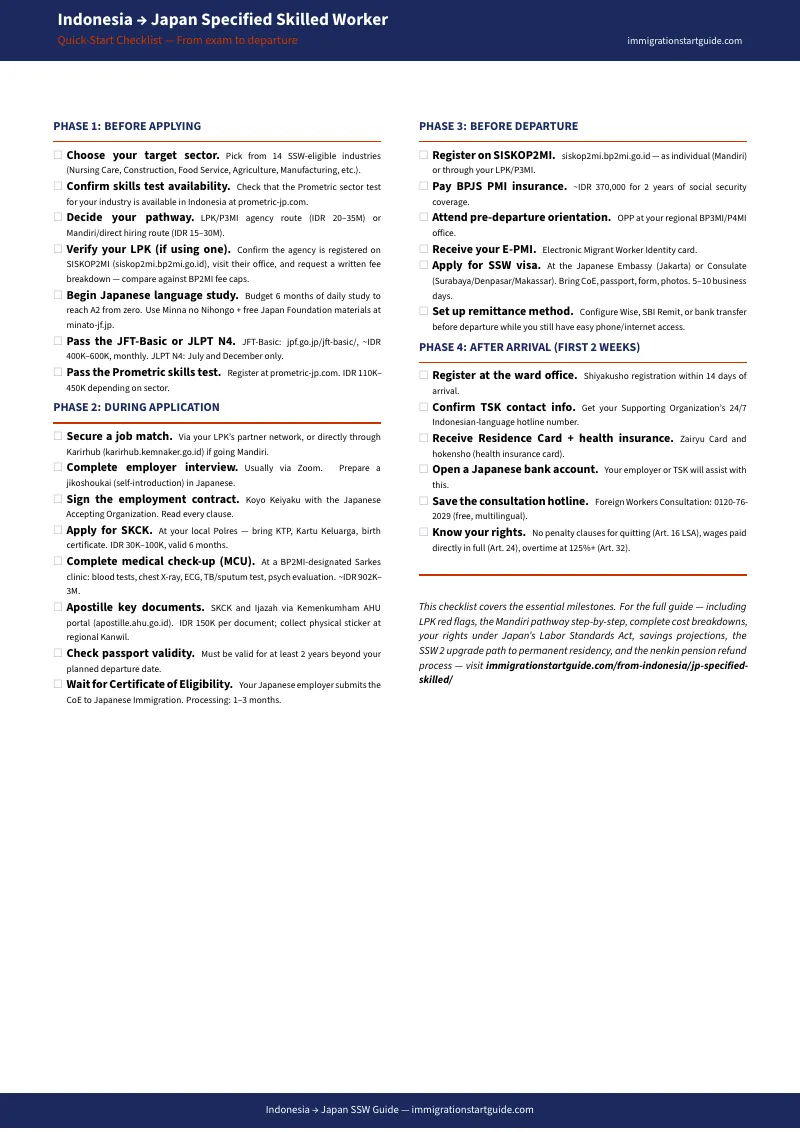
- Quick-Start Checklist (checklist.pdf) — every step from self-assessment and exam registration through LPK evaluation (or Mandiri registration), document preparation, CoE and visa processing, SISKOP2MI and E-PMI, pre-departure orientation, and your first two weeks in Japan — with the specific portal, fee, and timeline for each action item
- LPK Evaluation Checklist (lpk-evaluation-checklist.pdf) — the 5 verification steps and 8 red flags to audit any agency before signing, printed and brought to LPK visits
- Cost Breakdown Reference (cost-breakdown-reference.pdf) — legitimate worker costs, employer-responsibility items under Kepka No. 148/2023, and the red flag zone that identifies exploitative markups
- Document Preparation Checklist (document-preparation-checklist.pdf) — every document with the specific office, portal, fee, and processing time, sequenced against the CoE timeline
- Labor Rights Card (labor-rights-card.pdf) — Articles 16, 24, and 32 in plain language, TSK obligations, complaint channels, and the Foreign Workers Hotline — designed to print and keep in your wallet in Japan
- Financial Planning Worksheet (financial-planning-worksheet.pdf) — salary, deductions, expenses, savings projections, remittance comparison, and the nenkin pension refund claim process with fill-in fields for your personal numbers
- Application Timeline (application-timeline.pdf) — the month-by-month roadmap from language study through visa and departure with milestone checkboxes
- Three-Pathway Comparison (three-pathway-comparison.pdf) — LPK vs Mandiri vs G-to-G side by side with itemized cost breakdowns showing who pays what
- SSW Sector Guide (ssw-sector-guide.pdf) — all 14 sectors, SSW 1 vs SSW 2 comparison, skills test fees and language options, and JFT-Basic vs JLPT strategy
- Government Portals Quick Reference (government-portals-reference.pdf) — every portal URL and phone number you need, plus the Japan vs South Korea vs Taiwan vs Malaysia comparison
The Free Checklist vs. The Full Guide
The free Quick-Start Checklist gives you the critical action items — every step from choosing your sector and registering for exams through document preparation, SISKOP2MI registration, and your first two weeks in Japan. It is enough to see the full scope of the SSW process, identify which phase you are in, and understand what comes next.
The full guide gives you how — the LPK Evaluation Framework that audits your agency before you sign, the Mandiri pathway that eliminates the placement fee entirely, the cost comparison that shows exactly where the markup enters the system, your labor rights in plain language with the specific articles that protect you, the financial planning that turns JPY 180,000 per month into IDR 480-720 million in five-year savings, and the SSW 2 upgrade strategy that transforms a temporary work contract into permanent residency. The checklist shows you the steps. The guide shows you the system.
— Less Than One Day's Salary in Japan
An Indonesian SSW worker in Japan earns JPY 180,000-250,000 per month. The guide costs less than a single day's wages at that rate. The LPK markup it helps you identify or avoid — IDR 30-50 million — is the cost of a used car or a year's rent in many Indonesian cities. The salary deductions it teaches you to recognize and refuse could recover JPY 30,000 or more per month. The nenkin pension refund it explains can return hundreds of thousands of yen when you leave Japan. The guide pays for itself not by saving you a small amount — it pays for itself by preventing the single most expensive mistake Indonesian workers make: accepting a cost structure and a contract that transfers wealth from the worker to the intermediary, when the law says otherwise.
If the information in one chapter — the LPK fee audit that reveals your agency is charging IDR 40 million above the BP2MI cap, the Mandiri pathway that eliminates the placement fee entirely, the Labor Standards Act explanation that gives you the confidence to refuse an illegal penalty clause, the financial plan that adds JPY 30,000 per month back to your savings by stopping improper deductions, or the nenkin refund process that returns years of pension contributions you would have forfeited — changes one financial outcome during your five years in Japan, the guide has delivered a return measured in millions of rupiah.
100% satisfaction guaranteed. If the guide does not meet your expectations, email [email protected] for a full refund.