
You Have a Master's from Sharif, Five Years of Civil Engineering Experience, and 75 Points on the Australian Skills Assessment. But Between You and Australian Permanent Residency Are Four Barriers No Other Nationality Faces Simultaneously: No Australian Embassy in Tehran, SWIFT Banking Sanctions That Make It Impossible to Pay the AUD 4,910 Visa Fee Directly, ASIO Security Vetting Under PIC 4002 That Takes 12-30 Months While Your ImmiAccount Shows Nothing but "Further Assessment," and a 4-Tier SkillSelect System That Routes Most Iranian Engineers to Tier 3 or 4 — Where Invitations Depend Entirely on State Nomination Strategy.
You calculated your points. They are competitive. You are a Sharif or Amirkabir graduate, a software developer or civil engineer, and you have read enough Telegram threads in ایرانیان استرالیا to know that Australian skilled migration — Subclass 189, 190, or 491 — is the pathway. But every step of the Department of Home Affairs process assumes things that are not true for you. It assumes you can visit an Australian embassy for biometrics. The Australian Embassy in Tehran suspended immigration operations. It assumes you can pay the AUD 4,910 visa application charge with a credit card through ImmiAccount. Your bank is cut off from SWIFT. It assumes processing takes 10 to 15 months. For Iranian nationals, it takes 12 to 30 months because every application is routed to ASIO for non-routine security vetting under Public Interest Criterion 4002 — not because of anything you did, but because of your passport.
You need your degree assessed by Engineers Australia or the ACS. But first you need to verify it through the SAJAD portal at the Ministry of Science, Research and Technology. And before SAJAD releases your Daneshnameh and transcripts, you must clear Laghve Ta'ahod — the free education obligation that binds state university graduates to domestic employment or a financial buyout. If you graduated from Islamic Azad University, your degree classification depends on which branch you attended — the Australian government's Country Education Profiles divide Iranian universities into Section 1 (Sharif, Amirkabir, University of Tehran) and Section 2 (certain Azad branches, smaller provincial institutions). Section 1 degrees receive full Bachelor's equivalency. Section 2 degrees may be assessed as equivalent to an Australian Associate Degree or Advanced Diploma, requiring a Competency Demonstration Report to upgrade to professional engineer status. Get this wrong and you lose 5 to 10 points on the skills assessment that you cannot recover without restarting the entire process.
You need a police clearance from NAJA. The Department of Home Affairs says "Iranian National Police." In practice, you must register on the Mikhak portal, upload your Shenasnameh and Kart-e Melli, then physically visit an Iranian consulate for fingerprinting — in Istanbul, Ankara, Dubai, or Canberra. The fingerprints are sent to Interpol in Tehran. The process takes one to five months through consular channels. Generate the certificate at the wrong time and it expires before your application clears the 12-to-30-month ASIO vetting window, forcing a second round through Mikhak.
You need to pay AUD 4,910. But you cannot wire money from an Iranian bank to ImmiAccount. SWIFT is blocked. The practical mechanisms are a relative in Australia paying via BPAY or credit card on your behalf, or a registered Sarafi exchange house in Dubai or Istanbul that accepts IRR and pays AUD in Australia. Use an unregistered exchange and DFAT's Australian Sanctions Office flags the transaction — the red flags include funds arriving from UAE or Turkey routing hubs with opaque descriptions like "consulting" or "family support." The Department of Home Affairs does not reject your visa for using the wrong payment channel. They freeze the transaction and ask questions that delay your file by months while AUSTRAC reviews the source of funds.
You need English test scores. PTE Academic is not available in Iran. IELTS centres remain operational inside Iran through IDP, but many applicants need PTE scores specifically because the PTE's scoring system produces Superior-equivalent results more consistently — 79+ in each band for 20 points versus the IELTS 8.0 per band that fewer Iranian test-takers achieve. The difference between Proficient (10 points) and Superior (20 points) is 10 points on your skills assessment — enough to move you from outside the state nomination window to inside it. To sit the PTE, you must travel to Istanbul, Dubai, or Yerevan. That means a Turkish e-visa, flights, accommodation, and two to three days away from work — on top of the separate trip you will need for biometrics at a VFS Global centre that does not exist inside Iran.
You need to understand the 4-tier SkillSelect invitation system introduced for the 2025-26 Migration Program. Tier 1 occupations (medical specialists, surgeons, nurses) receive invitations at lower points thresholds with the highest weighting. Tier 4 occupations (software engineers, accountants, ICT business analysts) receive very limited Subclass 189 invitations regardless of points. Most Iranian engineers fall into Tier 3 (civil, mechanical) or Tier 4 (software, ICT). An Iranian software engineer with 95 points may wait longer for a 189 invitation than a regional nurse with 65 points. The realistic pathway for Tier 3 and 4 applicants is state nomination — Subclass 190 adds 5 points, Subclass 491 adds 15 points — but each state has its own priority occupation lists, registration of interest processes, and quotas that change each program year.
And throughout all of this, you are not doing it alone. Your parents in Tehran are funding the process. Your brother in Istanbul is booking the VFS appointment. Your spouse is coordinating document translations. Iranian skilled migration is a family operation — and every family member needs to understand the timeline, the sequence, and the dependencies, because a single misstep by anyone in the chain affects the entire application.
You are not short on qualifications. You are short on a systematic method for navigating four simultaneous barriers — suspended embassy, frozen banking, extended security vetting, and tiered invitation system — that no generic Australian skilled migration guide addresses because no other nationality faces all four at the same time.
The Sanctions and Security Protocol
This is not a generic skilled migration explainer. This is the Iran-specific operational protocol for every step where the Australian immigration process collides with Iranian geopolitical reality: the SAJAD portal workflow for verifying your degree through the Ministry of Science — including the Laghve Ta'ahod clearance and the Section 1 versus Section 2 university classification under the Australian government's Country Education Profiles that determines whether your engineering degree is assessed as a Bachelor's or an Advanced Diploma. The Mikhak portal workflow for NAJA police clearance from abroad — with consulate fingerprinting logistics for Istanbul, Ankara, Dubai, and Canberra, and the SANA shortcut for applicants with existing judiciary profiles. The sanctions-compliant payment protocols for the AUD 4,910 visa fee — BPAY proxy payments, registered Sarafi transfers, and the DFAT/AUSTRAC red flags that trigger source-of-funds audits. The PTE Academic testing corridor to Istanbul, Yerevan, and Dubai for applicants who need Superior scores unavailable through domestic IELTS testing. The 4-tier SkillSelect strategy that maps your ANZSCO code to the specific states actively nominating your occupation in the current program year. The ASIO security vetting timeline — 12 to 18 months median for clean applications, up to 30 months for complex cases involving IRGC service or form discrepancies — with FOI request strategy for Alert Reason Codes and the Ministerial Intervention pathway when vetting exceeds the standard of reasonableness. The CDR writing framework for Engineers Australia that satisfies EA's competency standards without triggering the AI plagiarism detection that has produced 12-month bans in the 2026 assessment season. And the Form 1399 documentation strategy for IRGC conscripts that establishes the mandatory-versus-voluntary distinction through evidence of rank, unit, duties, and service duration.
Migration agents in Australia charge AUD 3,000 to 8,000 for application management that covers document preparation but none of the sanctions-specific payment logistics, none of the SAJAD portal navigation, none of the IRGC conscription documentation strategy, and none of the state nomination targeting that determines whether your SkillSelect EOI receives an invitation in six months or twenty-four. The agent walks your documents through the system. The guide builds your entire migration system — designed for the four barriers that only Iranian applicants face.
What Is Inside
SAJAD Portal and Skills Assessment
Your degree verification begins not at Engineers Australia or the ACS but at the Iranian Ministry of Science, Research and Technology. The SAJAD portal controls whether your university releases your Daneshnameh and Riz-e-Nomarat for international use. But first you must clear Laghve Ta'ahod — the free education obligation that binds state university graduates. The guide covers the buyout calculation, the unemployment waiver path, and the timeline for clearance. Then the skills assessment itself: the Section 1 versus Section 2 university classification under the Country Education Profiles and why it determines your entire points outcome.
For engineers — the Competency Demonstration Report pathway, the three Career Episodes that must be original (Engineers Australia's 2026 AI plagiarism detection has produced 12-month bans for applicants who used template CDRs from Telegram groups), the Summary Statement mapping to EA Stage 1 competency standards, and the Nezam Mohandesi registration as supplementary evidence of professional standing. For IT professionals — the ACS "Skill Level Requirement Date" that deducts two years of Iranian work experience from your total history, and the documentation strategy that minimizes the deduction. For VETASSESS-assessed occupations — the MSRT accreditation requirements and the Azad University branch-specific handling that determines whether your degree receives full equivalency.
Mikhak Portal and NAJA Police Clearance from Abroad
The police clearance process for Iranians is a two-system, multi-country operation. The guide walks through the Mikhak portal registration, the identity document uploads (Shenasnameh and Kart-e Melli), the consulate selection and appointment booking for fingerprinting in Istanbul, Ankara, Dubai, or Canberra, and the Interpol verification timeline (one to five months after fingerprinting). The SANA shortcut for applicants with existing judiciary profiles that bypasses the standard consular queue. The "Proof Letter" option from the Iranian Embassy in Canberra (approximately AUD 45) for applicants whose clearance is still processing when their visa file reaches the character assessment stage. The validity window for the certificate and the optimal generation timing relative to the 12-to-30-month ASIO vetting: generate too early and it expires, forcing a second round through Mikhak. Generate too late and your file stalls at the character checkpoint.
Sanctions-Compliant Payment Protocols
The visa fee is AUD 4,910 for a primary applicant, AUD 2,455 for a spouse, AUD 1,160 per child. A typical family of three pays over AUD 8,000 in a single ImmiAccount transaction. Iranian banks are disconnected from SWIFT. The guide covers the three compliant payment channels: BPAY proxy payment through a relative or contact in Australia (lowest risk — uses domestic banking infrastructure and bypasses international routing filters entirely), registered Sarafi exchange houses in Dubai and Istanbul that accept IRR and pay AUD in Australia with AUSTRAC-compliant receipts, and third-country bank accounts for Iranians in transit countries. The DFAT Australian Sanctions Office red flags — funds from UAE and Turkey routing hubs, opaque transfer descriptions, structured payments below risk thresholds, and the "concealment of Iranian nexus via alternate spellings" indicator. The documentation checklist: source-of-funds declaration, Sarafi receipts identifying the applicant and visa reference number, and translated property deeds for asset-based proof of settlement capacity.
English Testing and the PTE Corridor
PTE Academic is not available in Iran. IELTS centres remain operational inside Iran through IDP, but the PTE's scoring system produces Superior-equivalent results (79+ per band for 20 points) more consistently for Iranian test-takers than the IELTS 8.0-per-band threshold. The guide maps the regional testing corridor: Istanbul and Ankara (Turkish e-visa, approximately USD 50, processed in minutes), Yerevan (visa-free for Iranians, 90-day stay), and Dubai (visitor visa required, higher cost). Test centre availability, registration timelines, and the strategic calculation: the 10-point difference between Proficient and Superior can move you from outside a state nomination window to inside it, but is the travel cost justified if your points already clear the threshold for your target state? The guide runs the math against your specific points breakdown and state nomination target.
4-Tier SkillSelect and State Nomination Strategy
The 2025-26 SkillSelect restructuring created four invitation tiers. Tier 1 (medical specialists, nurses) receives the highest weighting and fastest processing. Tier 4 (software engineers, accountants) receives very limited Subclass 189 invitations. Most Iranian professionals fall into Tier 3 (civil engineers, mechanical engineers) or Tier 4 (software engineers, ICT developers). The guide maps each ANZSCO code to its tier and then to the specific state nomination pathways that bypass the 189 bottleneck: NSW (190 and 491 streams with occupation-specific quotas), Victoria (190 target sector nominations for engineering and ICT), South Australia (491 regional pathway with lower points thresholds and active recruitment of infrastructure-sector occupations), Western Australia (Graduate Occupation List and general stream for mining-adjacent engineering), and Tasmania (491 pathway with the lowest points threshold but limited metropolitan employment). Each state's Registration of Interest process, processing timeline, and the realistic invitation window for Iranian applicants at 65-85 points — so you target the state that produces an invitation, not the city you would prefer to live in.
ASIO Security Vetting and the Amber MAL
Iranian applications are routed to non-routine ASIO security vetting as a procedural default under Public Interest Criterion 4002. The median vetting duration for clean applications is 12 to 18 months. Complex cases — applicants with IRGC service, form discrepancies, or Five Eyes coordination flags — can extend to 30 months. The guide covers the "Amber MAL" (Movement Alert List) status that indicates ongoing multi-jurisdictional intelligence assessment, the FOI request process for obtaining your Alert Reason Codes (which provides more transparency than Canada's heavily redacted GCMS notes), and the document renewal schedule when the 12-month medical exam validity expires during the vetting period.
The Ministerial Intervention pathway — when to request it, how to structure the submission, and the realistic success rate. The "lethal form discrepancies" that extend vetting indefinitely: mismatched residency dates between your Form 80 and your Shenasnameh, undisclosed previous surnames or aliases, and inconsistencies between your military service card dates and your Form 1399 declaration. One discrepancy in dates triggers a manual verification that requires coordination with Iranian authorities through indirect channels — adding months that a single proofread could have prevented.
IRGC Conscription and Form 1399
For Iranian males who completed mandatory military service in the Islamic Revolutionary Guard Corps, the character assessment is the highest-stakes section of the entire application. The IRGC is listed as a terrorist organization in several Western jurisdictions, and Australia has faced domestic pressure to do the same. IRGC service triggers an automatic Amber MAL alert, extending vetting to the upper range of 18-30 months. The guide covers the mandatory-versus-voluntary distinction that determines whether IRGC service produces a delay or a refusal.
The Form 1399 documentation strategy: how to describe your rank, unit, daily duties, and commanding officer in terms that establish fixed-term conscription status — emphasizing technical or administrative roles rather than security or ideological roles. The Smart Card requirement (Kart-e-Payan-e-Khedmat — must be the post-2016 version; older paper-based cards are not accepted). The exemption documentation for applicants exempted on medical grounds (Moafiate Pezeshki) or family circumstances (Kafalat). Evidence from submissions to the Australian Parliament establishes that conscripts are "compelled into service" and "not entrusted with sensitive ideological responsibilities" — the guide shows you how to position your documentation within this framework.
Document Legalization Without Apostille
Iran is not a signatory to the Hague Apostille Convention. Every official document — birth certificate, marriage certificate, Shenasnameh, degree — must follow a four-step legalization chain: original issuance, official translation by a Dadgostari-certified translator, Judiciary stamp, and Ministry of Foreign Affairs stamp. The guide covers the full chain for each document type, the NAATI translation requirement for onshore applicants versus the Dadgostari acceptance for offshore applicants, and the strategic recommendation to use NAATI-certified translations even for offshore applications to avoid Section 56 requests for additional information. The Kart-e Melli currency requirement — expired national cards require proof of Smart Card application. The Shenasnameh translation protocol — all pages must be translated, including blank ones, because missing pages trigger a completeness query that delays your file.
Biometrics and Medical Exam Travel Planning
No VFS Global biometrics centre exists in Iran. The guide compares the three primary destinations: Istanbul (Turkish e-visa, estimated trip cost USD 600-800, multiple VFS centres, medical exam approximately USD 150-250), Yerevan (visa-free for Iranians, USD 400-600, efficient processing), and Dubai (visitor visa required, USD 1,200-2,000, highest cost but highest appointment availability). The immigration medical exam — which can be completed inside Iran at Bupa-approved panel physicians in Tehran, Isfahan, Mashhad, and Shiraz — with the critical caveat that the medical is valid for only 12 months, and most Iranian applications take longer than 12 months to process, meaning a repeat medical is almost guaranteed. The guide covers optimal medical timing to minimize repeats, the VFS slot-booking strategy for Istanbul appointments, and the trip combination plan that sequences biometrics, PTE testing, and the medical exam across the fewest international journeys.
24-Month Execution Timeline
The complete migration timeline from first points calculation to Australian PR — calibrated for the 24-month security vetting reality, not the 10-to-15-month official service standard. Months 1-2: points audit, SAJAD portal degree verification, Laghve Ta'ahod clearance initiation, English test registration. Months 2-5: skills assessment submission (CDR for engineers, ACS for IT), English test completion (in Iran for IELTS or abroad for PTE), Laghve Ta'ahod clearance and SAJAD release. Months 5-7: skills assessment result, Expression of Interest lodgement, state nomination Registration of Interest submission. Months 7-12: invitation receipt (via state nomination), full application lodgement, biometrics trip, medical exam, Mikhak police clearance initiation. Months 12-24+: ASIO security vetting period — document renewal planning (police certificate and medical), FOI requests for Alert Reason Codes, Ministerial Intervention assessment. With the parallel task structure that runs SAJAD, skills assessment, English testing, and funds preparation simultaneously instead of sequentially — because sequential execution turns a 24-month process into a 36-month one.
Why Australia Instead of Canada?
The question every Iranian professional asks in every Telegram group: should I go to Australia or Canada? The data for 2026 answers it. Canadian CSIS security screening for Iranian STEM professionals now takes 24 to 65 months — over five years in complex cases. NSIRA complaints have triggered parliamentary inquiries into whether Iranians and Chinese applicants are being singled out for discriminatory delays. Your Express Entry application enters a black box where GCMS notes are heavily redacted and legal recourse is limited to high-risk Mandamus applications.
Australian ASIO vetting under PIC 4002 takes 12 to 18 months median, up to 30 months for the most complex cases. It is not fast. But it is half the Canadian timeline. FOI requests for Alert Reason Codes provide more transparency than GCMS notes. And the 2025-26 Migration Program allocates 185,000 permanent places with approximately 70 percent in the skilled stream — the demand for engineers, healthcare workers, and ICT professionals is structural, not cyclical. Australia is not easier. It is faster. For an Iranian engineer who has already decided to leave, faster is what matters.
Who This Is For
- Iranian STEM professionals — civil engineers, software developers, mechanical engineers, ICT specialists, biotech researchers — in Tehran, Isfahan, or Shiraz who have a points-competitive profile and need the Iran-specific protocol for sanctions, security vetting, and third-country logistics
- Graduates of Sharif University, Amirkabir University, University of Tehran, and other Section 1 state universities who need to navigate the SAJAD portal, Laghve Ta'ahod clearance, and Engineers Australia CDR pathway with original Career Episodes that pass the 2026 AI plagiarism detection
- Graduates of Islamic Azad University who need to understand which branches receive Section 1 equivalency under the Country Education Profiles, which are classified as Section 2, and what documentation prevents a degree downgrade from Bachelor's to Advanced Diploma
- Iranian professionals already in Turkey, the UAE, Armenia, or Malaysia as a stepping stone — who need to coordinate Mikhak police clearance, biometrics, English testing, and sanctions-compliant payments from a third country while managing the SAJAD portal remotely
- Iranian applicants with 65-85 points who need to identify which state nomination pathway (NSW, Victoria, South Australia, Western Australia, Tasmania) produces an invitation for their specific ANZSCO code and points range — because the 4-tier SkillSelect system has made Subclass 189 unrealistic for most Tier 3 and 4 occupations
- Male applicants under 45 whose military service branch (Artesh, Sepah, NAJA) directly affects their security vetting duration and who need the Form 1399 documentation strategy that establishes mandatory conscription versus voluntary membership
- Anyone whose application has been in "Further Assessment" for 6+ months and needs to understand whether their file is in routine or non-routine ASIO processing, when to file an FOI request for Alert Reason Codes, and when Ministerial Intervention becomes the appropriate escalation
Why Not Telegram Groups, Free Calculators, or the Home Affairs Website?
Telegram supergroups — the ایرانیان استرالیا and مهاجرت استرالیا channels with tens of thousands of members — are where someone tells you their skills assessment took "three months" without mentioning they graduated from a Section 1 university with streamlined processing, not the Section 2 institution that requires a full CDR to upgrade to professional status. Where another person says they paid the visa fee through a Sarafi in Dubai without specifying whether it was an AUSTRAC-registered operation or an unregistered exchange whose transfers are now flagged by the Australian Sanctions Office. Where a third person says their ASIO vetting took "ten months" without disclosing they served in Artesh, not Sepah, and the branch of service is the single largest variable in vetting duration. The advice is real but uncontextualized, undated, and filtered through survivorship bias — the people posting are the ones who received their visa, not the ones whose Sarafi transfers triggered AUSTRAC audits or whose Form 1399 discrepancies extended their Amber MAL by a year.
Free points calculators tell you your score. They do not tell you that your 75 points place you in Tier 3 for Subclass 189 where invitations are occupation-dependent and unpredictable, but that South Australia's 491 pathway adds 15 points and actively recruits civil engineers at 65+ — giving you a faster route to permanent residency through the regional pathway than waiting for a 189 invitation that may never come. A calculator gives you a number. The guide gives you a plan to change your trajectory — calibrated for the specific tier placement and state nomination landscape that determines whether Iranian engineers receive invitations or wait indefinitely.
The Home Affairs website explains what Subclass 189, 190, and 491 visas are. It does not explain how to clear Laghve Ta'ahod through the SAJAD portal, how to use the Mikhak portal for NAJA police clearance from abroad, how to pay AUD 4,910 without triggering an AUSTRAC sanctions audit, where to sit the PTE Academic now that it is not available in Iran, how to write Career Episodes that pass Engineers Australia's AI plagiarism detection, how to document IRGC conscription in Form 1399, which state nomination pathway matches your ANZSCO code in the current program year, or how to plan a 24-month timeline around an ASIO vetting process that the official service standard describes as 10 to 15 months. Official portals describe the rules. They do not describe the Iranian starting point.
Your Options
- DIY from free resources — Telegram groups, Reddit, Home Affairs website. Cost: zero. Risk: degree downgraded from Bachelor's to Advanced Diploma because of a Section 2 classification you did not know existed, CDR rejected for AI plagiarism because you used a template from a Telegram group, police certificate expired during ASIO vetting because you generated it 18 months too early, Sarafi transfer flagged by AUSTRAC because you used an unregistered exchange, Form 1399 discrepancy that extended your Amber MAL by 12 months because your service dates did not match your military card, state nomination targeting the wrong jurisdiction because you did not know your ANZSCO code was Tier 4 for 189 but actively recruited under South Australia's 491. One degree downgrade means restarting the skills assessment and losing months. One AUSTRAC flag means a source-of-funds audit that freezes your file. One Form 1399 discrepancy means the longest possible ASIO timeline.
- This guide — the complete Iran-specific Sanctions and Security Protocol. Cost: . Covers SAJAD portal and skills assessment, Mikhak police clearance, sanctions-compliant payment, PTE regional testing, 4-tier SkillSelect and state nomination strategy, ASIO vetting timeline management, CDR writing framework, Form 1399 documentation, document legalization, biometrics logistics, and the 24-month execution timeline.
- Migration agent in Australia — registered agents. Cost: AUD 3,000-8,000. Covers application lodgement and document preparation but not the SAJAD portal navigation, not the sanctions-specific payment logistics, not the IRGC conscription documentation strategy, not the state nomination targeting math, and not the ASIO vetting timeline planning that determines whether you budget for 12 months or 30.
- Immigration lawyer — for Ministerial Intervention or Administrative Appeals Tribunal review. Cost: AUD 5,000-15,000. Only relevant after your application has been in ASIO vetting for 18+ months or after a refusal. The guide helps you manage the first 18 months so you know exactly when and whether legal intervention becomes necessary — and gives you the documentation foundation that makes legal action effective if it does.
What You Get
The guide includes everything designed for the Iranian skilled migration pathway — 7 printable PDFs:
- Complete Guide (guide.pdf) — 12 chapters covering the SAJAD portal and Laghve Ta'ahod clearance, Section 1 versus Section 2 university classification under the Country Education Profiles, Engineers Australia CDR pathway with original Career Episode framework, ACS assessment and experience deduction strategy, Mikhak police clearance from abroad with SANA shortcut, sanctions-compliant payment protocols with DFAT/AUSTRAC compliance checklist, PTE Academic regional testing corridor, 4-tier SkillSelect strategy with state nomination mapping for the 2025-26 program year, ASIO security vetting timeline with FOI and Ministerial Intervention pathways, IRGC conscription and Form 1399 documentation, document legalization chain without Apostille, biometrics and medical travel planning, and the 24-month execution timeline
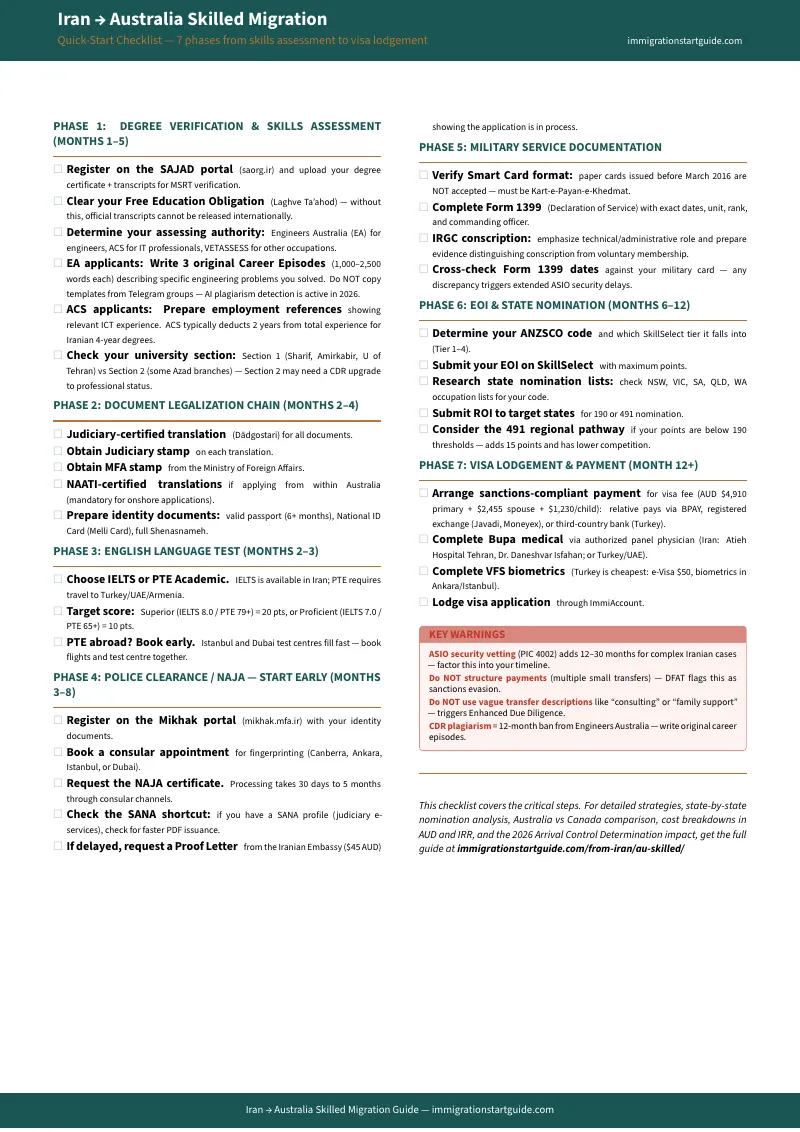
- Quick-Start Checklist (checklist.pdf) — every step from points calculation to PR grant, with the exact sequence, government fees, processing times, and the parallel task structure that runs SAJAD, skills assessment, English testing, funds transfer, and Mikhak simultaneously
- Points Worksheet (points-worksheet.pdf) — fillable points calculator with every scoring factor, Iranian-specific notes (NAATI Farsi advantage, Section 1 vs 2 impact), and a total score section to compare your profile against competitive thresholds for 189, 190, and 491
- Document Preparation Worksheet (document-worksheet.pdf) — comprehensive document tracker covering all 10 categories (identity, academic, skills assessment, military, employment, English, health, financial, visa application, family) with status columns for originals, translations, and certifications
- Sanctions-Compliant Payment Card (funds-card.pdf) — reference card with the three payment methods (BPAY proxy, registered Sarafi, third-country bank), fee schedule, DFAT red flags to avoid, and source-of-funds documentation checklist
- ASIO Security Vetting Card (security-card.pdf) — Form 1399 field guide, IRGC conscription evidence strategy, PIC 4002 / Amber MAL process flow, realistic vetting timelines by profile type, and the pre-submission consistency checklist
- Biometrics and Testing Trip Planner (trip-planner.pdf) — Turkey vs UAE comparison, panel doctor contacts in Iran, IELTS vs PTE analysis with ROI calculation, trip combination strategy, and a fillable trip planning table
The Free Checklist vs. The Full Guide
The free Quick-Start Checklist gives you the critical action items — every step from points calculation through SAJAD portal initiation, skills assessment submission, English test booking, Mikhak police clearance, sanctions-compliant payment, Expression of Interest lodgement, and ASIO vetting monitoring. It is enough to see the full scope of what stands between you and Australian PR, and to identify the long-lead-time items (Laghve Ta'ahod clearance, skills assessment, English preparation, funds preparation) that need to start moving immediately.
The full guide gives you how — the SAJAD portal walkthrough that prevents a degree downgrade. The CDR writing framework that passes Engineers Australia's AI detection. The Mikhak workflow with the SANA shortcut. The payment protocol that clears AUSTRAC without triggering a sanctions audit. The 4-tier SkillSelect analysis that identifies your optimal state nomination target. The Form 1399 strategy that manages the IRGC conscription assessment. The ASIO timeline plan with FOI and Ministerial Intervention triggers. The trip planner that combines biometrics, PTE testing, and medical exams into fewer international journeys. The complete Sanctions and Security Protocol from points calculation to permanent residency.
— Less Than One Percent of Your Total Migration Budget
The visa fee alone is AUD 4,910. Add a spouse and you are above AUD 7,000. Add skills assessment fees (AUD 500-1,000), English test fees (AUD 300-400), medical exams (AUD 300-500), document translations and legalization (AUD 400-800), biometrics travel (USD 600-2,000 depending on destination), and police clearance processing — your total migration budget exceeds AUD 8,000 before you reach the state nomination fee or the second medical exam that ASIO vetting makes almost inevitable. A migration agent charges AUD 3,000 to 8,000 on top of all of this — for document preparation that does not include the sanctions workarounds, the SAJAD portal navigation, the IRGC documentation strategy, or the state nomination targeting. At AUD 3,000 minimum, the agent bills roughly AUD 150 per hour for 20 hours of work. The guide costs less than a single hour of that time.
If the information in one chapter — the SAJAD walkthrough that prevents a degree downgrade and a months-long skills assessment restart, the Section 1 versus Section 2 classification that prevents a 5-point loss on the points test, the CDR framework that prevents a 12-month AI plagiarism ban from Engineers Australia, the payment protocol that prevents an AUSTRAC source-of-funds audit, the Form 1399 strategy that prevents a form discrepancy from extending your Amber MAL by a year, or the state nomination targeting that reveals South Australia's 491 pathway accepts your ANZSCO code at 65 points while you were waiting for a 189 invitation at 85 — saves you a single rejected assessment, a single unnecessary trip, or a single month of avoidable delay, the guide has paid for itself before you finish the first chapter.
100% satisfaction guaranteed. If the guide does not meet your expectations, email [email protected] for a full refund.