
You Have a Master's from Sharif, Three Years of Software Engineering Experience, and a CRS Score of 472. But Between You and Canadian Permanent Residency Are Three Barriers No Other Nationality Faces Simultaneously: No Canadian Embassy in Iran Since 2012, SWIFT Banking Sanctions That Make It Impossible to Pay IRCC Fees Directly, and a Mandatory CSIS Security Screening That Takes 12-24 Months While Your IRCC Portal Shows Nothing but "In Progress."
You calculated your CRS score. It is competitive. You are a Sharif or Tehran University graduate, a software engineer or data scientist, and you have read enough Reddit threads and Telegram supergroup messages to know that Canadian Express Entry is the pathway. But every step of the official IRCC process assumes things that are not true for you. It assumes you can visit a Canadian embassy for biometrics. There is no Canadian embassy in Iran — it closed in 2012. It assumes you can pay the CAD 1,525 application fee with a credit card. Your bank is cut off from SWIFT. It assumes processing takes six months. For Iranian nationals, it takes 18-24 months because every application is flagged for non-routine CSIS security screening — not because of anything you did, but because of your passport.
You need your degree evaluated by WES. But first you need to clear Laghv-e Ta'ahod — the free education commitment that blocks your transcripts until the Ministry of Science releases them through the Sajjad portal. If you graduated from Islamic Azad University, your Master's may be downgraded to a Graduate Diploma depending on which branch you attended — costing you 15 CRS points that you will never get back if you submit the wrong supporting documents. The Sajjad portal interface is entirely in Persian, requires a domestic mobile number, and if you are already outside Iran, you need a relative with a Vekalatnameh (power of attorney) to navigate the Ministry in person.
You need a police clearance certificate. IRCC says "Iranian National Police." In practice, you must use the Mikhak portal to register with the Ministry of Foreign Affairs, then physically visit an Iranian consulate for fingerprinting — in Istanbul, Dubai, or Yerevan, because there is no Iranian consulate in Canada either. If you are already in Canada, you must send a physical fingerprint card to the Iranian Interests Section in Washington, D.C., or empower a relative in Iran through a second Mikhak application. The certificate takes two to four weeks and costs approximately 25 Euros. Generate it at the wrong time and it expires before your application is assessed — 18 months later.
You need proof of funds — CAD 14,690 for a single applicant. But you cannot wire money from an Iranian bank to a Canadian bank. SWIFT is blocked. The legal mechanism is the SEMA $40,000 CAD exemption for non-commercial remittances, which allows transfers through licensed Sarafi exchange houses in Dubai or Istanbul. Use an unlicensed grey-market service and your application can be flagged for misrepresentation — a five-year ban. You need to know which Sarafi operations are FINTRAC-compliant and which are not, and you need a paper trail that Canadian banks will accept under their enhanced due diligence requirements for Iran-linked transactions.
You need IELTS scores. But IDP suspended all IELTS testing in Iran in January 2026 because banking sanctions prevented the transfer of test fees. You must now travel to Istanbul, Yerevan, Baku, or Dubai just to sit the exam. That means a Turkish e-visa, flights, accommodation, and two to three days away from work — on top of the separate trip you will need for biometrics at a VAC that also does not exist inside Iran.
And then you wait. You wait 12 to 24 months in the "Background Verification" stage while CSIS processes your security screening. IRCC sends no updates. Your GCMS notes show "APC" status and "referred to partner agency." Your medical exam expires after 12 months, so you pay for a re-med. Your police certificate expires, so you regenerate it through Mikhak. Your proof of funds must remain above the threshold for the entire waiting period. You are not being rejected. You are being vetted — at a pace that the official IRCC service standard does not acknowledge. Over 538,000 security screening requests were processed by CSIS in 2024 alone, and Iranian nationals are disproportionately represented in the non-routine queue.
You are not short on qualifications. You are short on a systematic method for navigating three simultaneous barriers — closed embassy, frozen banking, extended security vetting — that no generic Express Entry guide addresses because no other nationality faces all three at the same time.
The Sanctions and Security Protocol
This is not a generic Express Entry explainer. This is the Iran-specific operational protocol for every step where the Canadian immigration process collides with Iranian geopolitical reality: the Sajjad portal workflow for getting your degree released through the Ministry of Science and verified by WES — including the Laghv-e Ta'ahod clearance process and the Azad University branch-specific documentation that prevents a Master's-to-Diploma downgrade. The Mikhak portal workflow for police clearance from outside Iran — with the consulate fingerprinting logistics for Istanbul, Yerevan, and Dubai, and the Washington D.C. alternative for applicants already in Canada. The SEMA $40,000 CAD exemption for sanctions-compliant fund transfers through licensed Sarafi in third countries — with the FINTRAC paper trail requirements that prevent your deposit from triggering a misrepresentation finding. The IELTS alternatives after the January 2026 Iran suspension — test center logistics in Istanbul, Yerevan, Baku, and Dubai with visa requirements, costs, and the PTE Academic option. The biometrics trip planning for VAC appointments in Turkey, Armenia, or the UAE. The realistic 12-24 month security screening timeline with GCMS note interpretation, ATIP request strategy, and the Mandamus escalation pathway when the delay exceeds the standard of reasonableness. And the CRS optimization strategy built around the specific profile of Iranian STEM professionals — where category-based STEM draws at CRS 481 and Provincial Nominee Programs that add 600 points are the realistic pathways, not the general draw threshold above 520.
RCIC consultants in Canada charge CAD 2,000 to 5,000 for application management that covers document preparation but none of the sanctions-specific fund transfer logistics, none of the Sajjad portal navigation, and none of the security screening timeline management that determines whether you plan for six months or twenty-four. Mandamus lawyers charge CAD 5,000 to 10,000 — but only after you have already waited 18 months. The protocol in this guide replaces the consultant's navigational knowledge with a step-by-step system you execute yourself.
What Is Inside
Sajjad Portal and WES Credential Evaluation
Your degree verification begins not at WES but at the Iranian Ministry of Science. The Sajjad portal (portal.saorg.ir) controls whether your university releases your Daneshnameh (degree) and Riz-e-Nomarat (transcripts) for international use. But first you must clear Laghv-e Ta'ahod — the free education commitment that binds state university graduates to domestic employment. The guide covers the buyout calculation, the unemployment waiver path, and the timeline for clearance. Then the WES submission: which documents WES requires for Iranian degrees, the sealed-envelope direct-mail process from your university to WES, the specific handling for Azad University branches (Science and Research Branch receives full equivalency; regional and online branches risk downgrade to Graduate Diploma), the thesis and capstone documentation that prevents the downgrade, and the workaround for applicants outside Iran who must delegate the entire Ministry interaction through a Vekalatnameh. One WES rejection from incorrect transcript submission means restarting the process and losing six to eight weeks.
Mikhak Portal and Police Clearance from Abroad
The police clearance process for Iranians is a two-system, two-country operation. The guide walks through the Mikhak portal registration (mikhak.mfa.gov.ir), the identity document uploads (Shenasnameh and Kart-e Melli), the consulate selection and appointment booking for fingerprinting, and the processing timeline (two to four weeks after fingerprinting). For applicants already in Canada — where no Iranian consulate exists — the alternative path through the Washington D.C. Interests Section or through a relative in Iran holding a Vekalatnameh. The validity window for the certificate and the optimal generation timing relative to the 12-24 month security screening: generate too early and it expires before IRCC assesses your file, forcing a second round through Mikhak.
SEMA Exemption and Sanctions-Compliant Fund Transfers
IRCC requires liquid, transferable proof of funds — CAD 14,690 for a single applicant, scaling with family size. Iranian banks are disconnected from SWIFT. The guide covers the SEMA $40,000 CAD non-commercial remittance exemption, the licensed Sarafi exchange houses in Dubai and Istanbul that can execute compliant transfers, the FINTRAC enhanced due diligence requirements that Canadian banks apply to Iran-linked deposits, the paper trail documentation (receipts, exchange certificates, source-of-funds declarations), and the risks of grey-market payment agencies that use compromised cards or cryptocurrency conversions that trigger fraud alerts at IRCC. The bank letter format IRCC requires — six-month average balance, disclosure of debts, institutional letterhead — and the workarounds when Iranian banks issue "positive only" certificates that omit liabilities.
IELTS and Language Testing After the Iran Suspension
IDP suspended IELTS in Iran in January 2026 due to sanctions-related payment transfer failures. The guide maps the regional test hub logistics: Istanbul and Ankara (Turkish e-visa, USD 50, processed in minutes), Yerevan (visa-free for Iranians, 90-day stay), Baku (e-visa required), and Dubai (visitor visa required, higher cost). Test center availability, registration timelines, and the PTE Academic alternative — available in Dubai and Istanbul with 48-hour result turnaround versus 13 days for IELTS paper-based. The CLB 9 target strategy for Iranian STEM professionals and the CRS impact of each half-band improvement through the Skill Transferability crossover.
Security Screening Timeline and Mandamus Escalation
Iranian applications are routed to non-routine CSIS security screening as a procedural default. The guide covers the realistic 12-24 month timeline, the GCMS notes interpretation (what "APC" status means, what "referred to partner agency" signals), the ATIP request process for tracking your file's position, and the medical exam re-med that becomes necessary when the 12-month IME validity expires during the screening period. The Mandamus escalation pathway: when to file an Access to Information request, when to send a lawyer's Demand Letter (which often resolves files within 30-90 days before a court hearing), and when to file a Writ of Mandamus in Federal Court. The guide does not replace a Mandamus lawyer (CAD 5,000-10,000) — it helps you manage the first 18 months so you know exactly when and whether Mandamus becomes necessary.
Third-Country Biometrics and Medical Exam Logistics
No Canadian VAC or embassy exists in Iran. The guide compares the three primary biometrics destinations: Istanbul (Turkish e-visa, estimated trip cost USD 600-800, multiple VFS Global locations), Yerevan (visa-free, USD 400-600, efficient VAC), and Dubai (visitor visa required, USD 1,200-2,000, highest cost but highest efficiency). The immigration medical exam — which can be completed inside Iran at IRCC-authorized panel physicians in Tehran, Shiraz, Isfahan, and Mashhad — with the critical caveat that the IME is valid for only 12 months, and most Iranian applications take longer than 12 months to process, meaning a re-med is almost guaranteed. The guide covers IME timing to minimize the probability of needing more than one repeat.
CRS Optimization for Iranian STEM Profiles
Iranian professionals from Sharif, Tehran University, and Amirkabir consistently enter the Express Entry pool with CRS scores of 440-480. The general draw threshold is above 520. The guide covers the three realistic pathways: category-based STEM draws (issued at CRS 481 in recent rounds, covering software engineers, data scientists, and civil engineers), Provincial Nominee Programs that add 600 CRS points (OINP Human Capital Priorities Tech Draw selects candidates at 460-475 without a job offer), and the CLB 9 Skill Transferability threshold that adds 50-60 points through the education-language crossover — the single highest-leverage improvement for applicants with Master's degrees. The guide maps each pathway to your specific CRS score, age bracket, and work experience to determine which combination produces an ITA in the fewest months.
Iranian Document Handling: Shenasnameh, Military Service, and SSO Records
The Shenasnameh (identity booklet) requires full translation of all pages — including blank ones. The Kart-e Melli (national card) must be current; expired cards require proof of Smart Card application. For male applicants: the military service card (Kart-e Payan-e Khedmat) must be the post-2011 Smart version, and the branch of service matters for security screening — IRGC (Sepah) service triggers the longest delays and requires a supplementary Military Table detailing rank, duties, and locations. The SSO (Social Security Organization) record serves as an employment verification proxy when Iranian employers cannot or will not provide IRCC-compliant reference letters. The guide covers how to combine the SSO record with translated employment contracts and payslips to build an employment evidence package that satisfies IRCC without a standard employer reference letter.
18-Month Execution Timeline
The complete migration timeline from first CRS calculation to Canadian PR — calibrated for the 18-month security screening reality, not the six-month official service standard. Month 1: CRS score audit, WES application via Sajjad portal, IELTS registration at nearest regional test center. Months 1-4: Laghv-e Ta'ahod clearance, IELTS preparation and test (in Istanbul, Yerevan, or Dubai), proof of funds accumulation and Sarafi transfer. Months 4-6: WES result, Mikhak police clearance initiation, Express Entry profile creation, biometrics trip to VAC. Months 6-8: ITA receipt (via category-based draw or PNP), full application submission, IME at panel physician in Iran. Months 8-18+: Security screening period — GCMS monitoring, document renewal planning (police certificate and IME), ATIP requests, Mandamus assessment at the 18-month mark. With the parallel task structure that runs Sajjad, WES, IELTS, funds transfer, and Mikhak simultaneously instead of sequentially.
Who This Is For
- Iranian STEM professionals — software engineers, data scientists, civil engineers, mechanical engineers, biotech researchers — in Tehran, Isfahan, or Shiraz who have a CRS-competitive profile and need the Iran-specific protocol for sanctions, security screening, and third-country logistics
- Graduates of Sharif University, University of Tehran, Amirkabir, Iran University of Science and Technology, and other state universities who need to navigate the Sajjad portal, Laghv-e Ta'ahod clearance, and WES transcript delivery from inside or outside Iran
- Graduates of Islamic Azad University who need to understand which branches receive full WES equivalency, which risk a Master's-to-Diploma downgrade, and what thesis documentation prevents it
- Iranian professionals already in Turkey, the UAE, Armenia, or Europe as a stepping stone — who need to coordinate Mikhak police clearance, biometrics, and IELTS from a third country while managing the Sajjad portal remotely
- Iranian applicants with CRS scores of 440-510 who need to close the gap to an ITA through STEM category-based draws, Provincial Nominee Programs, or the CLB 9 Skill Transferability threshold — and need to know which lever produces the most points for their specific profile
- Male applicants under 41 whose military service branch (Artesh, Sepah, NAJA) directly affects their security screening timeline and who need the Military Table documentation strategy for IRGC service
- Anyone whose Express Entry application has been in "Background Verification" for 6+ months and needs to understand whether their file is in routine or non-routine processing, when to file an ATIP request, and when Mandamus becomes the appropriate escalation
Why Not Telegram Groups, Free Calculators, or the IRCC Website?
Telegram supergroups — the "WES for Iranians" and "Express Entry Iran" channels with tens of thousands of members — are where someone tells you their WES evaluation took "four weeks" without mentioning they graduated from a university that supports electronic delivery, not the sealed-envelope process your university requires. Where another person says they transferred funds through a Sarafi in Dubai without specifying whether it was a FINTRAC-compliant licensed operation or a grey-market agency that has since been flagged. Where a third person says their security screening took "eight months" without disclosing they served in Artesh, not Sepah, and the branch of service is the single largest variable in screening duration. The advice is real but uncontextualized, undated, and filtered through survivorship bias — the people posting are the ones who succeeded, not the ones whose WES applications were rejected or whose fund transfers triggered misrepresentation findings.
Free CRS calculators tell you your score. They do not tell you that your 472 is 41 points below the general draw threshold but 9 points below the category-based STEM draw, and that a half-band IELTS improvement in one module could activate Skill Transferability and add 50-60 points, making Provincial Nominee targeting unnecessary. A calculator gives you a number. The guide gives you a plan to change it — calibrated for the specific point distribution of Iranian STEM professionals.
The IRCC website explains what Express Entry is. It does not explain how to clear Laghv-e Ta'ahod through the Sajjad portal, how to use the Mikhak portal for police clearance from abroad, how to transfer funds under the SEMA $40,000 exemption without triggering FINTRAC scrutiny, where to take the IELTS now that testing in Iran is suspended, or how to plan an 18-month timeline around a security screening process that the official service standard describes as six months. Official portals describe the rules. They do not describe the Iranian starting point.
Your Options
- DIY from free resources — Telegram groups, Reddit, IRCC website. Cost: zero. Risk: WES rejection from incorrect Sajjad portal handling, Azad University Master's downgraded to Diploma, police certificate expired during security screening, fund transfer through non-compliant Sarafi triggering misrepresentation, IELTS score plateau without CLB 9 strategy, medical exam expiring during the screening wait. One rejected WES application means restarting and losing eight weeks. One misrepresentation finding means a five-year ban.
- This guide — the complete Iran-specific Sanctions and Security Protocol. Cost: . Covers Sajjad portal and WES walkthrough, Mikhak police clearance, SEMA fund transfer, IELTS regional testing, security screening timeline management, CRS optimization, biometrics logistics, document handling, and the 18-month execution timeline.
- RCIC immigration consultant — Canadian licensed consultants. Cost: CAD 2,000-5,000. Covers application management but not the Sajjad portal navigation, not the sanctions-specific fund transfer logistics, not the security screening timeline planning, and not the CRS optimization math.
- Mandamus lawyer — Federal Court application to compel IRCC decision. Cost: CAD 5,000-10,000. Only useful after 18+ months of delay. The guide helps you manage the first 18 months so you know exactly when and whether Mandamus becomes necessary.
What You Get
The guide includes everything designed for the Iranian Express Entry pathway — 8 printable PDFs:
- Complete Guide (guide.pdf) — 11 chapters covering the Sajjad portal and Laghv-e Ta'ahod clearance, WES credential evaluation with Azad University branch-specific handling, Mikhak police clearance from abroad, SEMA $40,000 exemption and sanctions-compliant fund transfers, IELTS regional testing after the Iran suspension, security screening timeline with GCMS interpretation and Mandamus escalation, CRS optimization for Iranian STEM profiles, third-country biometrics logistics, Iranian document handling (Shenasnameh, military service, SSO records), and the 18-month execution timeline
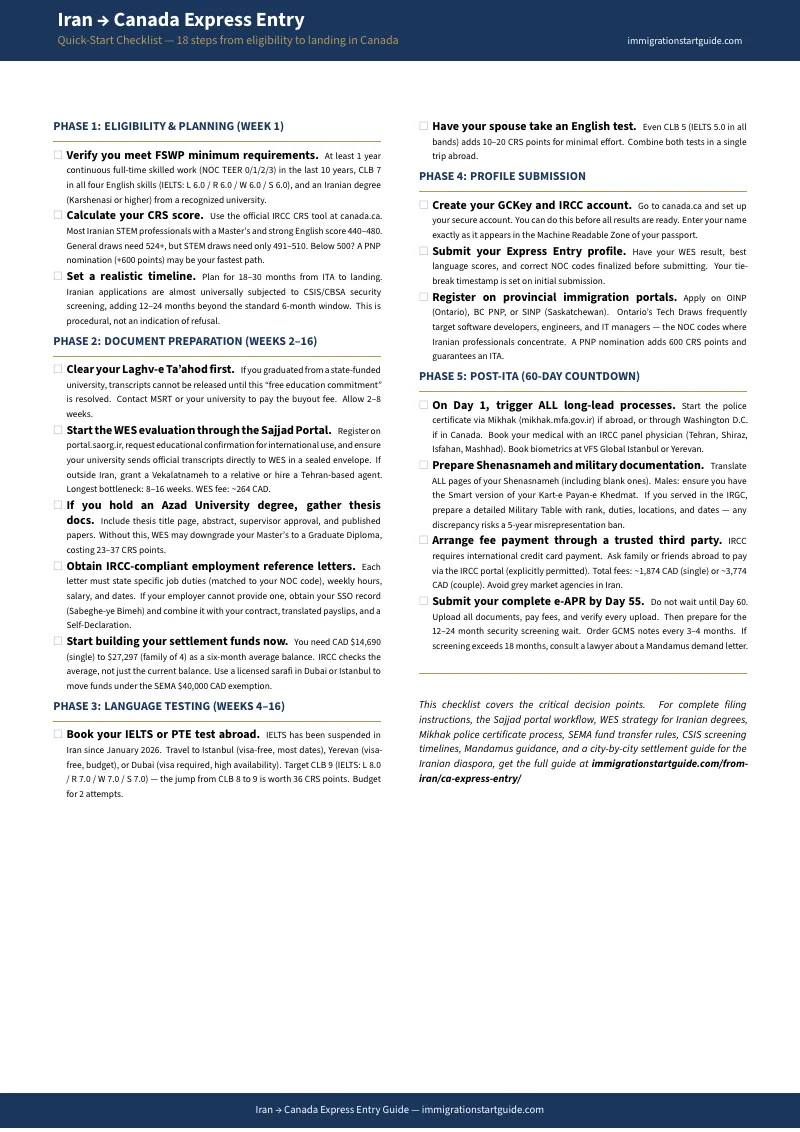
- Quick-Start Checklist (checklist.pdf) — every step from CRS calculation to PR card, with the exact sequence, government fees, processing times, and the parallel task structure that runs Sajjad, WES, IELTS, Mikhak, and fund transfers simultaneously
- CRS Score Worksheet (crs-worksheet.pdf) — fillable worksheet that calculates your current score, identifies point gaps, and maps each gap to the specific action that closes it, with the Skill Transferability crossover table for Iranian education levels
- WES Document Checklist (wes-checklist.pdf) — organized by degree type (Kardani, Karshenasi, Karshenasi Arshad, Doctorate) with Sajjad portal steps, sealed-envelope procedures, Azad University branch handling, and common rejection reasons
- Document Tracking Worksheet (document-worksheet.pdf) — fillable tracker for all required IRCC documents with Mikhak and Sajjad portal references, validity windows, and the generation timing calibrated for the 18-month security screening duration
- Security Screening Timeline Card (security-card.pdf) — the month-by-month security screening reference with GCMS note interpretation guide, ATIP request timing, document renewal schedule, and the Mandamus decision framework
- Fund Transfer Compliance Card (funds-card.pdf) — SEMA exemption requirements, Sarafi transfer checklist, FINTRAC paper trail documentation, bank letter format, and the proof of funds threshold by family size
- Biometrics and Testing Trip Planner (trip-planner.pdf) — side-by-side comparison of Istanbul, Yerevan, and Dubai for biometrics and IELTS, with visa requirements, estimated costs, panel physician locations, and the optimal trip sequencing that combines biometrics, IELTS, and IME into fewer trips
The Free Checklist vs. The Full Guide
The free Quick-Start Checklist gives you the critical action items — every step from CRS calculation through Sajjad portal initiation, WES application, IELTS booking, Mikhak police clearance, fund transfer, Express Entry profile creation, and security screening monitoring. It is enough to see the full scope of what stands between you and Canadian PR, and to identify the long-lead-time items (Laghv-e Ta'ahod clearance, WES evaluation, IELTS preparation, fund transfer) that need to start moving immediately.
The full guide gives you how — plus seven standalone printable tools you will use throughout the 18-month process: the CRS Score Worksheet that maps your exact point gaps to specific actions. The WES Document Checklist with Sajjad portal steps and Azad University handling. The Document Tracking Worksheet calibrated for the extended security screening timeline. The Security Screening Timeline Card with GCMS interpretation and Mandamus decision framework. The Fund Transfer Compliance Card with SEMA exemption and FINTRAC paper trail requirements. The Biometrics and Testing Trip Planner that combines multiple third-country trips into fewer journeys. Eight PDFs total — the complete Sanctions and Security Protocol from CRS calculation to PR card.
— Less Than One Hour of an Immigration Consultant's Time
An RCIC consultant charges CAD 2,000 to 5,000 for application management that covers document preparation but leaves you without the Sajjad portal navigation, the Mikhak police clearance workflow, the SEMA fund transfer compliance, the security screening timeline management, the CRS optimization strategy for STEM draws, the IELTS regional testing logistics, or the trip planning that determines whether you make three separate international trips or combine them into one. The consultant walks your documents. The guide builds your entire migration system — designed for the three barriers that only Iranian applicants face.
If the information in one chapter — the Sajjad portal walkthrough that prevents a WES rejection and an eight-week restart, the Azad University documentation that prevents a Master's-to-Diploma downgrade and a 15-point CRS loss, the SEMA compliance checklist that prevents a misrepresentation finding and a five-year ban, the security screening timeline that sets realistic expectations so you do not panic at month six and hire a CAD 5,000 Mandamus lawyer three months too early, or the CRS optimization that reveals you can target a STEM draw at 481 instead of waiting for a general draw at 524 — saves you a single rejected application, a single unnecessary trip, or a single month of avoidable delay, the guide has paid for itself before you finish the first chapter.
100% satisfaction guaranteed. If the guide does not meet your expectations, email [email protected] for a full refund.