
You Scored 450. The Cut-Off Is 515. Your English Is the Fix.
You created an Express Entry profile. You entered your degree from the University of Nairobi or JKUAT, your three years of experience as a software developer in Westlands or a nurse at Kenyatta National Hospital, your IELTS scores. The system gave you a CRS score somewhere around 440-460. Then you checked the general draw cut-offs for 2025 and 2026 — consistently above 500 — and realized you are 50 to 70 points short with no obvious way to close the gap.
The standard advice does not help. Get Canadian work experience (requires a work permit you do not have). Pursue a Canadian master's degree (an investment of KES 3 to 5 million in tuition alone, plus two years). Find an employer willing to sponsor an LMIA (the odds are not in your favour). Each path either requires money that should stay in your proof of funds account or time you cannot afford to lose while your age-related CRS points tick down every year after 30.
Meanwhile, the immigration industry in Nairobi has priced itself around your anxiety. An RCIC consultant costs KES 190,000 to 475,000 for end-to-end representation. Local visa agents charge KES 50,000 to 200,000 — many with no regulatory credentials, many delivering nothing more than form-filling that ends in rejection. And the free content on YouTube and Reddit repeats the same surface-level CRS breakdown without ever addressing how Kenyan credentials specifically interact with Canadian immigration systems — how WES processes a transcript request from JKUAT, what happens when your savings sit in a SACCO FOSA account, or why your "certificate of service" from your employer will be rejected by IRCC.
The English Advantage System
Here is what most Kenyan applicants do not realize: you are sitting on the single most valuable asset in the Express Entry pool, and you are not using it to its full potential. You speak English natively. That is not a small detail — it is a structural superpower. Applicants from non-Anglophone countries spend years and tens of thousands of shillings on language coaching just to reach CLB 7. You can target CLB 9 or CLB 10 with focused test preparation, because the barrier is not fluency — it is test technique.
The CRS math makes this concrete. Moving from CLB 7 to CLB 9 adds 56 or more direct points to your score. But that is only the beginning. High language scores unlock the maximum "Skill Transferability" cross-factor points — an additional 25 to 50 points depending on your education and experience. A 28-year-old Kenyan developer with a Master's degree who improves from CLB 7 to CLB 9 can see their total CRS jump from approximately 450 to over 500, crossing the most common ITA thresholds without changing anything else about their profile.
Add French through Alliance Francaise Nairobi — 12 to 18 months of study to reach NCLC 7 — and the picture changes completely. The 50-point bilingual CRS bonus plus access to French-category draws with cut-offs as low as 379 means your profile that was stuck at 450 is now competitive across multiple draw categories. This guide is built around these two linguistic strategies, and every other chapter — credential evaluation, documentation, provincial nomination, proof of funds — is organized around making them work for a Kenyan applicant.
What You Get
IELTS Strategy for Native English Speakers
You are not studying for fluency — you are studying for a test structure. Most Kenyan professionals lose points not because they cannot speak English but because they write like conversationalists instead of technical respondents, mismanage time in the Reading section, or under-prepare for the specific accent diversity in the Listening module. This chapter covers the CLB 9 and 10 targets, the exact CRS point thresholds that trigger score jumps, where to sit IELTS in Nairobi (British Council, IDP), Nakuru (Kabarak University), and Eldoret, and the preparation strategy calibrated for native speakers who need test technique, not language lessons.
WES Credential Assessment for Kenyan Degrees
How to get your transcripts to WES without losing months. The University of Nairobi requires a specific visit to the Registrar's Office on Harry Thuku Road. JKUAT's consolidated transcript takes up to three months if you do not follow up at the Deputy Registrar (Examinations) office in Juja. Kenyatta University, Moi, Strathmore, Mount Kenya University, and Chuka each have different fees, timelines, and digital capabilities. This chapter gives you the exact process for each institution, plus the "Master's Degree Advantage" (a Kenyan Master's maps to a Canadian Master's for 15 extra CRS points) and the "Double Degree" play (Bachelor's plus PGD for up to 8 additional points).
French Language Bonus via Alliance Francaise Nairobi
The Loitokitok Road campus offers Daily, Super-Intensive, and Alternate programs that can take you from zero French to NCLC 7 in 12 to 18 months. The investment — KES 245,000 to 375,000 including the TEF or TCF Canada exam at KES 55,700 — delivers 50 CRS bonus points and entry into French-category draws with cut-offs 130 or more points below general rounds. For any Kenyan applicant stuck below 490, this is the most efficient CRS strategy available. This chapter covers the realistic timeline, training costs, TEF versus TCF comparison, and the month-by-month study plan for working professionals.
Certificate of Good Conduct — Beating the DCI Backlog
The official processing time is two weeks. The reality during backlog periods is three to four months. If you mistime your application, your PCC expires before your submission deadline. This chapter walks through the eCitizen application (KES 1,050), fingerprinting at DCI Headquarters (Mazingira House), Huduma Centre, and divisional offices, the *512# status check, and the timing strategy that ensures your certificate remains valid throughout the 60-day post-ITA submission window. Also covers foreign police clearances for Kenyans who worked in the UAE, Saudi Arabia, or South Africa.
Proof of Funds: Navigating Kenyan Banking
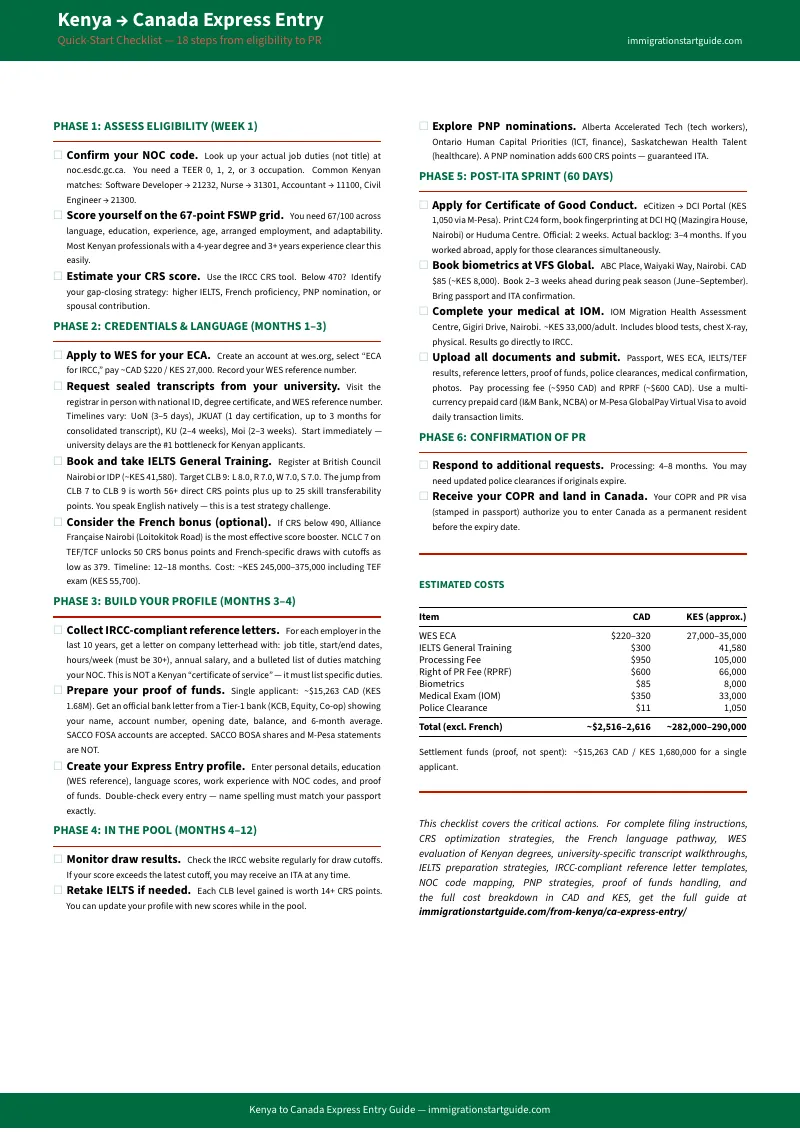
A single applicant needs approximately KES 1.68 million in liquid funds. IRCC requires a formal bank letter from a recognized institution showing your name, account number, opening date, current balance, and six-month average. This chapter explains which Kenyan financial accounts work and which do not: Tier-1 banks (KCB, Equity, Co-operative Bank) are ideal. SACCO FOSA accounts are accepted. SACCO BOSA shares are rejected. M-Pesa statements are useful as secondary evidence but never as primary proof. Templates for gift deeds when family members contribute. The six-month stability requirement that trips up applicants who move large sums at the last minute.
IRCC-Compliant Reference Letters
Your Kenyan employer issued you a "certificate of service" — a one-page letter confirming your dates and title. IRCC will reject this. They require a reference letter on company letterhead with nine specific elements: exact job title, start and end dates, hours per week, annual salary, and a bulleted list of duties matching your NOC description. Most Kenyan HR departments have never seen this format. This chapter provides the exact template to hand your employer, duty list examples for common Kenyan roles (NOC 21232, 31301, 21300, 11100), and fallback options including statutory declarations when former employers have closed.
CRS Score Optimization
Seven strategies with specific point values: the IELTS CLB 9 jump (56-100 points), French bilingual bonus (50 points), sibling in Canada (15 points), spousal contribution (up to 40 points), the Double Degree strategy (8-15 points), category-based draw alignment, and Provincial Nominee Programs (600 points). Worked CRS calculations for typical Kenyan profiles showing exactly how each strategy changes the outcome. This is not motivational advice — it is arithmetic.
Provincial Nominee Programs
When your federal CRS cannot reach general draw cut-offs, a PNP nomination adds 600 points — a guaranteed ITA. This chapter covers the four most relevant streams for Kenyan professionals: Alberta Accelerated Tech Pathway (for IT and software roles), Ontario Human Capital Priorities (ICT, finance, education), Saskatchewan Health Talent Pathway (healthcare workers), and Nova Scotia Labour Market Priorities. Eligibility criteria, application processes, and which stream fits which Kenyan career profile.
Post-ITA 60-Day Sprint
When IRCC sends you an Invitation to Apply, you have 60 days to submit a complete application with every supporting document. This chapter provides the day-by-day timeline for a Nairobi-based applicant: police certificate validity windows, medical exam scheduling at IOM Lavington (approximately KES 33,000 per adult), biometrics booking at VFS Global ABC Place on Waiyaki Way (book two to three weeks ahead during June to September peak), document upload specifications, IRCC fee payment logistics including the multi-currency prepaid card strategy for overcoming Kenyan bank daily transaction limits, and the errors that trigger procedural fairness letters or outright refusal.
Complete Cost Breakdown
Every fee from profile creation to landing in Canada, in both CAD and KES: WES evaluation (KES 27,000), IELTS (KES 41,580), IRCC processing fee (KES 105,000), Right of PR fee (KES 66,000), biometrics (KES 8,000), medical exam (KES 33,000), police clearance (KES 1,050), and settlement funds (KES 1.68 million for a single applicant). Total baseline without French: approximately KES 282,000. With French: approximately KES 527,000 to 662,000. Comparison against RCIC consultant fees and local agent costs to frame the real investment decision.
Who This Guide Is For
- Kenyan professionals with a CRS score in the 430-470 range who need a concrete strategy to close the gap to ITA thresholds
- Native English speakers who scored CLB 7 on IELTS and have not yet attempted the CLB 9 jump that could add 80 or more CRS points
- Software developers, nurses, engineers, accountants, and teachers whose NOC codes qualify for category-based STEM and healthcare draws
- Applicants quoted KES 190,000 or more by consultants for a process the IRCC explicitly designed for self-filing
- Kenyans who need the specific institutional logistics — how to get sealed transcripts from UoN, what to do about the DCI backlog, which bank letter format IRCC will accept
- Anyone whose savings are in SACCOs or M-Pesa and needs to know exactly how to present them to satisfy IRCC proof of funds requirements
Why Not Free Content?
Generic Express Entry guides explain the CRS system in general terms. They do not explain how WES processes transcripts from the University of Nairobi versus JKUAT. They do not cover the DCI Certificate of Good Conduct backlog or the *512# status check. They do not distinguish between SACCO FOSA and BOSA accounts for proof of funds. They do not provide the IRCC-compliant reference letter template that replaces the Kenyan certificate of service format. And they do not contain the IELTS preparation strategy calibrated for native English speakers who lose points on test structure rather than language ability.
The Express Entry system penalizes mistakes with processing delays, procedural fairness letters, or outright refusal. A WES evaluation delayed because your university registrar did not respond means months of waiting. An M-Pesa statement submitted as primary proof of funds means your financial documentation is rejected. A reference letter in certificate of service format means your work experience points are not counted. Each error has a specific cost in time, money, or both — and the free content does not cover the Kenyan-specific details that prevent them.
What's Included
- Complete Guide (PDF) — 16 chapters covering CRS optimization, IELTS strategy for native speakers, French language bonus, WES credential mapping for Kenyan universities, proof of funds with Kenyan banking, Certificate of Good Conduct logistics, employment reference letters, NOC code selection, PNP pathways, the post-ITA sprint, complete timeline, cost breakdown, and common mistakes
- Quick-Start Checklist (PDF) — 18-step action plan from eligibility assessment to permanent residency — also available as a free download
- 6 Standalone Printables (PDF) — IRCC reference letter template for Kenyan employers, WES university transcript tracker, proof of funds preparation worksheet, Certificate of Good Conduct timeline planner, post-ITA 60-day countdown, and complete cost breakdown in CAD and KES
Satisfaction guarantee. If the guide does not give you a clearer path to a competitive Express Entry score, email us at any time for a full refund.
— Less Than Your IELTS Test Fee
The IELTS test alone costs KES 41,580. A single WES evaluation costs KES 27,000. The total mandatory cost of the Express Entry process exceeds KES 282,000 before settlement funds. An RCIC consultant charges KES 190,000 to 475,000 for representation. This guide costs less than the biometrics fee — and it covers the entire strategy from CRS optimization through landing in Canada.