
You Passed the IELTS. You Have the Degree. And Your University Won't Send the Transcript.
You have a CLB 9. You have a four-year degree from UNILAG or UI or OAU or UNN. You have three years of professional experience in IT or engineering or finance. Your CRS score should be competitive. You are ready to Japa.
And now you are sitting in a Telegram group watching people who scored lower than you receive ITAs, while you cannot even enter the Express Entry pool because the transcript office at your university has not responded to WES in eleven weeks. The registrar's number rings out. The email bounces. The person you paid to follow up in person says "come back next week" for the fourth time. And your WES application — the $240 CAD you already paid — is in a holding pattern that could last another three months or another six.
Meanwhile the Naira has moved again. The $15,263 CAD proof-of-funds minimum you calculated last month now requires an extra ₦800,000 in your domiciliary account. The police clearance certificate you got from POSSAP three weeks ago expires in two months — and you haven't even started the MFA authentication in Abuja that IRCC requires but that nobody on YouTube mentioned.
You are not going to fail because Canada doesn't want you. You are going to fail because Nigerian institutions move on their own schedule, and every general Express Entry guide on the internet assumes your documents arrive on time.
The Nigerian Corridor Blueprint
This is the guide built for the gap between IRCC's requirements and Nigerian institutional reality. Not a generic Express Entry walkthrough — you can get that from the Canada.ca website. This is the Nigeria-specific administrative strategy that covers what happens inside Nigeria before a single document reaches Ottawa. The university registrars, the POSSAP portal, the MFA Legal Services Division in Abuja, the domiciliary account mechanics, the OANDA benchmark your proof of funds will be measured against — every institutional touchpoint where Nigerian applicants lose months, lose money, or lose their place in the draw.
Immigration consultants charge $2,000 to $5,000 CAD for Express Entry assistance. Their value is legal filing. But if you are a professional who can fill out an IRCC form yourself, what you actually need is not someone to click "Submit." You need the Nigerian institutional logistics that consultants in Toronto do not handle: which university has a responsive digital transcript portal, which ones require a physical proxy at the registrar's office, and what to do when neither option works.
What You Get
WES Transcript Tactics for Nigerian Universities
University-specific strategies for UNILAG, UI, OAU, ABU, UNN, and UNIBEN — the six institutions where 80% of Nigerian Express Entry applicants get stuck. When to use the direct submission pathway, when to deploy a local proxy at the registrar's office, and how to ensure your WES Reference Number is on every document so nothing sits in a holding queue. The WAEC DigiCert workaround for secondary school credentials. And the document-by-document vs. course-by-course decision — which evaluation type maximizes your CRS points based on your specific Nigerian qualification.
POSSAP Police Certificate Step-by-Step
The POSSAP portal fee is ₦30,000. The actual timeline is 1 to 4 weeks, not the 72 hours the system promises. The guide covers the full online workflow — NIN verification, biometric scheduling, payment confirmation — and the physical alternative at the Force Criminal Investigation Department for applicants who need results faster. The critical detail: your NPF certificate is only valid for three months, so timing this wrong means paying twice and starting over.
MFA Authentication — The Step Most DIY Applicants Miss
IRCC rejects police certificates that lack the Federal Ministry of Foreign Affairs authentication stamp from the Legal Services Division in Tafawa Balewa House, Abuja. This step is not on the IRCC website. It is not in the YouTube tutorials. It is the single most common reason Nigerian Express Entry applications are returned as incomplete. The guide covers the fee (₦5,000 per page), the realistic timeline (3 to 7 working days at MFA after the document clears), and the logistics for applicants who are not based in Abuja.
Proof of Funds with Naira Volatility Strategy
IRCC evaluates your settlement funds in Canadian dollars using the OANDA interbank rate on the day your application is processed — not the day you submitted it. If the Naira devalues between submission and review, your funds can fall below the $15,263 CAD minimum for a single applicant. The guide covers the 20% buffer strategy, domiciliary account mechanics (holding USD or GBP to hedge against Naira depreciation), the six-month average balance requirement, and what happens when a family member contributes funds — including the gift deed documentation that IRCC requires and the "clean paper trail" standard for large recent deposits.
CRS Optimization for Nigerian Credentials
A Nigerian four-year Bachelor's degree is worth 120 CRS points. A Bachelor's plus a post-graduate diploma is worth 128 points. A Master's degree is worth 135 points. The difference between these evaluations is determined by how WES classifies your Nigerian qualification — and the classification depends on what your university transcript says, not what you actually studied. The guide covers how to ensure your WES ECA report reflects the highest defensible classification, IELTS band-to-CLB conversion for maximum language points, and the cross-factor bonuses that most CRS calculators miss.
The 60-Day Post-ITA Sprint Plan
When you receive an Invitation to Apply, you have exactly 60 days to submit every document — police certificate, medical exam, bank letters, educational assessments, employment references. For applicants in countries with responsive institutions, this is comfortable. For Nigerian applicants managing POSSAP timelines, MFA authentication backlogs, and panel physician availability in Lagos and Abuja, 60 days is a hard deadline that requires pre-staging documents before the ITA arrives. The guide provides the pre-ITA preparation checklist and the day-by-day sprint plan that ensures nothing expires before submission.
Realistic 12-to-18-Month Timeline
YouTube says six months. Telegram groups say "my friend got PR in four months." The reality for a Nigerian applicant — accounting for university transcript delays, ECA processing, language test preparation, the six-month bank balance history, POSSAP, MFA authentication, and IRCC's own processing window — is 12 to 18 months from first action to PR confirmation. The guide breaks this into three phases with parallel task tracking so you are not waiting for one institution to respond before starting the next process.
Who This Is For
- Nigerian IT professionals scoring 440+ CRS — you have the points, you have the NOC code, but the WES transcript bottleneck and proof-of-funds volatility are the obstacles between you and the pool
- Engineers and finance professionals with 3+ years of experience — your work experience is your strongest CRS asset, and the guide shows how to document Nigerian employment history in the format IRCC expects
- Healthcare workers considering Canada alongside the UK — if you are also looking at the UK Skilled Worker route, the guide covers how to run both applications in parallel without duplicating costs on documents that serve both
- Nigerian Master's degree holders — you have the highest education points available, and the guide ensures your WES evaluation reflects the full Master's classification rather than a downgraded "post-graduate diploma"
- Couples applying together — spousal CRS bonuses, dual proof-of-funds thresholds, and the strategic decision of who should be the primary applicant based on combined credentials
Why Not YouTube, Nairaland, or Immigration Agents?
YouTube and Telegram channels give you the IRCC requirements — the same information that is on Canada.ca. They do not tell you how to get your UNILAG transcript released when the registrar has not responded in three months. They do not explain why the MFA authentication step exists or where to go in Abuja to get it done. They quote "six-month timelines" that assume your documents arrive on schedule. Nigerian documents do not arrive on schedule.
Nairaland threads are full of anecdotal advice from people who applied under different rules, different CRS cutoffs, and different IRCC processing standards. The proof-of-funds minimum changes every year. The CRS draw cutoffs shift every round. Advice from 2024 can disqualify you in 2026.
Immigration agents in Lagos charge ₦500,000 to ₦2 million and many are unregulated. The regulated consultants — RCICs licensed by the College of Immigration and Citizenship Consultants — charge $2,000 to $5,000 CAD. Their value is legal representation. But if you can fill out the IRCC forms yourself, what you need is not a consultant. You need the Nigerian institutional playbook that no consultant in Toronto has written because they have never stood in the transcript queue at OAU.
Printable Tools
The guide includes standalone appendices designed to be printed and used throughout your 12-to-18-month journey:
- Complete Document Checklist — every document with its issuing agency, realistic Nigerian processing time, and the common error that causes delays
- 12-to-18-Month Timeline Planner — three-phase plan with parallel task tracking, pre-ITA staging milestones, and the 60-day sprint countdown
- Proof-of-Funds Calculator — IRCC minimums by family size, OANDA conversion worksheet, buffer calculation, and domiciliary account tracking
- CRS Score Worksheet — calculate your actual score with Nigerian credential equivalencies, language point breakdowns, and cross-factor bonus identification
The Free Checklist vs. The Full Guide
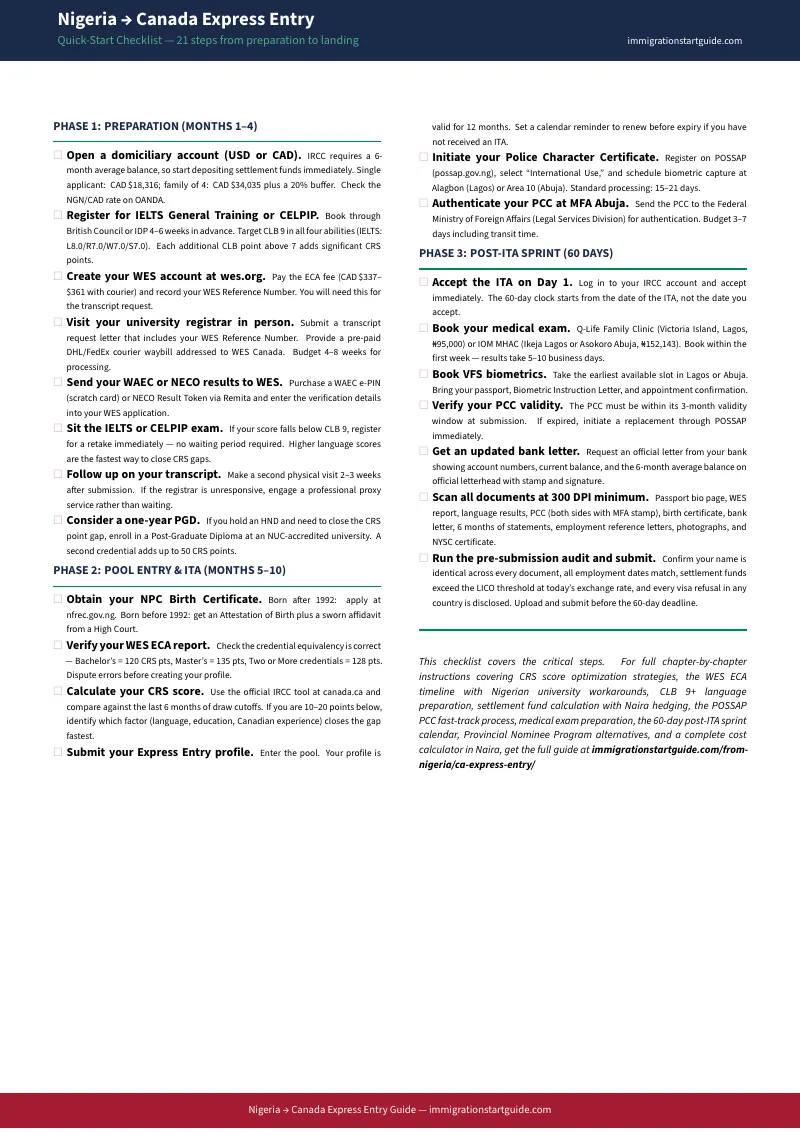
The free Quick-Start Checklist gives you the critical action items — documents to procure, agencies to contact, timelines to track. It is enough to see the full scope of what lies ahead and identify the steps where most Nigerian applicants lose time.
The full guide gives you how: the university-specific WES transcript strategies, the POSSAP and MFA authentication playbook, the Naira hedging and proof-of-funds defence, the CRS optimization for Nigerian credentials, and the 60-day post-ITA sprint plan that turns "I have an ITA" into "I have PR."
— Less Than a Single WES Application Fee
The total cost of a Canadian Express Entry application from Nigeria — WES evaluation, IELTS registration, POSSAP, MFA authentication, biometrics, medical exams, and settlement funds verification — exceeds $2,500 CAD in fees alone. That does not count the months of salary you invest in preparation, the domiciliary account deposits, or the opportunity cost of a failed application that sends you back to the beginning of a 12-month cycle.
If the information in one chapter — the WES transcript strategy for your specific university, the MFA authentication step you would have missed, or the proof-of-funds buffer that keeps your application above the OANDA threshold — prevents a single rejection, the guide has paid for itself before you finish reading it.
100% satisfaction guaranteed. If the guide does not meet your expectations, email [email protected] for a full refund.