
You Won the DV Lottery. Now You Have Four Months to Not Lose It.
You checked dvprogram.state.gov and your case number was there. After years of entering, you are selected. Your heart is pounding. You are telling your family. You are imagining JFK Airport, a Social Security card, a lease in Houston or Atlanta or Maryland. You are ready.
And then you start reading the requirements. The DS-260 asks questions about every address you have lived at since you were sixteen. The NPC office in your state says birth certificates take six to eight weeks and your interview is in three months. POSSAP says the police clearance is ready in 72 hours but the person at Alagbon says come back next Tuesday. Your WAEC result slip has a D7 in one subject and you have no idea whether the consular officer will count that as a pass or a fail. Someone in a Telegram group says you need an I-134 from a sponsor in America but someone else says you do not. The IOM medical exam costs ₦247,000 and you have not even confirmed whether you qualify for the interview yet.
You did not lose the DV lottery. You won it. But winning the lottery and receiving the visa are two completely different things — and the gap between them is filled with Nigerian institutional delays, consular scrutiny that has intensified since the 2026 visa pause, and a September 30 fiscal year deadline that does not care about your POSSAP timeline.
The Nigerian Selectee's Battle Plan
This is not a generic DV lottery guide. You can get the official instructions from travel.state.gov. This is the Nigeria-specific operational manual for everything that happens between your selection notification and your visa stamp — inside Nigeria, at Nigerian institutions, on Nigerian timelines. The POSSAP biometric capture process at Alagbon and the alternative Abuja route. The NPC birth certificate versus the NPC Attestation of Birth and which one you need based on your year of birth. The WAEC-to-US-grade mapping that determines whether the consular officer at Lagos accepts your education or sends you home. The I-134 sponsor strategy that addresses the public charge scrutiny Nigerian applicants face in 2026. The IOM and Q-Life medical exam booking logistics. And the two-visit interview protocol at the US Consulate on Walter Carrington Crescent that nobody mentions until you are standing at the gate wondering why they are sending you away on your first visit.
Immigration attorneys in Lagos charge ₦500,000 to ₦1.5 million for DV case handling. Their value is legal representation. But if you are a capable adult who can fill out a DS-260 yourself, what you actually need is not someone to submit your form. You need the Nigerian institutional playbook — the document timing, the fee realities, the grade defence, the financial evidence strategy — that no attorney in Maryland or Virginia has written because they have never navigated the POSSAP portal or stood in the NPC queue in Wuse.
What You Get
POSSAP Police Certificate Walkthrough
The POSSAP portal says ₦40,000 and 72 hours. The reality at Alagbon Close in Lagos is ₦60,000 to ₦100,000 and one to four weeks. The guide covers the full online workflow — NIN verification, payment confirmation, biometric capture scheduling — and the Abuja Force CID alternative for applicants who need a faster turnaround. The critical detail most selectees miss: your police certificate is only valid for three months from the date of issue. Get it too early and it expires before your interview. Get it too late and your case number passes while you wait. The guide includes the timing formula based on your case number range.
NPC Birth Documents — Certificate vs. Attestation
If you were born after 1992, you need an NPC Birth Certificate. If you were born before 1992, you need an NPC Attestation of Birth. The US Consulate Lagos treats late-registration certificates — those obtained years after your actual birth — as a red flag that triggers secondary verification. The guide explains how to obtain the correct document from your state NPC office, the supporting evidence to bring (hospital records, old school enrollment documents, baptismal certificates) to preempt consular scrutiny, and the MFA authentication in Abuja that the Consulate expects but that most selectees discover only after their first interview.
WAEC and NECO Grade Defence
The DV lottery requires the equivalent of a US high school diploma — defined as completion of a 12-year course of formal education. In Nigeria's 6-3-3 system, that means your WASSCE or NECO Senior Certificate. But the consular officer is looking for five credits in relevant subjects, and Nigerian grading does not map cleanly to the American system. A C6 is a credit. A D7 is a pass. An E8 is also technically a pass. The guide provides the grade-by-grade mapping to the US 4.0 scale, explains how to present borderline results as a strength rather than a liability, and covers what happens if you sat for NABTEB instead of WAEC — including when a vocational certificate qualifies and when it does not.
Public Charge Financial Strategy
The 2026 visa pause for Nigerian nationals is rooted in public charge concerns. The consular officer at Lagos is evaluating whether you will need US government assistance after arrival. Unlike family-based immigration, DV selectees are not required to file the binding I-864 Affidavit of Support — but in practice, an I-134 Declaration of Financial Support from a US-based sponsor is virtually mandatory for Nigerian applicants. The guide covers how to identify and prepare a qualifying sponsor (income at 125% of the Federal Poverty Guidelines, tax returns, employment verification), what to do when your sponsor's income is borderline, how to present your own financial profile (savings, employability, health insurance plan), and the "Self-Sufficiency Portfolio" strategy that addresses the consular officer's real concern: that you will land in the US with a plan, not just a prayer.
I-134 Sponsor Logistics
Your sponsor in America needs to provide their most recent IRS tax return transcript (not a copy of the filed return — the official IRS transcript), a letter from their employer confirming position and salary, bank statements showing liquid assets, and a signed I-134 with supporting evidence. If your sponsor is a distant relative, the guide explains how to document the relationship. If your sponsor is a friend, it covers the additional scrutiny that non-family sponsors receive. If you do not have a sponsor at all, the guide provides the alternative financial evidence package for self-sponsorship — which is harder to win with at Lagos but not impossible if your personal assets and employment prospects are strong.
IOM and Q-Life Medical Exam
The medical examination for DV applicants in Nigeria is conducted by IOM (International Organization for Migration) in Lagos or by Q-Life Medical in approved locations. The exam costs approximately ₦247,000 per adult and includes a physical examination, blood tests, chest X-ray, and required vaccinations. The guide covers how to book the appointment (the online portal fills up weeks in advance during peak DV season), which vaccinations are required versus recommended, the COVID-19 shot requirement that catches applicants who received their doses more than 12 months ago, and the realistic timeline from booking to receiving your sealed medical packet. The medical report is valid for six months — the timing strategy section shows you exactly when to book based on your expected interview date.
Lagos Consulate Two-Visit Interview Protocol
The US Consulate General Lagos on Walter Carrington Crescent, Victoria Island operates a two-visit process for DV interviews that most online guides do not mention. Your first visit is document review — you hand over your sealed medical packet, police certificate, birth documents, educational credentials, and financial evidence. You are given a date to return for the actual interview, which typically happens one to three days later. The guide prepares you for both visits: what to bring on Day 1, what to expect during the wait, the common interview questions and the answer frameworks that address the consular officer's underlying concerns (intent, financial sustainability, ties to a destination), and the body language and communication approach that experienced immigration attorneys recommend.
Section 221(g) Mitigation
A 221(g) refusal is not a denial — it is an administrative hold. In 2026, Nigerian DV applicants receive 221(g) holds at a higher rate than in previous years, driven by the broader visa pause policy and enhanced public charge screening. The most common triggers are missing vaccinations, discrepancies in NPC birth documents, borderline sponsor income, and the blanket processing hold affecting Nigerian nationals. The guide explains what a 221(g) means for your case, what documents the Consulate typically requests to resolve it, the realistic timeline for resolution, and what to do if the hold stretches close to the September 30 deadline — including the emergency measures available to selectees whose cases are current but stuck in administrative processing.
Scam Defence for DV Selectees
The moment your case number appears on dvprogram.state.gov, you become a target. Scammers send emails from addresses that look official. They call claiming to be from the "US Embassy processing unit." They charge ₦200,000 for "guaranteed interview scheduling" or ₦300,000 for "expedited police clearance." The guide includes the five-point verification protocol for any DV-related communication, the list of services that the US government never charges for through intermediaries, and the specific scam patterns that target Nigerian selectees — including the "agent" who claims to know someone inside the Consulate and the "lawyer" who guarantees visa approval for a fee paid upfront.
Post-Approval Settlement Roadmap
Your visa stamp is not the finish line — it is the starting point of a 180-day window to enter the United States. The guide covers what happens at the US port of entry (the CBP inspection, the I-551 stamp in your passport, the timeline for your physical Green Card to arrive by mail), the Social Security Number application process, the state-by-state comparison for initial settlement (cost of living, Nigerian diaspora density, employment market for your field), and the critical first-90-days checklist that covers driver's license, bank account, credit history building, and health insurance — the practical logistics that determine whether your first year in America is stable or chaotic.
Who This Is For
- DV lottery selectees with case numbers in the current fiscal year — you have been selected and you need the Nigeria-specific document procurement strategy, the financial evidence package, and the Lagos Consulate interview preparation before your number becomes current
- Selectees dealing with the 2026 visa pause — your case is on administrative hold and you need to understand what the pause means, what you can do now to keep your documents current, and how to be ready the moment processing resumes
- Applicants with borderline WAEC results — you have a D7 or E8 in one or two subjects and you need to know whether your education qualifies and how to present it to the consular officer
- Selectees without a strong US sponsor — you do not have a close relative in America with a high income, and you need the alternative financial evidence strategy that demonstrates self-sufficiency without a binding affidavit
- Married selectees and those with derivative applicants — your spouse and children are included in your application, and the guide covers the additional documentation, the per-person medical costs, and the scrutiny that post-selection marriages receive at the Lagos Consulate
- Future DV entrants preparing for the next cycle — you want to understand the full process before you enter, so that if you are selected, you are not starting from zero
Why Not Nairaland, YouTube, or an Immigration Agent?
Nairaland threads are the largest source of DV lottery information for Nigerians — and also the most dangerous. Threads from 2023 and 2024 describe a process that no longer exists in its original form. The 2026 visa pause, the enhanced public charge screening, and the updated IOM fee schedule mean that advice even twelve months old can be actively harmful. Survivor bias dominates these forums: the people posting success stories are the ones whose documents happened to arrive on time, whose sponsors happened to have high income, and whose case numbers happened to be called before the September 30 cutoff. The ones who were denied are not posting.
YouTube success stories give you the highlight reel. "I won the DV lottery and moved to America in six months." They do not show you the three weeks spent at Alagbon waiting for POSSAP, the emergency trip to Abuja for MFA authentication, the ₦100,000 in "facilitation fees" they paid to expedite documents, or the sponsor whose tax return was barely above the poverty guideline threshold. A ten-minute video cannot replace a systematic document procurement strategy, and the comments section is full of outdated advice from viewers who applied under different rules.
Immigration agents in Lagos and Abuja charge ₦500,000 to ₦1.5 million for DV case handling. Some are competent. Many are not licensed, not accountable, and not refunding your money when the visa is denied for reasons their "preparation" should have caught. The regulated immigration attorneys — those licensed to practice before US immigration courts — provide genuine legal value. But if you can fill out a DS-260 yourself, what you need is not legal representation. You need the Nigerian institutional logistics that no attorney in Houston or Maryland has documented: the POSSAP portal workflow, the NPC attestation timing, the WAEC grade defence, and the two-visit protocol at Walter Carrington Crescent.
Printable Tools
The guide includes standalone appendices designed to be printed and used throughout your DV process:
- Complete Document Checklist — every document with its issuing agency, realistic Nigerian processing time, validity period, and the common error that triggers a 221(g) hold
- DV Timeline Planner — month-by-month plan from selection notification to visa interview, with parallel task tracking so you are procuring documents simultaneously rather than sequentially
- Financial Evidence Worksheet — I-134 sponsor qualification calculator, personal assets inventory, public charge defence checklist, and the evidence package organiser for your interview folder
- Interview Preparation Guide — common questions, answer frameworks, document organisation for the two-visit protocol, and the 221(g) response plan
The Free Checklist vs. The Full Guide
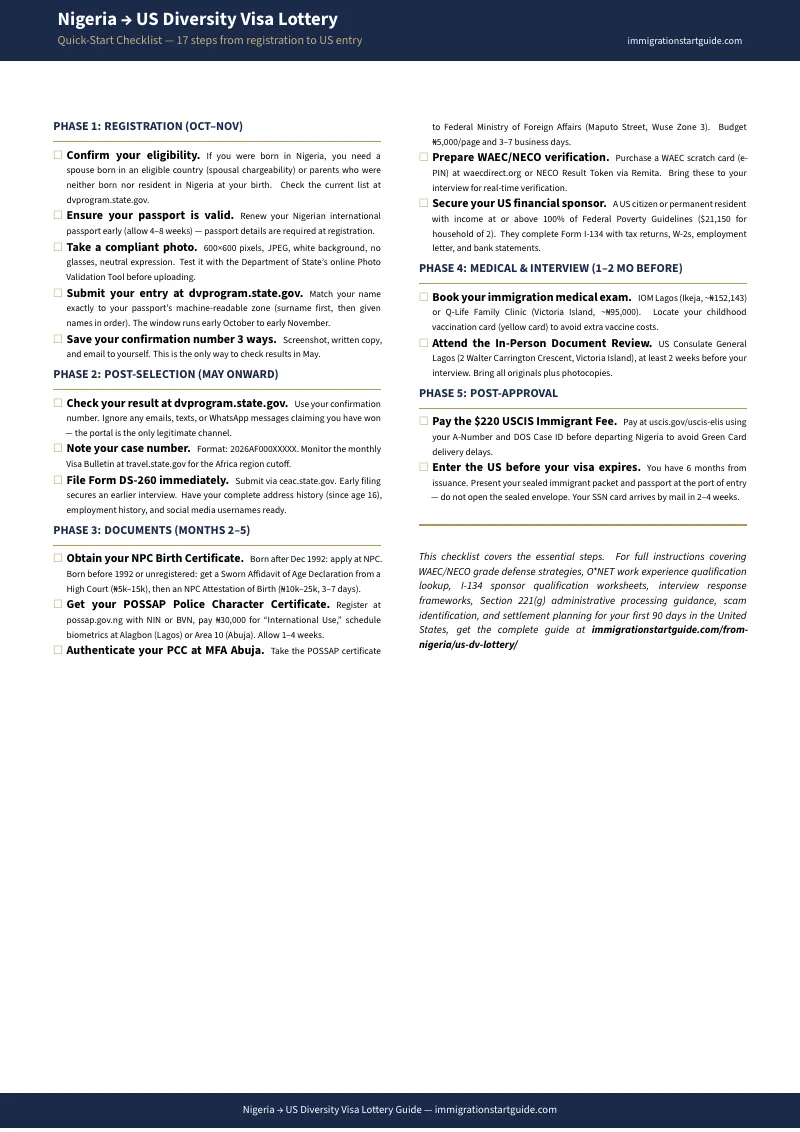
The free Quick-Start Checklist gives you the critical action items — every document you need, the agencies that issue them, and the order to tackle them. It is enough to see the full scope of what stands between selection and your visa stamp, and to identify the steps where most Nigerian selectees lose weeks or lose their case.
The full guide gives you how: the POSSAP portal walkthrough with timing formula, the NPC birth document strategy based on your year of birth, the WAEC grade defence for borderline results, the I-134 sponsor logistics and self-sufficiency portfolio, the IOM medical booking strategy, the Lagos Consulate two-visit preparation, and the 221(g) mitigation plan that keeps your case alive when administrative processing threatens to run past September 30.
— Less Than a Single POSSAP Police Certificate
The total cost of a DV application from Nigeria — IOM medical exam, consulate visa fee, POSSAP police certificate, NPC documents, MFA authentication, passport, photographs — exceeds ₦800,000 before you even account for travel to Lagos for the interview or flights to America after approval. That does not count the months of preparation, the time off work, the stress on your family, or the opportunity cost of a preventable denial that wastes every naira you invested.
If the information in one chapter — the POSSAP timing formula that prevents your certificate from expiring before the interview, the NPC attestation strategy that avoids the late-registration red flag, the grade defence that keeps a D7 from derailing your case, or the I-134 preparation that survives public charge scrutiny — prevents a single 221(g) hold or denial, the guide has paid for itself before you finish reading it.
100% satisfaction guaranteed. If the guide does not meet your expectations, email [email protected] for a full refund.