
You Have a Job Offer at £39,000. Your HEC Degree Is Laminated. The Ecctis QLS Identity Check Fails on Your Passport Chip. VFS "Priority" Takes 25 Days. And One in Three Pakistani Applicants Gets Refused — Losing the PKR 1.35 Million Application Fee That Took Your Family Two Years to Save.
You have a CoS from a UK employer. You have an engineering degree from NUST, a medical degree from Aga Khan, an IT degree from FAST, or an accounting qualification from ICAP. You have the skills the NHS and British tech companies are recruiting for. You assumed the Skilled Worker visa was a document-and-wait process — stressful, expensive, but straightforward if you do everything right.
Then everything started going wrong in ways no YouTube video or Reddit thread warned you about.
Your HEC attestation was rejected because your degree parchment is laminated. The HEC stamp cannot adhere to a laminated surface. You must either peel the lamination off — risking damage to the original document — or request a duplicate from your university, which takes four to eight weeks and requires you to restart the attestation queue. Your CoS is valid for three months. The clock is running before you even begin the visa application.
Your university taught in English. You assumed that exempted you from the IELTS. Since 2025, every Pakistani degree must go through the Ecctis QLS for English verification — and the new system requires a mandatory live identity check where you scan your passport chip and perform a facial verification on your phone. Older Pakistani passports with damaged biometric chips fail this check automatically. The application is closed. The £210 fee is non-refundable. You now need to sit the IELTS for UKVI at B2 level — IELTS 5.5 in all four bands — but test slots in Lahore and Karachi are booked six weeks out. Your CoS validity window is shrinking.
Then the financial reality. A 5-year Skilled Worker visa costs approximately £6,694 for a single applicant — roughly PKR 2.35 million at current exchange rates. For a family of four, the total approaches PKR 8.5 million. The Immigration Health Surcharge alone is £5,175 for five years. You do not have £6,694 sitting in a UK bank account. You are assembling this from family savings, possibly a property sale, possibly help from relatives. And when a large deposit appears in your bank statement without a documented source, UKVI flags it as "borrowed funds for the visa" — which triggers additional scrutiny and can result in refusal.
Then VFS. You paid £500 for Priority processing — expecting a 5-day decision. Pakistani applicants routinely receive "Non-Straightforward" (NSF) emails that extend processing to 20-30 working days despite the priority fee. The priority surcharge is non-refundable. Standard processing during peak season stretches to 8-12 weeks. And if your application is refused, the visa fee is gone. Only the IHS is refunded — but it goes to the original payment method. If your consultant or a relative abroad paid on their card, the refund lands in their account, not yours.
The overall approval rate for Pakistani Skilled Worker applicants is 66%. One in three is refused. Compare that to 88% for India and 91% for the Philippines. Pakistani applications face what UKVI internally classifies as "elevated scrutiny" — additional document verification, credibility interviews, social media audits for spouse dependants, and bank statement source-of-funds checks that applicants from higher-approval-rate countries rarely encounter.
The Anti-Refusal System
This is the operational manual for Pakistani professionals navigating the UK Skilled Worker visa from the specific position of holding Pakistani educational credentials, dealing with HEC and IBCC attestation, managing financial evidence in PKR, processing through VFS Pakistan, and facing the elevated scrutiny that produces a 34% refusal rate. Not a generic explanation of the Skilled Worker visa points system — the GOV.UK website covers that. This is the Pakistan-specific playbook for the five problems no other resource addresses simultaneously: getting your HEC/IBCC documents attested without falling into the lamination trap or name-mismatch rejection, proving English proficiency after the Medium of Instruction exemption died and Ecctis QLS introduced the passport chip identity check, structuring your financial evidence so large deposits are documented rather than flagged, navigating VFS Pakistan's real processing timelines rather than the advertised ones, and preparing your application to survive the credibility interview and document verification that produces that 34% refusal rate.
Immigration consultants in Pakistan charge PKR 200,000 to 500,000 for Skilled Worker application management. UK-based solicitors charge £2,000 to £5,000. Both handle compliance — filling forms, submitting documents, liaising with VFS. Neither delivers the strategic layer: whether your laminated degree needs to be de-laminated or duplicated, which of the four IOM TB centres has the shortest current wait, how to structure your bank statements so the source of a PKR 2 million deposit is pre-documented before the caseworker asks, why the Ecctis QLS identity check fails on certain Pakistani passport series and what to do when it does, or how to prepare your dependant spouse's evidence file for the social media audit that UKVI applies to arranged marriages from Pakistan.
What Is Inside
HEC, IBCC, and NADRA Document Strategy
The attestation chain — HEC for university degrees, IBCC for Matric and Intermediate certificates, NADRA for identity documents — is where most Pakistani applications lose their first month. The guide maps the parallel processing workflow that runs HEC attestation, IBCC equivalence, and NADRA document updates simultaneously rather than sequentially. It covers the lamination trap (HEC rejects laminated parchments — and some Pakistani universities laminate degrees by default), the name-matching requirement between your CNIC, passport, and degree certificates (married women whose educational documents bear their maiden name need a NADRA marriage certificate and affidavit to bridge the identity gap), and the HEC urgent walk-in appointment system that provides same-day attestation in Islamabad but requires securing a slot that fills days in advance.
English Proficiency After the B2 Shift and Ecctis QLS
Since January 2026, the Skilled Worker visa requires CEFR B2 English — up from B1. That means IELTS 5.5 in every band, not 4.0. The Medium of Instruction exemption that let graduates of English-medium Pakistani universities (LUMS, NUST, FAST, Aga Khan) skip the test is effectively dead for the Skilled Worker route. Every Pakistani degree must now be verified through Ecctis QLS — a £210 process with a 20-working-day turnaround, no fast-track option, and a mandatory live identity check that fails when the passport's biometric chip is damaged or unreadable. The guide covers the SELT alternative (sitting the IELTS for UKVI or PTE Academic UKVI at an approved centre in Pakistan), the Ecctis QLS process with the identity check workaround, the test centre locations and booking strategies for Lahore, Karachi, and Islamabad, and the scoring targets that Pakistani professionals at the B1-B2 boundary need to hit.
TB Screening at the Four IOM Centres
The TB certificate is mandatory for any UK stay over six months. IOM Pakistan operates centres in Islamabad, Lahore, Karachi, and Mirpur. The guide covers the booking process (the online system is frequently unavailable — phone booking at +92 51 111 466 472 is the reliable fallback), the documentation you need on the day (passport, three photos, cash or card), the PKR 14,000 adult fee, what happens if your chest X-ray shows abnormalities (sputum culture takes 6-8 weeks, which can expire your CoS), and the six-month certificate validity window that must be timed against your VFS appointment and expected decision date.
VFS Pakistan: The Real Processing Timeline
VFS Global operates centres in Islamabad, Lahore, and Karachi. The guide maps the actual processing reality: Priority Service (£500 surcharge) advertises 5-day decisions but Pakistani applicants routinely receive "Non-Straightforward" emails that extend processing to 20-30 working days. Standard processing during peak season runs 8-12 weeks. The guide covers the 240-day biometric window strategy (submit the online application to lock in current fees and rules, then delay the biometric appointment until your missing documents are ready), the Document Scanning service that replaces physical evidence bundles, and the practical decision framework for whether Priority Service is worth £500 when your application has NSF risk factors.
Financial Planning in PKR
A 5-year Skilled Worker visa costs approximately £6,694 for a single applicant (PKR 2.35 million) and approximately £24,186 for a family of four (PKR 8.5 million). The guide breaks down every fee — visa application (£769 or £1,519 depending on duration), IHS (£1,035/year for adults, £776/year for children), VFS service charges, priority surcharges — and maps the PKR equivalent at current rates. It covers bank statement "aging" (large deposits appearing suddenly are flagged — the guide shows how to document the source with gift deeds, property sale agreements, or salary accumulation evidence before the caseworker asks), the IHS refund trap (refunds go to the original payment method — if a consultant paid on their card, the refund lands in their account), and the £1,270 maintenance funds requirement with the list of UKVI-approved Pakistani banks.
Professional Pathways: GMC, NMC, PEC, ICAP-ICAEW
Pakistani doctors, nurses, engineers, and accountants each follow a distinct professional registration pathway that intersects with the Skilled Worker visa. The guide covers GMC registration via the PLAB route (with the EPIC verification process that requires direct communication between ECFMG and your Pakistani medical school), NMC registration for nurses (CBT, OSCE, and the SIFE pathway), the Washington Accord advantage for PEC-accredited engineering graduates (streamlined path to Chartered Engineer status), and the landmark 2025 ICAP-ICAEW recognition agreement that lets qualified ICAP members join ICAEW by completing only the Strategic Case Study and Ethics Learning Programme — bypassing most of the 15 ICAEW exams.
Dependant Applications and the Social Media Audit
Adding a spouse and children to a Skilled Worker application multiplies the cost (IHS alone is £5,175 per adult for 5 years) and the scrutiny. UKVI applies heightened verification to Pakistani dependant applications — particularly for arranged marriages, where caseworkers expect relationship evidence beyond the marriage certificate: WhatsApp chat logs, Facebook messaging history, joint financial records, engagement photos spanning several months. The guide covers the evidence file structure that satisfies this scrutiny, the NADRA Family Registration Certificate (FRC) that proves family composition, and the common naming inconsistencies between spouse NIC, passport, and nikah nama that trigger Requests for Further Information.
Credibility Interview Preparation
Pakistani Skilled Worker applicants — particularly those with sponsors at the salary threshold or small employers — are frequently called for credibility interviews. The guide covers the four areas caseworkers probe: how you found the job and who interviewed you, specific knowledge of your duties and SOC code, awareness of your sponsor's business (location, size, activities), and your housing and integration plans. It includes the preparation framework that prevents the vague or inconsistent answers that lead to refusal on genuineness grounds.
Timeline Management: Running Parallel Processes
The guide structures the entire timeline — from job offer to UK arrival — across 3-6 months. HEC attestation, TB screening, IELTS/PTE booking, and NADRA document updates can and should run in parallel. The guide maps which tasks are sequential (HEC must complete before Ecctis QLS), which are parallel (TB test and IELTS can run simultaneously), and the critical dependencies that determine whether your CoS expires before your application is submitted. It includes the post-arrival checklist: BRP collection within 10 days, National Insurance number application, GP registration, and UK bank account setup.
Printable Tools
- Full Guide (66 pages) — 13 chapters covering the complete Pakistan-to-UK Skilled Worker process, from document procurement through VFS submission to post-arrival settlement, with the Pakistan-specific traps and workarounds at every stage
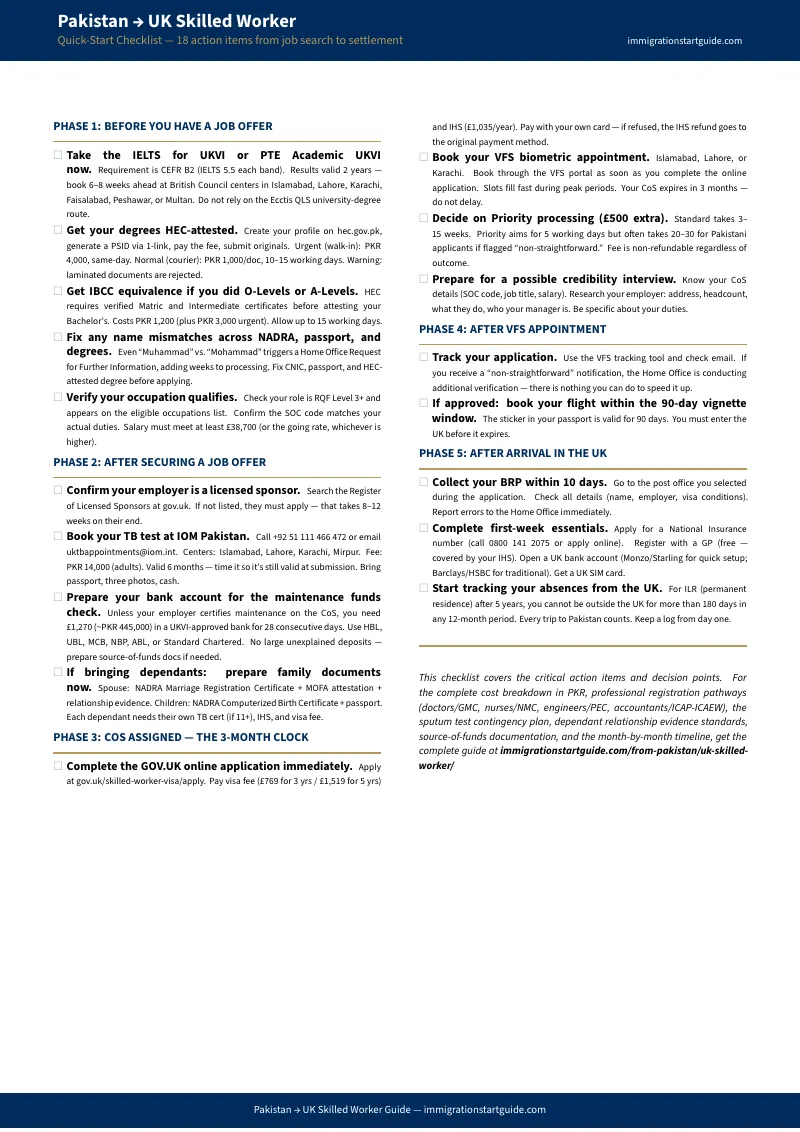
- Quick-Start Checklist — 18-item action sheet covering HEC attestation status, IBCC equivalence, NADRA document review, English test scheduling, TB screening booking, VFS appointment timing, bank statement preparation, and dependant evidence assembly
- Cost Calculator (PKR) — One-page reference card with the complete fee breakdown for 3-year and 5-year visas, single applicant and family of four, in both GBP and PKR — including IHS, visa fees, TB test, IELTS, HEC attestation, VFS Priority surcharge, and maintenance funds
- Key Contacts Reference Card — One-page fridge sheet with every organisation, phone number, website, and fee you need during the process — HEC, IBCC, NADRA, IOM Pakistan, VFS Global, British Council, Ecctis, GMC, NMC, ICAEW, and the UKVI Sponsor Register
Who This Is For
- Pakistani IT professionals — software engineers, developers, systems analysts — who have a CoS from a UK tech company and need to navigate HEC attestation for a FAST, NUST, or COMSATS degree, the Ecctis QLS identity check, and the financial planning for a £6,694 visa cost on a PKR salary
- Pakistani doctors — who are pursuing GMC registration via PLAB and need to coordinate EPIC verification with their Pakistani medical school, time their TB screening against the PLAB exam schedule, and structure an application that survives the credibility interview applied to healthcare worker visas at the salary threshold
- Pakistani nurses — who have an NMC job offer and need to coordinate the CBT/OSCE pathway with their Skilled Worker timeline, manage the B2 English requirement, and plan the IHS cost for themselves and their dependants
- Pakistani engineers — with PEC-accredited degrees who benefit from the Washington Accord but still need to navigate HEC attestation, Ecctis QLS, and the VFS process with Pakistan-specific documentation
- Pakistani accountants — ICAP members who can leverage the 2025 ICAEW recognition agreement and need to understand how this professional pathway intersects with the Skilled Worker sponsorship and visa timeline
- Anyone bringing dependants — who needs to prepare the relationship evidence file (chat logs, photos, joint records) for a spouse dependant application, understand the social media audit, and plan the financial impact of IHS for a family of three or four
Why Not YouTube, Facebook Groups, or a Visa Consultant?
YouTube and Facebook groups are the primary source of UK visa advice for Pakistani professionals — and they are a mix of outdated information and consultant marketing. The "Medium of Instruction exemption" videos were filmed before Ecctis QLS made the pathway unreliable. The "Priority visa in 5 days" testimonials do not mention the Non-Straightforward emails that extend Pakistani applications to 20-30 days. The financial planning posts quote pre-2024 salary thresholds and IHS rates. And the success stories from 2023 are based on a B1 English requirement that was replaced with B2 in January 2026.
Visa consultants in Lahore, Karachi, and Islamabad charge PKR 200,000 to 500,000 for Skilled Worker application management. UK-based solicitors charge £2,000 to £5,000. Their business model is compliance: they fill the forms, certify the documents, submit the application through VFS. They do not tell you that your laminated degree needs to be de-laminated before HEC will attest it. They do not explain why the Ecctis QLS identity check fails on certain Pakistani passport series. They do not coach you through the credibility interview or prepare your bank statements to pre-document the source of large deposits. And when the IHS refund goes to their payment card instead of your bank account, the recovery process is your problem — because they earned their fee regardless of whether your application succeeds or fails.
The GOV.UK website publishes every rule. The salary thresholds are listed. The document requirements are available. The IHS calculator works. But the website does not tell you that your HEC attestation will be rejected because your university laminated the degree. It does not warn you that Priority Service from Pakistan takes 20-30 days, not 5. It does not explain that a PKR 2 million deposit appearing in your bank statement without a source document triggers a refusal. The system is designed to be followed, not to protect you from the Pakistan-specific failure points that produce a 34% refusal rate.
The Free Checklist vs. The Full Guide
The free Quick-Start Checklist gives you the 18 critical action items — HEC attestation status, IBCC equivalence, NADRA document review, English test decision, TB screening booking, bank statement preparation, VFS appointment timing, dependant evidence assembly — in the order you should tackle them. It is enough to see the full scope of the process, identify the long-lead-time items that need to start immediately, and calculate whether your timeline fits within your CoS validity window.
The full guide gives you how: the HEC parallel processing workflow with the lamination trap and name-matching fixes, the Ecctis QLS process with the identity check workaround, the TB screening logistics across all four IOM centres, the VFS processing timeline with the 240-day biometric window strategy, the financial planning with bank statement aging defence and IHS refund protection, the professional pathways for doctors (GMC/PLAB), nurses (NMC/CBT/OSCE), engineers (PEC/Washington Accord), and accountants (ICAP-ICAEW), the dependant evidence file structure with social media audit preparation, the credibility interview framework, and the 3-6 month parallel timeline that prevents your CoS from expiring before your application is submitted.
— Refusal Insurance for a PKR 2.3 Million Investment
A single consultation with a UK immigration solicitor costs £150 to £400. Full-service Skilled Worker application management runs £2,000 to £5,000 in the UK or PKR 200,000 to 500,000 with a Pakistani consultant. Your total Skilled Worker costs will exceed PKR 1.35 million for a 3-year visa and PKR 2.35 million for a 5-year visa as a single applicant. For a family of four, the government fees alone exceed PKR 8.5 million.
If the information in one chapter — the HEC lamination fix that prevents a month-long attestation delay, the Ecctis QLS identity check workaround that saves a non-refundable £210, the bank statement documentation strategy that prevents a source-of-funds refusal, the VFS timing calculation that keeps your application within the CoS validity window, or the dependant evidence structure that survives the social media audit — prevents a single refusal, a single expired CoS, or a single IHS refund that lands in someone else's account, the guide has paid for itself before you finish the first chapter.
100% satisfaction guaranteed. If the guide does not meet your expectations, email [email protected] for a full refund.