
You Know the Dream. You Don't Know the Process.
You have the TESDA certification. You have the experience — years of it, maybe in Hong Kong, Singapore, or the Gulf. You know Canada is where you want to raise your family. But between you and that plane ticket sits a maze of acronyms, agencies, and scam artists who profit from your confusion.
IRCC paused the Home Care Worker Immigration Pilots in 2026. The "PR on arrival" pathway that made headlines? Closed to new applicants. The Facebook groups are full of panicked posts and contradictory advice. Half the people answering questions are recruiters trying to extract placement fees that are illegal under both Canadian and Philippine law.
You do not need to wait until 2030. You do not need to pay PHP 200,000 to a fixer. And you do not need to enter Canada on a tourist visa and pray.
The Caregiver Deployment System — Every Legal Pathway, Both Sides of the Border
This is the guide that covers what immigration lawyers charge CAD 3,000–5,000 to explain, and what recruitment agencies deliberately keep vague so you stay dependent on them. It walks you through every active pathway to Canada, the complete Philippine deployment process that Canadian sources never mention, and a scam-proof verification system that could save you hundreds of thousands of pesos.
Most guides cover the Canadian side or the Philippine side. This one covers both — because your application doesn't just go through IRCC. It goes through the DMW, the MWO, the DFA for apostille, TESDA for credentials, WES for your ECA, and a panel physician for your medical exam. Miss any one of these and your timeline slips by months.
What You Get
The Complete Program Breakdown
Every federal and provincial caregiver pathway mapped out for 2026: the paused HCWIP (and when it might reopen), the LMIA-based Temporary Foreign Worker Program route that is still open right now, and the Provincial Nominee Programs in Ontario, British Columbia, Nova Scotia, and Atlantic Canada that are your best "side doors" to permanent residence while the federal pilots are frozen. Each pathway with its eligibility requirements, processing times, and strategic advantages.
The Philippine Deployment Pipeline
The step-by-step DMW and MWO verification process, including the exact documents your Canadian employer must submit to the Philippine Consulate. The Overseas Employment Certificate lifecycle — new hires, Balik-Manggagawa returning workers, and change-of-employer scenarios. The 2026 eApostille system for NBI clearance and PSA certificates. The PDOS attendance requirement. The direct-hire rules and when they apply.
The Document Master Checklist
Every document you need, sequenced in the order you should prepare them. NBI clearance (including how to handle the "Hit" delay that affects common Filipino names), PSA birth and marriage certificates on security paper, WES Educational Credential Assessment, IELTS preparation for CLB 4, medical exam timing, biometrics, and passport renewal. Each item with its processing time, cost, shelf life, and the exact mistake that causes the most delays.
Scam Protection Protocol
The five recruitment scam patterns that target Filipino caregivers — "pay now, job later," the fake-relative direct hire, the tourist-to-work conversion trap, VIP processing fees, and disguised training charges. How to verify any agency on the DMW licensed registry. Step-by-step instructions for reporting illegal recruitment to the AIRB, including the 24/7 hotline (1348) and the e-Illegal Recruitment Portal. The evidence you need to gather before filing a Complaint-Affidavit.
Your Rights as a Worker in Canada
Provincial minimum wage rates, overtime rules, the difference between closed and occupation-restricted open work permits, your legal right to change employers, the Vulnerable Worker Open Work Permit for abuse situations, and the specific organizations that provide free legal help to Filipino caregivers.
The 18-Month Deployment Roadmap
A phased timeline from credentialing to arrival, with checkboxes for every milestone. Phase 1: credentialing. Phase 2: job match and MWO verification. Phase 3: IRCC application. Phase 4: DMW clearance and deployment. Designed for the 2026–2030 pause period so you spend the waiting time building the strongest possible profile.
Who This Is For
- OFWs in Hong Kong, Singapore, or the Middle East planning Canada as your final destination — your third-country experience counts, and the guide shows you how to document it properly
- TESDA graduates in the Philippines starting from zero — the full document pipeline with realistic timelines
- BSN holders considering the caregiver pathway as a bridge to Canadian nursing — NOC code mapping and the fastest PR pathway for your qualifications
- Caregivers already in Canada on temporary permits — the PNP breakdown and Canadian Experience Class strategy for the quickest route to PR during the federal pause
Why Not Just Use Facebook Groups?
Because the people in those groups are guessing. They are sharing what worked for them three years ago under a different pilot program with different requirements. They are repeating advice from recruiters who have a financial interest in keeping you confused. And when someone posts bad advice — like "just enter as a tourist and convert" — nobody is liable when that advice destroys your immigration record.
This guide was built from current IRCC policy documents, DMW regulations, MWO verification checklists, and provincial nominee program criteria. It is updated for the 2026 pause. It covers both sides of the border. And it costs less than a single consultation with a recruitment agency that may or may not be licensed.
6 Standalone Printable Tools
Beyond the main guide, you get six standalone PDFs designed to be printed and used on their own — at the agency office, at the testing center, or taped to your wall:
- Document Preparation Checklist — Every document with processing time, cost, and expiry date in a fillable worksheet
- 18-Month Deployment Roadmap — The phased timeline with checkboxes from credentialing to arrival
- Scam Protection Card — Red flags, agency verification steps, and reporting contacts on one page
- MWO Document Submission Checklist — The documents your employer must submit, ready to share with them
- Worker Rights Reference Card — Employment standards, how to change employers, abuse reporting contacts
- IELTS Score Requirements Card — CLB 4 minimum scores with a personal score tracker
The Free Checklist vs. The Full Guide
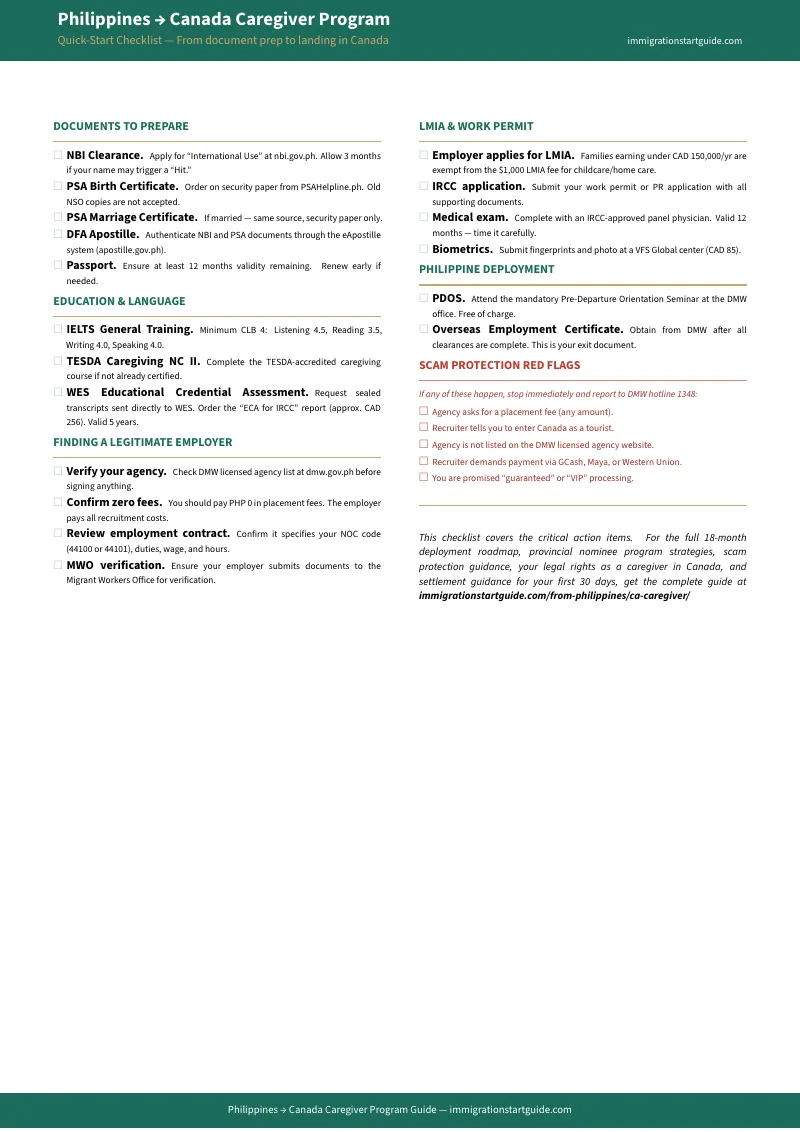
The free Quick-Start Checklist gives you the 20 most critical action items — documents to prepare, agencies to verify, red flags to watch for. It is enough to get oriented and avoid the worst mistakes.
The full guide gives you how: the 13-chapter deep dive with program comparisons, NOC code strategy, the complete LMIA process, provincial nominee program analysis, worker rights in every province, settlement resources, the 18-month phased roadmap, and 6 standalone printable tools that turn "I want to go to Canada" into "I'm boarding the plane."
— Less Than One Day's Wages, and It Could Save You PHP 300,000
That is not an exaggeration. The average illegal placement fee charged by unlicensed recruiters ranges from PHP 100,000 to PHP 300,000. This guide teaches you that the legal fee is zero and shows you exactly how to verify any agency before you hand over a single peso.
If the information in one chapter — the scam protection chapter — keeps you from paying an illegal placement fee, the guide has paid for itself hundreds of times over.
100% satisfaction guaranteed. If the guide does not meet your expectations, email [email protected] for a full refund.