
You Passed the CBT. You Have an NHS Job Offer. You Still Fail the OSCE Twice — Because Nobody Told You That UK Nursing Is a Behavioral Exam, Not a Clinical One.
You are a registered nurse in the Philippines. BSN graduate. PRC-licensed. Maybe you are working in a government hospital in Manila earning PHP 35,000 a month. Maybe you are on a two-year contract in Saudi Arabia earning $2,000 tax-free but with no path to permanent residency and a sponsor who controls your exit visa. Either way, you know the UK is hiring. The NHS has 40,000 nursing vacancies. Filipino nurses make up the largest group of internationally recruited nurses on the NMC register. A Band 5 position starts at £32,073 — four to six times your current salary — and after five years, you qualify for Indefinite Leave to Remain.
So you start. You pass the OET. You clear the CBT at Pearson VUE. An NHS Trust offers you a Band 5 position. The recruiter tells you the Health and Care Worker visa has lower fees and no Immigration Health Surcharge. You feel relief. You book your OSCE at Northampton.
Then you fail. Not because you lack clinical skill — you have more bedside experience than most UK-trained nurses in your cohort. You fail because you performed a blood pressure check correctly but did not verbalize each step to the examiner. You fail because you completed a fluid balance chart accurately but forgot to sign and date it using the UK format. You fail because at the Professional Values station, you deferred to the doctor's judgment instead of challenging an unsafe order — because that is what Philippine hospital hierarchy trained you to do. The OSCE is not testing whether you can nurse. It is testing whether you can nurse the way the NMC expects you to communicate that you are nursing.
The £397 resit fee is gone. Your NHS Trust is questioning the timeline. Your visa application is stalled because NMC registration requires a passed OSCE, and without registration, the Certificate of Sponsorship cannot be activated. Meanwhile, the DMW in Manila needs a verified employment contract before they will issue your OFW Pass, and the Pre-Departure Orientation Seminar slot you booked has expired. Everything is connected. One failure cascades into three delays.
The Philippines → UK Health & Care Worker Guide is the Career Transition Blueprint — the strategic framework that synchronizes your NMC registration pathway, your DMW compliance, and your visa application into a single coordinated timeline, so the OSCE does not blindside you, the paperwork does not expire while one agency waits on another, and no predatory recruiter exploits the gaps in your understanding. It sits between the scattered free information on NMC.org.uk and the £700-to-£4,000 OSCE prep courses that solve only the clinical piece — giving you the complete migration system that covers everything from PRC verification in Manila to your first payslip at an NHS Trust.
What's Inside the Career Transition Blueprint
The NMC Registration Roadmap — CBT Through OSCE (Chapters 1-3)
The NMC pathway is a four-stage sequence: English proficiency, CBT, Decision Letter, OSCE. Most Filipino guides describe these stages. None explain how they interact with your visa timeline. The CBT has two parts — Part A (numeracy, which Filipino nurses pass comfortably) and Part B (clinical knowledge and professional ethics, where UK-specific safeguarding scenarios and the Mental Capacity Act trip up applicants trained in Philippine hospital culture). This guide walks through the CBT content areas, the Pearson VUE scheduling in the Philippines, and the exact sequence of NMC correspondence between your CBT pass and your Authorization to Test. It maps the Decision Letter waiting period — typically 4-8 weeks — against your visa application timeline so you know when to submit documents to the Home Office and when to hold.
The OSCE Deep Dive — Station-by-Station Filipino Failure Points (Chapter 4)
The OSCE consists of 10 stations assessing clinical skills through the APIE framework (Assessment, Planning, Implementation, Evaluation). Filipino nurses consistently fail not on clinical competence but on behavioral performance. The guide covers every station: the Assessment station where forgetting to check the patient's wristband against their name board is an automatic fail. The Implementation station where performing hand hygiene correctly but not announcing "I am now performing hand hygiene" loses marks. The Documentation stations — NEWS2 scoring, fluid balance charts, Bristol Stool Chart, Braden/Waterlow pressure area scales — where a missing signature, date, or time on any single document fails the entire station. The Professional Values station where the NMC expects you to challenge an unsafe medical decision, report a near-miss, and advocate for the patient — behaviors that contradict the hierarchical deference trained into Philippine nursing culture. And the "silent skills" stations (Bowel Assessment, Nutritional Assessment using MUST, Pressure Area Assessment) where the failure is not knowledge but documentation format. Each station includes the exact behavioral items the examiner scores, the common Filipino failure pattern, and the corrective algorithm that lets you revert to a system when anxiety blanks your mind.
DMW Compliance — OFW Pass, PDOS, and the Direct Hire Trap (Chapter 5)
The Department of Migrant Workers regulates every Filipino worker departing for overseas employment. The old OEC is being replaced by the digital OFW Pass, and the rules around Direct Hire have created significant confusion. Under the 2023 DMW Rules, Filipino workers are generally prohibited from being hired directly by foreign employers without a Philippine Recruitment Agency. But exemptions exist for professionals recruited through government-to-government arrangements — which is how most NHS Trusts operate. The guide clarifies which recruitment models are legal, which trigger the Direct Hire Ban, how to verify that your UK-based agency has a legitimate Philippine Recruitment Agency partner with an active DMW Job Order, and the complete PDOS and OFW Pass process including the DOH-accredited medical certificate and the e-Registration portal sequence.
Ethical Recruitment Screening — The Red Flag Checklist (Chapter 6)
Under the UK Code of Practice for International Recruitment, it is illegal for any recruiter or agency to charge you a fee for job-finding services. The Certificate of Sponsorship costs the NHS employer £239 — you should never pay a single peso for it. Yet Filipino nursing forums document candidates routinely paying £3,000-£5,000 for "processing fees" or being forced into mandatory paid OSCE prep courses as a condition of their recruitment contract. The guide teaches you to identify illegal job-finding fees disguised as "administrative charges," audit repayment clauses (legitimate clauses taper proportionally — 100% within 12 months, 50% at 13-24 months, zero after 36 months; anything else is exploitative), recognize contract substitution (where you are hired as a nurse but deployed as a care worker), verify every employer against the Home Office Register of Licensed Sponsors and their CQC rating, and distinguish between the Ethical Recruiters List and the predatory agencies that target Filipino WhatsApp groups with "guaranteed NHS placement" ads.
Health and Care Worker Visa — The Financial Advantage (Chapter 7)
The Health and Care Worker visa is not just a work visa — it is a strategically advantaged immigration route. The application fee is £304 for up to three years (compared to £735 for a standard Skilled Worker). The Immigration Health Surcharge is waived entirely — for you and every dependent. For a family of four on a five-year visa, that exemption is worth over £20,000. The salary threshold is £25,000, protected by the Agenda for Change pay scale exemption, meaning Band 5 nurses automatically qualify. This chapter maps every financial advantage, compares the Health and Care Worker route against the standard Skilled Worker alternative, covers the CoS assignment process and the Confirmation of Acceptance for Studies interactions for nurses doing top-up qualifications, and explains the maintenance requirement exemption that means you do not need to save "show money" if your employer certifies maintenance — a fact that most Filipino applicants spend months worrying about unnecessarily.
Your First 90 Days in the NHS — The Hidden Curriculum (Chapter 8)
You arrive at your NHS Trust as a Band 4 pre-registrant. You have more clinical experience than most UK-trained nurses in your ward. But you cannot perform cannulation, phlebotomy, or catheterization until your Trust completes a competency sign-off — because in the UK system, these are "extended skills," not routine nursing duties. You will feel underutilized and possibly disrespected. This chapter prepares you for the cultural adjustment: the advocacy model where nurses are expected to challenge doctors, the "ICE" framework (Ideas, Concerns, Expectations) that structures every patient interaction, the safeguarding responsibilities that make you a legal reporter of suspected abuse, the Datix incident reporting system, the trade union options (RCN vs Unison), and the practical reality of bank shifts, agency work, and the HCAS supplement for London roles. It includes a 90-day orientation checklist covering everything from opening a UK bank account to registering with a GP.
Financial Planning — From Band 5 to ILR (Chapter 9)
A Band 5 nurse earns £32,073 gross, approximately £2,218 take-home after tax, National Insurance, and pension contributions. In London, comfortable living costs run £3,000-£3,500 per month for a single nurse. Outside London, £1,800-£2,200. This chapter provides the realistic budget framework — not the recruitment brochure version. It covers remittance planning for family support in the Philippines, the NHS Pension Scheme contribution rates, council tax obligations, and the £50-£100 monthly savings plan for the ILR and citizenship fees that arrive at year 5 and year 6. It includes the complete five-year settlement cost breakdown: visa renewal at year 3 (£304-£500), Life in the UK Test (£50), ILR application (£2,400-£3,000), and British Citizenship ceremony (£1,330).
Family Reunification — Bringing Your Spouse and Children (Chapter 10)
Most Filipino nurses are breadwinners who intend to bring their families to the UK. Dependent visa costs range from £304 to £590 per person. But the larger issue is the "No Recourse to Public Funds" condition — until you achieve ILR, you cannot claim child benefit, universal credit, or housing benefit. This chapter covers the dependent visa application process, the financial evidence requirements, the school enrollment process for children, the childcare cost reality (which is among the highest in the world), and the strategic timing question of whether to bring family during year 1 (when costs are highest and adaptation is hardest) or year 2-3 (when you have settled accommodation and a financial buffer).
ILR and Citizenship — The Long-Term Settlement Path (Chapter 11)
Five years of continuous residence on a Health and Care Worker visa leads to Indefinite Leave to Remain. "Continuous residence" means no more than 180 days outside the UK in any rolling 12-month period. For Filipino nurses who travel home to the Philippines for family emergencies or extended holidays, this 180-day rule is the most common reason ILR applications are refused. This chapter maps the continuous residence calculation, the Agenda for Change salary exemption that protects NHS staff from the general settlement salary threshold, the Life in the UK Test preparation strategy, and the pathway from ILR to British Citizenship — including the 12-month waiting period and the ceremony booking process.
Career Progression — Band 5 to Band 7 and Beyond (Chapter 12)
The UK nursing career ladder extends from Band 5 (staff nurse) through Band 6 (senior staff nurse/specialist) to Band 7 (ward manager/advanced practitioner) and beyond. Band 6 pays £37,338-£42,618. Band 7 pays £46,148-£52,809. This chapter covers the NMC revalidation process (required every three years), the clinical specialization pathways (Emergency, ICU, Mental Health, District Nursing, Health Visiting), the NHS Leadership Academy programmes, and the Advanced Clinical Practitioner route that opens prescribing rights. For nurses who entered on the Health and Care Worker visa, career progression within the NHS is unlimited once you achieve full NMC registration.
Standalone Printable Tools Included
Every paid download includes the complete 12-chapter guide plus 8 standalone printable PDFs — tools you can print individually and use at every stage of the process:
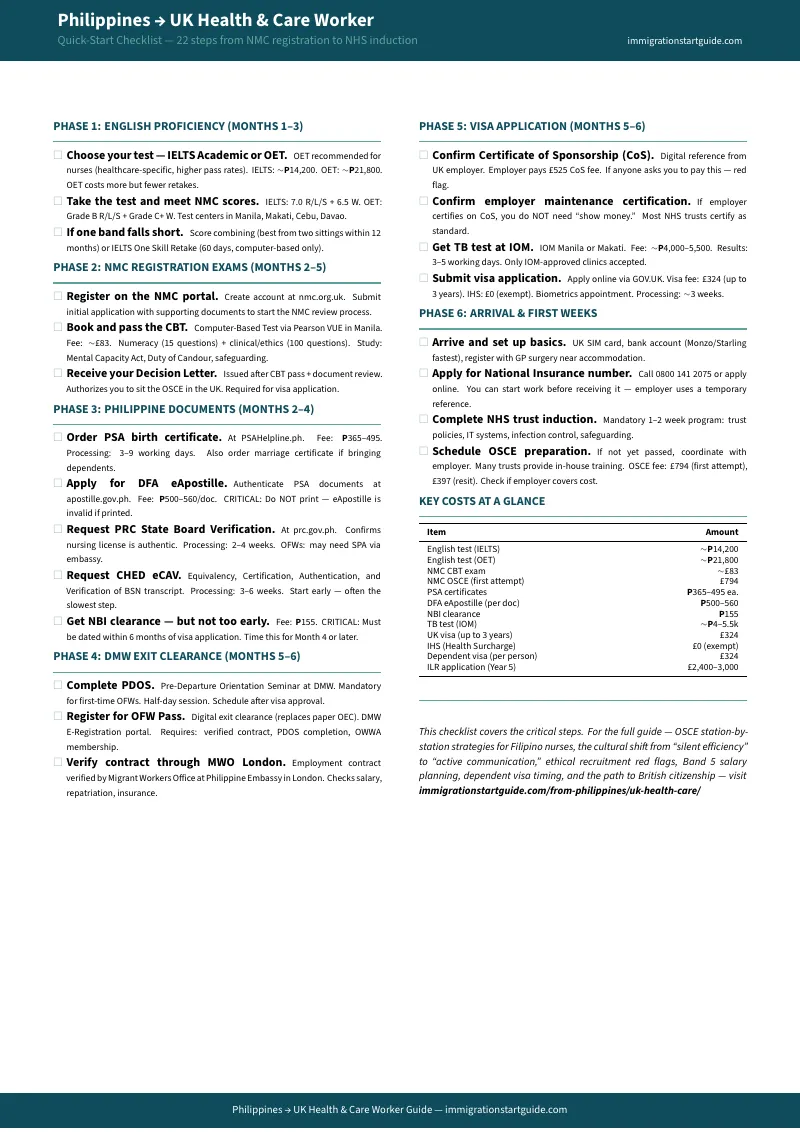
- Quick-Start Checklist — 20 critical action items covering NMC registration, DMW compliance, visa application, and settlement planning
- Document Checklist — every document required from Philippine agencies (PRC, PSA, NBI, DFA), the NMC, the Home Office, and your employer
- NMC Registration Timeline Planner — fillable target and actual dates for OET/IELTS, CBT, Decision Letter, OSCE, and visa application with the synchronization strategy
- OSCE Station Reference Card — 10-station breakdown with APIE framework, Filipino failure points, behavioral scoring items, and the recovery algorithm for each station
- Ethical Recruitment Red Flag Card — the fee rules, repayment clause audit items, contract substitution warning signs, and all reporting contacts if you encounter exploitation
- Fee Schedule and Budget Planner — complete cost breakdown in GBP and PHP from OET registration through British Citizenship, with a fillable "Your Actual Cost" column
- First 90 Days Orientation Checklist — bank account, GP registration, NI number, council tax, Trust induction, extended skills sign-off, and cultural adjustment milestones
- Settlement Timeline Tracker — continuous residence log for tracking travel absences against the 180-day rule, ILR qualifying period, and citizenship milestone tracking
Who This Guide Is For
This guide is for Filipino nurses and care workers navigating the complete pathway from Philippine licensure to an NHS career — whether you are applying from the Philippines, transitioning from the Gulf, preparing for your OSCE, or planning to bring your family:
- You are a BSN graduate working in a Philippine hospital earning PHP 25,000-45,000 per month and you have heard about NHS recruitment drives — but you do not know whether to start with the OET, the CBT, or a recruitment agency, and you cannot afford to get the sequence wrong when each exam costs £83-£794
- You are a nurse in Saudi Arabia or the UAE on a two-year contract with no path to permanent residency, and you know the UK offers ILR after five years — but you need to coordinate NMC registration, DMW compliance, and visa applications across three countries while your employer controls your exit documents
- You failed the OSCE on your first attempt and you are sitting as a Band 4 pre-registrant earning significantly less than your Band 5 colleagues — and you need to understand exactly why Filipino nurses fail so you do not spend another £397 on a resit without changing your approach
- You are a care worker in the Philippines or the Gulf considering the Health and Care Worker visa route — and you need to understand the July 2025 care worker route restrictions, the transitional in-country switching arrangements, and whether the nursing apprenticeship pathway is viable for your situation
- You have a conditional NHS job offer and a recruiter is asking you to pay £2,000 for "processing" and enroll in a mandatory £1,200 OSCE prep course before they will assign your Certificate of Sponsorship — and you need to know whether this is standard practice or a Code of Practice violation before you commit the money
- You are already in the UK, registered with the NMC, and earning Band 5 pay — but you have not started planning for your £2,400 ILR application at year 5, your family has not joined you yet, and you do not know how many days you can travel home to the Philippines without breaking the continuous residence requirement
This guide does not replace an immigration solicitor for complex cases involving criminal history, previous visa refusals, or asylum interactions. It gives you the Career Transition Blueprint that the NMC, DMW, and Home Office do not provide, that predatory recruiters exploit the absence of, and that OSCE prep courses costing £700-£4,000 only partially address.
Why Not Free Resources?
- NMC.org.uk publishes the registration steps. The Home Office publishes the visa requirements. The DMW publishes the OFW Pass process. None of them explain how the timelines interact. The NMC does not warn you that your OET results have a two-year validity window that will expire while the DMW processes your contract verification. The DMW does not tell you which UK recruitment models qualify for the Direct Hire exemption. The Home Office does not explain that your employer can certify maintenance so you do not need "show money." Each body publishes its rules in isolation — and you are expected to synchronize them yourself, across two governments and three regulatory frameworks, with zero margin for error.
- OSCE prep academies (Medax, Envertiz, ONT UK) charge £700-£4,000 for intensive multi-day clinical training with patient actors. They are effective at reducing exam anxiety and teaching the APIE framework. But they do not cover DMW compliance, visa application strategy, ethical recruitment screening, financial planning, family reunification, or settlement pathways. They solve one piece of the puzzle. You still need to coordinate the other nine.
- Facebook groups and Reddit (r/NursesPH, r/NursingUK, PinoyUKNurse) are where someone who deployed in 2023 tells you that the care worker route still works. Someone recommends an agency that is charging fees in violation of the UK Code of Practice. Someone shares a PDOS appointment process from before the OFW Pass transition. You get crowdsourced anxiety from nurses who navigated a different regulatory landscape, and nobody owns the consequences of wrong advice.
- Etsy sellers offer "OSCE Revision Booklets" and "SBAR Cheat Sheets" for £5-£50. These are clinical study aids. They do not include the DMW compliance roadmap, the ethical recruitment audit, the family reunification cost breakdown, the settlement timeline, or the Philippine-specific document procurement workflow. They solve revision. They do not solve migration.
- Immigration solicitors publish blog posts analyzing every Health and Care Worker visa policy change — because their business model is to demonstrate that the system is complex, then charge £1,000-£3,000 for a retainer. For a nurse in the Philippines earning PHP 35,000 per month, retaining a UK solicitor is not realistic. The solicitor's blog explains the problem. The solution they sell is priced for a different market.
This guide fills the execution gap — the space between "I know I need NMC registration and a UK visa" and "I have a coordinated, week-by-week plan that synchronizes my clinical exams, my DMW paperwork, my visa submission, and my financial preparation so nothing expires, nothing overlaps, and no predatory recruiter catches me off guard."
— Less Than a Single OSCE Resit Fee
A single OSCE resit costs £397. A failed OSCE means months as a Band 4 pre-registrant earning thousands less per year than your Band 5 colleagues. OSCE prep academies charge £700-£1,500 for multi-day courses — effective but narrow, covering clinical skills without the migration logistics. An immigration solicitor consultation costs £100-£300 for 30 minutes.
Your total costs over the next 12-18 months will include OET or IELTS (£350-£450), CBT (£83), OSCE (£794), visa application (£304), and months of preparation time. This guide represents a fraction of that investment — and it is the piece that determines whether the other thousands produce a Band 5 payslip or a cascade of delays, resit fees, and expired documents.
Money-back guarantee, no time limit. If the NMC registration roadmap, OSCE station-by-station breakdown, DMW compliance guide, and ethical recruitment screening do not make your pathway clearer, you pay nothing.
Download the free Quick-Start Checklist to see the 20-item action plan covering NMC registration sequencing, DMW requirements, recruitment red flags, and your first steps toward an NHS career. When you are ready for the complete Career Transition Blueprint — the OSCE deep dive, the ethical recruitment audit, the financial planning framework, the family reunification strategy, and the five-year settlement roadmap — the full guide is here.
The NHS needs Filipino nurses. The system was not built to help you get there. This guide was.