
You Have the CRS Score, the Degree from ODTU or Bogazici, and Three Years of Software Engineering Experience. But Between You and Canadian Permanent Residency Is a WES Evaluation That Rejects Turkish Transcripts Submitted in the Wrong Format, a Police Clearance That Must Be the "Yabanci Ulke / Apostil" Version from e-Devlet, and an IELTS Strategy That Nobody in the "Turkler Kanada'da" Facebook Group Explains for Turkish Speakers.
You calculated your CRS score on the IRCC website. It says 468. The latest general draw was 524. You are 56 points short. So you do what every Turkish engineer in Levent or Kavaklidere does: you open a dozen browser tabs, start reading Reddit threads from 2023, join three Facebook groups, and try to piece together whether you should target a category-based STEM draw, whether a Provincial Nomination from Ontario would close the gap, or whether you need to push your IELTS from 7.0 to 7.5 in every band. One person says the STEM draw threshold was 481. Another says STEM draws were paused in late 2025. A third person says they got an ITA with 467 through the OINP Tech Draw. Nobody explains which of these pathways is actually available in 2026, what the CRS thresholds are for each, or how to position your profile for the right one.
Meanwhile, you need your Lisans Diplomasi evaluated by WES. Your university issues transcripts in Turkish. WES requires them sent directly from the institution in a sealed envelope. But your university's student affairs office has never heard of WES, does not know about the sealed envelope procedure, and keeps asking you to pick up the transcripts in person. You do not know whether your university supports electronic delivery (some do, some do not), whether you need to send both the diploma and the transcripts, or what happens if WES receives a Yuksek Lisans transcript but you also hold an On Lisans from a different institution and whether submitting both would increase your education points.
You need a police clearance for Canada. The IRCC website says "Turkish National Police." But in practice, the correct document is the Adli Sicil Arsiv Kaydi — and it must be the foreign-use version, not the domestic one. Through e-Devlet, you can generate this document in English instantly. But if you select the wrong option in the menu, you get the domestic version that IRCC does not accept. And the document expires: IRCC requires it to be issued within the validity window relative to your application date. Generate it too early, and you redo it.
The Turkish Lira has lost over 50 percent of its real purchasing power since 2023. A senior developer in Istanbul earning TRY 100,000 per month is earning approximately CAD 3,800 per month. The same developer in Toronto earns CAD 10,000-15,000 per month — denominated in a currency that does not lose 15 percent of its value every year. The salary gap is not three-to-one. It is three-to-one plus compounding currency stability for every year you remain. Canadian Permanent Residency is not a lifestyle upgrade. It is sovereign insurance for Turkish professionals watching their savings evaporate in real terms every quarter.
You are not short on qualifications. You are short on a systematic method for navigating the Turkish credential system, the Canadian points framework, and the IELTS scoring strategy — all at the same time, in the right sequence, before the next draw you are eligible for.
The E-Devlet to PR System
This is not a generic Express Entry explainer — you can find those on Canada.ca. This is the Turkey-specific operational system for every step where the Canadian immigration process collides with Turkish institutional reality: the WES evaluation process for Turkish degrees — Lisans, Yuksek Lisans, On Lisans — with the exact transcript delivery method for every major Turkish university. The e-Devlet menu selections that generate IRCC-valid documents in English (not the domestic versions that get rejected). The CRS optimization strategy built around the specific point gaps Turkish applicants face — where age, language, and education interact mathematically, and where a half-band IELTS improvement in Writing creates a 20-point swing through Skill Transferability. The category-based draw targeting for STEM and Healthcare professionals. The Provincial Nominee pathway through OINP and BC PNP that adds 600 points and guarantees an ITA for Turkish tech workers with scores as low as 460. The Hague Apostille workflow that replaced the old embassy legalization chain in 2024, cutting document processing from weeks to days. And the proof of funds calculation with TRY-to-CAD conversion timing that prevents your savings from falling below the threshold between deposit and application.
Immigration consultants in Turkey charge TRY 80,000 to 320,000 for advice that covers document preparation but none of the CRS optimization math, none of the IELTS strategy for Turkish speakers, and none of the Provincial Nominee targeting logic that determines whether you wait for a general draw at 524 or receive an ITA at 467 through Ontario. Immigration lawyers charge TRY 250,000 to 800,000. The system in this guide replaces the consultant's navigational knowledge with a step-by-step protocol you execute yourself, for less than a single hour of a Turkish visa consultant's time.
What Is Inside
CRS Score Optimization Engine
The CRS is not one score — it is four interlocking subsections where Turkish applicants consistently leave 40-80 points on the table. The guide breaks down exactly where your points come from and where they are leaking: the Age section where every year after 29 costs you 5-11 points (creating real urgency for the 30-35 demographic). The Education section where submitting both your Lisans and your On Lisans as "two or more credentials" can add 22-25 points over submitting the Lisans alone. The Language section where CLB 9 triggers a Skill Transferability multiplier worth 50-60 additional points that CLB 8 does not unlock — and why this single threshold is the most important number in your entire application. The guide shows you exactly which lever to pull based on your current score, your age, and how far you are from the target draw range.
WES Turkish Degree Evaluation Walkthrough
WES evaluates your Turkish degree against Canadian standards. But the process is different for every university. The guide covers the exact requirements: which documents WES needs (diploma photocopy, official sealed transcripts sent directly from the institution), the specific delivery method for major Turkish universities — ODTU, Bogazici, ITU, Bilkent, Koc, Sabanci, Hacettepe, Istanbul, Ankara, Ege, Dokuz Eylul — including which ones support electronic delivery and which require sealed physical envelopes. The standard equivalency mappings (Lisans = Bachelor's four-year, Yuksek Lisans = Master's, On Lisans = two-year diploma), the processing timeline (typically 20-35 business days after receipt), and the common rejection reasons: transcripts not sent directly from the institution, missing course-by-course breakdown, or the diploma submitted without an accompanying transcript. One WES rejection means restarting the process and losing four to six weeks.
IELTS Strategy for Turkish Speakers
Turkish is an agglutinative, Subject-Object-Verb language. English is analytic, Subject-Verb-Object. Under IELTS pressure, Turkish speakers revert to SOV word order in Speaking and Writing, substitute /v/ for /w/ in pronunciation, and struggle with Perfect tenses because the Turkish Aorist does not map to them. These are not random errors — they are systematic patterns that predictably cost half-band to full-band deductions in every module. The guide provides the specific test tactics that address each pattern: the Signposting technique in Speaking that buys time for mental SVO translation, the sentence template structures in Writing Task 2 that force SVO order, the pronunciation drill list for the /w/, /θ/, and /ð/ sounds that Turkish does not have, and the tense decision tree that prevents Aorist interference in complex sentences. The target is CLB 9 — the threshold where Skill Transferability points activate and your CRS score jumps 50-60 points.
e-Devlet Document Generation
Turkey's digital government system is an enormous advantage — most documents can be generated instantly with verifiable barcodes. But the wrong version gets rejected by IRCC. The guide walks through the exact e-Devlet menu selections for the Adli Sicil Arsiv Kaydi — the criminal record that must use the "Yabanci Ulke / Apostil" option to produce the foreign-use version in English. The Vukuatli Nufus Kayit Ornegi for proof of identity and family status. The generation timing: IRCC requires the police certificate to be valid at the time of application, so generating it too early means regenerating it. Each document with the apostille authority, the Hague Convention process (new since January 2024 — Canada now accepts apostilles, replacing the old embassy legalization chain), and the validity window.
Category-Based Draw Targeting
In 2025, 59 percent of all Express Entry invitations were issued through category-based draws — not general draws. For Turkish applicants, this changes everything. The guide maps which categories align with your profile: STEM (software engineers, data scientists, DevOps — the occupations concentrated in Istanbul, Ankara, and Izmir tech hubs), Healthcare (Turkish doctors and nurses seeking better work-life balance and stable currency), French Proficiency (graduates of Istanbul's French-language schools who hold a CLB 7+ in French — a demographic that most guides ignore entirely). Each category with the recent draw thresholds, the NOC codes that qualify, and the profile positioning strategy that maximizes your chances of being selected.
Provincial Nominee Pathway (OINP and BC PNP)
A Provincial Nomination adds 600 CRS points — guaranteeing an ITA in the next draw regardless of your base score. For Turkish professionals in their mid-30s who lose 5-11 points per year for age, this is often the only viable path. The guide covers the Ontario Immigrant Nominee Program (OINP) Human Capital Priorities stream — which conducts Tech Draws for Express Entry candidates with experience in software engineering, data science, and information systems analysis, often at CRS scores of 460-475 that would be too low for a federal draw. The British Columbia PNP Tech stream — priority processing in two to four weeks for candidates with job offers in 35 targeted tech occupations. And the Alberta Accelerated Tech Pathway. Each with eligibility criteria, job offer requirements (Ontario often does not require one), and the application process.
Proof of Funds with TRY Conversion Strategy
Express Entry requires proof of funds — approximately CAD 14,690 for a single applicant, CAD 18,288 for a family of two, scaling up with family size. The funds must be in a bank account for a sustained period before you apply. For Turkish applicants, the challenge is the TRY-to-CAD conversion timing: if you convert TRY to CAD or USD and the Lira drops further before your application is assessed, your funds may technically meet the threshold but you will have converted at a worse rate than necessary. If you convert too late and the Lira drops, your TRY balance may fall below the CAD equivalent. The guide covers the optimal conversion timing relative to the application window, the bank letter format IRCC requires, and the specific Canadian and international banks that Turkish applicants use for the deposit.
Hague Apostille Workflow (Post-2024)
On January 11, 2024, Canada joined the Hague Apostille Convention. Previously, Turkish documents had to undergo a three-step legalization: local notarization, Turkish Ministry of Foreign Affairs, then the Canadian Embassy. Under the new regime, any Turkish public document with an Apostille stamp from a Sulh Hukuk Mahkemesi (Civil Court of Peace) or Kaymakamlik is recognized directly in Canada. The guide maps which apostille authority handles each document type, the fees, the processing time (typically one to two days), and the specific order: apostille first, then sworn translation. One wrong sequence — translating before apostilling — and you redo the entire document.
Military Service and Bedelli Askerlik
Turkish males under 41 who have not completed military service face travel restrictions. The guide covers the askerlik status check via e-Devlet, the Bedelli Askerlik paid exemption, the deferment (Tecil) option, and the process for managing your status through the Turkish Consulate in Canada after arrival. This is not optional — unresolved military status can prevent you from physically leaving Turkey.
8-Month Execution Timeline
The complete migration timeline from first CRS calculation to Canadian PR: Month 1 for CRS score audit and gap analysis, WES application submission, and IELTS registration. Months 1-3 for IELTS preparation targeting CLB 9, university transcript coordination, and proof of funds accumulation. Months 3-4 for WES result, e-Devlet document generation and apostille workflow, Express Entry profile creation. Months 4-6 for Express Entry pool entry, PNP application if targeting provincial nomination, draw monitoring. Months 6-8 for ITA receipt, full application submission with medical exam and biometrics, and landing preparation. With the parallel task structure that runs WES, IELTS, and funds accumulation simultaneously instead of sequentially.
Who This Is For
- Turkish STEM professionals — software developers, data scientists, DevOps engineers, mechanical and electrical engineers — in Istanbul, Ankara, or Izmir who have a CRS-competitive profile and need the Turkey-specific roadmap from WES evaluation to PR card
- Engineers from ODTU, Bogazici, ITU, Bilkent, Koc, Sabanci, Hacettepe, and other Turkish institutions who need to navigate the WES transcript delivery process specific to their university and understand how their degree maps to Canadian equivalency
- Turkish professionals scoring 450-510 on the CRS who need to close the gap to the current draw threshold through IELTS optimization, education credential stacking, or Provincial Nominee targeting — and need to know which lever moves the most points for their specific profile
- Healthcare professionals — doctors, nurses, pharmacists — who qualify for category-based Healthcare draws and need to understand the NOC code mapping for Turkish medical credentials
- Graduates of French-language schools in Turkey who hold CLB 7+ in French and can target French Proficiency draws — a category most Turkish applicants do not realize they qualify for
- Turkish males under 41 who must resolve military service status or arrange Bedelli Askerlik before departure
- Anyone who has been in the Express Entry pool for six months or more without receiving an ITA and wants to understand whether a Provincial Nominee pathway, a category-based draw, or an IELTS resit is the fastest route to an invitation
Why Not Facebook Groups, Free Calculators, or the IRCC Website?
Facebook groups like "Turkler Kanada'da" and "Kanada Express Entry Turkiye" are where someone tells you they got an ITA with a CRS of 467 without mentioning it was through a Provincial Nomination that added 600 points. Where another person says WES takes "three weeks" because their university supports electronic delivery — but yours does not, and the sealed envelope process takes eight weeks. Where a third person says the police clearance from e-Devlet "is fine" because "it worked last year" without specifying they selected the "Yabanci Ulke / Apostil" version, not the domestic one. The advice is contradictory, undated, and impossible to verify against 2026 draw thresholds and category-based selection rules.
Free CRS calculators tell you your score. They do not tell you where the 40-80 points you are leaving on the table are hiding — whether it is the CLB 8 to CLB 9 jump that activates Skill Transferability, the On Lisans + Lisans stacking strategy that adds 22-25 points, or the Provincial Nominee pathway that makes your 467 score irrelevant by adding 600. A calculator gives you a number. The guide gives you a plan to change it.
The IRCC website explains what Express Entry is. It does not explain how to get your Turkish university to send sealed transcripts to WES when they have never done it before, which e-Devlet menu option produces the IRCC-valid criminal record, how to time your proof of funds conversion to avoid TRY volatility, or how to position your profile for a category-based STEM draw versus a general draw. Official portals describe the destination. They do not map the Turkish starting point.
Your Options
- DIY from free resources — Facebook groups, Reddit, IRCC website. Cost: TRY 0. Risk: wrong e-Devlet document version, WES rejection from incorrect transcript submission, IELTS score plateau at CLB 8 without the Turkish-specific tactics, proof of funds timing error. One rejected WES application means restarting and losing six weeks. One missed draw threshold means waiting months for the next round.
- This guide — the complete Turkey-specific system. Cost: . Covers CRS optimization, WES walkthrough, IELTS strategy for Turkish speakers, e-Devlet document generation, apostille workflow, PNP targeting, proof of funds timing, military clearance, and the 8-month execution timeline.
- Immigration consultant — Turkish agencies or danismanlik firms. Cost: TRY 80,000-320,000. Covers document preparation but not CRS optimization math, IELTS strategy for Turkish linguistic patterns, or Provincial Nominee targeting logic.
- Immigration lawyer — Turkish or Canadian law firms. Cost: TRY 250,000-800,000. Full representation. Appropriate for complex cases with prior refusals or inadmissibility issues.
What You Get
The guide includes everything designed for your complete migration process — 8 printable PDFs:
- Complete Guide (guide.pdf) — 13 chapters covering CRS score optimization with Skill Transferability math, WES Turkish degree evaluation with university-specific transcript procedures, IELTS strategy for Turkish speakers targeting CLB 9, e-Devlet document generation with exact menu selections, Hague Apostille workflow (post-2024), category-based draw targeting for STEM and Healthcare, Provincial Nominee pathways (OINP Tech Draw, BC PNP Tech, Alberta), proof of funds with TRY conversion strategy, military service and Bedelli Askerlik, and the 8-month execution timeline with parallel task structure
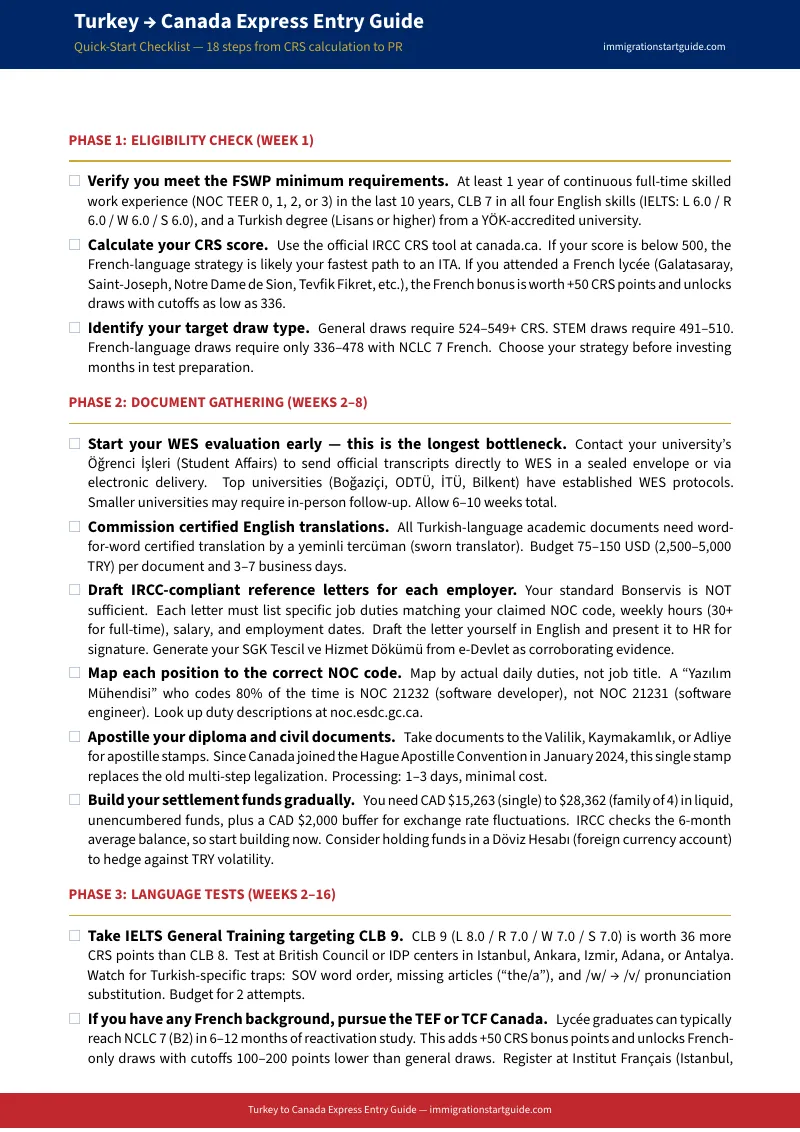
- Quick-Start Checklist (checklist.pdf) — every step from CRS calculation to PR card, with the exact sequence, government fees, processing times, and the parallel task structure that runs WES, IELTS, and funds accumulation simultaneously
- CRS Score Worksheet (crs-worksheet.pdf) — fillable worksheet that calculates your current score, identifies the point gaps, and maps each gap to the specific action that closes it — with the Skill Transferability crossover table that shows exactly how many points each half-band IELTS improvement adds at your education level
- WES Document Checklist (wes-checklist.pdf) — one-page checklist of every document WES requires for Turkish degrees, organized by degree type (On Lisans, Lisans, Yuksek Lisans), with the transcript delivery method for major Turkish universities and common rejection reasons
- Document Tracking Worksheet (document-worksheet.pdf) — fillable tracker for all required IRCC documents with apostille authority reference, validity windows, and the generation timing that prevents documents from expiring before your application is assessed
- PNP Targeting Card (pnp-card.pdf) — one-page reference mapping your NOC code and CRS score to the best Provincial Nominee pathway, with OINP Tech Draw occupations, BC PNP Tech eligible roles, draw frequency, and recent score thresholds
- IELTS Strategy Card (ielts-card.pdf) — Turkish-specific test tactics for each IELTS module addressing SOV word order reversion, /w/ and /θ/ pronunciation substitution, Aorist-to-Perfect tense confusion, and the Signposting technique for Speaking
- Proof of Funds Calculator (funds-calculator.pdf) — fillable worksheet with the IRCC minimum by family size, TRY-to-CAD conversion timing strategy, bank letter format requirements, and the deposit window relative to your application date
The Free Checklist vs. The Full Guide
The free Quick-Start Checklist gives you the critical action items — every step from CRS calculation through WES application, IELTS booking, e-Devlet document generation, apostille workflow, Express Entry profile creation, and draw monitoring. It is enough to see the full scope of what stands between you and Canadian PR, and to identify the long-lead-time items (WES evaluation, IELTS preparation, proof of funds accumulation) that need to start moving immediately.
The full guide gives you how — plus seven standalone printable tools you will use throughout the process: the CRS Score Worksheet that maps your exact point gaps to specific actions. The WES Document Checklist with university-specific transcript procedures. The Document Tracking Worksheet to manage your apostille and translation chain. The PNP Targeting Card that tells you whether Ontario, BC, or Alberta is your best Provincial Nominee path. The IELTS Strategy Card with Turkish-specific test tactics for every module. The Proof of Funds Calculator with TRY conversion timing. Eight PDFs total — the complete system from CRS calculation to PR card.
— Less Than One Hour of a Visa Consultant's Time
A Turkish immigration consultant charges TRY 80,000 to 320,000 for navigational knowledge that covers document preparation but leaves you without the CRS optimization strategy, the IELTS tactics designed for Turkish linguistic patterns, the Provincial Nominee targeting logic, the WES university-specific procedures, or the proof of funds conversion timing. The consultant walks your documents. The guide builds your entire migration system.
If the information in one chapter — the Skill Transferability math that shows you a half-band IELTS improvement is worth 50-60 CRS points (not five), the WES walkthrough that prevents a transcript rejection and a six-week restart, the e-Devlet walkthrough that prevents your police certificate from being rejected for using the wrong version, the PNP targeting that reveals you can receive an ITA at 467 instead of waiting for a 524 general draw, or the proof of funds timing that prevents your TRY savings from falling below the CAD threshold — saves you a single rejected application or a single missed draw cycle, the guide has paid for itself before you finish the first chapter.
100% satisfaction guaranteed. If the guide does not meet your expectations, email [email protected] for a full refund.