
You Have the Degree, the Skills, and the Job Offer. But Between You and a German Residence Permit Is an iDATA Appointment That Takes Four to Six Months in Istanbul, an Anabin Database That May Not List Your Degree Title, and an Apostille Workflow That Nobody in the Facebook Group Explains Correctly.
You found the position on LinkedIn. The salary is three to four times what you earn in Istanbul. The company confirmed they sponsor skilled worker visas. And now you are sitting at your desk in Levent or Kavaklidere trying to figure out whether your engineering degree from ITU is listed as "H+" or "H+/-" in a German database called Anabin that does not have a Turkish interface, does not explain its own classification system, and may list your university as fully recognized but your specific degree title as unmatched — which means the embassy rejects your application even though your institution is technically approved.
Meanwhile, you registered on iDATA three weeks ago and the system tells you the wait for a skilled worker visa appointment in Istanbul is four to six months. Izmir is one to three months but you live in Ankara. You do not know whether the wait resets if you miss the 60-day confirmation email, whether you can register at multiple consulates simultaneously, or whether the Section 81a fast-track procedure — which your employer has never heard of — would cut the wait to three weeks. Nobody in the "Almanya'da Yasam" Facebook group agrees on any of this.
You need an apostille for your diploma, your criminal record, and your population registry extract. Turkey is in the Hague Convention, so the process is simpler than in some countries — but you still need to know that the Adli Sicil Kaydi must be the "Yabanci Ulke / Apostil" version from e-Devlet (not the domestic one), that your diploma apostille comes from the Valilik (not the Kaymakamlik), and that the sworn translation must be done after the apostille stamp (not before). One wrong sequence and you redo the entire document. And the criminal record expires in six months, so if the iDATA appointment takes longer than expected, you generate a new one and apostille it again.
The Turkish Lira has lost over 50 percent of its real purchasing power against the Euro since 2023. Your savings in TRY are shrinking every quarter. A senior developer in Istanbul earning TRY 100,000 per month may feel affluent in nominal terms, but the same person in Berlin earning EUR 65,000 gross takes home EUR 3,300 net per month — denominated in a currency that does not lose 15 percent of its value every year. The salary gap is not three-to-one. It is three-to-one plus compounding currency stability for every year you remain.
You are not short on qualifications. You are short on a systematic method for navigating the Turkish e-government system, the German recognition framework, and the iDATA appointment bottleneck — all at the same time, in the right sequence, before the deadlines expire.
The Turkey-to-Germany Migration System
This is not a generic skilled worker visa explainer — you can find those on make-it-in-germany.com. This is the Turkey-specific operational system for every step where the German immigration process collides with Turkish institutional reality: the e-Devlet menu selections that generate embassy-valid documents (not the domestic versions that get rejected). The Anabin status for every major Turkish university — ODTU, Bogazici, ITU, Bilkent, Koc, Sabanci, Hacettepe, Ankara, Istanbul, and the newer foundation universities — with the degree-title matching rules that determine whether you need a EUR 200 ZAB evaluation or not. The iDATA appointment strategy that keeps your registration alive through the confirmation cycle. The five visa pathways — Blue Card, IT Specialist without a degree, Skilled Worker (academic and vocational), and Chancenkarte — mapped to your specific qualifications. The 2026 parent reunification pathway that lets your anne and baba join you legally. And the Section 81a fast-track with the draft email your German employer sends to cut the wait from six months to three weeks.
Immigration consultants in Turkey charge TRY 30,000 to 80,000 for advice that covers document preparation but none of the Anabin verification method, none of the iDATA timing strategy, and none of the salary threshold logic that determines whether your contract survives the January threshold increase. Immigration lawyers charge TRY 150,000 to 500,000. The government fees for the entire apostille and translation chain total approximately TRY 5,000-10,000. The system in this guide replaces the consultant's navigational knowledge with a step-by-step protocol you execute yourself, for a fraction of one document's consulting fee.
What Is Inside
Five Visa Pathways with Decision Logic
The EU Blue Card is the gold standard — permanent residency in 21 months with B1 German, spouse joins without language requirement, EU-wide mobility after 12 months. But the Blue Card requires a salary above EUR 50,700 (standard) or EUR 45,934 (shortage occupations: IT, engineering, healthcare). If you are a self-taught developer with two years of experience but no degree, the IT Specialist pathway (Section 19c) works at EUR 41,040. If you have no job offer, the Chancenkarte gives you 12 months in Germany to find one — if you score 6 points and deposit EUR 13,092 in a blocked account. The guide maps every pathway to your specific situation so you do not waste months applying on the wrong one.
Anabin Turkish University Status Table
The complete H+, H+/-, and H- classification for every major Turkish university — ODTU, Bogazici, ITU, Bilkent, Koc, Sabanci, Hacettepe, Ankara, Istanbul, Ege, Dokuz Eylul, Bahcesehir, Yeditepe, Baskent, and the newer foundation universities. But the institution status is only half the check. The guide explains the degree-title matching problem: your university may be H+ but your specific degree title (Bilgisayar Muhendisligi vs. Makine Muhendisligi vs. the German equivalent listed in Anabin) may not appear in the entry, triggering a mandatory ZAB Statement of Comparability that costs EUR 200 and takes two to four months. The guide shows you how to verify the exact title match before you apply, so you know whether you need the ZAB evaluation — and if you do, how to use the Blue Card fast-track procedure that cuts processing to two to four weeks.
e-Devlet Document Generation Walkthrough
Turkey's e-government system is an enormous advantage — most documents can be generated digitally with verifiable barcodes. But the wrong version of a document gets your application rejected. The guide walks through the exact e-Devlet menu selections for each required document: the Adli Sicil Kaydi with the "Yabanci Ulke / Apostil" option (not the domestic version), the Tam Vukuatli Nufus Kayit Ornegi (the full detailed version, not the abbreviated Ozet), and the YOK Diploma Sorgulama as supporting documentation. Each with the apostille authority, the fee, the processing time, and the sworn translation requirement.
iDATA Appointment Strategy
The iDATA system is the single largest bottleneck for Turkish applicants. Istanbul wait times run four to six months. Ankara is similar. Izmir is one to three months. The guide covers the registration process, the 60-day confirmation cycle (miss it and your position is deleted), the slot release patterns reported by Turkish developer communities, and the critical Section 81a Accelerated Procedure for Skilled Workers — a EUR 411 fee paid by your German employer that guarantees an embassy appointment within three weeks. Most German SMEs do not know this procedure exists. The guide includes a draft email template in English that you send to your employer's HR department explaining the process, the legal basis, and the fee — so they initiate it without you having to explain German immigration law over a video call.
2026 Salary Thresholds and the Decision Date Trap
The standard Blue Card threshold for 2026 is EUR 50,700 per year. The reduced threshold for shortage occupations is EUR 45,934. But the threshold that matters is the one in effect on the day the embassy decides your case, not the day you signed the contract. If you sign for EUR 46,500 in October and the threshold rises in January before your visa is processed, your application is rejected. The guide maps the threshold schedule, the shortage occupation list for 2026, and the salary buffer strategy for contracts signed in the danger zone between October and December.
Military Service and Bedelli Askerlik
Turkish males under 41 who have not completed military service face travel restrictions. The guide covers the askerlik status check via e-Devlet, the Bedelli Askerlik paid exemption (approximately TRY 243,013 for one month of training), the deferment (Tecil) option that can be managed through the Turkish Consulate in Germany after arrival, and the process for resolving your status before departure. This is not optional reading — it determines whether you can physically leave Turkey.
English-Speaking Job Search from Turkey
A curated strategy for finding skilled-worker-qualifying roles from Istanbul, Ankara, or Izmir without C1 German. The guide maps the English-first company tiers — Tier 1 (SAP, Zalando, Delivery Hero, N26, Personio, Siemens), Tier 2 (AWS, Google, Meta German offices), Tier 3 (Berlin and Munich startup ecosystem) — with the job portals that reach them (LinkedIn, StepStone, Indeed Germany, XING for Mittelstand companies, WeAreDevelopers). The AHK Turkiye (German-Turkish Chamber of Commerce) programs. The CV format that German ATS systems expect — which is not the same as the Turkish CV with a photo and personal details. And the salary negotiation framework with German market benchmarks by role and city, so you negotiate above the threshold with room to spare.
Goethe-Institut Istanbul, Ankara, and Izmir Language Plan
German is not legally required for the Blue Card if your work language is English. But B1 German cuts your path to permanent residency from 33 months to 21 months — saving a full year of employer dependency. The guide maps the Goethe-Institut infrastructure in Istanbul (Beyoglu), Ankara, and Izmir with 2026 course fees, intensive and blended learning options, and the timeline from A1 to B1 for professionals who cannot attend daily classes while working full-time.
2026 Parent Reunification Pathway
Starting in 2026, Germany allows Blue Card holders to bring their parents — a pathway that did not exist before. The guide covers the eligibility criteria, the financial requirements, and the application process. For Turkish professionals whose anne and baba are a major factor in the decision to move, this changes the calculation entirely.
City-by-City Settlement Guide with Turkish Community Infrastructure
Three million people of Turkish origin live in Germany. The guide maps Turkish community density, Turkish-speaking services, cost of living, and job market by city: Berlin (largest Turkish community, startup hub, affordable rent), Munich (engineering and automotive, higher salaries but higher costs), Hamburg (logistics and maritime engineering), Frankfurt (finance and IT), Dusseldorf and Cologne (manufacturing and Mittelstand). Each with the Turkish supermarkets, mosques, cultural centers, and professional networks that reduce settlement friction to near zero.
6-Month Execution Timeline
The complete migration timeline from first Anabin check to German residence permit: Month 1 for Anabin verification, ZAB application if needed, and iDATA registration. Months 1-3 for e-Devlet document generation, apostille workflow, and sworn translations (running in parallel with job search). Month 3-4 for iDATA appointment (or three weeks with Section 81a). Month 4-5 for visa processing and blocked account setup. Month 5-6 for arrival, Anmeldung registration, residence permit conversion, and health insurance enrollment. With the parallel task structure that runs documents, job search, and language study simultaneously instead of sequentially.
Who This Is For
- Turkish STEM professionals — software developers, data scientists, DevOps engineers, mechanical and electrical engineers — who have a German job offer or are actively searching and need the complete Turkey-specific roadmap from Anabin check to residence permit
- IT specialists without a traditional degree who qualify under the Section 19c pathway allowing two or more years of professional experience in lieu of a university degree, and need to understand how to document Turkish work experience via SGK records for the German system
- Engineers from ODTU, Bogazici, ITU, Bilkent, Koc, Sabanci, Hacettepe, and other Turkish institutions who need to verify whether their specific degree title matches the Anabin entry before investing months in the apostille and translation chain
- Healthcare professionals — doctors, dentists, pharmacists — who face the additional Approbation requirement and need B2/C1 German, and want to plan the language timeline alongside the visa process
- Turkish males under 41 who must resolve military service status or arrange Bedelli Askerlik before departure
- Anyone who has been waiting three or more months for an iDATA appointment and wants to know whether the Section 81a fast-track procedure applies to their situation
- Professionals considering the Chancenkarte who want to understand whether the points system, the EUR 13,092 blocked account, and the 12-month job search window make sense for their situation
Why Not Facebook Groups, YouTube, or the Official German Portal?
Facebook groups like "Almanya'da Yasam" and "Almanya'da Calisma" are where someone tells you the iDATA wait is "two months" without mentioning they applied from Izmir, not Istanbul. Where another person says Anabin H+ means automatic approval without checking the degree-title match. Where a third person claims the domestic Adli Sicil Kaydi is fine for the embassy because "it worked for a friend last year." The advice is contradictory, undated, and impossible to verify against the current 2026 thresholds and procedures.
YouTube videos give you a ten-minute overview of the Blue Card requirements without walking you through the e-Devlet menu selections, the Anabin degree-title verification method, the iDATA confirmation cycle, or the Decision Date salary trap. The information is generic, anecdotal, and filmed under rules that change annually.
Make it in Germany is the official portal. It explains what the skilled worker visa is. It does not explain how to generate the correct e-Devlet document versions for the embassy, which apostille authority handles your diploma versus your criminal record, how to keep your iDATA registration alive through the 60-day confirmation cycle, or what to do when your university is H+ but your degree title does not match the Anabin entry. Official portals describe the destination. They do not map the Turkish starting point.
Your Options
- DIY from free resources — Facebook groups, Reddit, official portals. Cost: TRY 0. Risk: wrong e-Devlet document version, missed iDATA confirmation, incomplete apostille chain. One rejection means another four to six months waiting for a new appointment.
- This guide — the complete Turkey-specific system. Cost: . Covers the five visa pathways, Anabin verification, e-Devlet walkthrough, iDATA strategy, apostille workflow, military clearance, job search, language plan, parent reunification, and settlement guide.
- Immigration consultant — Turkish agencies or danismanlik firms. Cost: TRY 30,000-80,000. Covers document preparation but not Anabin degree-title verification, iDATA timing strategy, or salary threshold logic.
- Immigration lawyer — Turkish or German law firms. Cost: TRY 150,000-500,000. Full representation. Appropriate for complex cases with prior rejections or regulated professions.
What You Get
The guide includes everything designed for your complete migration process — 8 printable PDFs:
- Complete Guide (guide.pdf) — 11 chapters covering visa pathway selection, Anabin verification with Turkish university status table, e-Devlet document walkthrough with exact menu selections, apostille workflow, iDATA appointment strategy with Section 81a fast-track, salary thresholds and Decision Date trap, military service and Bedelli Askerlik, job search strategy with ATS-compatible CV format, Goethe-Institut language plan, 2026 parent reunification pathway, city-by-city settlement guide with Turkish community infrastructure, and the long-term pathway to permanent residency and citizenship
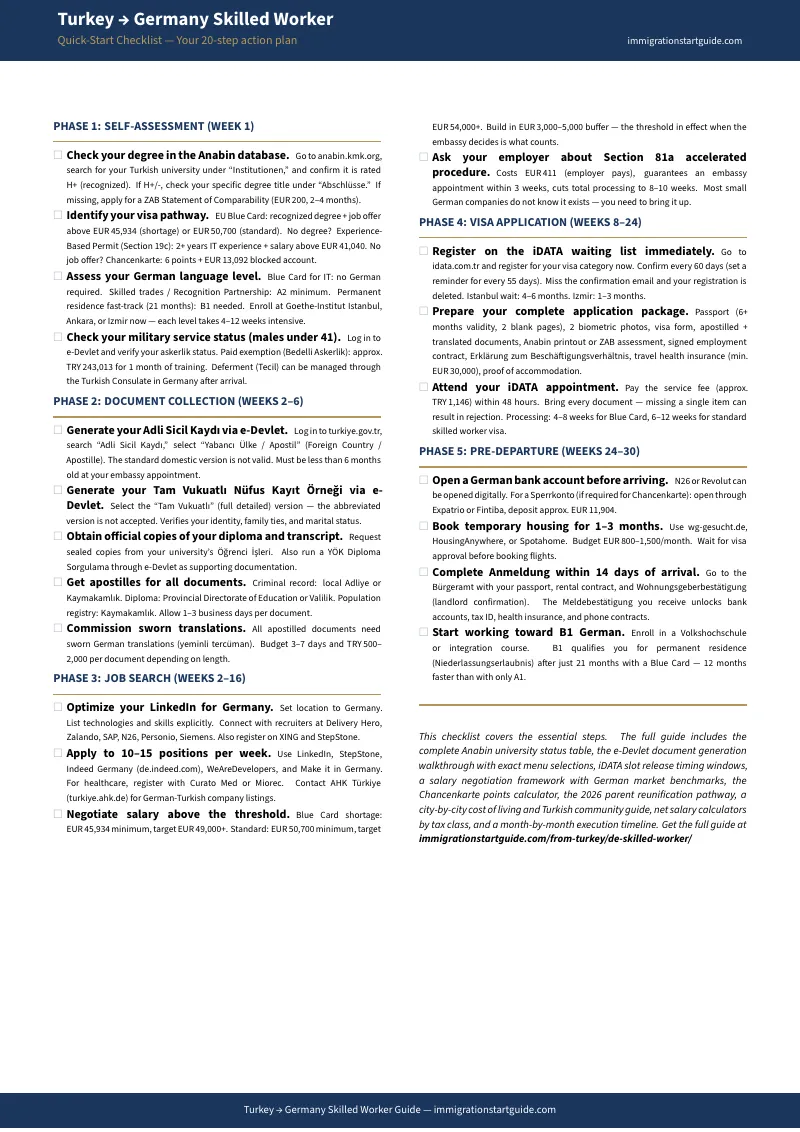
- Quick-Start Checklist (checklist.pdf) — every step from Anabin verification to residence permit, with the exact sequence, government fees, processing times, and the parallel task structure that runs documents, job search, and language study simultaneously
- Visa Pathway Selector (visa-pathway-selector.pdf) — one-page decision table mapping your qualifications to the right visa pathway, with all 2026 salary thresholds and the Chancenkarte points calculator
- Anabin University Table (anabin-university-table.pdf) — H+, H+/-, and H- status for every major Turkish university, the 8-step Anabin check procedure, and when you need the ZAB evaluation
- Document Tracking Worksheet (document-checklist-worksheet.pdf) — fillable tracker for all 15 required documents with apostille authority reference, sworn translation tracker, and pre-submission verification checklist
- iDATA Strategy Card (idata-strategy-card.pdf) — the iDATA registration process, 60-day confirmation trap, consulate wait times, slot release timing windows, and the Section 81a fast-track procedure with employer script
- Settlement Checklist (settlement-checklist.pdf) — week-by-week action items for your first 30 days in Germany, from Anmeldung to apartment search, with city-by-city rent budgets
- Salary Threshold Card (salary-threshold-card.pdf) — all 2026 visa salary thresholds, net pay examples by tax class, monthly deduction rates, and the Decision Date trap warning
The Free Checklist vs. The Full Guide
The free Quick-Start Checklist gives you the critical action items — every step in the apostille chain, the Anabin check, the iDATA registration, and the order to tackle them. It is enough to see the full scope of what stands between you and a German residence permit, and to identify the long-lead-time items (ZAB evaluation, iDATA registration, Goethe-Institut enrollment) that need to start moving immediately.
The full guide gives you how — plus six standalone printable tools you will use throughout the process: the Visa Pathway Selector that maps your qualifications to the right visa type. The Anabin University Table with H+ status for every major Turkish institution and the degree-title matching method. The Document Tracking Worksheet to manage your apostille and translation chain. The iDATA Strategy Card with the 60-day confirmation trap, slot release windows, and Section 81a employer script. The Settlement Checklist for your first 30 days in Germany. And the Salary Threshold Card with net pay examples and the Decision Date trap. Eight PDFs total — the complete system from Anabin check to Anmeldung.
— Less Than One Document's Consulting Fee
A Turkish immigration consultant charges TRY 30,000 to 80,000 for navigational knowledge that covers document preparation but leaves you without the Anabin degree-title verification method, the iDATA timing strategy, the salary threshold logic, the job search protocol, or the settlement plan. The consultant walks your documents. The guide builds your entire migration system.
If the information in one chapter — the Anabin degree-title verification that prevents a four-month ZAB delay you did not plan for, the Decision Date awareness that prevents a salary-based rejection after months of waiting, the Section 81a email template that cuts your iDATA wait from six months to three weeks, the e-Devlet walkthrough that prevents your criminal record from being rejected for using the wrong version, or the military clearance protocol that prevents you from being stopped at the airport — saves you a single rejected application or a single month of delay, the guide has paid for itself before you finish the first chapter.
100% satisfaction guaranteed. If the guide does not meet your expectations, email [email protected] for a full refund.