
You Have the Job Offer from Booking.com, Adyen, or ASML. But Between You and a Dutch Residence Permit Is an IND Application That Your Employer Has Never Filed for a Turkish Citizen, a 30% Tax Ruling That Evaporates If You Sign the Contract While Physically in the Netherlands, and an e-Devlet Screen That Generates Three Different Versions of Your Criminal Record — Only One of Which the IND Accepts.
You found the role on LinkedIn. The salary is EUR 70,000 — three to four times what you earn in Istanbul. The company says they sponsor Kennismigrant permits. And now you are sitting at your desk in Levent or Kavaklidere trying to figure out whether your employer knows that Turkish citizens pay EUR 85 in IND fees instead of EUR 423, whether the Ankara Agreement means you do not actually need a recognized sponsor, whether you should tell them about this or let them file the standard way, and whether flying to Amsterdam for a "trial week" before signing the contract will permanently disqualify you from the 30% tax ruling that would save you tens of thousands of euros over the next five years.
Meanwhile, you know Turkey has an advantage here. You have heard about the Ankara Agreement — something about lower fees and faster labor market access. But the details are scattered across Dutch legal websites in juridisch Nederlands, Turkish law blogs that reference 1970s protocols without explaining what they mean in 2026, and Reddit threads where someone claims Turks do not need an MVV entry visa while someone else insists the IND rejected them for not having one. The information exists, but nobody has assembled the Turkey-specific operational sequence from e-Devlet document generation through IND approval through 30% ruling application through BSN registration into a single system.
You need the Adli Sicil Kaydi from e-Devlet — but the version with "Yabanci Ulke / Apostil" selected (not the domestic version). You need the Tam Vukuatli Nufus Kayit Ornegi — the full detailed census, not the abbreviated Ozet version that gets rejected. You need an apostille from the Kaymakamlk for administrative documents and from the Adalet Komisyonu for judicial ones. You know Turkey issues "Formula A" and "Formula B" multilingual certificates that eliminate the need for sworn translations in the Netherlands — but you are not sure whether the IND actually accepts them or demands Dutch translations anyway.
The Turkish Lira has lost over 50 percent of its purchasing power against the Euro since 2023. Your savings in TRY shrink every quarter. A senior developer earning TRY 100,000 per month in Istanbul feels affluent domestically, but the same person earning EUR 75,000 in Amsterdam — with the 30% ruling reducing their taxable income by EUR 22,500 per year — takes home a net salary denominated in a currency that does not lose 15 percent of its value annually. The gap is not three-to-one. It is three-to-one plus compounding currency stability for every year you remain, plus the 30% ruling's cumulative tax savings of EUR 50,000 to 100,000 over five years. But one procedural mistake — signing the contract in Amsterdam, selecting the wrong e-Devlet document version, missing the 150km residence proof — and those savings vanish permanently.
You are not short on qualifications. You are short on a systematic method for leveraging the Ankara Agreement advantages that exist specifically for Turkish citizens, navigating the e-Devlet system for IND-valid documents, and securing the 30% tax ruling before the window closes in 2027.
The Istanbul-to-Amsterdam Migration System
This is not a generic Kennismigrant explainer — you can find those on ind.nl and business.gov.nl. This is the Turkey-specific operational system for every step where Dutch immigration law collides with Turkish institutional reality: the e-Devlet menu selections that generate IND-valid documents (not the domestic versions that get rejected). The Ankara Agreement provisions that reduce your IND fee from EUR 423 to EUR 85, eliminate the recognized sponsor requirement, give you full labor market freedom in three years instead of five, and exempt you from the RVO points system if you choose the self-employment pathway. The 30% tax ruling application with the 150km rule proof, the "recruited from abroad" requirement that breaks if you visit the Netherlands on a tourist visa before signing, and the 2025-2027 legislative transition that drops the benefit from 30% to 27% starting in 2027. The Dovizle Askerlik military exemption for males under 41. And the operational timeline that sequences everything — e-Devlet documents, apostilles, IND application, 30% ruling, BSN registration, housing, healthcare — in parallel instead of sequentially.
Immigration lawyers in the Netherlands charge EUR 2,000 to 5,000 for Ankara Agreement cases. Turkish avukatlar charge TRY 60,000 to 185,000. The IND application fees for a Turkish citizen total EUR 85. The system in this guide replaces the lawyer's navigational knowledge with a step-by-step protocol you execute yourself, for a fraction of one consultation's fee.
What Is Inside
The Ankara Agreement Decoded
The 1963 Association Agreement and the 1970 Additional Protocol create a "Turkish exception" in Dutch immigration law that most employers — and most Turkish applicants — do not fully understand. The guide maps every concrete advantage: the EUR 85 IND fee (vs. EUR 423 for other non-EU nationals). The exemption from the recognized sponsor requirement — meaning a Turkish engineer can work for any Dutch company, including startups and SMEs that cannot afford the EUR 5,080 sponsor registration fee. The 3-year path to full labor market freedom (vs. 5 years for Americans, Indians, and Chinese nationals). The 6-month job search period if you leave your employer (vs. 3 months for other HSMs). The exemption from civic integration requirements for permanent residency. The lower age threshold for dependent partners (18 vs. 21). And the self-employment pathway that bypasses the 300-point RVO system entirely. Each advantage is mapped to the specific legal article, the IND procedure it affects, and the exact step in your application where it applies.
30% Tax Ruling Calculator and Application Strategy
The 30% ruling allows your employer to pay up to 30% of your gross salary tax-free — intended to cover "extraterritorial costs" of living abroad. On a EUR 80,000 salary, that is EUR 24,000 per year that never enters the 49.5% Dutch tax bracket. Over five years, the cumulative savings range from EUR 50,000 to over EUR 100,000 depending on your salary level. But the ruling has requirements that are easy to violate without knowing: you must have lived more than 150km from the Dutch border for 16 of the 24 months before your first working day. You must be "recruited from abroad" — not locally. If you fly to Amsterdam for a trial period, sign the contract while physically present, or change your Turkish residence registration before the contract is signed, the Belastingdienst classifies you as locally recruited, and the ruling is permanently lost. The guide covers the 150km proof using your Yerlesim Yeri Belgesi from e-Devlet, the timing sequence between contract signature and relocation, the 2025-2027 legislative transition (30% drops to 27% starting 2027 for new applicants), and the abolition of partial foreign tax liability — which means your Turkish real estate and investments now face Dutch Box 3 wealth taxation unless protected by the Turkey-Netherlands tax treaty.
e-Devlet Document Generation Walkthrough
Turkey's e-government infrastructure is a genuine advantage — most documents can be generated digitally with verifiable barcodes that the IND can authenticate online. But the wrong version of a document gets your application rejected, and e-Devlet offers multiple versions of the same document with no indication of which one the IND requires. The guide walks through the exact menu path for each required document: the Adli Sicil Kaydi with "Yabanci Ulke / Apostil" selected (not the domestic version), the Tam Vukuatli Nufus Kayit Ornegi (the full detailed census, not the Ozet), the Yerlesim Yeri Belgesi (residence certificate for the 150km rule), the SGK Tescil ve Hizmet Dokumu (social security history proving professional experience), and the YOK Diploma Sorgulama. Each with the apostille authority (Kaymakamlik for administrative, Adalet Komisyonu for judicial), the fee, the processing time, and whether the Formula A/B multilingual certificate eliminates the sworn translation requirement.
Kennismigrant Application with the Turkish Exemptions
The standard Kennismigrant application assumes a recognized sponsor files on the migrant's behalf, with a 2-week processing time. The Turkish pathway is different in ways that most employers do not know. A Turkish professional does not legally need a recognized sponsor — any Dutch company that meets the salary requirements can hire them, opening the door to thousands of startups and SMEs. But the trade-off is a 90-day processing time instead of 2 weeks. The guide covers both scenarios: the fast track with a recognized sponsor (Booking.com, Adyen, ASML, Optiver, Mollie, Flow Traders) and the slower non-sponsor route for smaller companies. The 2026 salary thresholds: EUR 5,942 per month for professionals 30 and older, EUR 4,357 for under 30 (excluding 8% holiday allowance). The reduced threshold for top-200 university graduates. The MVV entry visa debate — whether Turkish nationals are exempt under the Standstill Clause. And the employer communication template that explains the Turkish fee reduction and non-sponsor option, so your future employer does not overpay or reject your application for the wrong reason.
Self-Employment Under the Ankara Agreement
If you prefer the freelance or entrepreneurial route, the Ankara Agreement provides Turkish citizens with the most favorable self-employment pathway in Dutch immigration law. While an American or Indian entrepreneur must pass the RVO 300-point system (100 points for experience, 100 for business plan, 100 for added value, minimum 30 in each), a Turkish applicant is assessed only on business viability — can the business sustain you without social assistance? The guide covers KvK (Chamber of Commerce) registration, the business plan structure the RVO expects from Turkish applicants, the capital documentation rules (EUR 5,000-10,000 recommended, with six months of bank statements showing legitimate accumulation), and the common rejection triggers — unexplained lump-sum deposits, insufficient proof of professional qualifications, and financial projections that do not meet the sociale bijstandsnorm. Plus the 3-year path to full labor market freedom, which means you can pivot from freelancing to salaried employment without a new permit.
Military Service and Dovizle Askerlik
Turkish males between 20 and 41 who have not completed military service face travel restrictions that can prevent departure. The guide covers the askerlik status check via e-Devlet, the Dovizle Askerlik paid exemption (approximately TRY 243,013 for those who have lived abroad for 1,095 days — which means three years of legal employment in the Netherlands qualifies you), the deferment (Tecil) option manageable through the Turkish Consulate in The Hague or the Amsterdam Baskonsoloslugu after arrival, and the age-based exemptions. For males in the 20-41 window, this chapter determines whether you can physically board the plane.
Credential Evaluation and Nuffic/IDW Assessment
The Dutch government uses the Nuffic/IDW system to evaluate Turkish degrees — determining whether your diploma is classified as HBO (applied university) or WO (research university). This classification matters for the 30% ruling reduced salary threshold and for certain employer requirements. Graduates from Bogazici, ODTU, ITU, and Koc typically receive WO equivalence. The guide covers the IDW application process (10 working weeks in 2026), the YOK equivalency for regulated professions, and how the credential evaluation intersects with the Kennismigrant salary thresholds.
BSN Registration, Housing, and the Amsterdam Survival Guide
Within five days of arrival, you must register with your local Gemeente to receive your BSN — the number required for everything from opening a bank account to receiving your first salary. The guide covers the BRP registration process with the apostilled documents you prepared in Turkey, the 2026 RNI restriction (non-EU nationals can now only get a BSN through Breda or Venlo — not Amsterdam or The Hague), the housing crisis (Amsterdam 1-bedroom city center: EUR 2,200-2,600, Eindhoven: EUR 1,300-1,600), the relocation housing strategy for the first 1-2 months, mandatory health insurance enrollment within four months, and the Dutch banking system. Plus the practical integration details: the Turkish professional networks in Eindhoven (TPN-E for ASML/Philips engineers), TurkTechDiaspora in Amsterdam, and the ITU ARI Teknokent partnership with CIC Rotterdam for Turkish tech entrepreneurs.
The 2025-2027 Window Strategy
Turkish professionals face a narrowing opportunity. The 30% ruling drops from 30% to 27% for those starting employment from 2027 onward — a difference of EUR 3,000-5,000 per year on a typical tech salary. The Kennismigrant salary thresholds are projected to increase significantly in 2027 beyond the standard 2-3% indexation. And the partial foreign tax liability abolition (effective 2025) means new arrivals must pay Dutch wealth tax on Turkish assets. The guide maps the optimal timing: when to sign the contract, when to relocate, and how to structure the transition to lock in the higher 30% benefit before the legislative change takes effect.
6-Month Execution Timeline
The complete migration timeline from first e-Devlet document generation to BSN registration: Month 1 for e-Devlet documents, apostille workflow, and Nuffic/IDW credential evaluation submission. Months 1-3 for IND application processing (2 weeks with recognized sponsor, up to 90 days without). Month 2-3 for MVV biometrics at the Dutch Consulate in Ankara or Istanbul (if required). Month 3-4 for 30% ruling application submission. Month 4-5 for arrival, Gemeente registration, BSN receipt, and health insurance. Month 5-6 for bank account, DigiD activation, and first salary with 30% ruling applied. With the parallel task structure that runs document preparation, credential evaluation, and housing search simultaneously instead of sequentially.
Who This Is For
- Turkish software engineers, data scientists, and DevOps professionals who have a job offer from a Dutch tech company — Booking.com, Adyen, ASML, Optiver, Mollie, Flow Traders, TomTom, Philips — or are actively searching, and need the complete Turkey-specific system from e-Devlet documents through IND approval through 30% tax ruling
- Engineers and researchers from Bogazici, ODTU, ITU, Bilkent, Koc, and Sabanci who qualify for the Kennismigrant reduced salary threshold as top-200 university graduates and want to verify their Nuffic/IDW credential equivalence before applying
- Turkish IT freelancers and consultants who want to establish a ZZP or BV in the Netherlands under the Ankara Agreement self-employment pathway — bypassing the 300-point RVO system that applies to all other non-EU entrepreneurs
- Finance professionals in Istanbul's banking sector targeting Optiver, Flow Traders, ABN AMRO, or ING — where the 30% ruling on salaries above EUR 100,000 creates tax savings exceeding EUR 15,000 per year
- Turkish males under 41 who must resolve Dovizle Askerlik military exemption or arrange Tecil deferment through the Turkish Consulate before or after departure
- Professionals considering both Germany and the Netherlands who want to understand why the Ankara Agreement advantages — EUR 85 fees, no recognized sponsor requirement, 3-year labor market freedom, no civic integration for PR — make the Dutch pathway structurally different from the German one
- Turkish entrepreneurs and startup founders who want to leverage the Ankara Agreement's viability-only business plan assessment to establish in the Netherlands without the standard points-based RVO evaluation
Why Not Expat Blogs, YouTube, or the IND Website?
Expat forums and Reddit threads are where someone tells you Turks do not need an MVV without mentioning the IND rejected their friend for not having one last month. Where another person says the recognized sponsor requirement does not apply to Turks, which is technically correct, but does not explain that skipping the sponsor extends processing from 2 weeks to 90 days. Where a third person claims the 30% ruling is "automatic" without mentioning the 150km residence proof, the recruited-from-abroad requirement, or the fact that visiting Amsterdam on a tourist visa before signing the contract can permanently disqualify you. The advice is contradictory, undated, and impossible to verify against 2026 thresholds and procedures.
YouTube videos give you a fifteen-minute overview of the Kennismigrant permit without explaining the Ankara Agreement fee reduction, the non-sponsor exemption, the e-Devlet menu selections for IND-valid documents, the 30% ruling application timing relative to your contract signature date, or the Dovizle Askerlik military clearance. The information is generic, filmed under rules that change annually, and assumes you are applying from a country without Turkey's unique legal advantages.
The IND website explains what the Kennismigrant permit is. It does not explain how to generate the correct e-Devlet document versions for the IND, which apostille authority handles your criminal record versus your diploma, how the Ankara Agreement reduces your fee from EUR 423 to EUR 85, why signing the contract in Amsterdam destroys your 30% ruling eligibility, or what the 3-year labor market freedom pathway means for your career flexibility. Official portals describe the destination. They do not map the Turkish starting point.
Your Options
- DIY from free resources — expat forums, Reddit, official portals. Cost: EUR 0. Risk: wrong e-Devlet document version, lost 30% ruling from signing the contract in the Netherlands, unresolved military status at the airport, 90-day processing delay from skipping the recognized sponsor without knowing the trade-off.
- This guide — the complete Turkey-specific system. Cost: . Covers the Ankara Agreement advantages, e-Devlet document walkthrough, Kennismigrant application with Turkish exemptions, 30% tax ruling strategy, self-employment pathway, military clearance, credential evaluation, housing and BSN registration, and the 6-month execution timeline.
- Dutch immigration lawyer — Amsterdam or The Hague firms specializing in Ankara Agreement cases. Cost: EUR 2,000-5,000. Full representation. Appropriate for complex cases with prior rejections or self-employment applications requiring RVO negotiation.
- Turkish avukat — Istanbul or Ankara immigration practices. Cost: TRY 60,000-185,000. Document preparation and consulate coordination. Often does not cover 30% ruling strategy, Nuffic credential evaluation, or Dutch-side settlement logistics.
What You Get
The guide includes everything designed for your complete migration process:
- Complete Guide (guide.pdf) — Ankara Agreement advantages with specific legal articles, e-Devlet document generation with exact menu selections, apostille workflow with authorities and fees, Kennismigrant application with Turkish exemptions and employer communication template, 30% tax ruling strategy with 150km proof and 2025-2027 legislative transition, self-employment pathway under the Ankara Agreement with business plan structure, military service and Dovizle Askerlik, Nuffic/IDW credential evaluation, BSN registration and the 2026 RNI restriction, housing strategy for Amsterdam and Eindhoven, healthcare enrollment, Turkish professional networks, and the 2025-2027 window strategy for maximizing the 30% benefit
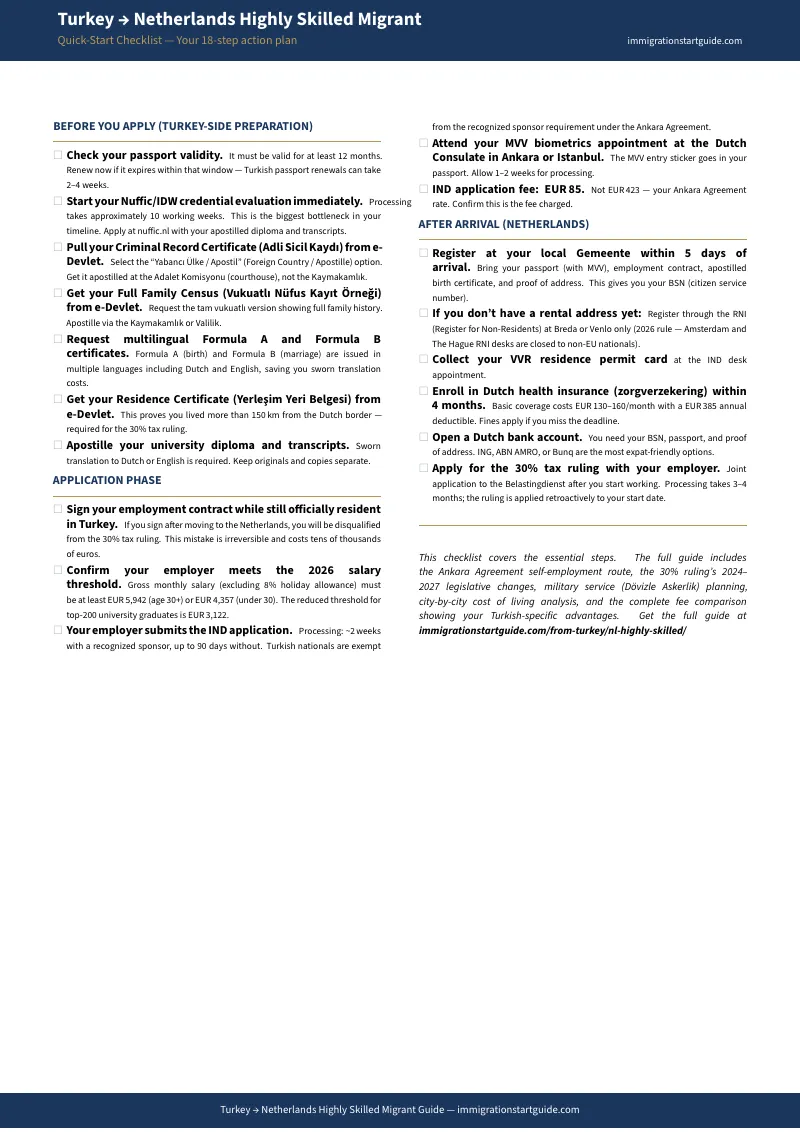
- Quick-Start Checklist (checklist.pdf) — every step from e-Devlet document generation to BSN registration, organized by phase with government fees, processing times, and the parallel task structure that runs documents, IND application, 30% ruling, and housing search simultaneously
- Document Checklist (document-checklist.pdf) — printable one-page checklist of every document required for your IND application, organized by phase: Turkey-side preparation, employer documents, 30% ruling application, and upon arrival in the Netherlands
- Fee Comparison Card (fee-comparison.pdf) — one-page reference showing your Ankara Agreement fee for every IND application type versus the standard non-EU fee, with the exact savings per application and the family-of-three total
- Salary Thresholds Card (salary-thresholds.pdf) — one-page reference with 2025-2026 Kennismigrant thresholds by age bracket, the holiday allowance calculation, and the 30% ruling minimum taxable salary after deduction
- 30% Tax Ruling Calculator (tax-ruling-calculator.pdf) — fillable one-page worksheet to calculate your annual tax savings at any salary level, with an eligibility check, a worked example, and the 2027 rate reduction factored in
The Free Checklist vs. The Full Guide
The free Quick-Start Checklist gives you the critical action items — every step in the e-Devlet document chain, the IND application, the 30% ruling, and the order to tackle them. It is enough to see the full scope of what stands between you and a Dutch residence permit, and to identify the high-stakes items (30% ruling timing, military clearance, credential evaluation) that cannot be deferred.
The full guide gives you how: the Ankara Agreement provisions mapped to every advantage you are entitled to as a Turkish citizen. The e-Devlet walkthrough with the exact menu selections that produce IND-valid documents. The 30% tax ruling application strategy with the 150km proof, the recruited-from-abroad requirement, and the contract-signing sequence that must happen while you are still registered in Turkey. The Kennismigrant application with the non-sponsor exemption explained and the employer communication template. The self-employment pathway with the viability-only business plan structure. The Dovizle Askerlik military exemption with the 1,095-day qualification and consulate deferment process. The Nuffic/IDW credential evaluation for Bogazici, ODTU, ITU, and other Turkish universities. The BSN registration with the 2026 RNI restriction. The Amsterdam and Eindhoven housing strategy with Turkish professional networks. And the 6-month execution timeline.
— Less Than One Hour of an Immigration Lawyer's Time
A Dutch immigration lawyer charges EUR 2,000 to 5,000 for an Ankara Agreement case. A Turkish avukat charges TRY 60,000 to 185,000. Both cover document preparation and application filing. Neither covers the 30% tax ruling application strategy, the recruited-from-abroad timing requirement, the Nuffic credential evaluation, the housing search, the BSN registration process, or the Turkish professional networks that smooth your first months in the Netherlands. The lawyer files your paperwork. The guide builds your entire migration system.
If the information in one chapter — the 30% ruling timing sequence that prevents you from permanently losing EUR 50,000-100,000 in tax savings by signing the contract in Amsterdam, the e-Devlet walkthrough that prevents your criminal record from being rejected for using the domestic version, the Ankara Agreement fee reduction that saves you EUR 338 on the IND application alone, the military clearance protocol that prevents you from being stopped at Ataturk Airport, or the self-employment exemption that bypasses the 300-point RVO system — saves you a single rejected application, a single lost tax ruling, or a single month of delay, the guide has paid for itself before you finish the first chapter.
100% satisfaction guaranteed. If the guide does not meet your expectations, email [email protected] for a full refund.