
Your CUAET Permit Expires. Your Canadian Life Does Not Have To.
You moved here to survive. You stayed because Canada became home. Your kids are in school. You found work. You learned the bus routes and the grocery stores and the way the snow sounds different in Saskatchewan than it does in Kyiv. And now the permit that made all of this possible has a countdown on it.
The CUAET open work permit extension deadline is March 31, 2027. After that, there is no renewal. No second extension. No emergency program. If you do not have permanent residency or an active PR application in a qualifying inventory by then, every piece of the life you built here becomes temporary again.
You already know this. The anxiety is not new. What is new is the confusion about what to actually do. Your settlement agency has a six-week wait for a 30-minute appointment. Your Telegram group says there is a "new TR-to-PR portal opening in 2026" — there is not. Your Facebook group says CUAET holders get "automatic extensions" — they do not. A lawyer quoted you CAD $3,500 and your warehouse job pays $18 an hour. The IRCC website has the right information buried under 47 pages of bureaucratic language that assumes you already know the difference between CEC, FSW, SINP, and AAIP.
Meanwhile, you have an engineering degree from KPI and you are loading pallets at a distribution center because nobody told you that a single conversation with your shift manager about an internal promotion to "Logistics Coordinator" would move you from TEER 4 to TEER 2 — and start your 12-month clock for Canadian Experience Class eligibility.
The Ukraine to Canada CUAET/PR Pathway Guide is a Status Transition System — a single document that replaces the fragmented advice, the contradictory Telegram threads, the overwhelmed settlement workers, and the impenetrable government websites with one clear, step-by-step framework for getting from temporary status to permanent residency. It covers every pathway available to CUAET holders in 2026, with the wartime documentation workarounds, the career bridging strategies, and the provincial nomination analysis that no free resource, community group, or $200-per-hour settlement consultant provides in one place.
What Is Inside the Status Transition System
Situational Pathway Decision Framework
You do not need to understand every PR pathway in Canada. You need to know which one applies to your situation — your current province, your NOC code, your language level, your work experience. The decision framework walks you through a structured assessment that directs you to the right pathway based on where you are right now: Express Entry CEC if you have 12 months of skilled work, Saskatchewan SINP if you have 6 months in-province, Alberta Opportunity Stream if you are in Calgary or Edmonton, or the Rural Community Immigration Pilot if you are in a smaller centre. One framework, not 14 government websites.
Career Bridge Strategy
Because your Ukrainian engineering degree should not mean another year in the warehouse. This section maps the internal promotion pathways that move you from TEER 4/5 (warehouse associate, delivery driver, kitchen helper) to TEER 2/3 (logistics coordinator, shift supervisor, office administrator) — often within the same employer. It covers the NOC 2021 classification system in plain language, identifies the exact job titles that qualify as "skilled" work for CEC purposes, and provides the conversation framework for requesting a role change that your employer will agree to because it costs them nothing. For professionals with Ukrainian degrees, it also covers the funded retraining programs — Better Jobs Ontario ($28,000 in training funding), TRU Trades Foundation programs, and provincial bridging programs — that create a direct path to TEER 2/3 employment in healthcare, skilled trades, and technology.
Provincial Nominee Program Navigator
The PNP is where most CUAET holders will get their PR, and the differences between provinces are enormous. Saskatchewan lets you apply after 6 months of work with CLB 4 English. Alberta requires 12 months but has priority processing for tech and healthcare. Ontario is score-based and brutally competitive. BC requires 2 years of experience for most streams. Manitoba has a Temporary Resident Retention Pilot designed for exactly your situation. This section gives you the province-by-province analysis — eligibility requirements, processing times, priority sectors, and the honest assessment of which provinces are realistic for your profile — so you can make a relocation decision based on data, not on which Facebook group has the most confident opinions.
In-Canada Workers Initiative Decoder
The most misunderstood program in Canadian immigration right now. Half the Telegram channels say it is a "new TR-to-PR portal." It is not. It is a backlog management tool that fast-tracks 33,000 people who already have active PR applications in specific inventories — PNP, Atlantic Immigration Program, Rural Community Immigration Pilot, Caregiver Pilots, or Agri-Food Pilot. If you are not already in one of those inventories, waiting for this initiative is not a strategy. Getting into one of those inventories as fast as possible is a strategy. This section explains exactly what the initiative does, who it benefits, and the specific steps to position yourself to catch the fast-track wave.
Wartime Document Solutions
Your diploma is in a building that no longer exists. Your birth certificate was in an apartment in Mariupol. Your work experience letters are from an employer whose office was destroyed. The standard ECA process requires original documents that you cannot obtain because of the war — and nobody at the settlement agency has time to explain the alternative. This section covers the WES Digital Bridge (the secure file transfer protocol with Ukraine's Ministry of Education), the DIGIFLOW platform for post-2016 credentials, and the IRCC missing document procedures — including the statutory declaration templates (Form IMM 0191) with the specific language that meets IRCC's "consistency and credibility" standard. Because losing your documents to a war should not mean losing your PR application.
CRS Score Optimization Playbook
If you are targeting Express Entry, your Comprehensive Ranking System score determines whether you receive an Invitation to Apply or sit in the pool indefinitely. This section covers every controllable factor: language test strategy (CLB 7 vs. CLB 9 is a 50+ point difference), education credential assessment timing, spousal factors, Canadian work experience thresholds, and the provincial nomination that adds 600 points and effectively guarantees an invitation. It also covers the category-based selection draws that IRCC runs for specific occupations — healthcare, STEM, trades, transport, agriculture — and whether your NOC code qualifies.
Application Assembly Guide
The actual filing process, step by step. IRCC Portal account creation, document upload specifications, fee payment ($1,365 per adult, $230 per child for PR), biometrics scheduling, medical exam booking, and the timeline from submission to decision. Includes the common rejection triggers specific to CUAET holders — gaps in work history, inconsistent addresses across forms, and the employment letter format that IRCC officers expect — so you do not discover a fixable error after a 12-month processing wait.
Standalone Printable Tools
Four standalone PDFs you can print and use immediately: the PR Pathway Decision Tree (a flowchart that directs you to the right pathway based on your TEER, province, and language level), the Document Checklist Worksheet (fillable tracker for every document your PR application requires), the Statutory Declaration Template (ready-to-use language for the IRCC declaration when Ukrainian documents are missing due to the war), and the PNP Comparison Table (one-page province-by-province reference card for eligibility, language, and processing times).
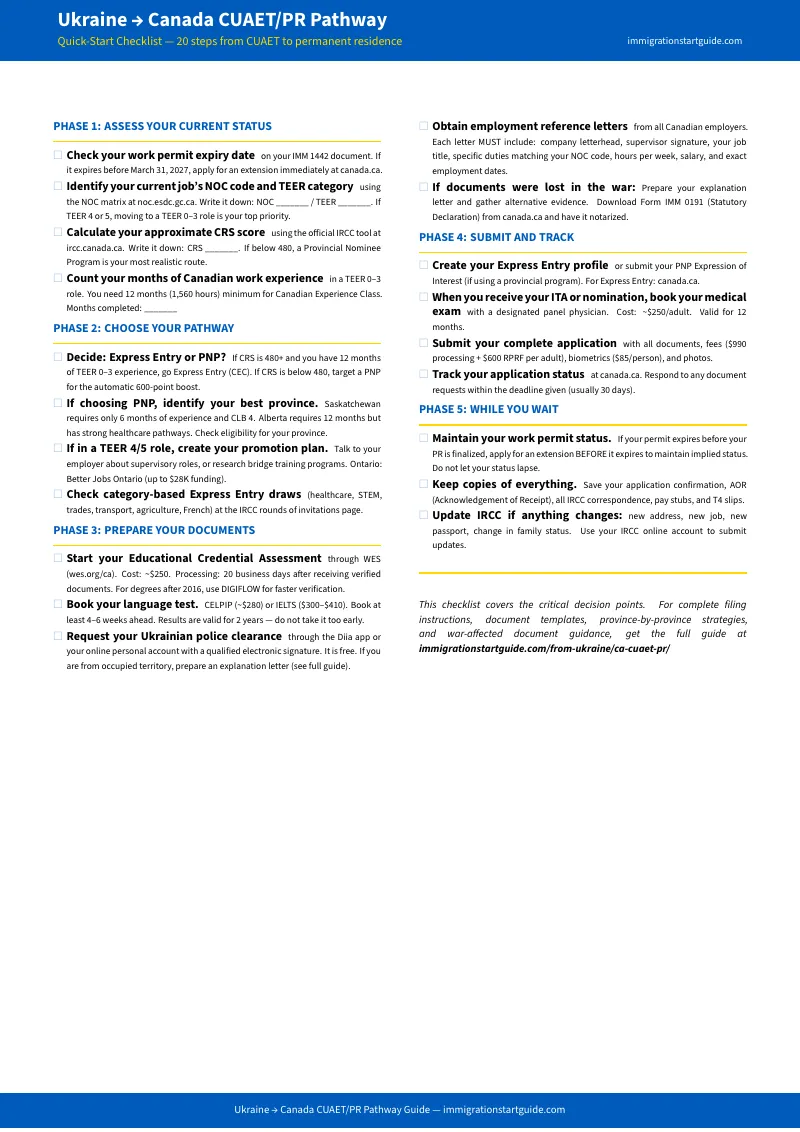
Quick-Start Checklist (free download)
The critical first steps distilled into a single printable page: confirm your current permit status and expiry date, identify your NOC code, check your language test scores against CLB requirements, determine which PR pathway fits your profile, and gather your core documents. Enough to take your first strategic step tonight.
Who This Guide Is For
This guide is for Ukrainians in Canada on CUAET or other temporary status who need a clear path to permanent residency before their permits expire:
- You arrived under CUAET in 2022 or 2023 and your open work permit expires in 2026 or 2027 — you need to know which PR pathway gives you the best chance with the time you have left
- You have a Ukrainian university degree but you are working in a TEER 4/5 role — warehouse, kitchen, delivery — and you need the career bridging strategy that moves you into CEC-eligible employment without starting over
- You are in Saskatchewan, Alberta, or Manitoba and you have heard that provincial nomination is "easier" but you do not know the specific eligibility requirements, processing times, or whether your occupation qualifies
- Your documents were lost or destroyed in the war and you need the IRCC-approved alternative evidence procedures — statutory declarations, digital verification, explanation letter templates — not guesswork from a Facebook group
- You are supporting family in Ukraine on a Canadian warehouse salary and a lawyer's $3,500 fee is not realistic — you need the same strategic framework at a fraction of the cost
- You have been waiting for the "new TR-to-PR program" that Telegram keeps promising, and you need someone to tell you clearly what the In-Canada Workers Initiative actually is and what you should be doing instead of waiting
Why Not Free Resources?
Free information about CUAET and PR pathways exists. Here is what it actually delivers:
- IRCC and Canada.ca provide the official requirements — accurate, comprehensive, and written in bureaucratic language that assumes you already understand the difference between CEC, FSW, PNP, SINP, AAIP, and AIP. You will learn that you need "12 months of full-time skilled work experience in a TEER 0, 1, 2, or 3 occupation." You will not learn that your current warehouse job is TEER 4 and that a conversation with your manager about a title change could fix that in a week.
- Settlement agencies (UCC, SISA, local newcomer centres) are overwhelmed. Wait times stretch to six weeks for a 30-minute appointment that covers general advice. The counsellors are doing heroic work with impossible caseloads, but they do not have time to build a personalised pathway strategy for your specific NOC code, province, and language level.
- Facebook and Telegram groups are where misinformation spreads fastest. "CUAET holders get automatic PR." "There is a new portal opening in June." "You do not need an ECA if you have a Ukrainian degree." Every one of these claims is wrong, and every one of them has been repeated hundreds of times by well-meaning people who do not know the regulatory details. A single bad piece of advice — like waiting for a program that does not exist — can cost you the remaining months on your permit.
- Immigration lawyers and RCICs provide excellent, personalised service. They also charge CAD $2,000 to $5,000. For a family sending money to relatives in Ukraine while earning entry-level Canadian wages, that fee is a month's rent. The guide does not replace a lawyer for complex legal disputes. It replaces the $2,000 spent learning which pathway to pursue, what documents to gather, and how to structure an application that does not get rejected for a preventable error.
This guide fills the gap between free confusion and expensive certainty. It provides the structured, verified, situation-specific framework that no free resource delivers — at a fraction of what a lawyer charges for the same strategic clarity.
— Less Than One Hour of a Lawyer's Time
An RCIC charges CAD $200 to $350 per hour. A full-service PR application runs CAD $2,000 to $5,000. A single rejected application means months of reprocessing, additional fees, and the risk of your permit expiring while you wait.
The guide does not replace legal representation for appeals or complex humanitarian cases. But it gives you the pathway analysis, the career bridging strategy, the document solutions, and the application assembly framework that prevent the filing mistakes that trigger rejections — the ones that cost thousands in additional fees and months you do not have. If you are self-filing, it is your complete roadmap. If you are hiring a lawyer, it transforms you from a confused client into a prepared one who saves billable hours and gets a stronger application.
Money-back guarantee, no time limit. If the guide does not give you a clear, actionable path to PR, you pay nothing.
Download the free Quick-Start Checklist to identify your pathway tonight. When you are ready for the full Career Bridge Strategy, the Provincial Nominee Navigator, the wartime document templates, and the complete Status Transition System, the full guide is here.
Your permit has an expiry date. Your preparation does not have to wait.