
You Have a Ky Su Degree From Bach Khoa, Six Years of Software Development at FPT Software, a PTE Score of 72, a Points Calculation of 80 — and No Invitation to Apply. You Have Read Every Post in "Dinh Cu Uc Dien Tay Nghe." You Have Used the Points Calculator Seventeen Times. Your Score Has Not Changed. What Has Changed Is That Two Colleagues Who Started After You Have Already Received Their State Nominations — and One of Them Had a Lower PTE Score. The Difference Was Not Their English. It Was That Someone Told Them the ACS Would Deduct Five Years Because Their Transcript Was Classified as "Minor," That Western Australia Was Running an Offshore Nomination Window for Their ANZSCO Code, and That VssID Records — Not Just a Reference Letter — Were Now Required as Third-Party Employment Evidence.
You have decided to move to Australia. You have done the research, taken the PTE, calculated your points score, and studied the occupation lists. You have read the Department of Home Affairs website. You have joined the Facebook groups — Dinh cu Uc, Dinh cu Uc dien tay nghe, Nguoi Viet tai Uc. You have watched the SkillSelect invitation rounds, checking whether the cut-off dropped into your range. It has not. You are sitting in the EOI pool with tens of thousands of other candidates, watching the 189 threshold hover between 90 and 95 while your score sits at 80. You are 30 years old. Every birthday after 32 costs you 5 points. And the migration agents in District 1 are telling you the only solution is to pay them 80 to 200 million VND to "manage your file" — or worse, to enroll in an Australian Master's program at 600 million to 1.5 billion VND so you can come back through the post-study work visa in two years.
Nobody told you there was a direct option. The offshore skilled migration option.
The du hoc agencies will not tell you because they earn commissions when you enroll. The migration agents will not tell you because a self-filing applicant does not pay agent fees. The Facebook groups will not tell you because the most active "helpful members" work for agencies. And the Department of Home Affairs website tells you the rules but not how to use the rules from inside the Vietnamese system — how to get the ACS to classify your Bach Khoa transcript as "Major" instead of "Minor" when the difference is a 2-year deduction versus a 5-year deduction and 5 points on the board, how to get a detailed employment reference letter when your HR department only issues a standard Giay xac nhan kinh nghiem lam viec, how to export your VssID social insurance records as third-party evidence when the case officer asks for employment verification beyond your reference letter, how to apply for Ly lich tu phap so 2 (not so 1 — so 1 is useless for Australian migration) through the Cong dich vu cong quoc gia when the processing takes 10 to 20 days and nobody tells you to start it first.
The Vietnamese skilled migration applicant faces friction that no British, Indian, or Filipino applicant faces. Your degree is classified differently by the ACS. Your engineering program requires a Competency Demonstration Report because Vietnam is not a Washington Accord signatory. Your employment reference letters do not match the format case officers expect. Your social insurance records need to be extracted from VssID and certified. Your criminal record certificate has two versions and only one is accepted. Your PTE is solid but the invitation threshold demands Superior — and the 5 NAATI CCL points available from a Vietnamese-English interpreting test that most applicants have never heard of could be the difference between a two-year wait and a three-month nomination.
The Vietnam to Australia Skilled Migration Guide is the Points Accelerator System — the complete Vietnam-specific GSM filing system that replaces the 80 to 200 million VND migration agent and prevents the 600 million to 1.5 billion VND study-abroad detour. This is not a translation of the Department of Home Affairs website. This is not generic skilled migration advice written for applicants in London or Delhi. This is the guide built specifically for Vietnamese IT, engineering, nursing, and accounting professionals who have the qualifications to get permanent residency through Subclass 189, 190, or 491 but are losing points to bureaucratic friction that is unique to the Vietnamese administrative system.
What's Inside the Points Accelerator System
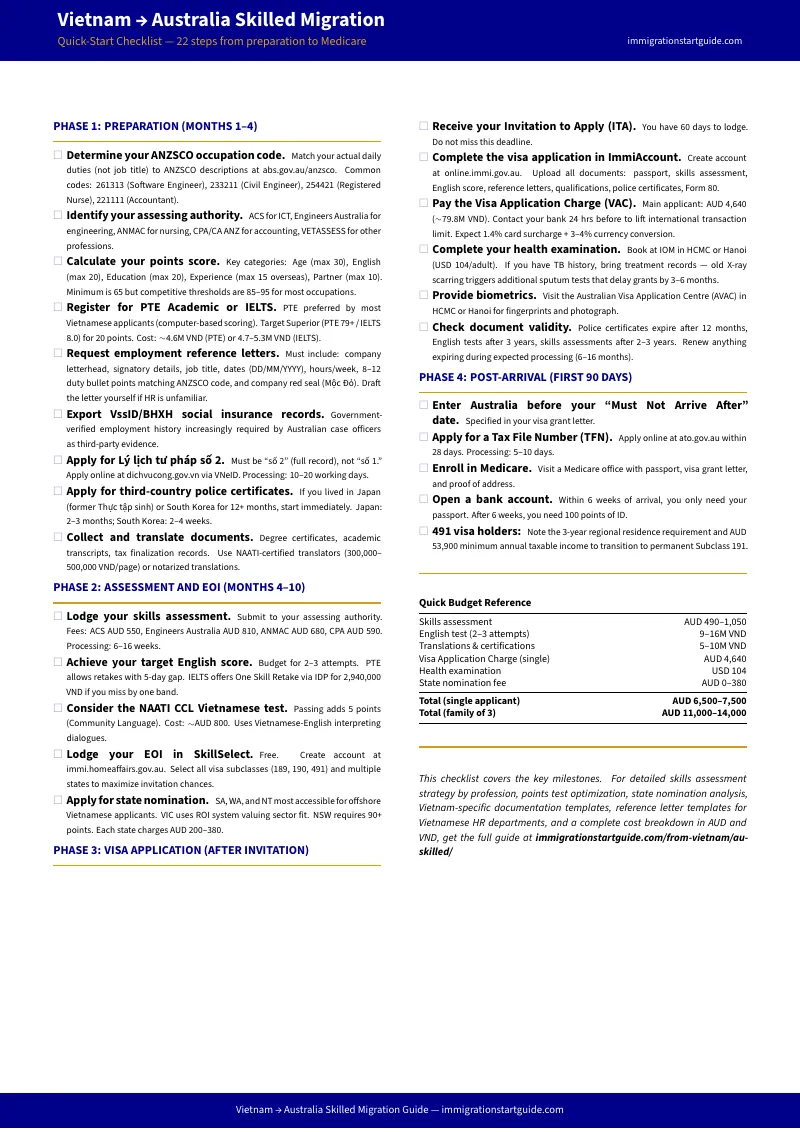
Twelve chapters, a quick-start checklist, and eight standalone printable tools covering every step from your first points calculation through your first 90 days in Australia:
The ACS Experience Deduction Playbook for Vietnamese IT Professionals
The ACS does not simply count your years of work experience. It calculates a "Skill Level Requirement Met Date" by deducting years of experience — and the size of that deduction depends on how the ACS classifies your Vietnamese degree. A Bach Khoa Computer Science graduate with a closely related ICT major loses 2 years. But if your transcript is classified as "Minor" — because your program was labeled Electrical Engineering or Mechatronics despite containing heavy programming and embedded systems content — the deduction jumps to 5 years. Suddenly your 8 years of real experience becomes 3 years of claimable experience, dropping you from 10 points to 5 points. The guide covers how to request a detailed transcript from your university's Phong Dao tao that lists every subject with its credit hours, how to prepare a supplementary document highlighting all ICT-related subjects, and the specific classification criteria the ACS uses to determine Major versus Minor. For graduates of Bach Khoa Ha Noi (HUST), Dai hoc Bach Khoa TP.HCM (HCMUT), Dai hoc Quoc gia, and FPT University, the guide includes institution-specific notes on transcript formats and common classification outcomes.
The Engineers Australia CDR Pathway for Vietnamese Ky Su Graduates
Since Vietnam is not a full signatory to the Washington Accord for most engineering programs, Vietnamese Ky su graduates must apply through the Competency Demonstration Report pathway — three Career Episodes of 1,000 to 2,500 words each, a Continuing Professional Development list, and a Summary Statement mapping your experience to EA's competency elements. Vietnamese engineers consistently struggle with the narrative style EA requires. Career Episodes should read like case studies, not job descriptions. The guide provides the exact format — "I identified a problem, I analyzed it using specific engineering principles, I designed a solution, I implemented it, here was the outcome" — with examples tailored to Vietnamese civil and electrical engineering projects. It also covers the HCMUT-UTS joint program exception that may allow you to bypass the CDR entirely if your specific program is accredited under the Washington Accord.
The Employment Reference Letter Crisis — Solved
Australian assessing authorities require a detailed reference letter that lists your job title, your duties aligned to the ANZSCO code, your hours per week, your employment dates in DD/MM/YYYY format, and your supervisor's signature on company letterhead with the company's Moc Do (red seal). Vietnamese HR departments issue a standard Giay xac nhan kinh nghiem lam viec — a one-paragraph confirmation of dates and title. No duties. No hours. When you ask HR to write the Australian-format letter, they refuse because they have never seen the format or they are uncomfortable signing a detailed English document. The guide provides three ready-to-use bilingual templates: one for cooperative HR departments, one for situations where your direct supervisor writes the letter instead of HR, and one for when your company refuses entirely and you need a Statutory Declaration witnessed by a Cong chung vien (Notary Public). For IT professionals at FPT Software, Viettel, VNPT, VNG, and major tech companies, the guide includes company-specific notes on which departments handle these requests.
The VssID Employment Verification Strategy
Australian case officers have become increasingly rigorous about verifying employment claims. A reference letter alone is no longer enough — they want third-party evidence. The VssID app provides government-verified BHXH (Bao hiem xa hoi) records showing your employer name, contribution dates, and salary basis for every job you have held. The guide covers how to export your full contribution history, how to handle the salary discrepancy issue (where your BHXH records show a lower declared salary than your actual compensation), and how to combine VssID records with bank statements and labor contracts into a document package that satisfies the case officer's employment verification requirements without triggering additional information requests.
The State Nomination Targeting Engine
State nomination is where strategy separates the applicants who receive invitations in three months from those who wait two years. Not all states treat offshore Vietnamese applicants the same. NSW requires 90+ points and targets a narrow Critical Skills List. Victoria uses an ROI system that prioritizes applicants whose experience matches their "Growth Sectors" — a Software Engineer working in renewable energy may be invited over one with 10 more points in generic IT support. Western Australia is aggressively recruiting offshore engineers and construction professionals from Southeast Asia. South Australia has historically been open to offshore applicants at lower points thresholds. The Northern Territory offers the lowest points requirements of any state with a 3-year commitment. The guide provides a state-by-state analysis with current occupation priorities, points thresholds, nomination fees, and offshore acceptance rates — so you can target your EOI to the states most likely to nominate you, rather than waiting indefinitely for a 189 invitation that requires 95 points.
The Points Optimization Engine
Your points score is not fixed. It is a function of decisions you have not made yet. The guide maps every legal point-gaining strategy available to a Vietnamese applicant, ranked by effort-to-points ratio. The highest-ROI strategy that almost no Vietnamese applicant uses: the NAATI CCL Vietnamese-English test. Passing adds 5 Community Language points. The test assesses your ability to interpret dialogues — not translate technical documents — and Vietnamese applicants have a natural advantage. Five points may sound small, but in a system where the difference between an invitation and a two-year wait is often exactly 5 points, the NAATI CCL test (approximately 800 AUD) has one of the highest returns of any investment in the entire process. The guide also covers the partner skills strategy (5 to 10 points if your spouse achieves Competent English or a positive skills assessment), the PTE versus IELTS decision for Vietnamese speakers, and the timeline for pushing from Proficient (10 points) to Superior (20 points).
The Complete Cost Breakdown in VND
The full financial commitment of skilled migration from Vietnam to Australia, broken down in both AUD and VND: skills assessment fees (AUD 550 to 1,050 depending on your authority), English tests (budget for 2 to 3 attempts at 4.6 million VND each), the Visa Application Charge (AUD 4,640 for the main applicant — approximately 79.8 million VND), health examination (USD 104 at IOM Vietnam), state nomination fees (AUD 200 to 380), translation costs, and the credit card surcharges that add 5 to 8 million VND to the VAC payment alone. Total budget: 112 to 241 million VND depending on family size and profession. The guide covers how to lift your Vietnamese credit card's international transaction limit before paying the VAC, the Wise account alternative that avoids the 3 to 4 percent bank conversion markup, and the PayPal backup option when the Home Affairs payment gateway declines your card.
The Vietnamese Document Pipeline
The Ly lich tu phap so 2 (not so 1 — so 1 is for domestic use and does not contain the information the Department of Home Affairs requires) takes 10 to 20 working days through the Cong dich vu cong quoc gia using your VNeID. The skills assessment takes 6 to 16 weeks. Your PTE score is valid for 3 years. Your police certificate is valid for 12 months. Your medical exam is valid for 12 months. If you lived in Japan as a Thuc tap sinh, the Japanese police certificate takes 2 to 3 months from the embassy in Hanoi. If you lived in South Korea, the Korean police certificate takes 2 to 4 weeks. The guide sequences every document by processing time and validity period so you start the longest items first, avoid expiry conflicts, and arrive at your invitation with every document current and correctly prepared.
The 18 to 24 Month Roadmap
A realistic timeline broken into six phases — Preparation, Skills Assessment, SkillSelect and State Nomination, Visa Lodgement, Processing, and Visa Grant — with parallel tracks so you are not doing things sequentially when they can overlap. The guide shows you how to prepare for your PTE while gathering documents for your skills assessment, how to apply for police certificates while waiting for your assessment result, and how to have your Form 80 and health examination ready before your invitation arrives so you can lodge within the 60-day deadline without scrambling.
Australia vs. Canada — A Strategic Comparison
Many Vietnamese professionals debate between Australia and Canada. The guide provides a fact-based comparison across climate compatibility (Australia's 15 to 30 degrees versus Canada's minus 20 degree winters), salary and tax (Australia's higher nominal wages and lower average tax rate of 23.6 percent versus Canada's 28 percent), assessment complexity (Australia's rigorous skills assessment versus Canada's simpler ECA), PR speed (Canada is faster at 6 to 12 months versus Australia's 12 to 24 months), and community size (318,000 Vietnamese-born in Australia versus 240,000 in Canada). The guide also explains how to pursue both pathways simultaneously — there is no rule preventing parallel Australian and Canadian applications.
Plus 8 Standalone Printable Tools
Every major strategy in the guide is also available as a standalone printable PDF — designed to be printed, filled in, and used in the real world:
- Points Calculator Worksheet — fill in your age, English score, education, experience, and partner details to calculate your base, 190, and 491 scores against current competitive thresholds
- Bilingual Reference Letter Templates — three ready-to-print templates (cooperative HR, supervisor version, and Statutory Declaration) in English and Vietnamese that you hand directly to your employer
- ANZSCO Quick Reference Card — common occupation codes for Vietnamese IT, engineering, healthcare, and accounting professionals with assessing authorities and key duties
- State Nomination Comparison Card — all eight states side by side: offshore acceptance, points thresholds, nomination fees, and which states are best for your profile
- Complete Cost Breakdown in VND — every mandatory fee in AUD and VND, with grand totals for single, couple, and family scenarios
- Document Timing Planner — every document with its processing time and validity period, with blank columns for your actual dates so nothing expires before your visa grant
- 10 Common Mistakes Reference Card — the most common pitfalls Vietnamese applicants face, with one-line fixes for each
- Australia vs Canada Comparison — side-by-side decision aid covering climate, salary, tax, assessment complexity, PR speed, and Vietnamese community size
Who This Guide Is For
This guide is for Vietnamese professionals applying for Australian permanent residency through the GSM program from within Vietnam:
- IT professionals at FPT Software, Viettel, VNG, VNPT, and multinational tech companies who need the ACS to classify their Bach Khoa degree correctly — because the difference between "Major" and "Minor" is a 2-year deduction versus a 5-year deduction, and that costs you 5 points and months of waiting.
- Engineering graduates who need to write a Competency Demonstration Report for Engineers Australia — three Career Episodes in a narrative format that Vietnamese engineering education does not prepare you for, using competency elements that sound nothing like the way you describe your work in Vietnamese.
- Nurses who need ANMAC assessment and face the higher English threshold (IELTS 7.0 or PTE 65 minimum just for the assessment, before visa points even come into play) — and need to understand the 800-hour clinical placement documentation requirement.
- Accountants whose Vietnamese degrees from Foreign Trade University or UEH are missing Australian Taxation Law coverage — and need to know exactly which CPA bridging subjects to complete, how long they take, and how much they cost before their assessment can be converted to a positive result.
- Professionals whose HR departments refuse to write a detailed English-language reference letter — you need the bilingual templates, the Statutory Declaration alternative, and the VssID evidence strategy.
- Applicants stuck in the EOI pool with 75 to 85 base points who need a concrete strategy to close the gap — whether that is the NAATI CCL test, the partner skills bonus, a state nomination from WA or SA, the 491 regional pathway, or a combination.
- Professionals being pressured by migration agents to pay 80 to 200 million VND or by du hoc agencies to enroll in an Australian Master's at 600 million to 1.5 billion VND — you need to see the direct route before committing to the expensive route.
Why Not Free Information?
Because the free information in this market is structured around the interests of the people providing it, not the people consuming it.
- Facebook groups — Dinh cu Uc, Dinh cu Uc dien tay nghe, Nguoi Viet tai Uc — are saturated with agency employees and migration agents who answer questions in ways that lead to their services. They recommend skills assessment "assistance" (for a fee), reference letter "review" (for a fee), and EOI "optimization" (for a fee). The advice that would actually help you — that you can prepare the ACS transcript classification yourself, that you can draft the reference letter template and hand it to HR, that the NAATI CCL Vietnamese test adds 5 points for less than 14 million VND — does not generate revenue for anyone in the group.
- Migration agents charge 80 to 200 million VND for services that an informed applicant can perform independently. They provide genuine value for complex cases — partner visa complications, health waiver issues, character concerns — but for a straightforward GSM application by a qualified IT professional or engineer, the agent's value is primarily in document preparation and state nomination targeting. The same document preparation. The same targeting strategy. Available in this guide.
- The Department of Home Affairs website is accurate, comprehensive, and written for a global audience. It does not cover how to get the ACS to classify a Bach Khoa transcript as "Major." It does not cover how to handle a Vietnamese HR department that refuses the reference letter format. It does not cover the Ly lich tu phap so 2 versus so 1 distinction. It does not cover VssID as employment evidence. It does not cover which states are currently accepting offshore Vietnamese nominations.
- Du hoc agencies will never tell you that you can get PR directly through the GSM program without spending two years and over a billion VND on an Australian Master's. The study-then-work pathway generates commission for the agency. The direct offshore skilled migration pathway does not.
The Points Accelerator System exists because no single source in the Vietnamese market combines the Australian requirements with the Vietnamese administrative reality — the ACS transcript classification strategy, the CDR narrative format for Ky su graduates, the VssID export process, the reference letter bilingual templates, the state nomination targeting by offshore acceptance rate — in a format built for self-filing applicants who do not need an agent, they need the agent's knowledge.
— Less Than a Single PTE Test
A migration agent charges 80 to 200 million VND. A study-abroad pathway costs 600 million to 1.5 billion VND. The ACS skills assessment alone costs AUD 550 — and if your transcript is classified as "Minor" instead of "Major," you lose 5 points and 3 years of claimable experience. A single PTE test costs 4.6 million VND. The total mandatory government fees for skilled migration — Visa Application Charge, health examination, police certificates, biometrics, state nomination — exceed AUD 5,500 (approximately 95 million VND) for a single applicant. When you are already investing 95 million VND in mandatory fees before you even board a plane, the last thing you need is a 200 million VND agent fee on top.
This guide costs less than a single PTE test. It covers the ACS experience deduction playbook for Vietnamese IT degrees, the Engineers Australia CDR pathway for Ky su graduates, the employment reference letter bilingual templates, the VssID employment verification strategy, the state nomination targeting engine with offshore acceptance rates, the points optimization engine with the NAATI CCL and partner skills strategies, the complete cost breakdown in VND, the Vietnamese document pipeline with processing times and validity periods, the 18 to 24 month roadmap with parallel tracks, the Australia versus Canada strategic comparison, and the post-arrival guide for your first 90 days. The ACS transcript strategy alone can save you 5 points — the difference between sitting in the pool for two years and receiving a state nomination in the next round. The reference letter templates can prevent the single most common reason Vietnamese skilled migration applications are returned for additional information. The state nomination targeting can redirect your application from a 95-point NSW queue to a 75-point WA or SA pathway where your profile is exactly what the state is looking for.
You have the degree. You have the experience. You have the PTE score. You have the professional profile that Australia's migration system was literally designed to attract — IT professionals, engineers, nurses, accountants with years of skilled experience. What stands between you and permanent residency is not your qualifications. It is the gap between the Australian requirements and the Vietnamese administrative system — the transcript classification, the reference letters, the police certificate version, the VssID export, the state nomination strategy. Every one of these is solvable. Every one of them, if left to guesswork or to an agent who charges more than your quarterly salary, becomes an obstacle that costs you months, points, and hundreds of millions of dong.
Money-back guarantee, no time limit. If the ACS experience deduction playbook, the CDR pathway guidance, the employment reference letter templates, the VssID strategy, the state nomination targeting engine, the points optimization engine, the Vietnamese document pipeline, the cost breakdown, and the complete application walkthrough do not give you more actionable, Vietnam-specific guidance than anything you could assemble from Facebook groups, agent consultations, and the Department of Home Affairs website, you pay nothing.
Download the free Quick-Start Checklist to calculate your points score tonight, determine your ANZSCO code, check which states are currently accepting offshore nominations for your occupation, and start the Ly lich tu phap so 2 application — because the police certificate alone takes 10 to 20 working days, the Japanese police certificate takes 2 to 3 months if you lived there, and if you are waiting for an agent to tell you when to start these, you are already behind.
Your degree, your experience, and your PTE score already qualify you for a system that Australia built to find people exactly like you. The ACS classification, the CDR format, the reference letter templates, the VssID evidence, the state nomination strategy, and the document pipeline are the only things standing between you and your visa grant notification. Start the process today — because every month you wait is another month the invitation threshold could shift, another month closer to the age bracket that costs you 5 points, and another month the du hoc agencies spend trying to convince you that the expensive route is the only route. It is not.