
You Have a Bachelor's Degree From Bach Khoa, Three Years of Software Development Experience at FPT Software, an IELTS 7.0, a CRS Score of 471 — and No Invitation to Apply. You Have Read Every Post in "Du Hoc Va Dinh Cu Canada." You Have Watched Every YouTube Video on Express Entry. You Have Used the IRCC Calculator Fourteen Times. Your Score Has Not Changed. What Has Changed Is That Three Colleagues Who Started After You Have Already Received Their ITAs — and Two of Them Had Lower IELTS Scores. The Difference Was Not Their English. It Was That Someone Told Them About the French Bonus, the STEM Category-Based Draws, and the Fact That WES Would Assess Their Bang Ky Su as a Bachelor's Unless They Submitted the Transcript a Specific Way.
You have decided to move to Canada. You have done the research, taken the IELTS, calculated your CRS score, and created your Express Entry profile. You have read the IRCC website. You have joined the Facebook groups. You have watched the draw results every two weeks, checking whether the cut-off dropped below your score. It has not. You are stuck in the pool with 200,000 other candidates, watching the cut-off hover between 510 and 530 while your score sits at 470. You are 28 years old. Every birthday costs you points. And the consultants in District 1 are telling you the only solution is to pay them 50 to 150 million VND to "manage your file" — or worse, to enroll in a Canadian college at 300 to 800 million VND per year so you can come back through the Canadian Experience Class in three years.
Nobody told you there was a third option. The direct option.
The study-abroad agencies will not tell you because they earn commissions when you enroll. The consultants will not tell you because a self-filing applicant does not pay consultant fees. The Facebook groups will not tell you because the most active "helpful members" in Du hoc va Dinh cu Canada work for agencies. And the IRCC website tells you the rules but not how to use the rules from inside the Vietnamese system — how to get sealed transcripts with the moc giap lai from your university's Phong Dao tao when the staff have never heard of WES, how to get an employment reference letter in IRCC format when your HR department only issues a standard Giay xac nhan cong tac, how to get proof of funds when your family's wealth is in gold and real estate rather than a bank account, how to get the Phieu Ly lich Tu phap So 2 (not So 1 — So 1 is useless for immigration) from the Department of Justice when the processing takes three to four weeks and nobody tells you to start it first.
The Vietnamese Express Entry applicant faces friction that no Canadian, Indian, or Filipino applicant faces. Your degree is assessed differently. Your employment letters do not match the format. Your financial proof sits in assets that IRCC does not recognize. Your criminal record certificate has two versions and only one is correct. Your IELTS is solid but the cut-off demands more — and the 50 CRS points available from a French language test that takes six months of study is a secret hidden in plain sight on a government website that nobody in your Facebook group has ever mentioned, because nobody in your Facebook group has studied French since high school.
The Vietnam to Canada Express Entry Guide is the Direct Route System — the complete Vietnam-specific Express Entry filing system that replaces the 50 to 150 million VND consultant and prevents the 300 to 800 million VND per year study-abroad detour. This is not a translation of the IRCC website. This is not generic Express Entry advice written for applicants in London or Mumbai. This is the guide built specifically for Vietnamese IT, engineering, and healthcare professionals who have the qualifications to get permanent residency through Express Entry but are losing points to bureaucratic friction that is unique to the Vietnamese administrative system.
What's Inside the Direct Route System
Ten chapters, a quick-start checklist, and five standalone reference tools — the WES Document Preparation Kit, the Employment Reference Letter Templates, the CRS Optimization Worksheet, the Document Timeline Planner, and the Provincial Nominee Comparison Chart — covering every step from your first CRS calculation through your Confirmation of Permanent Residence:
The WES Evaluation Playbook for Vietnamese Degrees
WES does not evaluate your degree the way you think. A five-year Bang Ky su from Bach Khoa is assessed as a Bachelor's equivalent, not a Master's — and that costs you 30 to 40 CRS points. A Bang Cu nhan from a four-year program is assessed as a Bachelor's, but only if WES receives the correct combination of transcripts and degree certificate in the correct format. The guide covers the exact process for getting sealed transcripts with the moc giap lai from your university's Phong Dao tao, including the specific Vietnamese phrases to use when requesting documents from staff who have never processed a WES request. It covers how to handle bilingual versus Vietnamese-only degree certificates, when you need a certified translation through the Department of Justice versus when the university's English transcript is sufficient, how to avoid the $230 evaluation fee being wasted on a rejected submission, and the specific steps for graduates of Bach Khoa Ha Noi, Dai hoc Bach Khoa TP.HCM, Dai hoc Quoc gia, FPT University, and the major regional universities. If you hold both a Cu nhan and a separate Cao dang, the guide shows you how to submit both for the "two or more credentials" CRS bonus that most applicants do not know they qualify for.
The Employment Reference Letter Crisis — Solved
IRCC requires a reference letter that lists your job title, your duties aligned to the NOC code, your salary, your weekly hours, and your supervisor's signature on company letterhead. Vietnamese HR departments issue a standard Giay xac nhan cong tac — a one-paragraph confirmation of employment dates and title. No duties. No salary. No hours. When you ask HR to write the IRCC-format letter, they refuse because they have never seen the format, they do not want to disclose salary on a letter signed by a technical manager, or they are confused about whether the moc do (red seal) is required. The guide provides three ready-to-use templates: one for cooperative HR departments, one for situations where you need your direct manager to write the letter instead of HR, and one that combines the standard Giay xac nhan cong tac with supplementary evidence — So bao hiem xa hoi (social insurance book), bank statements showing monthly salary deposits, and labor contracts — into a single document package that satisfies IRCC's completeness check. For IT professionals at FPT Software, Viettel, VNPT, VNG, and major tech companies, the guide includes company-specific notes on which departments handle these requests and what language to use in the internal request email.
The CRS Optimization Engine — Including the French Bonus Nobody Mentions
Your CRS score is not fixed. It is a function of decisions you have not made yet. The guide maps every legal point-gaining strategy available to a Vietnamese applicant, ranked by effort-to-points ratio. The highest-ROI strategy that almost no Vietnamese applicant uses: the French language bonus. A CLB 7 in French (via TEF Canada or TCF Canada) combined with your existing English score adds 50 CRS points. In a pool where the cut-off fluctuates by 10 to 20 points between draws, 50 points is the difference between sitting in the pool for two years and receiving an ITA in the next draw. Vietnam is a member of La Francophonie. Many Vietnamese high schools — Chu Van An, Le Hong Phong, Tran Phu — have French language tracks. Even without prior French, the ROI of studying French for six months to achieve CLB 7 is dramatically higher than trying to push an IELTS 7.0 to an 8.0, which yields fewer points for more effort. The guide includes the TEF/TCF test schedule in Vietnam, the CLB-to-CRS point conversion, and the study timeline for Vietnamese speakers starting from zero.
The STEM Category-Based Draw Strategy
Since 2023, IRCC has run category-based draws that invite candidates based on occupation rather than overall CRS score. STEM draws have pulled candidates with scores as low as 480 — while the general draw cut-off sat at 530. If you are a software developer (NOC 21232), software engineer (NOC 21231), QA analyst (NOC 21233), database administrator (NOC 21223), or any of the dozens of STEM-eligible occupations, you may already qualify for a category-based invitation without changing anything about your profile. The problem: most Vietnamese applicants monitor only the general draw results. They see "530" and assume they are out. They do not know that a STEM-specific draw happened two weeks earlier at 488. The guide provides the complete STEM-eligible NOC list with the Vietnamese job title equivalents, the 12-month work experience requirement as of February 2026, and the specific language you need in your Express Entry profile to ensure your occupation maps correctly to the STEM category.
The Provincial Nominee Program Backup Plan
If your CRS score is below the federal draw cut-off even after optimization, a Provincial Nominee Program (PNP) nomination adds 600 points — effectively guaranteeing an ITA. The guide covers the three PNP streams most relevant to Vietnamese tech professionals: Ontario's Human Capital Priorities stream (OINP), which targets Express Entry candidates with tech experience and does not always require a job offer; British Columbia's Tech stream (BC PNP), which provides a prioritized pathway for 29 in-demand tech occupations with lower point thresholds; and Alberta's Express Entry stream (AINP), which targets specific occupations and has become increasingly accessible for STEM workers. For each stream, the guide covers the eligibility requirements, the application process, the typical processing time, and the strategy for positioning your profile to receive a provincial notification of interest.
The Vietnamese Document Pipeline
The Phieu Ly lich Tu phap So 2 (not So 1 — So 1 is for domestic use and does not contain the information IRCC requires) from the Department of Justice takes three to four weeks. The medical exam must be conducted at a panel physician designated by IRCC — and there are only a handful of authorised clinics in Hanoi and HCMC. The WES evaluation takes six to eight weeks after they receive your documents. Your IELTS score is valid for two years. Your medical exam is valid for 12 months. Your police certificate is valid for 12 months from issuance. The guide sequences every document by processing time and validity period so you start the longest items first, avoid expiry conflicts, and arrive at your ITA with every document current and correctly prepared. It covers the specific offices in Hanoi and HCMC where each document is processed, the forms required, the fees, and the processing times as of 2026.
The Proof of Funds Strategy for Vietnamese Applicants
A single applicant must demonstrate approximately $14,000 CAD (roughly 260 million VND) in liquid funds. In Canada, India, or the Philippines, applicants show bank statements. In Vietnam, wealth is held in gold, real estate, and cash. The guide covers how to convert non-liquid assets into acceptable proof, the specific bank account and deposit timeline IRCC expects, how to document a gift or family loan that does not trigger fraud suspicion, and the common mistakes Vietnamese applicants make when presenting proof of funds — including the danger of sudden large deposits that appear without a transaction history.
The Application Filing Walkthrough
The complete step-by-step process for creating your Express Entry profile, calculating your CRS score, submitting your profile to the pool, responding to an ITA within the 60-day deadline, uploading documents in the IRCC portal, scheduling biometrics at the VFS Global centre in Hanoi or HCMC, and tracking your application through to the Confirmation of Permanent Residence. Each step includes the specific fields, the formatting requirements, the common errors that trigger a Request for Additional Information, and the timeline for a Vietnamese applicant filing from within Vietnam.
Who This Guide Is For
This guide is for Vietnamese professionals applying for Canadian permanent residency through Express Entry from within Vietnam:
- IT and software professionals at FPT Software, Viettel, VNG, VNPT, and other tech companies who qualify for STEM category-based draws but do not know it — because every CRS calculator shows the general cut-off, not the occupation-specific thresholds that could put your 480 score above the line.
- Engineering graduates from Bach Khoa, Dai hoc Quoc gia, and regional technical universities who need their Bang Ky su or Bang Cu nhan assessed correctly by WES — and cannot afford to waste the $230 evaluation fee on a submission that gets rejected because the Phong Dao tao sealed the transcript incorrectly.
- Professionals whose HR departments refuse to write an IRCC-format reference letter — you need the templates, the alternative evidence strategy using So bao hiem xa hoi and bank statements, and the specific Vietnamese-language request to send to your manager.
- Applicants stuck in the Express Entry pool with a CRS score between 450 and 510 who need a concrete strategy to close the gap — whether that is the French bonus, a STEM draw, a PNP nomination, or a combination.
- Professionals being pressured by consultants to pay 50 to 150 million VND or by study-abroad agencies to enroll in a Canadian college at 300 to 800 million VND per year — you need to see the direct route before committing to the expensive route.
Why Not Free Information?
Because the free information in this market is structured around the interests of the people providing it, not the people consuming it.
- Facebook groups — Du hoc va Dinh cu Canada, Express Entry Vietnam, Hoi IT Canada — are saturated with agency employees and consultants who answer questions in ways that lead to their services. They recommend WES evaluation "assistance" (for a fee), reference letter "review" (for a fee), and profile "optimization" (for a fee). The advice that would actually help you — that you can request sealed transcripts yourself, that you can write the reference letter template and hand it to HR, that the French bonus exists — does not generate revenue for anyone in the group.
- Immigration consultants charge 50 to 150 million VND for services that an informed applicant can perform independently. They provide genuine value for complex cases — spousal sponsorship complications, inadmissibility issues, criminal record waivers — but for a straightforward Express Entry application by a qualified IT professional, the consultant's value is primarily in document preparation and filing. The same document preparation. The same filing process. Available in this guide.
- The IRCC website is accurate, comprehensive, and written for a global audience. It does not cover how to get the moc giap lai from a Vietnamese university. It does not cover how to handle an HR department that refuses the reference letter format. It does not cover the Phieu Ly lich Tu phap So 2 versus So 1 distinction. It does not cover proof of funds for a country where wealth is held in gold.
- Study-abroad agencies will never tell you that you can get PR directly through Express Entry without spending three years and a billion VND on a Canadian diploma. The du hoc roi PR pathway generates commission for the agency. The direct Express Entry pathway does not.
The Direct Route System exists because no single source in the Vietnamese market combines the IRCC requirements with the Vietnamese administrative reality — the specific offices, the specific forms, the specific Vietnamese-language phrases, the specific document sequencing — in a format built for self-filing applicants who do not need a consultant, they need the consultant's knowledge.
— Less Than a Single IELTS Test
A consultant charges 50 to 150 million VND. A study-abroad pathway costs 300 to 800 million VND per year. The WES evaluation alone costs $230 CAD — and if your documents are prepared incorrectly, you pay it again. A single IELTS test costs $250. The total mandatory government fees for Express Entry — processing fee, right of permanent residence fee, biometrics, medical exam — exceed $2,300 CAD (approximately 43 million VND). When you are already investing 260 million VND in proof of funds and 43 million VND in mandatory fees, the last thing you need is a 150 million VND consultant fee on top.
This guide costs less than a single IELTS test. It covers the WES evaluation playbook for Vietnamese degrees, the employment reference letter templates, the CRS optimization engine with the French bonus and STEM draw strategy, the PNP backup plan, the Vietnamese document pipeline with processing times and validity periods, the proof of funds strategy for Vietnamese financial culture, and the complete application filing walkthrough from profile creation through Confirmation of Permanent Residence. The WES playbook alone can save you $230 in wasted evaluation fees. The CRS optimization chapter — particularly the French bonus — can be the difference between sitting in the pool for two years and receiving an ITA in the next draw. The reference letter templates can prevent the single most common reason Vietnamese Express Entry applications are returned for additional information.
You have the degree. You have the experience. You have the IELTS score. You have the professional profile that Canada's immigration system was literally redesigned to attract — STEM workers, French speakers, healthcare professionals. What stands between you and permanent residency is not your qualifications. It is the gap between the Canadian requirements and the Vietnamese administrative system — the sealed transcripts, the reference letters, the police certificate version, the proof of funds format. Every one of these is solvable. Every one of them, if left to guesswork or to a consultant who charges more than your monthly salary, becomes an obstacle that costs you months, points, and hundreds of millions of dong.
Money-back guarantee, no time limit. If the WES evaluation playbook, the employment reference letter templates, the CRS optimization engine, the STEM draw strategy, the PNP comparison chart, the Vietnamese document pipeline, the proof of funds strategy, and the application filing walkthrough do not give you more actionable, Vietnam-specific guidance than anything you could assemble from Facebook groups, consultant brochures, and the IRCC website, you pay nothing.
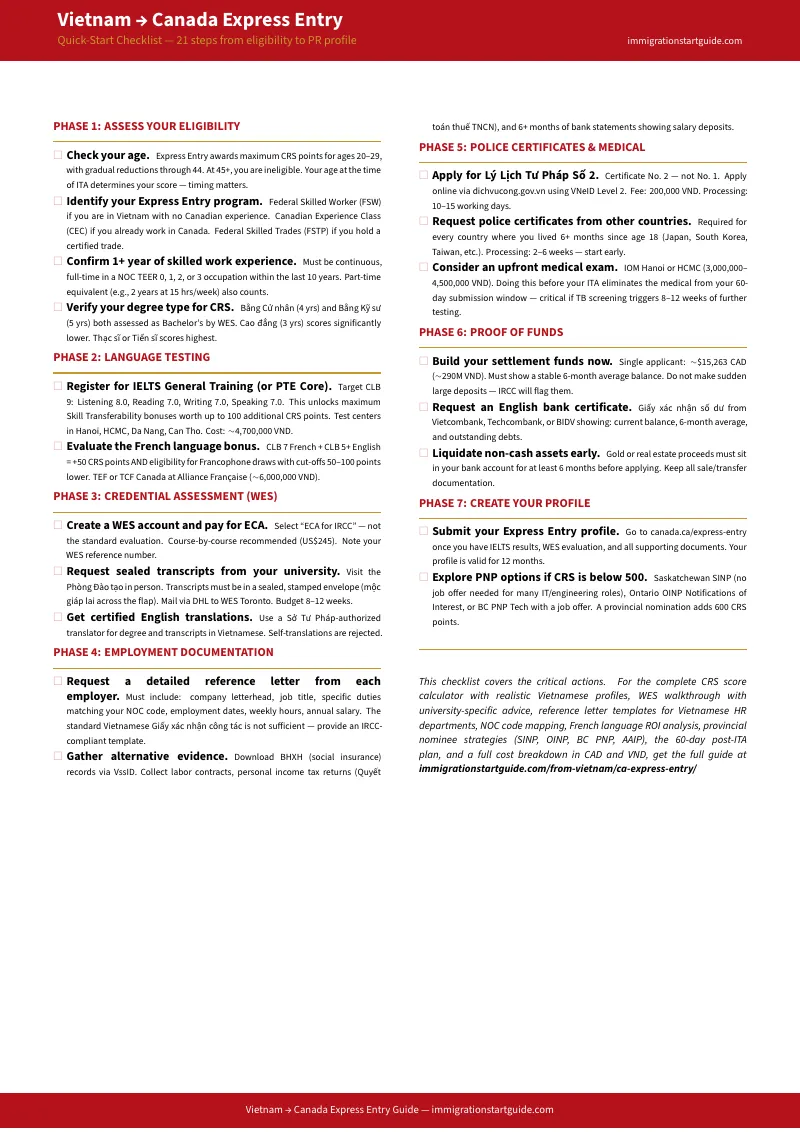
Download the free Quick-Start Checklist to check your CRS eligibility on the IRCC tool tonight, verify whether your occupation qualifies for STEM category-based draws, and start the Phieu Ly lich Tu phap So 2 application — because the police certificate alone takes three to four weeks, and if you are waiting for a consultant to tell you when to start it, you are already behind.
Your degree, your experience, and your IELTS score already qualify you for a system that Canada built to find people exactly like you. The WES evaluation, the reference letter format, the CRS optimization, the document pipeline, and the proof of funds preparation are the only things standing between you and the Confirmation of Permanent Residence. Start the process today — because every month you wait is another month the CRS cut-off could shift, another month closer to the age threshold that costs you points, and another month the study-abroad agencies spend trying to convince you that the expensive route is the only route. It is not.