
You Have JLPT N4, a Vocational Certificate in Welding, a Verbal Promise From a Dispatch Agency in Thanh Hoa That "Your Don Hang Is Confirmed" — and No Written Contract, No DOLAB Fee Receipt, No Way to Know Whether the 250 Million VND They Quoted Includes a 100 Million VND Kickback to the Broker Who Introduced You. Your Family Is About to Put the Land Title Up as Collateral. And the Agency Cannot Tell You That the Legal Fee Cap for a Three-Year Contract Is 3,600 USD — Because Telling You Would Cut Their Margin in Half.
You have decided to go to Japan. You have studied the language, passed the exam, and you are ready to invest three to five years of your life in a country where you can earn five times what you earn at home. You have talked to the senpai in your village who came back from Aichi with enough money to build a house. You have read the Facebook posts in "Cong dong nguoi Viet tai Nhat" where people share their monthly salary slips. You have watched the TikTok videos from Vietnamese workers in Japanese factories explaining overtime rates. You know SSW, you know Tokutei Gino, you have heard of the new Ikusei Shuro program. You are ready to commit.
And then the dispatch agency (cong ty phai cu) takes over.
They quote you a "package price" of 200 to 300 million VND. When you ask for a breakdown, they say "that includes everything — language training, health exam, visa processing, flight, and placement." When you ask why a different agency quoted 120 million, they say "those agencies send you to bad factories." When you ask to see the DOLAB fee cap — Official Dispatch No. 1123/LDTBXH-QLLDNN, which limits service fees to 3,600 USD (approximately 91 million VND) for a three-year contract — they change the subject. When you ask whether you can apply directly to a Japanese employer without going through a dispatch agency, they tell you it is impossible. It is not impossible. The SSW visa explicitly allows direct hiring. Most workers do not know this because every source of information in their world — the agency, the broker in the village, the Facebook group where agency employees pose as helpful senpai — has a financial interest in keeping them dependent on the intermediary system.
The financial math is brutal. If you borrow 250 million VND from a commercial bank at 10% annual interest and your monthly net salary in Japan is 25 million VND after living expenses, you send home 12 to 15 million per month. At that rate, your family spends the first 18 to 24 months of your three-year contract just paying off the debt. If you borrowed from informal lenders at 3 to 5% per month — and many rural families do when they cannot get a bank loan — the interest alone can exceed the monthly remittance. You arrive in Japan to find that you are working not for your family but for the debt. And if the factory cuts your overtime, or if the union (kumiai) reassigns you to a lower-paying worksite, the break-even point moves further away while the interest keeps compounding.
If you are an engineer or IT professional — a graduate from HUST, VNU, or FPT — the financial trap is different but the information asymmetry is the same. Engineer visa applicants face a different bureaucratic maze: the Certificate of Eligibility (COE) application, the credential verification process, the employer sponsorship requirements, and the question of whether your Vietnamese degree will be recognised by the Japanese immigration bureau. High-end recruitment agencies advertise "0 VND fee" placements for top talent, but most graduates do not know which agencies actually deliver this, how to evaluate an employment contract in Japanese, or how the engineer visa differs from SSW in terms of employer mobility, salary trajectory, and permanent residency eligibility.
The Japanese government side of the process is well documented by the Immigration Services Agency. The Vietnamese side — the ly lich tu phap (criminal record) from the Department of Justice that takes two to four weeks and requires a local commune verification, the health exam from an authorised hospital, the DOLAB fee cap that agencies do not disclose, the bank loan comparison between VBSP policy rates at 6.6% and commercial rates at 10%, the difference between a legitimate cong ty phai cu with a DOLAB licence and an unlicensed broker operating through a village middleman — is where workers lose control of their own migration.
The Vietnam to Japan Work Visa Guide is the Worker's Shield — built for Vietnamese workers navigating the SSW, Engineer, and Ikusei Shuro visa pathways from within the Vietnamese administrative and financial system. This is not a translation of the Immigration Services Agency website. This is not guidance written to protect an agency's commission. This is the independent, pro-worker filing system covering the complete cost breakdown with DOLAB fee caps and market reality comparisons, the dispatch agency evaluation framework with licence verification steps and contract red flag checklist, the direct hiring roadmap for SSW applicants who want to bypass agencies entirely, the SSW versus Engineer versus Ikusei Shuro decision framework matched to your education, language level, and long-term goals, the Vietnamese document preparation pipeline for ly lich tu phap, health exams, diploma legalisation, and commune verification, the loan comparison between VBSP policy loans, commercial bank loans, and the interest rate thresholds where debt becomes a trap, the Japanese labour rights chapter covering minimum wage enforcement, overtime calculation, union obligations, and the complaint mechanisms you are legally entitled to, and the in-Japan settlement chapter covering residence card registration, health insurance enrollment, pension contributions, the lump-sum withdrawal payment (dattai ichijikin) when you leave, and remittance options.
What's Inside the Worker's Shield
Twelve chapters, a quick-start checklist, and seven standalone reference tools — the Agency Evaluation Scorecard, the DOLAB Fee Cap Reference, the Document Timeline Planner, the Loan Comparison Worksheet, the SSW Exam Tracker, the Labour Rights Card, and the Settlement Checklist — covering every step from your first agency meeting through your first month in Japan:
The Dispatch Agency Evaluation Framework
Before you sign anything or pay anything, you need to know whether the cong ty phai cu sitting across the table is legitimate. The guide walks you through verifying DOLAB licence status on the official registry, checking the agency's track record with previous workers, reading the contract clause by clause for hidden fees, understanding what "bao gio" (guaranteed placement) actually means and what it does not, and identifying the ten warning signs of a predatory agency. You will know the legal fee cap before they quote you. You will know what services the fee must include. You will know what to do if the quoted price exceeds the regulated maximum. The agency evaluation chapter exists because no Facebook group post, no TikTok video, and no village broker will ever tell you this — their income depends on you not knowing it.
The Direct Hiring Roadmap
The SSW visa allows direct hiring between a Japanese employer and a Vietnamese worker. No dispatch agency required. Most workers do not know this is possible because every information source in their ecosystem has a financial interest in the intermediary model. The guide covers how to find Japanese employers recruiting directly, the administrative steps for a direct-hire SSW application, the role of the registered support organisation (tokutei gino shien kikan) that replaces the dispatch agency's support functions, and the cost comparison showing that a direct-hire SSW pathway can reduce total migration costs by 100 to 150 million VND compared to a high-fee agency route. This chapter is not for everyone — it requires Japanese language ability and self-direction. But for workers who can navigate it, it is the single largest cost saving available in the entire migration process.
The Visa Pathway Decision Framework — SSW vs Engineer vs Ikusei Shuro
Dispatch agencies funnel workers into the pathway that generates the highest commission, not the pathway best suited to the worker's profile. The guide provides a structured decision framework: SSW (Tokutei Gino) for vocational workers with JLPT N4 or JFT-Basic, covering 14 industries with a five-year cap under Type 1 but a permanent residency pathway under Type 2. Engineer/Specialist in Humanities for university graduates, offering higher salary ranges (35 to 55 million VND equivalent per month), greater employer mobility, and family sponsorship eligibility. The new Ikusei Shuro program replacing TITP, with its improved worker protections and limited right to change employers within the same industry. Each pathway is mapped against education level, language certification, industry preference, salary expectations, and whether you want to bring your family to Japan.
The Vietnamese Document Pipeline
The ly lich tu phap (criminal record certificate) from the Department of Justice requires an application at the provincial justice department, a verification visit from local police to your commune, and two to four weeks of processing. The health examination must be conducted at a hospital authorised by the Japanese Embassy. Diplomas require notarisation and, for some pathways, legalisation through the Ministry of Foreign Affairs. The giay xac nhan nhan su (personal verification) comes from your commune or ward People's Committee. The guide sequences these documents by processing time and validity period so you start the longest items first, avoid expiry conflicts, and arrive at your visa interview with every document current and correctly prepared.
The Migration Finance Chapter
Total compliant cost for a three-year SSW placement should be between 80 and 120 million VND when the agency follows DOLAB regulations. The guide breaks down every component: language training fees, health examination, visa processing, pre-departure orientation, and airfare. It compares VBSP policy loans (6.0 to 6.6% annual interest, available to qualifying households) against commercial bank loans (9 to 11% annual interest, requiring land title collateral) and shows the break-even timeline for each scenario. At what interest rate does the debt become a trap? At what monthly remittance rate does your family start building wealth instead of servicing interest? The loan calculator answers these questions with your actual numbers — not generic averages that obscure the risk.
The Japanese Labour Rights Chapter
You have the right to the prefectural minimum wage — not a "trainee allowance," not a reduced rate for foreigners. You have the right to overtime pay calculated at 125% of base rate for standard overtime and 150% for late-night work. You have the right to paid leave. You have the right to refuse unsafe working conditions. You have the right to file a complaint with the Labour Standards Inspection Office (rodo kijun kantokusho) without retaliation. You have the right to change employers under SSW. The guide covers each of these rights with the specific Japanese legal provisions, the complaint filing process, the support organisations for Vietnamese workers in Japan (including OTIT and the Vietnamese Embassy hotline), and the practical steps for reporting wage theft, excessive working hours, or passport confiscation by an employer or union.
The SSW Exam Preparation and Schedule
SSW requires passing both a technical skills evaluation test and a Japanese language test (JLPT N4 or JFT-Basic). The guide covers exam dates and testing centres in Vietnam, the registration process for each industry's skills test, the difference between JLPT and JFT-Basic (and which one to take based on your preparation timeline), study resources available in Vietnamese, and the exam score requirements. For workers transitioning from the old TITP system, the guide covers the exemptions and transitional provisions under the new Ikusei Shuro framework.
The In-Japan Settlement Chapter
Your first week in Japan determines the next three to five years. The guide covers residence card (zairyu card) registration at the ward office within 14 days, National Health Insurance enrollment, pension enrollment (and the lump-sum withdrawal payment — dattai ichijikin — you can claim when you leave Japan, potentially recovering hundreds of thousands of yen), bank account opening for salary deposits, remittance services for sending money home (comparing bank transfers, Wise, and SBI Remit), mobile phone setup, and the practical realities of Japanese work culture — from the morning chorei (morning assembly) to the unwritten rules around overtime and socialising with colleagues.
Quick-Start Checklist (free download)
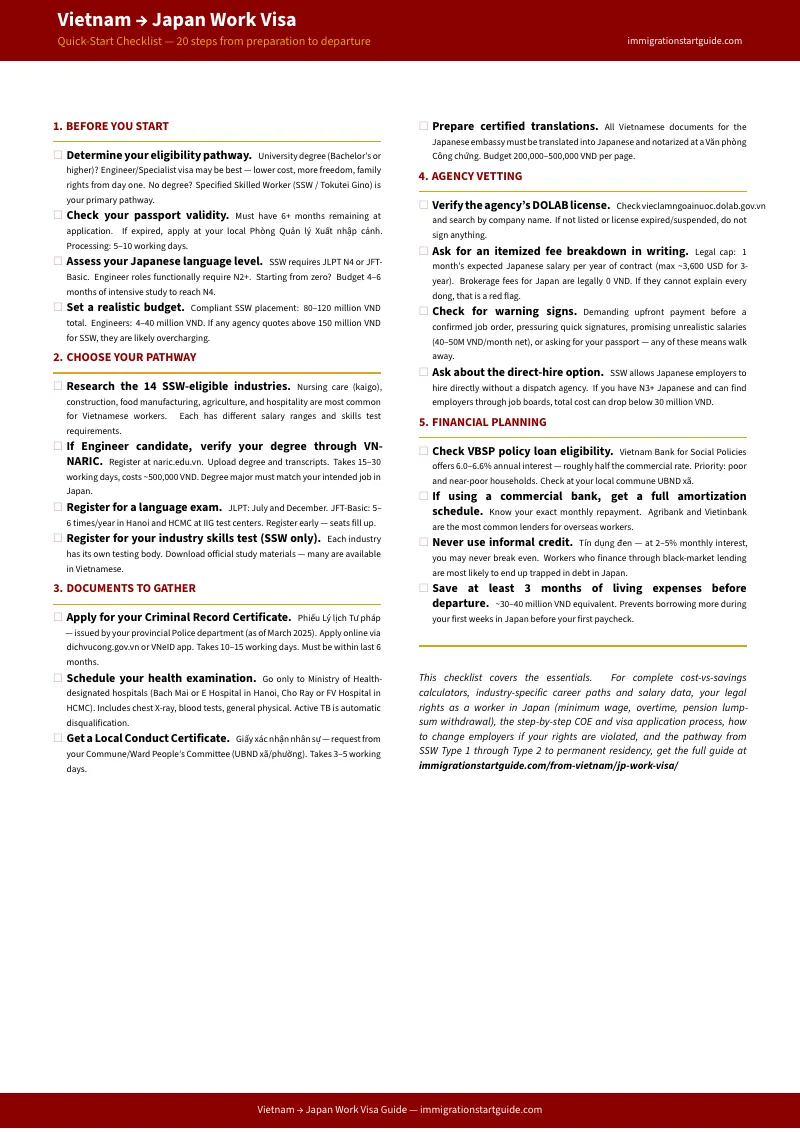
Twenty critical actions distilled into a single action sheet organised across five phases: Before You Start, Choose Your Pathway, Documents to Gather, Agency Vetting, and Financial Planning. Enough to verify whether your agency is DOLAB-licensed tonight, understand the legal fee cap for your contract length, and start the ly lich tu phap application — because the criminal record certificate alone takes two to four weeks, and if you are waiting on the agency to tell you when to start it, you are already behind.
Who This Guide Is For
This guide is for Vietnamese workers and professionals applying for Japanese work visas from within Vietnam:
- SSW (Tokutei Gino) applicants in any of the 14 eligible industries — construction, food manufacturing, nursing care (kaigo), agriculture, building cleaning, hospitality, and others — who need to understand the true cost of migration, evaluate whether their dispatch agency is charging within DOLAB limits, and know their rights before they arrive in Japan, not after they discover a problem they cannot fix from inside a factory dormitory.
- Workers considering the direct hiring route who want to bypass the dispatch agency entirely — you need the step-by-step process for connecting with Japanese employers directly, the registered support organisation requirements, and the administrative pathway that can save you 100 to 150 million VND in agency fees.
- Engineer and IT professionals from HUST, VNU, FPT, and other Vietnamese universities seeking the Engineer/Specialist in Humanities visa — you need the COE application process, the credential verification requirements, the employment contract evaluation framework, and the salary negotiation baseline for your industry in Japan.
- Former TITP technical interns transitioning to SSW or the new Ikusei Shuro program — you need to understand the transitional provisions, the exam exemptions you may qualify for, and whether staying in Japan versus returning to Vietnam and reapplying gives you a better outcome.
- Families taking on debt to finance a migration — you need the loan comparison between VBSP policy rates and commercial rates, the break-even calculator, and the interest rate threshold beyond which the debt consumes more than the migration produces. You need to run these numbers before the land title goes to the bank, not after.
Why Not Free Information?
Because the free information in this market is not free — it is funded by the people who profit from your confusion.
- Facebook groups are infiltrated by agency employees posing as helpful senpai. They recommend specific agencies (theirs), dismiss direct hiring (which threatens their model), and attack anyone who posts about DOLAB fee caps (which exposes their overcharging). The advice looks like peer support. It is marketing.
- Dispatch agency "guidance" exists to keep you dependent on the agency. They will never tell you the legal fee cap. They will never explain direct hiring. They will never compare their quote to the regulated maximum. Their guidance is a sales funnel, not a protection mechanism.
- Government websites — DOLAB, the Japanese Embassy, the Immigration Services Agency — provide accurate legal information in bureaucratic language with no practical instructions. They tell you what documents are required but not how long each one takes in the Vietnamese system, in what order to start them, or how to avoid the specific traps that cost Vietnamese workers millions of dong in wasted fees and months in lost time.
- TikTok and YouTube creators share genuine lived experience, but a three-minute video about overtime pay in Nagoya does not replace a structured decision framework for choosing between SSW and Engineer visas, a loan interest calculator, or a dispatch agency contract review checklist.
The Worker's Shield exists because there is no single source of information in the Vietnamese migration market that is comprehensive, structured, current with the 2025-2026 regulatory changes, and written exclusively for the worker's interest.
— Less Than a Single Health Exam
A dispatch agency charges 200 to 300 million VND for a package placement. The DOLAB-regulated maximum for a three-year contract is 3,600 USD (approximately 91 million VND). The difference between those two numbers — 100 to 200 million VND — is not "better service." It is the margin created by information asymmetry. A single overcharge from a predatory agency costs your family more than a year of debt repayment. A single missed document — a ly lich tu phap that expires during processing, a health exam from a non-authorised hospital, a diploma that was notarised but not legalised — means starting that step over from zero.
This guide costs less than a single health examination, and it covers the complete Vietnam-to-Japan pathway: the dispatch agency evaluation framework, the direct hiring roadmap, the visa pathway decision framework, the Vietnamese document pipeline, the migration finance chapter with loan comparisons and break-even calculations, the Japanese labour rights card, the SSW exam preparation guide, and the in-Japan settlement chapter. The agency evaluation framework alone can save you 100 million VND in overcharges. The direct hiring roadmap can eliminate the agency fee entirely. The labour rights chapter can prevent wage theft that compounds over three to five years of employment.
You have the language. You have the skills. You have the willingness to work in a country that needs your labour more than any other developed economy on Earth. What stands between you and the salary that changes your family's future is not eligibility — it is the gap between the Vietnamese intermediary system that profits from your dependence and the Japanese labour market that will pay you fairly once you arrive. The dispatch agency evaluation. The fee cap verification. The document sequencing. The loan calculation. The rights awareness. Every one of these is knowable. Every one of them, if left to the agency, becomes a tool for extracting more money from your family.
Money-back guarantee, no time limit. If the dispatch agency evaluation framework, the direct hiring roadmap, the visa pathway decision framework, the Vietnamese document pipeline, the migration finance chapter, the Japanese labour rights chapter, the SSW exam guide, and the in-Japan settlement chapter do not give you more actionable protection than anything you could assemble from Facebook groups, agency brochures, and government websites, you pay nothing.
Download the free Quick-Start Checklist to verify your agency's DOLAB licence tonight, understand the legal fee cap for your contract length, and start your ly lich tu phap application. When you are ready for the complete Worker's Shield — the full guide with the agency evaluation framework, the direct hiring roadmap, the loan calculator, the labour rights chapter, and the settlement guide — the full guide is here.
Your skills earned the right to work in Japan. The agency evaluation, the fee verification, the document pipeline, and the rights awareness are the only things standing between you and the salary that transforms your family's economic future. Start the process today — because every month you wait is another month the debt compounds, another month the agency controls the timeline, and another month closer to the next regulatory change that reshapes the pathway you are counting on.