
You Have the Degree, the Experience, and the TOPIK Score. But Between You and the E-7 Visa Is a K-Point System Nobody Explains, a KVAC Appointment That Keeps Failing With "Error No. 7," and a Lý Lịch Tư Pháp That Has Been Sitting at Sở Tư Pháp for Three Weeks.
You did the math. Your bachelor's degree from a Vietnamese university, your three years of engineering experience, and your TOPIK 4 certificate put you in the qualified range for an E-7-1 professional visa. You started telling your family you were going to Korea.
Then you discovered the K-Point 1100 scoring system. Not the summary on a blog — the actual scoring matrix with 300 base points across income, language, and age, plus bonus points for employer recommendations, regional placement, and continuous service. No single Vietnamese-language source explains the full breakdown. The Facebook groups say "you need 200 points" but do not tell you how income is calculated (is it gross or net? does overtime count?), how the age brackets work (you lose points every year after 33), or that working in a depopulation area is worth +20 bonus points that most Vietnamese workers leave on the table because they assume "rural Korea" means isolation.
And that was just the scoring. Then came the documents. Your Vietnamese degree needs VN-NARIC verification — not just a notarized copy, but an official authentication certificate from the Ministry of Education and Training. After VN-NARIC, the document must be translated, notarized, legalized by the Consular Department of MOFA, and then authenticated by the Korean Embassy. Miss one step in this sequence and the entire package comes back rejected. Your Lý lịch tư pháp (Judicial Record Certificate No. 2) requires a trip to Sở Tư pháp in the province where you hold permanent residence. The statutory processing time is 10 working days. You are now on day 15 and nobody is answering the phone.
Then the KVAC appointment. You booked your slot at the Korea Visa Application Center in Hanoi two months in advance. You showed up on time with your complete document set. The result: rejection under "Error No. 7" — insufficient evidence of the purpose of entry and the stability of the employment contract. The KVAC officer did not explain what was missing. The rejection notice is a single line. The Facebook group advice is contradictory: one person says add a company recommendation letter, another says it was the employment contract format, a third says it is random. You have spent VND 390,000 on the service fee, weeks of preparation, and a day off work, and you are back at zero.
You are not short on qualifications. You are short on a system that connects what Vietnamese institutions produce by default to what Korean immigration authorities demand by policy.
The Immigration Literacy System
This is not a generic explainer of the E-7 visa categories — you can get that from the Ministry of Justice website. This is the Vietnam-specific operational manual for every step where the Korean immigration process collides with Vietnamese institutional reality: the K-Point 1100 scoring calculator that tells you your real points total before you commit to the application. The VN-NARIC authentication sequence for Vietnamese degrees — the exact order of verification, translation, notarization, MOFA legalization, and Embassy authentication that prevents the "wrong sequence" rejection. The Lý lịch tư pháp procurement strategy for provinces where "10 working days" means four weeks. The KVAC appointment walkthrough that addresses the specific triggers behind Error No. 7 — so you submit a package that does not come back.
The guide covers all four E-7 sub-types that matter for Vietnamese applicants. E-7-1 for professionals with degrees and experience. E-7-3 for skilled technical workers in shipbuilding, welding, and electrical trades. E-7-4 for E-9 workers transitioning to skilled status through the K-Point system. And the path beyond — from E-7 to F-2-R regional residency and eventually F-5 permanent residence.
Agencies in Vietnam charge 50 to 150 million VND for Korean work visa processing when the official EPS cost is 26 to 30 million VND. Some know the system. Many push E-9 factory placements because those are easier to sell than a 12-month E-7 application that requires document authentication, employer sponsorship, and K-Point scoring optimization. What you need is not someone to fill out your forms. You need the technical playbook for navigating a scoring system that changes annually, a document authentication chain that has five sequential dependencies, and a KVAC process where one formatting error resets your timeline by months.
What Is Inside
K-Point 1100 Scoring Walkthrough
The K-Point system is the gatekeeper for every E-9 to E-7-4 transition and the backbone of long-term residency eligibility. The guide breaks down all 300 base points across the three core categories — average annual income (120 points max, with thresholds at 25M and 50M KRW that depend on whether your overtime is properly documented for tax purposes), Korean language proficiency (120 points max, where the difference between TOPIK 2 and TOPIK 4 is 70 points), and age (60 points max, with the "golden window" of 27-33 granting full marks). Then the bonus points that most applicants miss: the mandatory employer recommendation (+50), continuous service at one workplace for 3+ years (+20), placement in a depopulation area (+20), a Korean technical certification (+20), and a Korean driver's license (+10). The guide includes a fillable scoring worksheet so you can calculate your total before committing to the application.
Vietnamese Document Authentication Sequence
Every Vietnamese credential in your application must pass through a specific authentication chain, and the order matters. The guide maps the complete sequence for each document type: university degrees through VN-NARIC verification, then certified translation, then notarization, then MOFA Consular Department legalization, then Korean Embassy authentication. It covers the Lý lịch tư pháp (Certificate No. 2) process at Sở Tư pháp — the VND 200,000 fee, the 10-to-15 working day statutory timeline, the follow-up strategy when your province's office goes quiet, and when to escalate. It covers medical examination requirements at the designated hospitals in Hanoi, Ho Chi Minh City, and Da Nang — including the TB screening, drug test, and the specific conditions that trigger automatic disqualification.
KVAC Appointment and Error No. 7 Prevention
The Korea Visa Application Center is where most Vietnamese applications either succeed or stall. The guide covers the appointment booking logistics for KVAC Hanoi (12th Floor, Discovery Complex), KVAC Ho Chi Minh City (253 Dien Bien Phu), and KVAC Da Nang — including the two-month advance booking window, the mobile verification requirement, and the 15-minute lateness cancellation policy. More importantly, it addresses Error No. 7 directly: the specific evidence gaps that trigger this rejection, the employment contract formatting that Korean immigration expects (which differs from what Vietnamese employers produce), and the supplementary documentation strategy that demonstrates both purpose of entry and intent to comply with visa conditions.
E-7-1 Professional Visa Pathway
For Vietnamese professionals with a bachelor's degree or higher, the E-7-1 covers 67 occupational categories across IT, engineering, finance, bio-tech, and management. The guide explains the degree-plus-experience formula (Bachelor's + 1 year, Master's + 0, or 5 years experience without a degree), the minimum salary threshold (approximately 80% of GNI per capita — around KRW 31 million for 2026), the employer sponsorship requirements (domestic-to-foreign employee ratio, tax compliance, labor law record), and the specific advantage for graduates of Korean universities who are exempt from the employment ratio requirement.
E-9 to E-7-4 Transition Strategy
This is the most valuable pathway for Vietnamese workers already in Korea. The guide covers the complete transition from E-9 non-professional status to E-7-4 skilled worker status: the 4-year minimum service requirement, the K-Point scoring optimization strategy (starting TOPIK preparation in year 2, not year 4), the employer recommendation negotiation (this is mandatory and worth 50 points — the guide covers how to approach your employer and what they need to submit), and the timeline for when to initiate the transition relative to your E-9 contract expiration. It also covers the strategic tension between changing workplaces for higher wages versus staying with one employer for the +20 continuous service bonus.
The E-7 to F-2-R to F-5 Residency Roadmap
The E-7 visa is not the destination — it is the bridge to permanent settlement. The guide maps the full residency staircase: from E-7 to F-2 long-term residency (requiring TOPIK 4 and 70% of GNI income), to the F-2-R regional visa for workers in Korea's 107 designated depopulation areas (which allows your spouse to work and your children to attend local schools), to F-5 permanent residency. It covers the Social Security Agreement between Vietnam and Korea that allows you to totalize pension contributions across both countries — and the lump-sum National Pension refund that many Vietnamese workers forget to claim when they leave Korea.
Financial Planning in VND and KRW
The true cost of the E-7 pathway from Vietnam — degree authentication, VN-NARIC verification, MOFA legalization, KVAC service fee, medical examination, language preparation, and the initial settlement fund — runs to tens of millions of VND before you earn your first Korean won. The guide breaks down every line item in both VND and KRW, covers the agency fee transparency issue (the difference between the 26-30 million VND official cost and the 50-150 million VND agency markup), and explains which fees are refundable and the procedure for claiming them. It includes the remittance strategy for sending earnings home — comparing Hanpass, SentBe, and GME fintech apps against traditional SWIFT transfers.
Language Preparation Strategy
Korean language proficiency is the single highest-ROI investment in your entire migration plan. In the K-Point system, the gap between TOPIK 2 (50 points) and TOPIK 4 (120 points) is 70 points — more than any other single factor. The guide covers the preparation pathway from zero to TOPIK 4: King Sejong Institute programs in Hanoi and HCMC (VND 2.8-5.5 million per course), private centers specializing in EPS-TOPIK preparation (SOFL, Ganada, Phuong Dong), the KIIP (Korea Immigration and Integration Program) alternative for workers already in Korea, and the specific TOPIK sections that disproportionately affect your score.
Printable Tools
The guide includes standalone tools designed to be printed and used throughout your application:
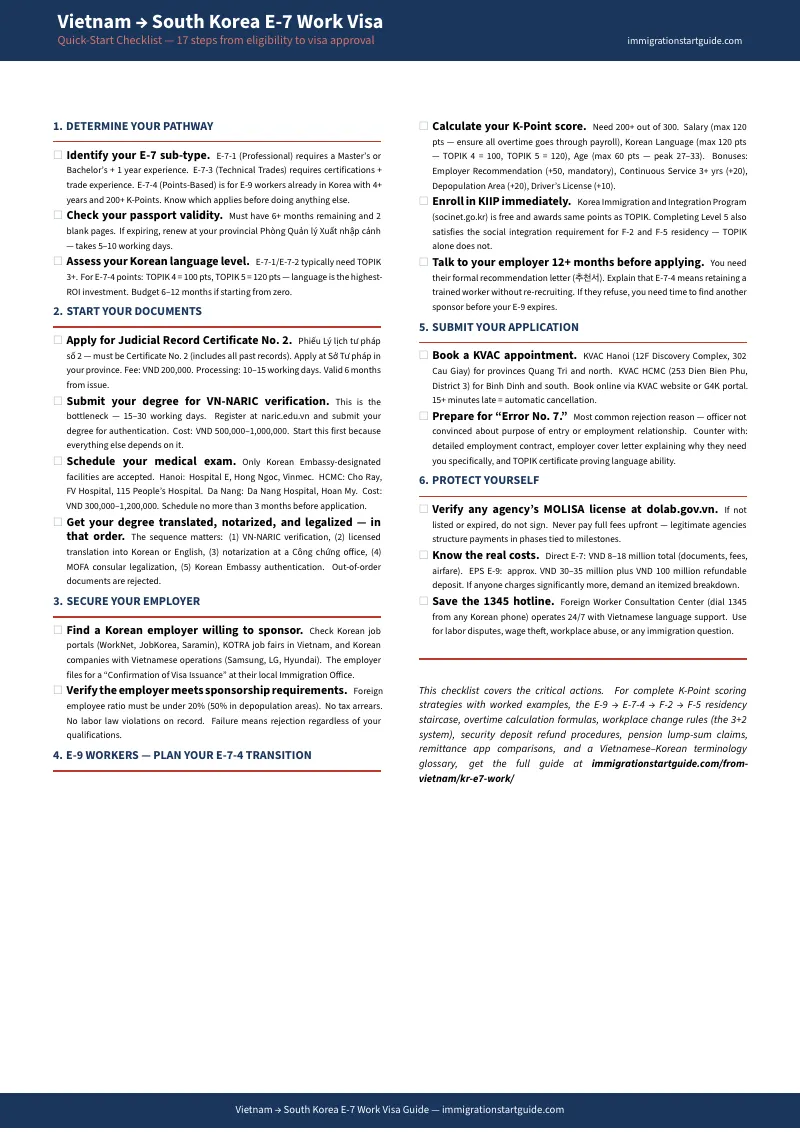
- Quick-Start Checklist — every step from VN-NARIC verification to Alien Registration Card pickup, with realistic Vietnamese processing times and the parallel task structure that prevents sequential bottlenecks
- K-Point Scoring Worksheet — calculate your actual K-Point total across all base and bonus categories to see whether you qualify before committing to the E-7-4 application
- True Cost Calculator — every fee in both VND and KRW for the complete E-7 pathway, from document authentication through settlement
- Document Authentication Tracker — status tracking for every document in the VN-NARIC → translation → notarization → MOFA → Embassy chain, with expected timelines and common error points
Who This Is For
- Vietnamese IT professionals and engineers — software developers, mechanical engineers, electrical engineers, biotech researchers — with a bachelor's degree or higher who are targeting the E-7-1 professional visa and need to navigate VN-NARIC degree authentication and employer sponsorship requirements
- Vietnamese skilled workers in shipbuilding, welding, and electrical trades — targeting the E-7-3 technical worker visa with Korean technical certifications and industry-specific sponsorship
- Vietnamese E-9 workers already in Korea — approaching the 4-year-10-month contract limit and needing to transition to E-7-4 through the K-Point system before their E-9 expires and they are forced to return home
- Vietnamese graduates of Korean universities — who have the exemption advantage for E-7 sponsorship requirements but still need to navigate the document authentication chain for their Vietnamese credentials
- Workers planning the full residency pathway — from E-7 to F-2-R regional residency to F-5 permanent residence, including family reunification and spouse work rights
- Anyone currently paying an agency 50-150 million VND — for services that consist primarily of form-filling and document submission, without the K-Point scoring strategy or Error No. 7 prevention that determines whether your application succeeds
Why Not Facebook Groups, YouTube, or a Vietnamese Agency?
Facebook groups like "Cộng đồng người Việt tại Hàn Quốc" and "Hội E7 tại Hàn Quốc" are the largest source of Korean visa information for Vietnamese applicants — and they are dominated by survivor bias and outdated advice. The person posting "I got my E-7-4" does not detail the K-Point scoring strategy that got them there, the three KVAC rejections before the fourth attempt worked, or the employer recommendation negotiation that took six months. The posts from 2024 describe a K-Point system that was overhauled for 2025-2026. And the advice is contradictory: one person says "focus on TOPIK 4 first," another says "get the employer recommendation first," and neither knows your specific K-Point breakdown, your age bracket, or whether your workplace qualifies for the depopulation area bonus.
YouTube vloggers in Korea give you the highlight reel of factory life and salary comparisons. A ten-minute video cannot walk you through the K-Point scoring matrix, the VN-NARIC authentication sequence, the KVAC Error No. 7 triggers, the employer recommendation process, and the F-2-R residency pathway. The comments section is recycled advice from viewers who applied under different rules. The creator is monetizing views, not outcomes — their success metric is watch time, not whether you received your E-7 visa.
Vietnamese agencies charge 50 to 150 million VND and focus on high-volume E-9 placements because those are simpler to process and the commissions are faster. Most do not understand the K-Point scoring optimization — they submit your application and hope for the best. Many push factory placements because those are easier to sell than a professional E-7-1 application that requires degree authentication, employer sponsorship negotiation, and months of KVAC preparation. The ones who handle E-7 cases add their margin on top of every official fee without providing the scoring strategy or the document authentication expertise that determines whether your application succeeds or returns with Error No. 7.
The Free Checklist vs. The Full Guide
The free Quick-Start Checklist gives you the 18 critical action items — every step you need to take, the agencies involved, and the order to tackle them. It is enough to see the full scope of what stands between you and an E-7 visa, and to identify the long-lead-time items (VN-NARIC verification, Lý lịch tư pháp, TOPIK preparation) that need to start moving immediately.
The full guide gives you how: the K-Point 1100 scoring worksheet with worked examples for Vietnamese applicants, the VN-NARIC authentication sequence with the exact order and common rejection triggers, the KVAC Error No. 7 prevention strategy, the E-9 to E-7-4 transition timeline, the employer recommendation negotiation approach, the F-2-R regional residency pathway, the financial planning in VND and KRW, the language preparation roadmap from zero to TOPIK 4, and the document templates adapted for Vietnamese institutional contexts.
— Less Than One Day's Wages in Korea
The total cost of professional migration from Vietnam to South Korea — degree authentication, VN-NARIC verification, MOFA legalization, KVAC fees, medical examination, language preparation, and initial settlement — exceeds tens of millions of VND for a single applicant. That does not count the months of preparation, the trips to Sở Tư pháp and MOFA, the KVAC appointments, the time off work, or the opportunity cost of a rejected application that wastes your KVAC fee and resets your timeline by months because your documents were authenticated in the wrong sequence.
If the information in one chapter — the K-Point scoring worksheet that reveals you qualify for the depopulation area bonus worth 20 extra points, the VN-NARIC authentication sequence that prevents a rejected document package, the KVAC Error No. 7 checklist that keeps your application from coming back, or the employer recommendation strategy that secures the mandatory 50 bonus points — prevents a single wasted fee or a single failed KVAC appointment, the guide has paid for itself before you finish the first section.
100% satisfaction guaranteed. If the guide does not meet your expectations, email [email protected] for a full refund.