
You Scored 92. Your Dream School Needs 100.
You read academic papers in English. You follow lectures without subtitles. You debate complex topics with native speakers. But the TOEFL keeps returning scores in the low 90s — and your target program needs 100. Or worse: you hit 100 overall, but your Speaking came back at 23, and the TA funding you need requires 26.
That gap is not a language gap. It is a strategy gap. And in January 2026, it got wider.
The 2026 Test Changed Everything
The TOEFL iBT is no longer a fixed test. ETS introduced multi-stage adaptive routing for Reading and Listening, a new 1-6 band scoring scale alongside the 0-120 composite, and entirely new task types — Build a Sentence, Write an Email, Listen and Choose a Response. The old three-hour marathon is gone. The Independent Writing task is gone. Templates that worked for a decade are gone.
Most prep books on shelves right now still cover the old format. The ETS Official Guide gives you practice questions for the new format but does not teach you how to exploit it. YouTube has hundreds of videos about the 2023 changes and scattered speculation about the 2026 overhaul. Magoosh offers 120+ hours of video — helpful if you have four months, useless if your application deadline is six weeks away.
None of them explain the single most important thing about the adaptive engine: your performance on Module 1 determines whether Module 2 even gives you a path to a high score. Get the first ten questions wrong, and the algorithm routes you to an easier second module that caps your maximum score — no matter how perfectly you perform from that point on.
The Adaptive Score Strategy System
The TOEFL iBT Score Strategy Guide is built around one insight that separates strategic test-takers from everyone else: the 2026 TOEFL is a routing game, and the routing decision happens in the first ten minutes.
This is not a practice test collection. It is the strategic architecture for the adaptive era — the layer that tells you where to focus, when to push, and how to ensure the algorithm gives you the high-difficulty route that makes 100+ possible.
What's Inside
Module 1 Priority Protocol
In the adaptive format, the first module of Reading and Listening is the most consequential ten minutes of the entire test. One careless mistake can lock you out of the high-score band for that section. The guide teaches you the pacing discipline, answer-verification techniques, and cognitive endurance strategies that protect your routing to the high-difficulty Module 2 — which is the only path to section scores above 25.
The Speaking 26 Accelerator
A composite score of 100 means nothing if your Speaking comes back at 23 and your TA funding requires 26. The three points between 23 and 26 are not about vocabulary or grammar — they are about delivery. Specifically: intonation variation, strategic pause placement, and the difference between "reading a script" and "thinking out loud." The Accelerator provides the exact delivery shifts that move scores across the 26 threshold, with drill sequences designed for the 2026 format's two spontaneous Speaking tasks.
Academic Discussion Engagement Method
The Writing for an Academic Discussion task looks like a short essay. It is not. The rubric specifically rewards engagement with the simulated classmates' posts — and most students miss this entirely. Writing "I agree with the environmental perspective" scores lower than "While I understand David's concern about cost, the long-term savings outweigh the initial investment he's worried about." The guide provides the specific linguistic moves that signal engagement to both the AI scoring engine and the human raters.
MyBest Scores Tactical Framework
ETS lets universities see your best section scores across multiple test dates. Most students treat this as a nice bonus. Strategic students treat it as a multi-sitting project: focus entirely on Reading and Listening in Sitting A, then focus on Speaking and Writing in Sitting B. The framework shows you how to plan a two-sitting campaign that reduces cognitive load per test day and maximizes each section score — including which universities accept MyBest scores and which require single-sitting composites.
New Task Type Drills
Build a Sentence (unscrambling words in under 40 seconds), Write an Email (professional tone, three bullet points), Listen and Choose a Response (conversational reflexes, not academic listening). These tasks reward functional fluency — a completely different skill from the academic reading comprehension the TOEFL tested before 2026. The guide includes targeted drills for each new task type, because your Barron's book does not cover them.
Study Plans by Timeline
A 3-month prep plan does not help someone with 3 weeks left. The guide includes separate study tracks for 8-week, 4-week, and 2-week timelines — each calibrated to different starting score ranges. Every day has a specific focus, a specific drill, and a specific benchmark. You will know within the first week whether your strategy is working.
Who This Is Built For
- Graduate applicants stuck at 85-95 who need to break through 100 for top-tier US, Canadian, or UK programs and cannot afford to waste another $200-$300 on a retake without changing their approach
- PhD and TA candidates needing Speaking 26 — because your entire funding package depends on three points in one section, and no amount of general English practice addresses the specific delivery shifts the rubric rewards
- Students preparing for the 2026 adaptive format who have discovered that their existing prep books still cover the old fixed-format test and the deprecated Independent Writing task
- Late-start applicants with 2-6 weeks until their test date who need a high-density strategic framework, not a 120-hour video course they will never finish
- Retakers who scored within 5-8 points of their target — close enough that strategy, not language ability, is the bottleneck
Why Not the ETS Official Guide?
The ETS Official Guide is essential — for practice questions. It is the test maker's material, and the question accuracy is unmatched. But ETS does not teach you how to beat the test. They tell you that you scored 23 in Speaking. They do not tell you that your intonation was monotone for the last 15 seconds of Task 2, which is exactly where the rubric penalizes "reading from notes" delivery. They test you; this guide teaches you.
Use the ETS Official Guide for practice. Use this guide for the strategy that makes practice productive.
The Retake Math
A single TOEFL iBT attempt costs $200-$300 depending on your country. Add the rescheduling fee if you are not ready. Add the $75-$125 application fees per university — multiply that by 8-10 schools. A student applying to competitive US graduate programs has $1,000+ on the line before tuition is even discussed. If this guide prevents one retake, it has paid for itself several times over. If it prevents a one-year delay to your graduate career, the return is incalculable.
The full TOEFL iBT Score Strategy Guide costs . That is less than the late registration surcharge on a single test sitting.
Your Purchase Is Protected
If the guide does not give you a clear, actionable strategy for your target score, email us at any time for a full refund. No questions asked.
Stop Practicing Blind. Start Scoring Strategic.
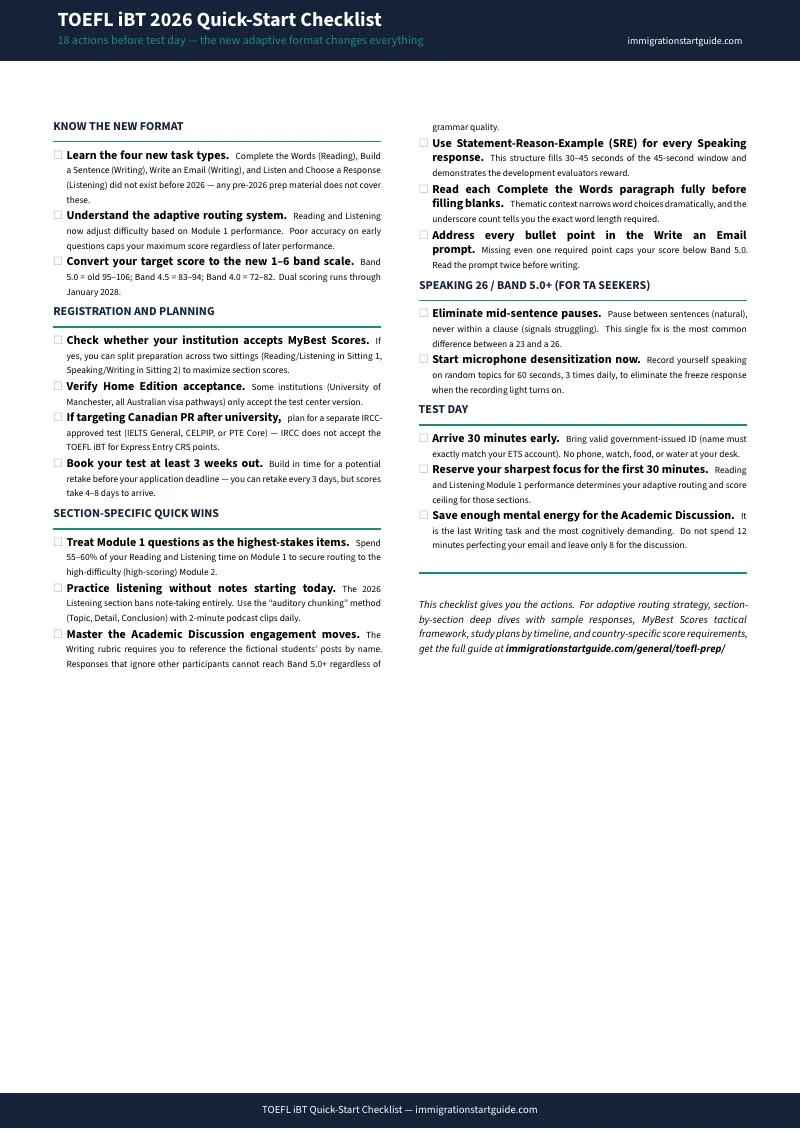
Download the free Quick-Start Checklist to identify the single highest-leverage section for your target score, check whether your prep materials cover the 2026 adaptive format, and make one strategic change to your next practice session tonight. When you are ready for the full Adaptive Score Strategy System — the Module 1 Priority Protocol, the Speaking 26 Accelerator, the MyBest Tactical Framework, and the timeline-matched study plans — get the complete TOEFL iBT Score Strategy Guide.