
Your Visa Interview Lasts 3 Minutes. You've Already Spent $1,000 Getting to That Window.
You booked the embassy appointment. You paid the $185 application fee. You paid the $350 SEVIS fee. You got the medical exam, the bank statements, the employment letter. You traveled to the consulate city, booked a hotel, stood in line since 5 AM. By the time you reach the officer's window, you've invested somewhere between $535 and $2,000 — often your family's savings, not just yours — and the person across the glass will decide your future in roughly 120 to 300 seconds.
So you start preparing. You type "visa interview tips" into YouTube. One video says dress formally. Another says dress casually to seem relaxed. One channel says keep answers short. A different one says volunteer information to show transparency. Reddit threads from last year contradict Reddit threads from this year. You could spend $459 on a coaching session with a former consular officer — but you've already spent months of savings on application fees alone.
Thirty hours later, you've watched dozens of videos, read hundreds of forum posts, and you still don't have a preparation strategy. You have a collection of contradictions. And the appointment is next week.
Here's what the YouTube videos and Reddit threads never explain: the officer isn't making conversation. They're running an adjudication algorithm. Every question is designed to test a specific legal criterion. In the US, Section 214(b) means every applicant is legally presumed to be an intending immigrant until they prove otherwise. In the UK, the Genuine Student Test is a formal credibility assessment that can run 60 minutes. In the Schengen Area, Article 32 of the EU Visa Code governs — and consular data suggests nearly a third of Indian Schengen applications are refused for financial inconsistencies alone.
The questions aren't random. They're diagnostic. And if you don't know what each question is actually measuring, you'll give a sincere, truthful answer that still triggers a refusal — because truth isn't the issue. Framing is.
The Visa Interview Preparation Toolkit is built around the Adjudication Logic Framework — a structured system that teaches you why each question is asked, what legal criterion it tests, and how to frame your honest answer so the officer checks the box they need to check. Not a question list. Not a script. A framework for understanding the decision-making machine so you can answer any question — including ones nobody warned you about.
When you understand what the officer needs to hear, the interview stops being an interrogation and becomes a 3-minute presentation of evidence you've already gathered. The qualifications are yours. This makes sure the officer sees them.
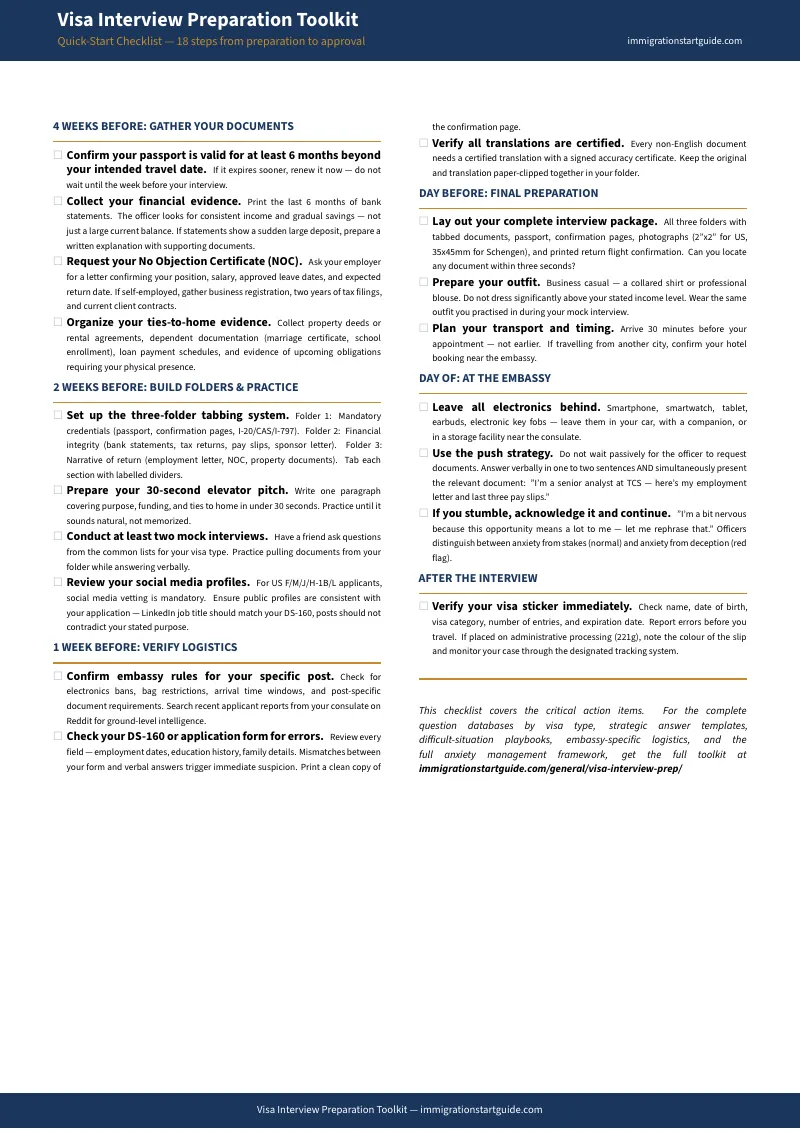
Start with the free Quick-Start Checklist — 18 items that structure your preparation from document organization to answer practice. Or keep reading to see what the full toolkit covers.
What's Inside the Adjudication Logic Framework
A 12-chapter guide, a quick-start checklist, and 20 answer templates. Everything structured around one principle: the officer has a legal standard to apply, and your job is to make that standard easy to satisfy. Whether your interview is four weeks away or four days away, the framework scales — start with the chapters that match your visa type, then work outward.
Understanding the System
The Three-Minute Window (Chapter 1)
Why most interviews are decided in the first 60 seconds, and how the officer processes three simultaneous data streams — your DS-160, your documents, and your verbal answers — to build a snap assessment. You'll understand what's happening on the other side of the glass before you open your mouth.
The Adjudication Logic Framework (Chapter 2)
The core methodology. Every visa question falls into one of four categories: intent verification, financial credibility, ties assessment, or consistency checking. This chapter teaches you to identify which category a question belongs to in real time — so when the officer asks "Do you have family in the US?" you hear what it actually is: a ties assessment probe that has ended thousands of applications.
US Consular Interviews — The 214(b) Presumption (Chapter 3)
The officer starts from the legal position that you intend to immigrate. The interview is your chance to rebut that presumption. The chapter covers the three categories of evidence officers weigh — economic anchors, social ties, and return obligations — with specific strategies for F-1 students, B-1/B-2 visitors, H-1B workers, and L-1 transferees. "I have a job back home" doesn't rebut anything. "I'm the project lead on a contract delivering in December 2026, and here's the signed engagement letter" does.
UK Credibility Interviews — The Genuine Student Test (Chapter 4)
Up to 60 minutes testing your academic intent, institutional knowledge, financial provenance, career trajectory, and English communication simultaneously. Naming your university isn't enough — you need specific modules, why this institution over competitors, and the starting salary for your target role back home. The chapter maps exactly what the Entry Clearance Officer evaluates on each pillar.
Schengen Interviews — Article 32 and Financial Behavior (Chapter 5)
Schengen consulates don't just check your bank balance — they evaluate the trail of income. A sudden deposit of $5,000 the week before your appointment, even if it's genuine savings you transferred, gets flagged as "borrowed funds." The chapter covers the financial behavior patterns consulates look for, insurance requirements (minimum €30,000 with repatriation), and daily subsistence thresholds that vary by country.
Preparing Your Responses
Question Databases With Officer Intent Decoded (Chapter 6)
Not just "common questions." Databases organized by visa type (F-1, B-1/B-2, H-1B, L-1, UK Student, Schengen Tourist, Schengen Business) with two columns you won't find anywhere else: Underlying Adjudicator Intent and Strategic Response Logic. "Why did you choose this university?" isn't about the university. It's testing whether you're a genuine student or just seeking entry. The database tells you what each question really asks.
Answer Construction Method (Chapter 7)
A repeatable system for building answers that hit the legal standard without sounding rehearsed — because officers are trained to recognize scripted responses and dismiss them. Lead with the compliance signal, support with one concrete detail, and stop. No over-explaining. No volunteering information that opens new lines of questioning.
Difficult Situations Playbook (Chapter 8)
Standard prep resources assume a perfect applicant. Real applicants have previous refusals. Employment gaps. Career pivots that look inconsistent. A "young and single" profile that officers statistically flag as high risk. Previous overstays. The playbook covers twelve common difficult situations with framing strategies that address them honestly — because concealment is the fastest path to a permanent ban, and the right framing turns a red flag into something the officer can work with.
Practical Readiness
The Document Architecture System (Chapter 9)
You've spent months assembling documents. There's a good chance the officer won't look at most of them — unless you know the "push strategy." A three-folder tabbing system that lets you retrieve any document in under five seconds, when to proactively offer documents versus waiting to be asked, and how to use physical evidence to anchor your verbal answers during the window when the officer is actually paying attention.
Anxiety Management for High-Stakes Adjudication (Chapter 10)
Interview anxiety isn't just uncomfortable — it's functionally dangerous. Stuttering, hesitation, and impaired recall are non-verbal cues that officers interpret as deception signals. The chapter covers energy reframing, the 30-second pitch technique that sets the tone for the entire interview, and the dress rehearsal method for desensitizing yourself to the formal environment before the real day.
Embassy Logistics and Consulate Intelligence (Chapter 11)
Mumbai starts queuing at 4:30 AM and bans all electronics including smartwatches. Lagos runs a two-step process — document review with local staff first, then the consular interview weeks later. Manila applicants should bring a jacket (the embassy is cold) and prepare for a two-hour wait for a 3-minute interview.
Post-Interview Scenarios (Chapter 12)
What the colored slips mean (blue, white, pink, yellow, green). What 221(g) administrative processing actually is — and why the large majority of holds are eventually approved. How to respond to a 214(b) refusal. When reapplying makes sense versus when it wastes money. The appeals process for Schengen refusals and UK administrative reviews.
Answer Templates
Twenty pre-built answer frameworks covering the highest-frequency questions across five visa types: US F-1 student, US B-1/B-2 visitor, US H-1B worker, UK student, and Schengen tourist/business. Each template shows the adjudicator intent behind the question, the compliance signal your answer must contain, and a structural model you customize with your own details. Not scripts to memorize — frameworks to internalize.
Who This Toolkit Is For
This toolkit is for anyone preparing for a consular visa interview who:
- Has an appointment booked and no structured plan for the 3-minute interaction that determines whether a $1,000+ investment pays off or evaporates
- Has been refused before — under 214(b), the Genuine Student Test, or Article 32 — and needs to understand exactly what went wrong before spending another round of fees
- Is applying for a US, UK, or Schengen visa and wants to understand the specific legal standard their interview is testing, not just memorize generic questions
- Has a complicated profile — young and single, employment gaps, career pivot, previous overstay, or limited travel history — that standard question lists don't address
- Can't afford $279-$459 coaching but needs more than 30 hours of contradictory YouTube advice to feel prepared
- Already has a lawyer or agent and wants to walk into the $300-$500/hr mock interview already 80% prepared, so the paid session adds real value instead of covering basics
Why Not Free Resources?
Free visa interview advice exists in massive quantities. Here's what it actually gives you:
- YouTube channels provide thousands of hours from "visa gurus" whose videos directly contradict each other. Dress up or dress down? Be brief or volunteer information? You'll find confident advice on both sides of every question — and no framework to determine which applies to your visa type, your consulate, and your profile. The hidden cost: 20-30 hours of research to synthesize a strategy that might still be wrong.
- Reddit and VisaJourney threads are useful for real-time logistics ("Mumbai wait times are 45 minutes today") but structurally useless for strategy. Every post is one person's anecdote at one consulate on one day. The applicant approved for being brief sat next to someone approved for being detailed. Without understanding adjudication logic, you can't tell which experience applies to you.
- $15-$50 Udemy courses offer video walkthroughs that reviewers consistently cite for outdated content and instructors reading from textbooks. A course recorded in 2023 doesn't cover the 2025 social media vetting mandate or Lagos's new two-step process.
- "Top 50 Questions" blog posts give you questions without the one thing that makes them useful: the officer's intent. Knowing "Why this university?" is common doesn't help. Knowing it tests whether you're a genuine student or just seeking entry — and that the officer wants specific modules and faculty, not rankings — changes the outcome.
- Immigration lawyers and agents are essential for your paperwork and petition, but most charge $300-$500 per hour for interview prep. A single mock interview session at that rate covers the basics. This toolkit provides the foundational framework for a fraction of the cost — so if you do invest in a coaching session, you spend it on advanced strategy, not fundamentals.
This toolkit fills the logic gap — the space between "I know the questions they might ask" and "I understand what each question is actually testing." That's the gap between a refusal and an approval.
— Refusal Insurance for Your Entire Application Investment
Former consular officers charge $279-$459 for a single coaching session. Immigration lawyers charge $300-$500 per hour for mock interviews. These services exist because the stakes justify the cost — a refusal doesn't just mean losing the fees you've already paid. It creates a negative record that makes every future application harder and more expensive to win.
Your application fees, medical exams, travel costs, and document preparation already represent months of savings — yours and often your family's. The interview is the single point of failure where all of that either converts into a visa or disappears. This toolkit costs less than the photo and translation fees you've already paid, and covers the strategic framework that coaching clients pay hundreds of dollars to receive.
Money-back guarantee, no time limit. If the Adjudication Logic Framework, question databases with decoded officer intent, and answer templates don't strengthen your interview preparation, you get a full refund. No questions.
Download the free Quick-Start Checklist to see the 18-item preparation plan and start building your strategy tonight. When you're ready for the full Adjudication Logic Framework, question databases, answer templates, difficult situations playbook, and embassy intelligence, the complete toolkit is here.
You've invested too much to walk into that window unprepared. Understand the logic, and let your qualifications do the rest.