
ACS Rejects 40% of Bangladeshi IT Assessments. Your Application Doesn't Have to Be One of Them.
You've done the math. Age: 30 points. PTE: 20 points. Degree: 15 points. Five years of experience: 10 points. You're at 75, and with a state nomination you'll clear 80. You've been reading SkillSelect invitation data for months. This is supposed to work.
Then you pay the AUD 530 ACS assessment fee and wait eight weeks. The result comes back: your 3-year B.Sc. from the National University has been assessed at AQF Level 6 — a Diploma, not a Bachelor's. Your education points drop from 15 to 10. Worse, ACS deducts four years of experience instead of two because the degree isn't "closely related" at the required level. Your five years of software development experience become one year of "skilled employment." Five points for experience, not ten. You've just lost 10 points in a single assessment letter. Your 75 became 65. The 190 invitation that was within reach is now mathematically impossible without starting over — a new English test, a NAATI CCL booking, months of waiting for a retest. The AUD 530 is gone. The eight weeks are gone. And you're 30 years old, which means every month of delay inches you closer to the age bracket where you lose another five points.
That's not the only trap. You need a Police Clearance Certificate from the Special Branch, so you file on pcc.police.gov.bd and enter your permanent address — the ancestral village in Faridpur that's on your NID. But you've lived in Mirpur for seven years. The investigation officer shows up at an empty house in Faridpur. Nobody can verify your identity. The application stalls for weeks while you scramble to get a family member to the village, and your EOI sits uninvited in SkillSelect the entire time.
Then the transcripts. You graduated from a college affiliated with the National University, so your official transcripts come from the Gazipur campus — not from your college. You drive three hours from Dhaka, arrive at the One Stop Service Centre at 12:15 PM, and discover that same-day processing closes at 11:50 AM. You've burned a day. When you come back, the registrar's office seals your transcripts in an envelope, but without the official stamp across the seal — and ACS rejects unstamped envelopes. Another trip to Gazipur. Another month gone.
You think about hiring an agent. Firms in Gulshan and Banani charge BDT 300,000 to BDT 800,000. But the agent can't sit your PTE exam. The agent can't visit Gazipur for your transcripts. The agent can't make the Special Branch verify your address faster. And the worst stories you hear — the ones that keep you up at night — are about agents who submitted fabricated reference letters, triggering PIC 4020 and a 3-to-10-year ban on all Australian visas. The applicant didn't know. The applicant carries the ban.
The Bangladesh → Australia Skilled Migration Guide is the Dhaka-to-Australia Filing System — the structured protocol that sits between your decision to pursue Australian PR and a clean Department of Home Affairs lodgement. It covers the documentation chain that's unique to Bangladesh: the ACS "3-year pass degree" qualification mapping that prevents you from wasting AUD 530 on an assessment destined to fail, the 10-step National University transcript process at the Gazipur One Stop Service Centre with exact room numbers and cutoff times, Special Branch police clearance via pcc.police.gov.bd with the permanent-address verification workaround, PTE 79+ strategy addressing the specific pronunciation patterns that cost Bangladeshi speakers points, documenting Gulf work experience through GOSI and WPS records for Saudi and UAE returnees, state nomination strategy across NSW, Victoria, South Australia, and Western Australia, and the ImmiAccount visa lodgement walkthrough including how to pay the AUD 4,640 visa fee from Bangladesh despite credit card transaction limits. This is not a generic Australian immigration overview. This is the Bangladesh-specific layer that turns a competitive points profile into an approved visa — without an agent touching your documents.
What's Inside the Dhaka-to-Australia Filing System
17 chapters covering the complete Bangladesh-to-Australia skilled migration journey, plus 7 printable standalone tools — a quick-start document checklist, cost breakdown worksheet, employment reference letter templates, Gulf returnee documentation templates, state nomination comparison matrix, Gazipur transcript pipeline, and a 60-day post-invitation countdown:
The Three Visa Subclasses — 189, 190, 491
The Subclass 189 is permanent residency with no geographical restrictions, but current invitation thresholds for IT and engineering occupations sit at 90-95 points. The Subclass 190 grants permanent residency with a 5-point state nomination bonus and a two-year residency obligation. The Subclass 491 is a five-year provisional visa with a 15-point regional bonus — the most accessible pathway for Bangladeshi professionals who cannot reach the 190 threshold. This chapter maps each subclass to typical Bangladeshi points profiles and shows you exactly which one to target based on your score, occupation, and willingness to live regionally. It also explains why filing EOIs for multiple subclasses simultaneously is the correct strategy.
Points Optimization for Bangladeshi Profiles
The pass mark is 65. Nobody gets invited at 65. The actual competition operates at 75-95 depending on the subclass and occupation. This chapter maps the full points table against two typical Bangladeshi scenarios — a 29-year-old IT professional and a 36-year-old engineer — and shows where Bangladeshi applicants leave points on the table: the 10-point swing between Proficient and Superior English, the 5 free NAATI CCL Bengali points most applicants ignore, the partner skills strategy that turns a spouse's English test into 10 points, and the ACS experience deduction that silently reduces your employment score before you even know it happened.
Skills Assessment — ACS, Engineers Australia, VETASSESS
This is where most Bangladeshi applications fail. The ACS deducts 2 years of work experience even with a closely related 4-year degree — and up to 6 years if the degree is assessed at a lower level. For the thousands of National University graduates holding 3-year "Pass" degrees, the risk is a Diploma-level assessment that costs 5 education points and adds years to the experience deduction. This chapter provides the qualification mapping protocol: how to check whether your specific program and institution have a track record of positive assessments before you spend AUD 530 and wait 8-12 weeks for a negative result. For engineers, it covers the June 2024 Washington Accord recognition of IEB-accredited programs (BUET, CUET, KUET, RUET) and the CDR pathway for everyone else — including the plagiarism detection, first-person writing requirements, and competency mapping that determine pass or fail.
National University Transcripts — The Gazipur Process
If you graduated from a college affiliated with the National University, your official transcripts come from the Gazipur campus. The process has moved partially online but still requires at least one physical visit — and complex cases require two or three. This chapter walks through all 10 steps: college clearance, online profile creation, fee payment through Sonali Seba, the Gazipur trip logistics (arrive before 11:30 AM, budget 2-3 hours from Dhaka), original document verification, attestation for Australian authorities, the sealed envelope with official stamp, and international dispatch via DHL or FedEx. It covers the problems that stall applicants: records not in the digital system, name discrepancies between academic documents and passport, and the specific phrasing to use with the Controller of Examinations office.
Special Branch Police Clearance
The PCC from the Special Branch is mandatory. The official timeline says 2-3 weeks. The realistic timeline is 7-13 weeks. The chapter covers the pcc.police.gov.bd portal, the BDT 500 treasury challan payment, and the "Address Trap" — the permanent-address verification that stalls when the investigation officer visits your ancestral village and nobody is there. It provides the workaround: how to prepare your family for the officer's visit, what documents they need on hand, and when to consider updating your NID address. For Gulf returnees, it also covers obtaining police clearances from Saudi Arabia, the UAE, and Qatar — a process that can take 2-6 months and must start well before visa lodgement.
English Testing Strategy — PTE 79+ for Bangladeshi Speakers
English proficiency is the highest-leverage variable in your points total. The difference between Proficient (10 points) and Superior (20 points) is a 10-point swing that determines invitation or indefinite wait. This chapter explains why PTE is the strategic choice for most Bangladeshi applicants (computer scoring removes accent bias, structured speaking tasks suit Bangladeshi test-takers better than the IELTS conversational interview), provides section-by-section preparation for the 79+ target (including the "v/w" and "th" pronunciation patterns that cost Bangladeshi speakers points), and covers the NAATI CCL Bengali test — 5 migration points for a test you can take online from Bangladesh for AUD 814.
Gulf Returnee Strategy — Documenting Saudi/UAE Experience
If you've spent 3-10 years in Saudi Arabia or the UAE, your Gulf experience can earn 10-15 points for overseas employment. But proving it requires documentation that Gulf employers don't routinely provide. This chapter covers the GOSI printout from Saudi Arabia, the WPS records from the UAE, the host-company-vs-recruitment-agency distinction that determines whether your reference letter is accepted, the NAATI translation requirement for Arabic documents, and the statutory declaration pathway for employers that have closed or are unresponsive.
SkillSelect EOI and Invitation Rounds
The Expression of Interest is not a visa application — it's a declaration that you're ready. This chapter explains how invitation rounds work, how occupation ceilings affect your chances, why the date-of-effect tie-breaker means every day of delay costs you, and the critical rule that every point you claim in the EOI must be backed by evidence when you lodge the actual visa. It covers the strategy of submitting EOIs for both 190 and 491 simultaneously and updating your EOI immediately when circumstances change.
State and Territory Nomination
State nomination is the mechanism that makes the 190 and 491 visas possible. NSW uses a selection model (they pick you from SkillSelect), Victoria has its own portal, South Australia prioritizes long experience and regional settlement, and Western Australia focuses on mining, resources, and healthcare. This chapter covers each state's allocation, priority sectors, and application process — plus Tasmania, ACT, and the smaller territories that offer lower competition.
Health Examination and the TB Protocol
Bangladesh is classified as a high-TB-prevalence country. A clear chest X-ray means straightforward processing. Any scarring, calcification, or abnormality triggers a sputum culture — 6-8 weeks of laboratory testing that adds 2-3 months to your medical clearance and directly delays your visa. This chapter lists the BUPA panel physicians in Dhaka (IOM, Green Crescent, Medical & Radiology Clinic), explains the HAP ID system, and provides the timing strategy: complete the health examination as early as possible so that a sputum culture doesn't blow your 60-day lodgement window.
ImmiAccount Visa Lodgement
You have 60 days from invitation to lodge. This chapter walks through every section of the online form, the document upload requirements, and the payment challenge: the AUD 4,640 visa fee (approximately BDT 350,000-400,000) often exceeds the per-transaction limit on Bangladeshi credit cards. It covers the three payment methods that work from Bangladesh — temporary limit increase from Standard Chartered or BRAC Bank, third-party payment from a contact in Australia, and the bank draft option for VFS-assisted lodgement. The chapter includes VFS Dhaka biometrics logistics: mandatory appointment booking, the BDT 3,000-3,500 fee, and what to bring.
Form 80 and Form 1221 — Character Assessment
For Bangladeshi applicants, these forms are almost guaranteed to be requested. They trigger the extended security assessment that accounts for the longest portion of processing time. This chapter explains how to reconstruct your complete 10-year timeline (every address, every job, every international trip), why consistency across Form 80, your EOI, your CV, and your reference letters is non-negotiable, and why proactively uploading these forms with your initial lodgement can reduce the chance of additional RFIs.
Realistic Processing Times — The 18-24 Month Horizon
Applications from Bangladesh routinely take 18-24 months from lodgement to grant. The published "global processing times" are misleading for Bangladeshi applicants because of enhanced security vetting, Gulf employment verification complexity, and the volume of the Bangladesh-Australia corridor. This chapter explains the 4-stage pipeline (initial review, RFI, employment verification, external security clearance) and the front-loading strategy that minimizes delays: submit everything with the initial lodgement, complete health and police checks before lodging, and respond to any RFI within days.
Complete Cost Breakdown in AUD and BDT
The full investment from English test to settlement, broken down by phase: preparation (PTE, skills assessment, NAATI CCL, transcripts, translations), lodgement (visa fee, partner and child fees), finalization (health examination, police clearances, biometrics), and post-grant (flights, first-month settlement). A single applicant should budget approximately AUD 6,500 (BDT 560,000). A family of four: approximately AUD 11,500 (BDT 975,000). A MARA agent adds AUD 2,860-7,950 on top of these base costs.
Avoiding Scams — The Anti-Fraud Chapter
"Guaranteed visa" claims. Payment requests via bKash or personal bank accounts. "Special connections" at the Australian High Commission. "Placement fees" for jobs that don't exist. This chapter explains the red flags, the MARA verification process, and the PIC 4020 risk — the provision that results in automatic refusal and a 3-to-10-year ban on all Australian visas when fraudulent documents are detected. The self-filing advantage: when you file your own application, every document is genuine because you prepared it yourself.
After Visa Grant — Travel and Settlement
The practical first steps of life in Australia: understanding your initial entry date, booking flights from Dhaka, transferring funds through Bangladesh Bank, activating Medicare, opening a bank account within 100 days, applying for a Tax File Number, and connecting with the 51,000-strong Bangladeshi-Australian community. For 190 holders: the two-year state residency obligation. For 491 holders: the three-year regional requirement and the AUD 53,900 income threshold for the Subclass 191 permanent residency transition.
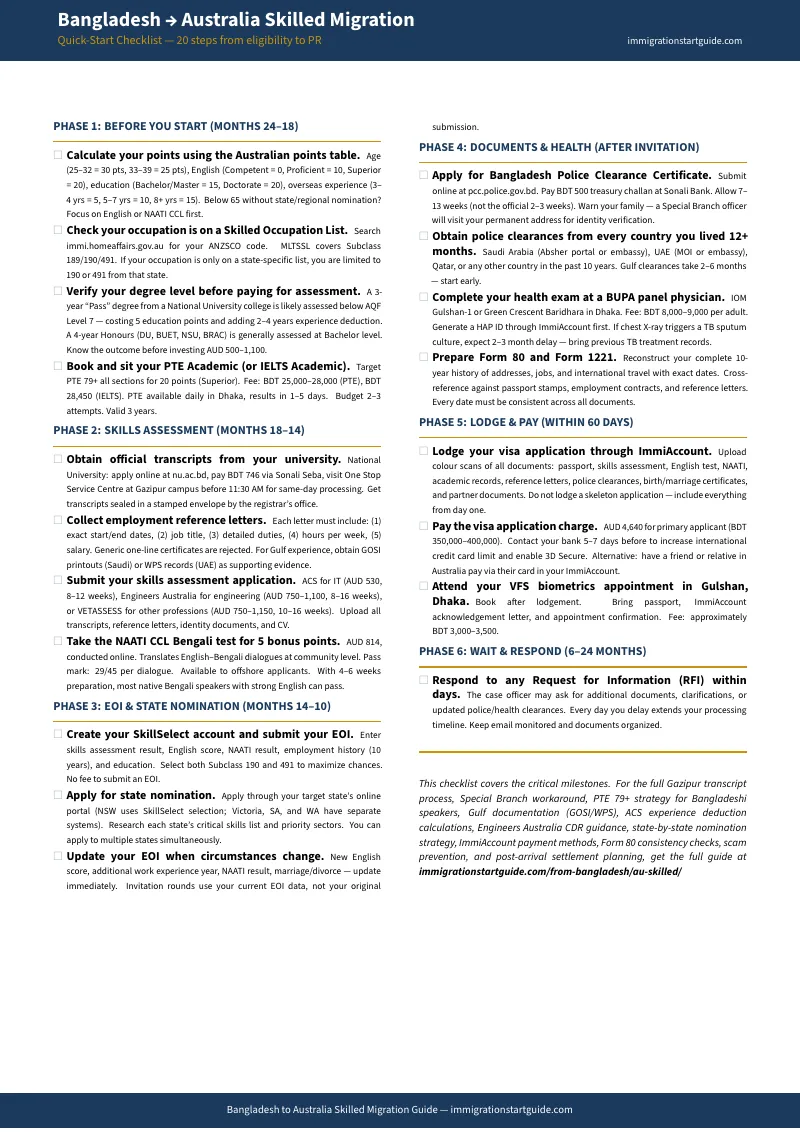
Quick-Start Document Checklist (free download)
Every Bangladesh-specific document you need for the Australian skilled migration process, in one printable checklist: skills assessment prerequisites (qualification mapping, employment evidence), National University transcript requirements, Special Branch police clearance, Gulf police clearances, health examination documents, ImmiAccount lodgement materials, and Form 80/1221 preparation. Enough to start organizing your files tonight.
Who This Guide Is For
This guide is for Bangladeshi skilled professionals pursuing Australian permanent residency through the General Skilled Migration program — whether you're calculating your points for the first time or you're mid-process and hitting documentation roadblocks:
- You're a software developer, network engineer, or ICT professional in Dhaka with 5+ years of experience and a points calculation that looks competitive — but you don't know whether ACS will assess your degree at AQF Level 7 or penalize your 3-year National University qualification with extra experience deductions that wipe out your employment points
- You're an engineer from BUET, CUET, or RUET and you've heard that the Washington Accord now recognizes IEB-accredited programs — but you graduated before June 2024, or your program wasn't IEB-accredited, and you need the CDR pathway explained without the risk of plagiarism detection or competency mapping failure
- You're returning from 5-8 years in Saudi Arabia or the UAE, you have strong experience that should earn 10-15 points, but your Gulf employer only gave you a one-line employment certificate and you don't know how to build the GOSI/WPS evidence package that Australian authorities actually accept
- You're trying to get transcripts from the National University for your skills assessment, but you've never been to the Gazipur campus, you don't know the cutoff times, and nobody has explained the sealed-envelope-with-stamp requirement that ACS demands
- You've been scoring PTE 65-72 on practice tests and you need to reach 79+ for the 20-point Superior score — a 10-point swing that determines whether you get invited or wait indefinitely
- You've been quoted BDT 300,000 to BDT 800,000 by a Dhaka agent and you want to self-file — but you need a structured system, not contradictory Facebook group advice and YouTube videos that don't address the Bangladesh-specific traps
Why Not Free Resources or an Agent?
Free information about Australian skilled migration exists everywhere. Here's what it actually gives you:
- HomeAffairs.gov.au publishes the official requirements, fee tables, and processing times. It doesn't tell you how ACS treats 3-year National University degrees, how to navigate the Gazipur transcript process, how to handle the Special Branch address verification trap, or how to pay the AUD 4,640 visa fee when your Bangladeshi credit card has a per-transaction limit of USD 3,000. The official site describes the rules for all nationalities. It doesn't explain how to execute them from Dhaka.
- Dhaka agents charge BDT 300,000 to BDT 800,000 for "complete handling." But the agent can't sit your PTE exam, can't visit Gazipur on your behalf, and can't speed up the Special Branch. The worst outcomes aren't just wasted money — they're agents who submit fabricated reference letters without the applicant's knowledge, triggering PIC 4020 and a 3-to-10-year ban on all Australian visas. Your agent doesn't carry that ban. You do.
- YouTube channels cover Australian skilled migration for all nationalities. They don't explain the ACS qualification mapping for Bangladeshi degrees, the National University transcript logistics, the Special Branch permanent-address workaround, or the Gulf returnee documentation strategy for proving Saudi and UAE employment to Australian authorities.
- Facebook groups ("Australia Immigration Bangladesh", "BD to Australia") contain real experiences mixed across years, visa types, and wildly varying circumstances. One person says their 3-year degree got a positive ACS result. Another was assessed as a Diploma. Neither mentions whether their program had 65% ICT content or how many experience years were deducted. The detail that determined the outcome is missing from every post.
This guide fills the Bangladesh documentation gap. It doesn't replace a registered migration agent for complex cases (refusal history, character concerns, health issues). It handles the entire Bangladesh-specific administrative layer that generic guides skip and agents charge BDT 300,000-800,000 to manage: the ACS qualification mapping, the Gazipur transcript process, the Special Branch police clearance logistics, the Gulf experience documentation strategy, the PTE preparation for Bangladeshi speakers, and the ImmiAccount payment workaround for Bangladeshi credit cards.
— Less Than 1% of Your ACS Assessment Fee
An agent charges BDT 300,000 to BDT 800,000. And if your application fails because ACS assessed your degree at the wrong level and you claimed points you couldn't back up, or because your Gulf employer's reference letter was missing one of the five required elements, or because your police clearance stalled for months because the investigation officer visited an empty house in Faridpur — the downstream costs are real. A failed ACS assessment wastes AUD 530 and 8-12 weeks. A visa refusal wastes the AUD 4,640 application fee. A PIC 4020 finding for fraudulent documents ends your Australian migration for a decade.
The guide doesn't replace a solicitor. It handles the Bangladesh-specific documentation strategy that sits between your decision to pursue Australian PR and a clean Department of Home Affairs lodgement. It turns scattered Facebook group advice and buried HomeAffairs.gov.au pages into a structured protocol built for Bangladeshi educational institutions, Bangladeshi police clearance procedures, Bangladeshi banking limitations, and the Gulf employment documentation challenge that thousands of Bangladeshi returnees face.
Money-back guarantee, no time limit. If the guide doesn't give you clearer control over the Bangladesh-side documentation of your skilled migration application, you pay nothing.
Download the free Quick-Start Checklist to see every Bangladesh-specific document you need for Australian skilled migration. When you're ready for the ACS qualification mapping, the Gazipur transcript walkthrough, the Special Branch workaround, the Gulf experience documentation strategy, and the complete cost breakdown in AUD and BDT, the full guide is here.
51,000 Bangladeshi Australians navigated this process before you. The bureaucracy is the same. The difference is whether you walk into it with a system or without one.