
Your CRS Score Is 470. The General Draw Cutoff Is 524. You Are 54 Points Short — and Every Birthday After 30 Costs You 5 More. Unless You Know the Strategy That Gets Brazilians Invited at 379.
You have run the CRS calculator a dozen times. You have tweaked every variable — adding a year of work experience, imagining a higher IELTS band, wondering if a provincial nomination you do not have would close the gap. The number barely moves. You are qualified. You have the degree, the experience, the English. And every Express Entry draw proves the same thing: qualified is not enough.
The general pool cutoff has not dropped below 520 in over a year. For a Brazilian IT professional with a Bacharelado, three years of experience, and IELTS 7.5, the CRS math caps out around 460 to 480. You can study for months to push your IELTS from 7.5 to 8.0 — and gain exactly 4 points. You can wait for more work experience — and lose 5 points per year to the age factor after 30. The math does not work. Not in the general pool.
But that is not the only pool.
In 2026, Canada's French-language category draws invited applicants with CRS scores as low as 379. The STEM and healthcare category draws cut off at 460 to 485. And here is what almost no Brazilian applicant realizes: Portuguese speakers can reach the French NCLC 7 requirement in 12 to 15 months of study — fast enough to qualify for the next round of French-language draws, where the cutoff is 140 points lower than the general pool.
That is not the only thing Brazilian applicants get wrong. Most discover too late that WES downgrades their 2-to-3-year Tecnólogo degree to a "two-year diploma" — costing them the Bachelor's-level education points they assumed they had. That their company's HR department will refuse to issue a reference letter matching the IRCC's required format — because Brazilian HR writes employment letters the Brazilian way, and the Canadian way reads like a foreign document to them. That the Federal Police clearance they need is not the Atestado de Antecedentes from the Polícia Civil they get for job applications — it is a different certificate from a different institution. That the apostille fee for their documents varies from R$50 in Rondônia to R$175 in Minas Gerais, and that ordering from the wrong state costs them more than this guide.
The Brazil → Canada Express Entry Guide is the Brazilian Express Entry Blueprint — built for the specific reality of navigating Canada's immigration system from within the Brazilian administrative ecosystem. This is not a translation of the IRCC website. This is the integrated system covering the WES credential evaluation strategy for Tecnólogo, Bacharelado, and Lato Sensu degrees, the French-language CRS bonus pathway with TEF vs TCF test selection for Portuguese speakers, the CTPS-to-reference-letter conversion with bilingual templates for resistant HR departments, the settlement fund documentation strategy for BRL savings in digital banks, the Federal Police clearance process, the Hague Apostille state-by-state cost optimization, the NOC code matching for Brazilian job titles, the category-based draw targeting strategy, and the complete post-ITA document assembly timeline.
What's Inside the Brazilian Express Entry Blueprint
The complete guide, a quick-start checklist, and standalone printable tools — covering every step from CRS calculation through your Confirmation of Permanent Residence:
The WES Credential Strategy for Brazilian Degrees
This is where most Brazilian applications silently lose 30 to 50 CRS points before they even begin. WES evaluates your degree based on the Canadian equivalency — and for Tecnólogo graduates, the result is devastating. A 2-to-3-year Tecnólogo degree, which is legally higher education in Brazil and recognized by MEC, is classified by WES as a "two-year post-secondary diploma" — not a Bachelor's degree. The CRS difference between "two-year diploma" and "Bachelor's" is the difference between an invitation and indefinite waiting. The guide covers the exact transcript format that maximizes your WES outcome, when to pair a Tecnólogo with a Lato Sensu Pós-Graduação to qualify for the "two or more credentials" category (which scores nearly as high as a Master's), how to ensure your Pós transcript shows the minimum 360 hours required for MEC recognition, and when to use alternative evaluation agencies like IQAS or the University of Toronto's Comparative Education Service instead of WES. If you hold a Bacharelado or Licenciatura, the guide covers those pathways too — but the Tecnólogo strategy alone can rescue an application that would otherwise stall in the general pool.
The French-Language CRS Bonus Pathway
This is the single most underutilized strategy available to Brazilian Express Entry applicants. Canada's 2026-2028 Immigration Levels Plan targets 9 to 10 percent Francophone immigration outside Quebec. The French-language category draws have cut off at CRS 379 to 410 — scores that are reachable for almost any qualified Brazilian professional. And Portuguese speakers have a structural advantage: both languages share Latin roots, similar grammar, and overlapping vocabulary. A Brazilian starting from zero French can reach NCLC 7 (B2 level) in 600 to 800 hours of study — roughly 12 to 15 months at one hour per day. Compare that to spending the same 15 months trying to push your IELTS from 7.5 to 8.0, which might gain you 4 CRS points. French gives you 50 bonus points and access to draws where the cutoff is 140 points lower. The guide provides the complete French pathway: the TEF Canada vs TCF Canada comparison for Portuguese speakers (which test suits the oral communication strength that Brazilians typically have), the study timeline with milestone targets, the NCLC 7 scoring breakdown, and the exact CRS simulation showing your score in the French-language pool versus the general pool.
The CTPS-to-Reference-Letter Conversion System
IRCC requires a reference letter that explicitly lists your job duties matching a National Occupational Classification (NOC) code. Brazilian HR departments do not write letters like this. They issue a standard Declaração de Vínculo Empregatício — a confirmation of employment that states your job title, hire date, and salary. It says nothing about your daily duties. When you ask HR to add a duty list matching a Canadian occupational code, they refuse — because it looks nothing like a Brazilian employment document and their legal department will not sign it. Meanwhile, your CTPS records you as "Analista de Sistemas" while you have been performing the duties of a Software Engineer (NOC 21232) for five years. The guide provides bilingual reference letter templates in Portuguese and English that Brazilian HR departments will actually sign, the Letter of Explanation strategy for when HR still refuses, the secondary evidence package using signed contracts, performance reviews, and holerites to satisfy the IRCC officer, and the NOC code matching guide for common Brazilian job titles that do not translate directly into the Canadian classification system.
The Settlement Fund Documentation Strategy
For a family of four, Canada requires CAD $28,362 in unencumbered funds — roughly R$119,000 to R$128,000 depending on the exchange rate. The money must be liquid, accessible, and documented with bank letters showing your name, the 6-month balance history, and confirmation of no outstanding debt. For Brazilians using digital banks like Nubank, Inter, or C6, this creates a problem: IRCC expects a formal bank letter on institutional letterhead with a physical or certified digital signature. A screenshot of your Nubank app balance is not acceptable. Neither is a PDF export from Inter's dashboard. The guide covers how to obtain the formal documentation from each major Brazilian digital bank, the exchange rate buffer strategy (because the BRL/CAD rate that qualifies you today may disqualify you when IRCC reviews your application months later), the acceptable evidence for funds sourced from vehicle sales, parental gifts, or investment redemptions, and the 2025-2026 settlement fund table with BRL equivalents at multiple exchange rates.
The Federal Police Clearance and Hague Apostille
Two administrative steps that sound simple but catch Brazilian applicants constantly. First, the police clearance: IRCC requires the Certificado de Antecedentes Criminais from the Polícia Federal — not the Atestado de Antecedentes from the Polícia Civil, which is the certificate Brazilians normally obtain for domestic employment. The Federal Police certificate must be validated online; an unvalidated document is considered invalid by Canadian officers. Second, the Hague Apostille: every document submitted to IRCC must be apostilled at a cartório, but the cost varies dramatically by state — from R$50 in Rondônia to R$175 in Minas Gerais. For an application requiring 6 to 8 apostilled documents, the difference between states can exceed R$1,000. The guide includes the state-by-state apostille cost table, the strategy for using proxy services to apostille in lower-cost states, and the document validity timeline so your apostilles do not expire before your application is submitted.
The CRS Maximization and Category-Based Draw Strategy
Express Entry is not one draw — it is multiple parallel draws with different cutoffs. The general all-program draw cuts off above 520. The STEM draw cuts off around 460 to 485. The healthcare draw is similar. The French-language draw cuts off at 379 to 410. The guide provides the complete CRS breakdown with every point-scoring opportunity mapped to the Brazilian context: the education points strategy (including the Tecnólogo workaround), the language points optimization (English plus French), the Canadian work experience bonus for those already on work permits, the provincial nomination pathway as a backup, and the category-based draw calendar so you know which draws to target based on your profile. It includes the age-adjusted timeline — because if you are 29, you have different strategic options than if you are 34, and every year of delay costs more than the last.
The Post-ITA Document Assembly Timeline
Once you receive an Invitation to Apply, you have 60 days to submit a complete application with every supporting document. For Brazilians, this is where preparation separates approved applications from abandoned ones. The guide covers the exact 60-day countdown: which documents to pre-assemble before the ITA arrives, the medical exam scheduling strategy (designated panel physicians in major Brazilian cities have booking queues), the biometrics appointment at the nearest VAC, and the document upload sequence in the IRCC portal. It includes the common refusal reasons specific to Brazilian applications and the preventive measures for each one.
Quick-Start Checklist (free download)
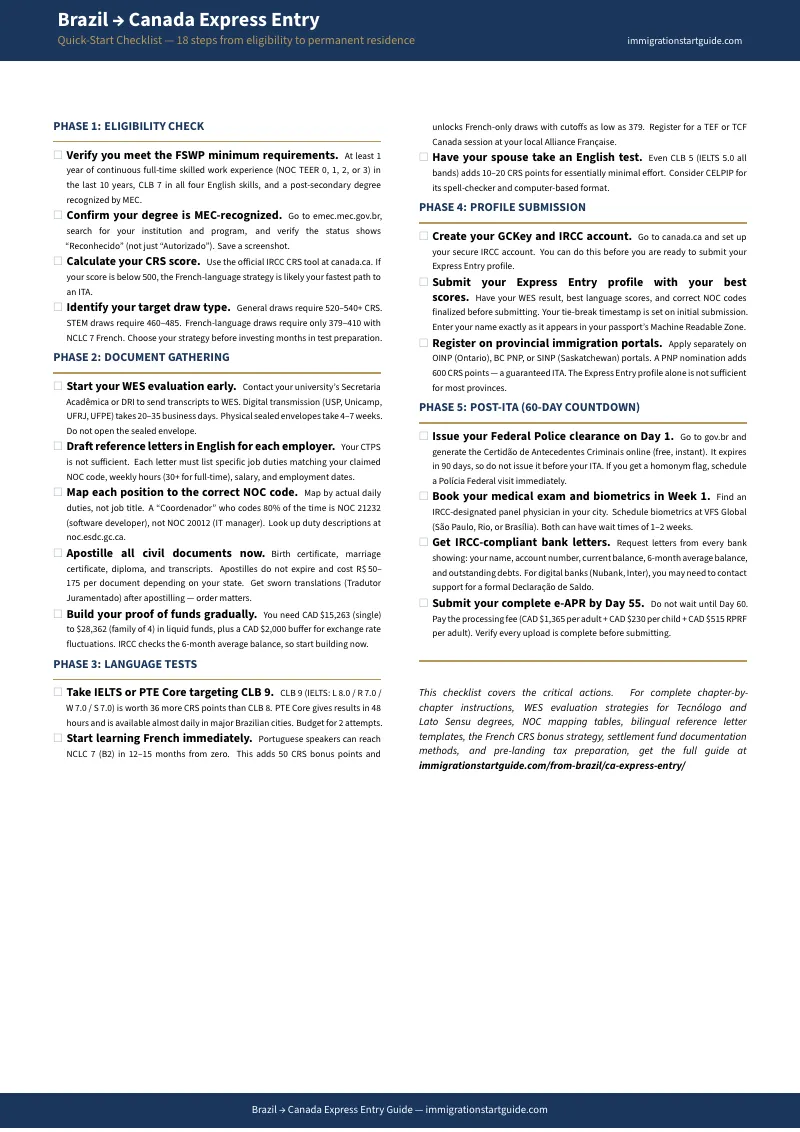
The critical steps distilled into a single action sheet organized by phase: CRS score assessment, credential evaluation strategy, language test selection, settlement fund preparation, document gathering, and Express Entry profile creation. Enough to calculate your realistic CRS score tonight and identify whether the French-language pathway or a category-based draw is your fastest route to an ITA.
Who This Guide Is For
This guide is for Brazilians applying through Canada's Express Entry system:
- IT professionals, software developers, and data engineers registered as "Analista" on their CTPS while performing duties that map to higher-value NOC codes — you need the reference letter conversion system, the NOC matching guide, and the bilingual templates that get Brazilian HR departments to sign letters in the Canadian format.
- Engineers, healthcare workers, and STEM professionals who qualify for category-based draws with lower CRS cutoffs — you need the draw targeting strategy and the documentation requirements specific to your occupational category.
- Tecnólogo graduates whose degrees risk being downgraded by WES — you need the credential evaluation strategy that either maximizes your Tecnólogo outcome or pairs it with a Lato Sensu to reach the "two or more credentials" scoring tier.
- Professionals aged 25 to 35 watching their CRS age points decline with every birthday — you need the age-adjusted timeline showing exactly how many points you lose per year and which strategies close the gap fastest.
- Applicants with intermediate English who have plateaued on IELTS — you need the French-language pathway that converts your Portuguese-speaker advantage into 50 CRS bonus points and access to draws 140 points lower than the general pool.
- Families planning to move together who need to document settlement funds of R$119,000 or more from Brazilian digital bank accounts — you need the bank letter strategy, the exchange rate buffer, and the proof-of-funds documentation that IRCC actually accepts.
This guide is not for: Canadian citizens or permanent residents (you are already there), applicants applying through Provincial Nominee Programs without Express Entry (see the relevant PNP guide), or non-Brazilian applicants (see the Canada Express Entry FSW Guide for the general pathway).
Why Not Free Resources?
Free information about Express Entry for Brazilians is everywhere. Here is what it actually delivers:
- The IRCC website lists the requirements: education, language, work experience, settlement funds. It does not explain the WES Tecnólogo downgrade, the French-language draw strategy, or how to get a Brazilian HR department to issue a reference letter in Canadian format. The government tells you what to submit. It does not tell you how to translate Brazilian documents into what Canadian officers expect.
- Reddit and Brazilian Facebook groups give you anecdotes. One person approved with a Tecnólogo evaluated as a diploma. Another rejected because their reference letter did not list duties by NOC code. A third who waited 14 months for a general draw that never dropped below 520. Each story is real. None tells you which scenario applies to your degree type, your CRS score, or your specific HR department's willingness to cooperate.
- YouTube videos in Portuguese walk through the Express Entry profile step by step. They do not cover the CRS math that shows why the general pool is unreachable for most Brazilian profiles, the French-language draw as an alternative, or the Tecnólogo-plus-Pós-Graduação credential stacking strategy. A video titled "Express Entry — Passo a Passo" gives you the process. It does not give you the strategy.
- Immigration consultants in Brazil charge CAD $3,000 or more for full representation. They handle the filing. They do not teach you how to maximize your CRS before filing, which category-based draws to target, or how to build the French-language advantage. And they expect you to show up with your WES evaluation, your reference letters, and your settlement fund proof already assembled — the hardest parts of the process are still on you.
This guide fills the gap between "I know I want Express Entry" and "I have my Confirmation of Permanent Residence" — the space where qualified Brazilians still fail because WES downgraded their degree, their HR department refused to write a proper reference letter, their Nubank statement was rejected as proof of funds, or they spent two years waiting for a general draw that never dropped low enough, never knowing that the French-language pool would have invited them six months ago.
— Less Than One Hour of a Canadian Immigration Consultant's Time
An immigration consultant charges CAD $3,000 or more for Express Entry representation. A credential evaluation at WES costs CAD $220 — and if WES downgrades your Tecnólogo because you did not know how to present your transcript, you pay again at a different agency. A rejected application after the ITA stage costs you the CAD $1,365 processing fee, months of preparation, and — if you turned 30 while waiting — CRS points you will never get back. One wrong reference letter format, one missing NOC duty description, one settlement fund letter rejected because it came from a digital bank without institutional signature, and the application that should have been approved becomes a refusal.
This guide costs less than one hour of a Canadian immigration consultant's billing rate and covers every step, every document, every Brazilian-specific obstacle, and every CRS optimization strategy between your first score calculation and your Confirmation of Permanent Residence. The French-language pathway alone can be worth 50 CRS points and access to draws that Brazilian applicants in the general pool will never reach.
You have the skills Canada is selecting for. You have the experience. You have, as a Portuguese speaker, a linguistic advantage for the French-language bonus that most nationalities do not have and most Brazilians do not know about. What stands between you and permanent residency is not qualification — it is the gap between the Brazilian administrative system you know and the Canadian documentation system that will evaluate you. The WES evaluation of your degree. The format of your reference letter. The proof of your settlement funds. The strategy for which draw to target. Every one of these is solvable. Every one of them, if solved wrong, costs you months, money, or the CRS points that disappear with age.
Money-back guarantee, no time limit. If the WES credential strategy, the French-language CRS pathway, the bilingual reference letter templates, and the settlement fund documentation system do not make your Express Entry application stronger than anything you could assemble from Reddit threads, Facebook groups, and generic YouTube walkthroughs, you pay nothing.
Download the free Quick-Start Checklist to calculate your realistic CRS score, identify whether the French-language pathway applies to your profile, and determine which category-based draw gives you the best chance of an ITA. When you are ready for the complete Brazilian Express Entry Blueprint — the full guide with the WES strategy, the bilingual templates, the settlement fund documentation system, and the draw targeting roadmap — the full guide is here.
The draw is happening whether you are ready or not. Every month you wait, the age factor takes points you cannot earn back. Start building the application that gets invited — in the pool where your score is enough.