
Your CRS Score Is 470. The Cutoff Is 507. This Guide Closes the Gap.
You ran the numbers on the official IRCC calculator. You have a master's degree, five years of experience, and CLB 8 in English. You expected to be a strong candidate. Instead, you're staring at a score that sits 40 points below every general draw cutoff in 2026 — and the gap feels impossible to close.
So you start searching. You watch YouTube videos that contradict each other. You read Reddit threads where one person says retaking IELTS is the answer and another says to chase a Provincial Nomination. You find a 2021 forum post about NOC skill levels that doesn't mention the TEER system because it didn't exist yet. Three weeks and 60 browser tabs later, you have a document folder full of screenshots and no strategy.
Here's the problem nobody explains upfront: Express Entry in 2026 is not a form-filling exercise. It's a competitive positioning problem. General draws require 507+. Category-based draws for French speakers accept 393. Healthcare draws clear at 467. The difference between an ITA and another year in the pool is not your qualifications — it's how you position them. And free resources will never teach you how, because the IRCC website explains the rules without explaining the strategy, and forums give you anecdotes from people who filed under different rules.
The Canada Express Entry (Federal Skilled Worker) Guide is a CRS Optimization Playbook. Not a recap of government pages — a structured decision framework that identifies your highest-ROI score interventions, maps your occupation to category-based draws and Provincial Nominee streams, and walks you through the 60-day post-ITA sprint that turns an invitation into an approved application. It replaces months of fragmented research with a single reference you can execute from today through landing day.
What's Inside the CRS Optimization Playbook
8 PDFs — the complete guide plus 6 standalone printable tools and a quick-start checklist you can print and work from tonight:
The CRS Optimization Decision Tree (Chapter 4)
Your CRS score isn't fixed — it's engineered. The decision tree maps your current score against every available intervention and ranks them by point gain per dollar and month invested. CLB 8 to CLB 9 on IELTS? That's 50 to 70 CRS points from the skill transferability multiplier alone. Basic French ability? Taking the TEF Canada opens category-based draws at 393 — over 120 points below general cutoffs. Spouse hasn't taken a language test? Even a modest CLB 5 adds 5 to 20 points you're currently leaving on the table. The tree tells you exactly which lever to pull first.
Category-Based Selection and PNP Strategy Matrix (Chapter 5)
Since 2023, IRCC runs targeted draws for French speakers, healthcare workers, STEM professionals, tradespeople, and transport workers — all at CRS cutoffs dramatically lower than general draws. The guide maps your NOC code to every applicable category and identifies which Provincial Nominee streams are actively recruiting from the Express Entry pool in 2026. A provincial nomination adds 600 CRS points and virtually guarantees an invitation. The matrix tells you which provinces to target, which streams accept outland applicants without a job offer, and how to trigger a Notification of Interest from Saskatchewan, Nova Scotia, or Ontario.
Bulletproof Reference Letter Templates (Chapter 6)
The single highest cause of Express Entry refusals is failing to prove work experience correctly. Immigration officers don't check your job title — they cross-reference your employer reference letter against the Lead Statement and Main Duties of your chosen NOC code. If your HR department wrote "managed team responsibilities" instead of listing specific duties that align with TEER category 0, 1, 2, or 3, your application is refused. The guide provides annotated templates showing exactly what a passing letter looks like versus a rejected one, with the communication framework for diplomatically getting your employer to write what IRCC actually requires — including exact weekly hours, annual salary, and duties that mirror the NOC profile word-for-word.
The 60-Day Post-ITA Sprint Plan (Chapter 8)
You receive an Invitation to Apply. The clock starts. You have exactly 60 days to submit a flawless electronic Application for Permanent Residence. Missing documents, formatting errors, or a police clearance certificate that arrives on day 61 means your ITA expires — months of preparation and thousands of dollars wasted. The sprint plan breaks the entire 60 days into five phases with specific deliverables for each: Days 1 to 5 trigger police clearances and transcript requests. Days 6 to 15 schedule medical exams and translations. Days 16 to 40 finalize reference letters. Days 41 to 50 lock in proof-of-funds documentation. Days 51 to 60 are final assembly and submission.
Country-Specific Documentation Chapters (Chapter 7)
Generic guides pretend every applicant faces the same process. They don't. Indian applicants with three-year bachelor's degrees risk having WES downgrade their credential to a college diploma — costing them critical CRS points — unless they understand the NAAC accreditation grade workaround. Nigerian applicants face aggressive proof-of-funds scrutiny where a single unexplained lump-sum deposit triggers a borrowed-funds investigation. Filipino applicants need NBI clearance certificates with the exact thumbprint and dry seal format IRCC demands, plus written explanations for any remarks on the certificate. The guide addresses each source country's bureaucratic realities so nothing blindsides you at the worst possible moment.
NOC 2021 TEER Classification Walkthrough (Chapters 3 and 6)
The 2022 switch from NOC skill levels to the TEER system means any advice from before that date is actively dangerous. The guide explains how to select the correct five-digit NOC code based on your actual duties — not your job title — and how the TEER category determines both your FSWP eligibility and your positioning for category-based draws. Choosing NOC 21231 instead of 21232 can be the difference between qualifying for a STEM draw and sitting in the general pool indefinitely.
The 67-Point Selection Grid Analysis (Chapter 2)
Before your CRS score matters, you must clear the first gate: 67 out of 100 points across six selection factors. The guide walks through each factor with worked examples showing common scenarios — a 32-year-old with CLB 7 and no Canadian ties who barely reaches 67, versus a 28-year-old with CLB 9 and a master's who cruises past. If you're below 67, the guide identifies which factor is holding you back and the fastest intervention to cross the threshold.
Fee Schedule and Settlement Funds Calculator (Chapter 9)
Total Express Entry costs for a single applicant exceed $5,000 to $10,000 CAD when you add government processing fees ($1,590 CAD), IELTS ($300 CAD), ECA ($250 CAD), medical exams, police clearances, and settlement funds ($15,263 CAD for a single applicant). The guide provides a complete fee breakdown for individuals, couples, and families — so you know exactly what capital you need before you start, not after you've committed thousands to the process.
Post-Refusal Legal Options (Chapter 10)
If your application is refused, the guide covers your three paths forward: Requests for Reconsideration, Federal Court Judicial Review, and resubmission strategy. It explains the misrepresentation trap that catches applicants who innocently report inconsistent dates between their Express Entry profile and their application — and why even a minor discrepancy can result in a five-year ban from Canada.
Quick-Start Checklist (free download)
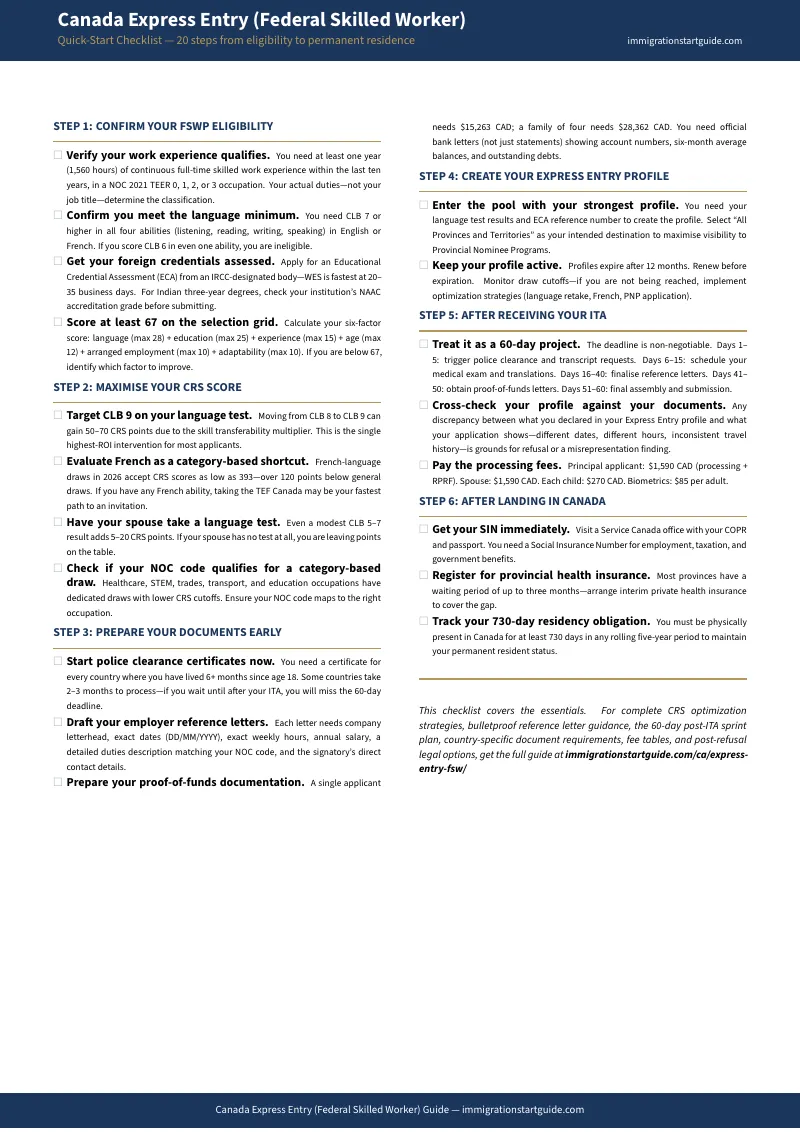
A 20-item action plan covering the essentials: confirm FSWP eligibility, verify your NOC code, check your selection grid score, evaluate CRS optimization options, and understand the 60-day post-ITA timeline. Enough to assess your position and identify your next move tonight.
Who This Guide Is For
This guide is for skilled professionals applying for Canadian permanent residency through the Federal Skilled Worker Program who:
- Have a CRS score below the current general draw cutoff and need a structured plan to close the gap — through language optimization, category-based draws, or Provincial Nomination
- Are preparing their Express Entry profile for the first time and want to position it correctly from day one — choosing the right NOC code, maximizing points, and targeting the right draw categories
- Received an Invitation to Apply and need a day-by-day project plan to assemble a flawless application within the 60-day deadline
- Are applying from India, Nigeria, the Philippines, Pakistan, or China and need country-specific guidance on credential assessments, proof of funds, and police clearance procedures
- Want to understand how the Provincial Nominee Program works as a backdoor to Express Entry — which provinces are recruiting, which streams accept outland applicants, and how to trigger a Notification of Interest
- Are deciding between hiring an immigration consultant at $3,000 to $8,000 CAD and doing it themselves — and want a resource that makes the DIY path strategic, not risky
Why Not Free Resources?
Free information on Express Entry is abundant. Here's what it actually delivers:
- The IRCC website is the definitive rulebook. It tells you that you need a reference letter with your duties listed. It will never tell you that writing "managed project deliverables" instead of mapping specific duties to the NOC Lead Statement is the reason applications get refused. You get regulations, not execution guidance.
- Immigration law firm blogs publish excellent analysis of policy changes — because their business model is to demonstrate that the system is overwhelmingly complex, then offer $5,000 full-representation retainers to resolve it. The blog explains the problem. The solution costs five figures.
- Reddit and Canadavisa forums are where you read advice from someone who filed in 2021 under NOC skill levels that no longer exist, and discover too late that their strategy doesn't work under the 2022 TEER system. You're getting survivorship bias from strangers who filed under different rules, in different categories, with different backgrounds.
- YouTube creators publish 10-minute videos that each cover one fragment of the process. To reconstruct a complete strategy, you'd need to watch dozens of videos from different creators with different levels of accuracy — and you still wouldn't have a template, a checklist, or a decision framework.
- Etsy templates sell a generic reference letter for $3 to $5 or a basic checklist for $20. They're not updated for 2026 TEER classifications, they don't address country-specific documentation requirements, and they don't connect to any broader strategy. You get a single page that may or may not reflect current IRCC expectations.
This guide fills the strategy gap — the space between "I know the rules" and "I can position myself to win." It gives you the same optimization framework that immigration consultants charge thousands to apply, structured so you can execute it yourself.
— Less Than 2% of Your Total Immigration Costs
Immigration consultants charge $3,000 to $8,000 CAD for full Express Entry representation. A 30-minute phone consultation costs $300 CAD. And the applicant still does the work — passing the language test, tracking down transcripts, securing reference letters, gathering proof of funds.
Total Express Entry costs will exceed $5,000 to $10,000 CAD before you ever land in Canada. This guide represents less than 2% of that total investment — and it's the piece that determines whether the other 98% produces an approval or a refusal.
A refused application doesn't just cost you $2,150 CAD to re-file. It costs 6 to 12 months of delay. It costs the career opportunity you were planning around. It costs the settlement funds sitting frozen in your account for another year.
Money-back guarantee, no time limit. If the optimization strategies, reference letter templates, and sprint plan don't make your application stronger, you pay nothing.
Download the free Quick-Start Checklist to see the 20-item action plan and assess your current position. When you're ready for the CRS optimization decision tree, bulletproof reference letter templates, category-based draw strategy, and the complete 60-day post-ITA sprint plan, the full guide is here.
You have the qualifications. Now build the application that proves it.