
You Are About to Bet $50,000 on a Program That May No Longer Lead to PR. This Guide Makes Sure It Does.
You have spent six months researching colleges. You have compared tuition fees across provinces, read every Reddit thread about the September intake, and sat through YouTube videos titled "Best Courses for PR in Canada 2026" from creators who get paid by the colleges they recommend. Your agent sent you a list of programs at three partner institutions. You are ready to pay the deposit.
But here is the question nobody around you can answer: does the specific program on your acceptance letter have a CIP code that appears on the 2026 PGWP-eligible list? Because if it does not, you will spend two years in Canada, pay $40,000 to $80,000 in tuition and living costs, graduate on schedule, and receive nothing. No Post-Graduation Work Permit. No Canadian work experience. No Express Entry profile. No path to permanent residence. The family debt remains. The immigration outcome you planned your entire financial life around does not exist.
This is not a hypothetical. Since November 2024, IRCC restricted PGWP eligibility for college diploma and non-degree graduates to exactly 920 approved fields of study. General business administration, marketing, hospitality management, human resources, and general IT diplomas are excluded. The list is frozen for 2026 — no additions, no exceptions. Meanwhile, study permit approval rates have collapsed to 46% overall. Indian approvals fell 66%. Nigerian approvals fell 52%. The Student Direct Stream is dead. Provincial quotas cap the number of permits each province can issue. And the Express Entry system is being overhauled to reward high-wage occupations and punish graduates who end up in minimum-wage jobs.
Your education agent cannot help you navigate this. They are paid commission by the colleges they place you at — their incentive is to fill seats, not to verify whether your program's CIP code maps to a PGWP-eligible field, whether that field leads to a NOC code targeted by category-based Express Entry draws, or whether the resulting occupation pays enough to trigger the new high-wage CRS bonus. A Regulated Canadian Immigration Consultant charges $1,000 to $3,000 for a study permit application. A $15 Etsy checklist gives you a list of documents without explaining why 70% of refusals cite "purpose of visit" and how to structure a Statement of Purpose that survives the dual-intent test.
The Canada Study Permit + PGWP Guide is built around one principle: every program choice is a permanent residence decision. It maps the full pipeline — from CIP code verification through program selection, PAL sequencing, financial documentation, SOP architecture, PGWP application, Express Entry category targeting, and the high-wage occupation factor — so that the $50,000+ you invest in Canadian education actually terminates in PR, not in a flight home.
What's Inside
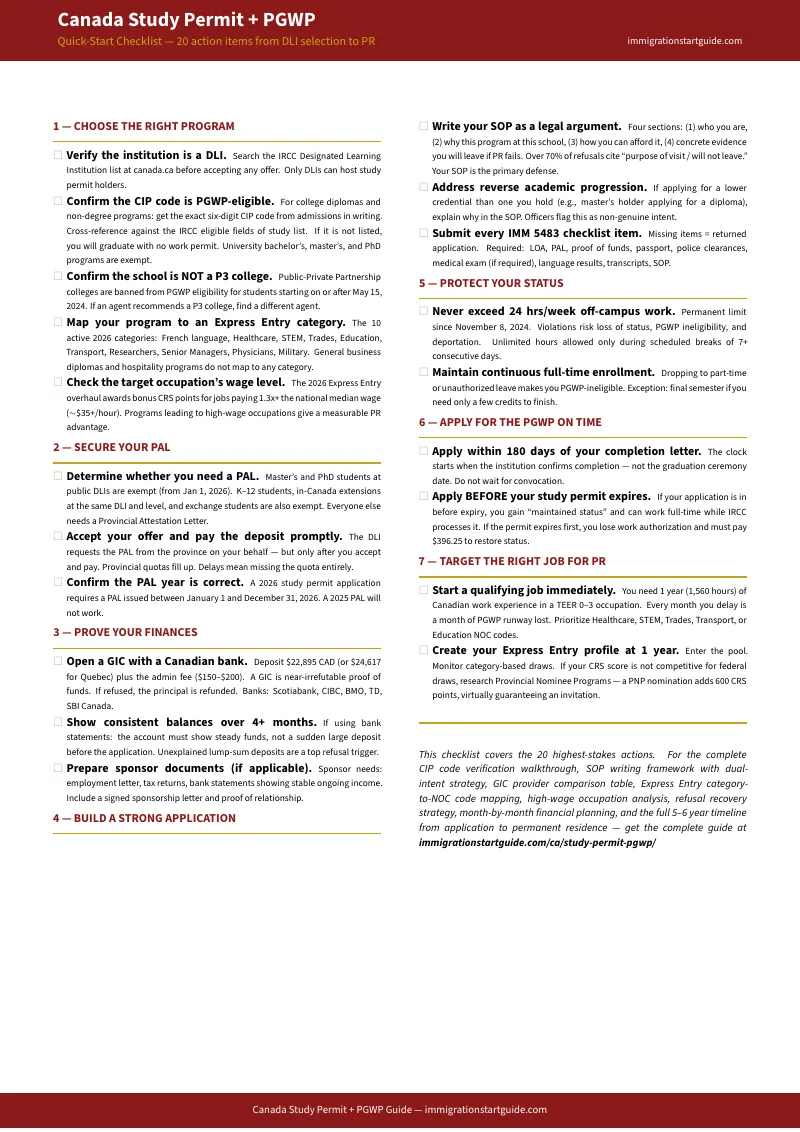
The complete 10-chapter guide, a 20-item quick-start checklist, and 7 standalone printable tools — covering every stage from choosing the right program through securing permanent residence:
The CIP Code Verification System
How to confirm your program's six-digit CIP code appears on the 2026 PGWP-eligible list before you pay a dollar in tuition. Which programs are excluded (general business, marketing, hospitality, general IT), which sectors are approved (healthcare, STEM, trades, agriculture, transport), how to get the CIP code in writing from the admissions office, and how to cross-reference it against the IRCC eligible fields list. This chapter prevents the single most expensive mistake in Canadian immigration — enrolling in a program that no longer leads to a work permit.
Reverse-Engineering from PR: The Strategic Program Selection Framework
Instead of choosing a program and hoping it leads somewhere, you start at the end: which Express Entry category do you want to qualify for? The guide maps CIP codes to NOC codes to category-based selection streams to wage levels, so you can trace a line from your first day of class to your permanent residence application. A dental hygiene program (CIP 51.0602) maps to NOC 32111, which falls under the Healthcare category draw, and the occupation pays $38-$45/hour — triggering the high-wage CRS bonus. A general business diploma (CIP 52.0201) maps to nothing. This framework eliminates guesswork.
Provincial Attestation Letter (PAL) Sequencing
The PAL is your ticket through the provincial quota system, and the order of operations determines whether you get one. The guide covers who needs a PAL, who is exempt (master's and PhD students at public DLIs skip it entirely since January 2026), how the DLI requests one on your behalf, why paying the tuition deposit fast matters, PAL validity rules, and the joint-program single-PAL provision. A wrong-year PAL or a missed provincial quota means your application is returned before an officer even reads it.
Financial Documentation That Survives Scrutiny
The 2026 proof of funds requirement is $22,895 CAD for living expenses alone (outside Quebec) — plus full first-year tuition on top. The guide covers Guaranteed Investment Certificate (GIC) setup with a five-bank comparison table, bank statement requirements (why a 4-month consistent balance matters and why lump-sum deposits trigger refusals), sponsor documentation architecture (employment letters, tax returns, signed sponsorship letters, proof of relationship), and the complete financial planning table showing realistic first-year costs of $40,000-$70,000 CAD. Officers are not checking whether you have money. They are checking whether the money is real, stable, and yours.
The Statement of Purpose Architecture
Over 70% of study permit refusals cite "purpose of visit" or "will not leave" under Subsection 216(1) of IRPA. Your SOP is the primary defense. The guide provides a four-section framework: identity and program, academic and professional rationale, financial narrative, and home country ties with a concrete return strategy. It covers the dual-intent doctrine (you are legally allowed to want PR — the trick is proving you will leave if it does not work out), how to address reverse academic progression without triggering a red flag, and how to narrate sponsor funding without creating a financial insufficiency argument for the officer.
PGWP Application Mechanics
The 180-day application window, maintained status rules that let you work full-time while the application processes, the 1+1 program stacking strategy for a 3-year PGWP, status restoration if your study permit expires before you can apply ($396.25 and 90 days of legal limbo), and why flagpoling no longer works. One missed deadline and you lose the only PGWP you will ever be issued — it is a once-in-a-lifetime permit with no second chances.
Express Entry Category Targeting and the High-Wage Factor
The 2026 Express Entry overhaul eliminates job offer points, introduces CRS bonuses for occupations paying 1.3x to 2x the national median wage, and continues 10 category-based selection streams. The guide maps all 10 categories with their targeted NOC codes, explains how category-based draws issue invitations at significantly lower CRS thresholds than general draws, details the Provincial Nominee Program 600-point guarantee as a backup, and provides a month-by-month timeline from PGWP to PR covering strategic job targeting, language score improvement, and PNP positioning.
When Things Go Wrong: Refusal Recovery
How to order your GCMS notes through an ATIP request ($5, 30-60 day turnaround) to uncover the specific officer concerns behind your refusal. The three paths forward: reapplication with a stronger file, informal reconsideration for factual errors, and judicial review in Federal Court (15-day deadline for in-Canada decisions, $2,000-$5,000 in legal fees). The guide covers each path's realistic success rate so you spend money and time on the option that matches your situation.
Complete Fee Schedule and 5-6 Year Timeline
Every government fee from study permit ($150) through biometrics ($85) through PGWP ($255) through Express Entry PR application ($1,590) — totaling $2,080-$2,480 in government fees alone before tuition and living expenses. Plus a month-by-month planning framework that maps the entire pipeline from initial research through permanent residence confirmation, so you know exactly where you should be at every stage.
Who This Guide Is For
- International students choosing a Canadian program for September 2026 or January 2027 intake — you need to verify your program's PGWP eligibility before paying the tuition deposit, not after you have spent two years and $50,000 in a program that leads nowhere
- Students from India, Nigeria, Philippines, Pakistan, Nepal, or Bangladesh facing 50%+ refusal rates — you need the SOP architecture and financial documentation strategy that addresses the specific refusal grounds officers use for high-volume corridors, not a generic checklist
- Families investing $40,000-$80,000 in a child's Canadian education — you need to understand whether the program your agent recommended actually maps to a PGWP, a category-based Express Entry stream, and a high-wage occupation, or whether it is a seat the agent earns commission on
- Students already in Canada preparing for PGWP and the PR transition — you need the Express Entry category mapping, the high-wage factor analysis, and the month-by-month job targeting strategy to convert your PGWP into permanent residence before it expires
- Anyone who has already been refused a study permit — you need the GCMS notes strategy, the refusal recovery framework, and the SOP rewrite architecture to identify exactly what went wrong and fix it for the next application
Why Not Free Resources?
- Your education agent is paid 15-30% commission by the colleges they place you at. Their job is filling seats, not verifying whether a program's CIP code leads to a PGWP or whether the resulting occupation triggers the Express Entry high-wage bonus. They recommend what their partner institutions need to sell, not what your immigration outcome requires. The guide has no institutional partnerships and no commission structure. It maps every recommendation to the actual IRCC regulatory framework.
- RCICs and immigration lawyers provide legally sound, individualized advice for $1,000 to $3,000 per study permit application. They are essential for complex cases involving prior refusals, criminal inadmissibility, or judicial review. But for the strategic planning layer — which program to choose, how to map CIP codes to Express Entry categories, how to target high-wage occupations during your PGWP — most consultants assume you have already made the right academic choice. This guide covers the 80% of strategic value that comes before the lawyer's involvement, at less than 2% of the cost.
- YouTube creators build audiences by documenting the emotional reality of international students in Canada — the refusal stories, the expired PGWPs, the students working without authorization. They validate your fear. They do not provide a structured, step-by-step system you can execute against. The guide converts that anxiety into a documented pipeline with specific actions, deadlines, and verification steps at every stage.
- Etsy and Gumroad checklists ($8-$15) give you a list of documents to submit. They do not explain why your Statement of Purpose needs a four-section architecture to survive the dual-intent test, how to verify a CIP code, or how to map your program to Express Entry category-based draws. The guide operates at the strategic layer that determines whether your entire investment pays off — not just whether your envelope is complete.
— Less Than One Day's Tuition
A single year of Canadian college tuition costs $15,000 to $20,000. A single year at a Canadian university costs $20,000 to $35,000. A GIC deposit locks up another $22,895. An RCIC charges $1,000 to $3,000 before your application is even submitted. And if the wrong program choice means two years of tuition with no PGWP at the end, the total loss is $40,000 to $80,000 — plus the opportunity cost of years spent in a dead-end pathway and the family debt that does not care whether you got permanent residence.
This guide does not replace an immigration lawyer for complex legal situations, criminal inadmissibility, or judicial review proceedings. But it provides the strategic planning system — the CIP code verification, the program-to-PR mapping, the SOP architecture, the Express Entry category targeting — that prevents the upstream mistakes which make downstream legal intervention necessary in the first place.
If it saves you from enrolling in one PGWP-ineligible program, from one study permit refusal caused by a weak SOP, or from one year of PGWP employment in a job that does not generate enough CRS points for PR, it pays for itself before you finish Chapter 2.
Money-back guarantee, no time limit. If the guide does not make your Canadian immigration pathway clearer, you pay nothing.
Download the free Quick-Start Checklist to see the 20 highest-stakes action items across seven phases — from CIP code verification through Express Entry profile creation. When you are ready for the complete strategic planning system, the SOP architecture, the Express Entry category mapping, and the full 5-6 year timeline from application to permanent residence, the guide is here.
Canada is still taking international students. It is just no longer taking all of them. This guide makes sure you are one of the ones who gets through.