
You Waited Five Years in the PGP Lottery Pool, Finally Won a Spot, and Then Had Your Application Returned Because of a Family Size Miscalculation That Added One Person You Forgot to Count. The Problem Was Never the Lottery — It Was the 60 Days After. This Guide Is the Submission-Ready System That Protects a Lottery Win You Cannot Get Back.
You already know the basics. The Parents and Grandparents Program grants permanent residency to your parents through an annual lottery draw. You need to meet the Minimum Necessary Income threshold for three consecutive tax years. You get 60 days after an Invitation to Apply to submit a complete, error-free application. One returned application means your ITA is gone — and you go back into a pool where the selection rate hovers around 5 to 7 percent.
What you probably did not know: your family size for the MNI calculation includes every person from a prior active sponsorship undertaking, even if that person has been a citizen for years but the undertaking period has not expired. If you sponsored your sibling under a 10-year undertaking in 2018, they still count toward your family size in 2026 — pushing your required income up by $10,291 per year. Most applicants calculate their family size based on who lives in their household. IRCC calculates it based on who you are legally responsible for. That single miscalculation is the most common reason lottery winners have their applications refused after waiting years for an invitation.
The Canada Parent & Grandparent Sponsorship Guide is a Submission-Ready System — built for the three problems that separate lottery winners from approved applications: calculating the Minimum Necessary Income correctly across three tax years with every family member and prior undertaking accounted for, assembling every document from both the sponsor and the applicant before the 60-day clock starts, and executing the full dual-pathway strategy — PGP for permanent residency and Super Visa as a bridge so your parents can be in Canada now while the application processes over 34 to 48 months.
What's Inside the Submission-Ready System
12 chapters + 8 standalone printable tools + the quick-start checklist — a complete guide covering the PGP lottery mechanics and the 2020 pool legacy, the MNI calculation with family size traps and co-signer strategy, the 60-day post-ITA submission sprint, sponsor and applicant document assembly, the Quebec MIFI separate undertaking and 2024–2026 moratorium, the Super Visa bridge strategy with the 2026 income flexibility reforms, medical inadmissibility and excessive demand mitigation planning, every government and ancillary cost mapped, processing timelines, and the post-landing transition from PR to citizenship.
Your standalone printable tools: Family Size Calculation Worksheet, MNI Income Tracker (three-year assessment grid), 60-Day Submission Sprint Timeline (fridge sheet), Complete Document Assembly Checklist, Medical Inadmissibility Mitigation Plan Template, Quebec Welcome & Integration Plan Framework, 2026 Cost Breakdown Worksheet, and Processing Timeline Tracker. Print them, fill them in, and bring them to your desk — each one works as a self-contained tool.
The MNI Calculation — Every Family Member, Every Trap (Chapter 3)
The LICO + 30% threshold across three consecutive tax years, how to count every person IRCC includes in your family size — your spouse, dependent children, any person from a prior active sponsorship undertaking, and the parents being sponsored plus their dependents. The co-signer strategy when your income alone falls short, including the joint liability implications for a 20-year undertaking. The specific CRA documents IRCC requires and how to reconcile discrepancies between your Notice of Assessment and your actual tax filing. Most lottery winners do not learn they miscalculated their family size until their application is returned — by which point the 60-day window has closed.
The 60-Day Post-ITA Submission Sprint (Chapter 5)
The day-by-day sequence for assembling a complete application within IRCC's unforgiving deadline — and the pre-lottery readiness strategy that gives you a 30-day head start. Police certificates from India, Nigeria, and Pakistan routinely take 6 to 10 weeks. Certified translations add another 2 to 3 weeks. If you start gathering these documents after winning the lottery, you have already lost half your deadline before the forms are even filled in. The guide maps every document that can be prepared in advance and every document that requires an active ITA, so you spend day one through five on the few remaining items instead of scrambling for eight weeks straight.
The Super Visa Bridge Strategy (Chapter 8)
For the 190,000+ families not selected in the PGP lottery — and for everyone who missed the 2020 intake window entirely — the Super Visa allows stays of up to five years per entry with a possible two-year extension. The 2026 income flexibility reforms now allow a two-year lookback and supplemental visitor income, lowering the effective threshold. The mandatory insurance requirement ($1,500 to $6,000 per year depending on age and health), the pre-existing condition stability rider, and the comparison framework for Canadian versus OSFI-approved insurers. How to maintain Super Visa status while your PGP application processes — because the worst outcome is not losing the lottery, it is winning the lottery while your parent is stranded abroad waiting for a police certificate.
Medical Inadmissibility and the Mitigation Plan (Chapter 6)
The excessive demand threshold rises to $28,878 per year ($144,390 over five years) in 2026. If your parent has a chronic condition that triggers a medical review — dialysis, advanced cardiovascular disease, neurological disorders — you will receive a Procedural Fairness Letter, and you have a limited window to respond. The guide covers how to draft a mitigation plan that demonstrates you can cover medical costs privately: lining up private insurance quotes, identifying private care providers, and presenting financial evidence. Having this plan ready before the letter arrives saves critical weeks in a process where every delay compounds.
The Quebec Sponsorship Exception (Chapter 7)
Quebec operates a completely separate sponsorship undertaking through MIFI — with a 10-year undertaking instead of 20, its own income formula based on 12 months rather than three years, and the Welcome and Integration Plan requirement for sponsored persons aged 18 to 55. The 2024–2026 moratorium means Quebec is not accepting new undertaking applications until June 25, 2026. If you live in Quebec and win the federal lottery, you can submit the federal application — but finalisation requires a CSQ from MIFI. The guide maps the timing so you do not discover the provincial block after celebrating a federal win.
Complete Cost Breakdown (Chapter 9)
Every fee itemised across both pathways: the $75 sponsorship application fee, the $75 principal applicant processing fee, the $150 dependent processing fee, the $500 Right of Permanent Residence Fee per person, $85 biometrics, medical exams ($200–$450), police certificates ($30–$100 per country), certified translations ($30–$50 per page), passport photos, and Super Visa insurance. Total budget for sponsoring one parent: approximately $1,500–$2,500 in government and ancillary fees. For two parents: $2,500–$4,500. These are sunk costs — if your application is returned due to a documentation error, you pay them again.
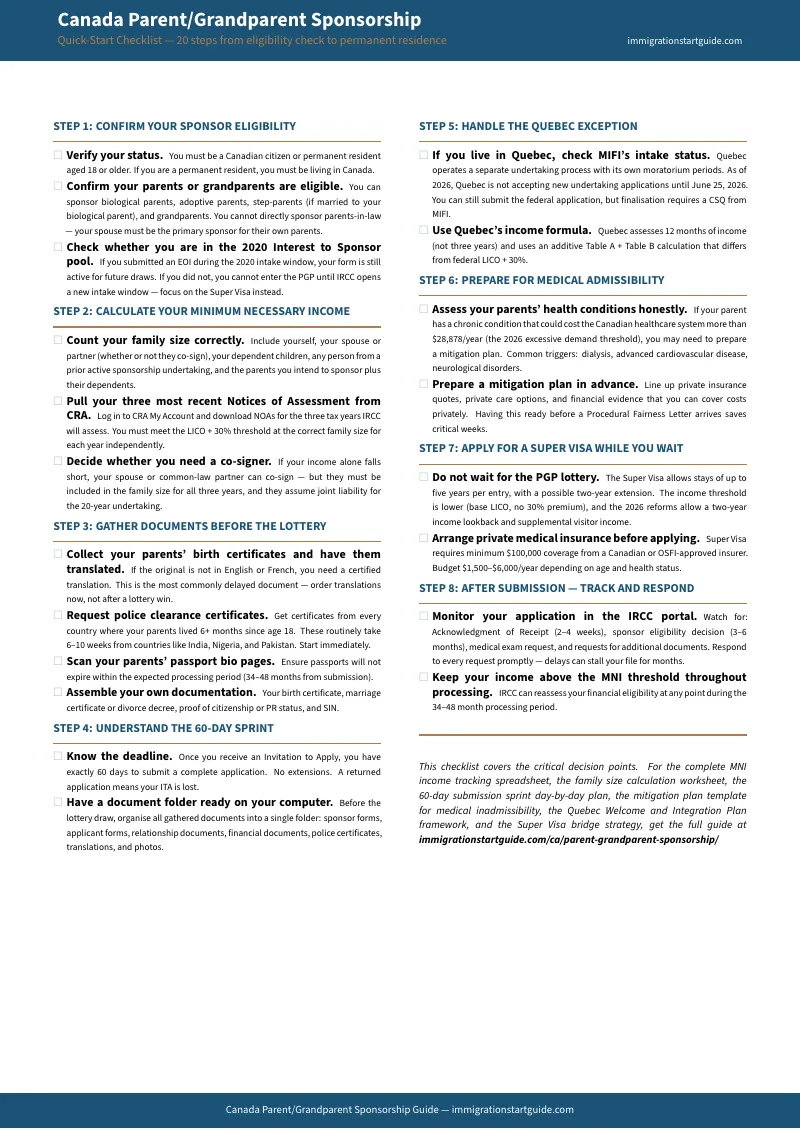
Quick-Start Checklist (free download)
A 20-item action plan in eight phases: confirming sponsor eligibility, calculating your MNI correctly, gathering documents before the lottery, understanding the 60-day sprint, handling the Quebec exception, preparing for medical admissibility, applying for a Super Visa while you wait, and tracking your application after submission. Enough to assess your position and identify your next move tonight.
Who This Guide Is For
This guide is for Canadian citizens and permanent residents who want to bring their parents or grandparents to Canada permanently through the PGP, or temporarily through the Super Visa while waiting for a lottery win — who have realised that understanding the program rules and actually submitting a successful application are two entirely different challenges:
- You are in the 2020 Interest to Sponsor pool and have not been selected in five annual draws. You need a readiness plan so that when your number finally comes up, you can submit a complete application within 60 days without scrambling for police certificates and translations that take longer than the deadline allows
- You became a permanent resident or citizen after 2020 and were never able to enter the PGP pool. The Super Visa is your only option for bringing your parents to Canada right now, and you need a clear comparison of pathways, insurance requirements, and the transition strategy for when the PGP reopens
- You won the lottery in a previous year and had your application returned or refused — because of a family size miscalculation, missing documentation, or an income shortfall you did not anticipate. You need the systematic approach to prevent the same result if you are selected again
- Your parents have health conditions that may trigger a medical inadmissibility review, and you need to understand the excessive demand threshold and how to draft a mitigation plan before the Procedural Fairness Letter arrives
- You live in Quebec and need to navigate MIFI's separate undertaking process, its own income formula, and the moratorium on new applications — on top of the federal PGP requirements
- You found immigration lawyers quoting $4,500 to $8,500 and consultants quoting $2,000 to $5,000 for what is fundamentally a document-organisation task. You want to understand the process well enough to file on your own — or to engage a professional for a targeted review rather than paying for full representation
This guide is not for: people sponsoring a spouse or dependent child (different pathway, different requirements), or people looking for a general Canadian immigration overview. Every chapter, every calculation, every deadline is specific to the parent and grandparent sponsorship pathway and the 2026 regulatory environment.
Why Not Free Resources?
Free information on parent sponsorship exists everywhere. Here is what it actually delivers:
- The IRCC official guide (Guide 5772) lists the forms and requirements. It does not explain how to count family members from prior sponsorship undertakings, does not provide a pre-lottery document readiness plan, and does not cover the strategic interplay between the PGP and Super Visa. You get the rules. You do not get the system for executing them within a 60-day deadline.
- Canadavisa.com forums have thousands of threads from applicants in different years, under different income thresholds, with different family configurations. Finding the answer to your specific MNI question means sifting through anecdotes that may not reflect current rules — and one wrong answer about family size can cost you a lottery win you waited five years for.
- Immigration consultant websites publish detailed PGP overviews to demonstrate complexity and sell $2,000–$5,000 retainers. The overview is free. The document preparation, income verification, and submission strategy cost more than most families budget for the entire application.
- Reddit and YouTube provide real-time experiences and walkthrough videos. Most reference pre-2026 rules, do not account for the 2026 intake pause, and none provide the integrated dual-pathway strategy, the family size worksheet, the 60-day sprint timeline, or the mitigation plan template for medical inadmissibility. You cannot assemble a submission-ready system from fragments posted by people who were navigating a different version of the program.
This guide fills the execution gap — the space between "I understand the PGP lottery" and "I have every document prepared, my MNI calculated correctly for all three tax years, a mitigation plan ready for medical issues, a Super Visa strategy for the interim, and a day-by-day plan for the 60-day sprint." It gives you the complete system that free resources describe in pieces but never assemble — structured so you can execute it yourself or engage a lawyer for a targeted review of your completed application rather than paying thousands for full representation.
— Less Than a Single Immigration Consultation
Immigration lawyers charge $4,500 to $8,500 for a standard PGP application. Consultants charge $2,000 to $5,000. A one-hour consultation runs $150 to $325 — and in that hour, you get verbal advice that disappears when the call ends. No MNI worksheet. No document readiness plan. No 60-day sprint timeline. No mitigation plan template.
Your total PGP sponsorship will cost approximately $1,500 to $4,500 in government and ancillary fees — the sponsorship application fee, processing fees, Right of Permanent Residence Fee, biometrics, medical exams, police certificates, translations, and photos. If you add a Super Visa for the interim, that is another $1,500 to $6,000 per year in mandatory insurance alone. That is money you cannot recover if your PGP application is returned because you miscounted your family size or missed a police certificate that takes 10 weeks from the issuing country.
A returned PGP application does not just cost you in fees. It costs you the lottery win you waited years for. It costs you the months of processing time that restart from zero. For families with aging parents abroad, it costs the time together that no amount of money can replace.
Money-back guarantee, no time limit. If the MNI calculation system, the 60-day submission sprint, the document readiness plan, the Super Visa bridge strategy, and the medical inadmissibility mitigation framework do not make your sponsorship application stronger, you pay nothing.
Download the free Quick-Start Checklist to verify your eligibility, calculate your family size, check the documents you can gather now, and identify your next move tonight. When you are ready for the complete MNI income tracking system, the pre-lottery document plan, the 60-day sprint timeline, and the full dual-pathway strategy, the guide is here.
Over 200,000 people expressed interest in sponsoring a parent or grandparent. Fewer than 15,000 spots open each year. The lottery is random — but what happens in the 60 days after is entirely within your control. This guide is that control.