
You Created Your Arrima Profile, Entered Every Detail Correctly, and Then Watched Months of Draws Go By Without an Invitation. The Problem Was Never Your Qualifications — It Was Your Strategy. This Guide Is the Post-Reset Playbook That Turns a Stalled Profile Into a CSQ.
You already know the basics. Quebec selects its own economic immigrants under the 1991 Canada-Quebec Accord. You need a Certificat de selection du Quebec (CSQ) before you can apply for federal permanent residency. The PEQ was abolished on November 19, 2025. Everyone now competes through the Programme de selection des travailleurs qualifies (PSTQ) via the Arrima platform.
What you probably did not know: a validated job offer in Montreal is worth 30 points, but the exact same offer in Trois-Rivieres or Saguenay is worth 50 points. Living outside the Montreal metropolitan area for 48 months adds 40 points. Working outside Montreal for 48 months adds another 60 points. That is a 100-point swing that can transform a profile stuck below the cutoff into one that clears it with room to spare. Most applicants spend thousands of dollars on additional French classes to gain 6 points when they could gain 50 by looking for employment three hours from Montreal.
The PSTQ has four streams with cutoffs that ranged from 531 for regional manufacturing workers to 782 for professionals in Montreal during 2025-2026 draws. Choosing the wrong stream wastes months. Misclassifying your NOC code triggers a five-year misrepresentation ban. And the government website that explains the rules does not explain how to win the competition those rules create.
The Canada Quebec Immigration (CSQ) Guide is a Post-Reset Navigation System — built for the three problems that separate qualified applicants from an invitation: understanding which PSTQ stream gives you the highest probability of selection, maximizing your Arrima score through the regional and occupational factors most applicants overlook, and executing the dual-process timeline from provincial CSQ through federal PR without triggering the documentation inconsistencies that cause five-year bans.
What's Inside the Post-Reset Navigation System
16 chapters + 5 appendices + 6 standalone printable tools + the quick-start checklist — a complete guide covering Quebec's sovereign selection framework, the PSTQ's four streams, the Arrima scoring grid, the 100-point regional strategy, the French proficiency roadmap, the NOC classification audit, the Quebec Values Test, the dual-process CSQ-to-PR timeline, and every government fee and deadline mapped in sequence:
The Four PSTQ Streams Decoded (Chapters 2-3)
Stream 1 (TEER 0-2 professionals, oral French Level 7+, 2026 cutoffs 716-782), Stream 2 (TEER 3-5 trades, oral French Level 5+, 12 months Quebec experience required, cutoffs 531-573), Stream 3 (regulated professions requiring authorization to practice, 44% of March 2026 invitations), and Stream 4 (exceptional talent, no French requirement, 8-12 invitations per draw). Each stream's specific requirements, recent draw history, and the occupational categories that receive priority. You will know which stream gives you the best probability of selection before you submit your profile — not after months of silence in the wrong one.
The Arrima Scoring Grid — Every Factor, Every Point (Chapter 4)
How education, work experience, age, French proficiency, English ability, job offers, spouse factors, and regional connections combine into your total score. The extraction-date tiebreaker logic MIFI uses when scores are equal. The specific factors where small changes create disproportionate point gains — because gaining 20 points from a validated regional job offer costs nothing, while gaining 20 points from French classes costs months and thousands of dollars. The grid is not on the government website in a format that lets you calculate trade-offs. It is here.
The 100-Point Regional Strategy (Chapter 6)
The single most underused scoring advantage in the PSTQ. A validated job offer outside the Communaute metropolitaine de Montreal (CMM) earns 50 points instead of 30. Residence outside CMM for 48+ months adds 40 points. Work experience outside CMM for 48+ months adds 60 points. LMIA processing outside Montreal is regular while Montreal and Laval remain suspended through December 2026. The guide identifies which regions offer the lowest draw cutoffs and which deficit occupations (manufacturing, healthcare, construction) are being targeted with cutoffs 200+ points lower than general Montreal draws. This chapter alone can change whether you receive an invitation or wait indefinitely.
The French Proficiency Acceleration Roadmap (Chapter 7)
French is the most heavily weighted factor in the PSTQ scoring grid, and government Francisation Quebec services have 4-month wait lists. The guide compares Francisation Quebec (free but overwhelmed), Alliance Francaise, Preply, and Fluent Fast Academy with realistic timelines from each starting level to the minimum threshold for your target stream. It maps the TEF/TCF score equivalencies to the Quebec Scale (EQNCF) and calculates the exact point impact of each proficiency level — so you know whether spending six months improving from Level 7 to Level 9 is worth the 80-120 additional points or whether that time is better spent pursuing a regional job offer worth 50 points immediately.
The NOC Classification Audit (Chapter 8)
Misclassification of occupations is a leading cause of rejection and five-year misrepresentation bans. Immigration officers use a "70-80% duties match" benchmark — choosing "Sales Manager" instead of "Marketing Coordinator" because the title sounds better can result in a finding that your actual work duties do not match the NOC you claimed. The guide provides the audit methodology: how to verify your duties against the official NOC listing, how to ensure your reference letters describe the same duties in the same sequence, and the "master spreadsheet" strategy that standardizes every date, title, and duty description across all documents before you create your Arrima profile.
The Quebec Values Test Study Framework (Chapter 11)
The Attestation of Learning about Democratic Values consists of 20 randomly selected questions on secularism (Bill 21), gender equality, and linguistic rights (Bill 96). You have 60 days to complete it after receiving the request. If you fail twice, you must attend an in-person "Objectif Integration" session in Quebec — a hidden travel expense of thousands of dollars for offshore applicants. The guide covers the legislative logic behind each topic area so you understand the principles being tested, not just the correct answers. Most applicants treat this as a formality until the 60-day clock starts.
The Dual-Process Timeline — CSQ to Federal PR (Chapters 12-13)
The provincial sprint (Arrima invitation to CSQ in 6-12 months) and the federal marathon (IRCC application to PR card in 12-18 months). The "intent to reside" trap where IRCC rejects PR applications from CSQ holders who moved to Ontario. Every government fee itemized: $821 CSQ application, $1,525 federal processing + RPRF, $85 biometrics, medical exams, police certificates — total approximately $3,500 per adult before language tests and credential evaluations. The Bridging Open Work Permit strategy for when your current permit expires before PR is issued. No guide that stops at the CSQ has finished the job — your goal is the PR card.
Quick-Start Checklist (free download)
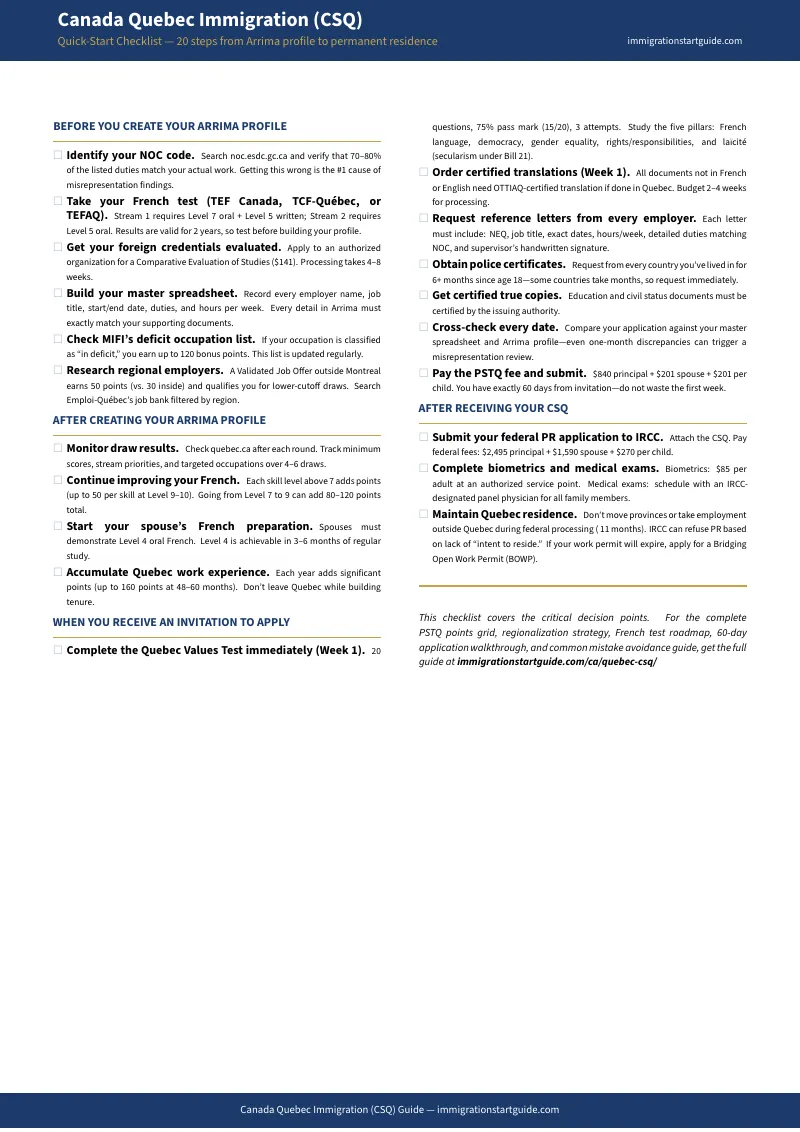
A 20-item action plan in four phases: before creating your Arrima profile (NOC verification, French test, credential evaluation, master spreadsheet, deficit occupation check, regional employer research), after creating your profile (draw monitoring, French improvement, spouse preparation, Quebec experience accumulation), the 60-day ITA response sequence (Values Test, translations, reference letters, police certificates, cross-checking, payment), and post-CSQ federal steps (IRCC application, biometrics, medical exams, bridging work permit, maintaining Quebec residence). Enough to assess your position and identify your next move tonight.
6 Standalone Printable Tools (included with the guide)
Print-ready reference cards and worksheets you can use independently: the Scoring Grid Reference (every PSTQ factor and point value on one card), NOC Audit Worksheet (fillable duties-match verification and reference letter cross-check), 60-Day ITA Checklist (pin-to-wall response sprint from Values Test through submission), Fee Summary Card (every government fee across both stages on one page), Values Test Study Guide (five pillars and legislative logic for the Democratic Values attestation), and Processing Timeline (visual map from Arrima profile to PR card). These are the pages you will actually print and use — extracted from the guide so they work as standalone tools.
Who This Guide Is For
This guide is for workers, students, and professionals targeting permanent residency in Quebec through the CSQ — who have realized that creating an Arrima profile and actually receiving an invitation are two entirely different challenges:
- You created an Arrima profile months ago and have not received an invitation. You cannot determine whether the problem is your stream selection, your score, your occupation classification, or your regional profile — and the government website does not provide the diagnostic framework to find out
- You were counting on the PEQ or a pilot program, and those pathways were abolished. You are now competing in a points-based system you did not prepare for, with no strategy for maximizing your score across the four PSTQ streams
- You are a Francophone professional from North or West Africa with NCLC 7 or 8 French, and you see Quebec as your primary gateway to Canada — but profiles with similar qualifications are receiving invitations while yours is not. The answer is almost certainly in the regional scoring grid
- You are living in Montreal with a work permit expiring in 2026. The LMIA suspension means your employer may not be able to renew it. You need a strategy that accounts for the LMIA restrictions, the CAQ French requirement, and the fastest path from your current status to a CSQ
- You are learning French specifically to qualify for Quebec because your federal Express Entry CRS score is stuck below 500. You need a realistic roadmap from your current level to the minimum threshold for your target PSTQ stream
- You found immigration consultants quoting $5,000 to $8,000 for a standard CSQ case. You want to understand the process well enough to file competently on your own — or to engage a consultant for a targeted review rather than paying for full representation
This guide is not for: people seeking a general Canadian immigration overview. It is a single-system deep dive — every chapter, every strategy, every point calculation is specific to Quebec's sovereign selection framework and the 2026 regulatory environment.
Why Not Free Resources?
Free information on Quebec immigration is abundant. Here is what it actually delivers:
- The MIFI website publishes the PSTQ requirements and draw results. It does not explain that the same occupation can yield a 200-point scoring difference depending on which stream and which region you target. It does not map the deficit occupations that receive lower cutoffs, or explain how the extraction-date tiebreaker works when scores are equal. You get the rules. You do not get the strategy for winning the competition those rules create.
- Immigration consultant websites publish detailed Quebec overviews — because their business model is to demonstrate complexity and then offer $5,000-$8,000 retainers. The overview is free. The strategy costs more than most applicants budget for the entire government fee schedule.
- Reddit and forum posts provide experiences from applicants in different years, under different programs, in a system that was fundamentally restructured in November 2025. A 2024 post about the PEQ describes a pathway that no longer exists. A draw score reported before the PSTQ launch is irrelevant to current cutoffs. You get anecdotes from a regulatory environment that has been replaced.
- YouTube walkthroughs cover basics in 10-minute videos. Most still reference pre-2026 rules. None map the four PSTQ streams with current draw cutoffs, the 100-point regional swing, the NOC audit methodology, or the complete dual-process timeline through federal PR. You cannot assemble a strategy from fragments of outdated information.
This guide fills the strategy gap — the space between "I know the PSTQ exists and I created an Arrima profile" and "I know which stream gives me the highest probability of selection, how to gain 100 points through regional positioning, how to avoid the NOC misclassification that triggers five-year bans, and how to execute the entire dual-process timeline from Arrima to PR card." It gives you the strategic framework that government resources describe but never provide, structured so you can execute it yourself — or engage a lawyer for a targeted review rather than paying for full representation.
— Less Than a Single Immigration Consultation
Immigration consultants charge $5,000 to $8,000 CAD for a standard CSQ case. A document review costs $350 to $550. A one-hour consultation runs $150 to $325 — and in that hour, you get verbal advice that disappears when the call ends. No scoring grid analysis. No regional strategy. No NOC audit checklist. No dual-process timeline.
Your total Quebec immigration journey will cost approximately $3,500 per adult in government fees alone — the $821 CSQ application, $1,525 federal processing and RPRF, $85 biometrics, medical exams, police certificates — before you add language tests ($300-$500 per attempt) and credential evaluations ($141+). That is money you cannot recover if you chose the wrong stream, misclassified your occupation, or missed the 100-point regional advantage that would have put you above the cutoff.
A refused CSQ application does not just cost you in fees. It costs you the months of processing time you cannot recover. It costs you the work permit that may expire while you regroup. For applicants who sold assets and relocated to Quebec, it costs the investment they made in a plan that failed because of a strategic error, not a qualification gap.
Money-back guarantee, no time limit. If the PSTQ stream analysis, the Arrima scoring grid, the regional strategy, the NOC audit, and the dual-process timeline do not make your Quebec immigration application stronger, you pay nothing.
Download the free Quick-Start Checklist to verify your NOC code, assess your French level against stream thresholds, check the deficit occupation list, and identify your next move tonight. When you are ready for the complete scoring grid, the regional strategy, the French acceleration roadmap, and the 60-day ITA response plan, the guide is here.
Quebec admitted approximately 45,000 permanent residents in 2026. The PSTQ selects through a points competition, and the applicants who receive invitations are the ones who understood which factors move the score — not the ones who simply entered their qualifications and waited. This guide is that understanding.