
Your CRS Score Looks Competitive. Your Indonesian Documents Will Stall the Application.
You ran the CRS calculator. You scored 450, maybe 470. You have an S1 from UI or ITB, five years writing code at Gojek or Tokopedia, and IELTS scores that look solid. You created your Express Entry profile, selected Federal Skilled Worker, and started imagining a life in Toronto or Vancouver. Then the real process began.
You submitted your degree to WES. Weeks passed. Then the status changed to "Awaiting Documents" — because WES checked PDDIKTI and found a mismatch. Your name on the Ijazah doesn't match the PDDIKTI record. Or your program code is missing. Or the transcript your university sent was a photocopy, not the sealed original from the BAA. You call your university in Bandung. They've never heard of WES. They don't know what "Qualification Check" means. The registrar says they'll "process it" but can't give you a timeline. Meanwhile, your WES clock — 35 business days — hasn't even started.
Your colleague who got a COPR last year tells you to just fix the PDDIKTI record. You check the portal. The data was entered in 2014 and nobody at your university knows who has access to update it. Another colleague says to try IQAS instead. A Reddit thread says IQAS takes 20 weeks. A third person in the "WNI di Kanada" Facebook group says their D3 was downgraded to a diploma and they lost 40 CRS points overnight. Nobody agrees on what to do. Nobody cites their specific degree type or university. And every month you wait, the draw cutoffs shift and your age ticks closer to the next five-point penalty.
Meanwhile, you ask your HR department at Tokopedia for a reference letter. They give you a Paklaring — your name, your title, your start and end dates. No job duties. No salary. No weekly hours. No supervisor contact information. You know from the Express Entry subreddit that submitting a bare Paklaring gets your work experience rejected. But you also know that fabricating details on company letterhead is misrepresentation — a five-year ban from Canada. You need a third option, and you need to know exactly how to build it using Indonesian employment records that IRCC will actually accept.
The Indonesia → Canada Express Entry Guide is the Indonesian Applicant's Defense System — the regulatory and procedural knowledge that bridges the gap between Canada.ca's rules and Indonesia's administrative reality. It covers the WES credential pipeline that generic guides skip entirely, the employment evidence workaround that Indonesian tech professionals actually need, and the SKCK, Apostille, proof-of-funds, and VFS logistics that only apply when you're filing from Indonesia.
What's Inside the Indonesian Applicant's Defense System
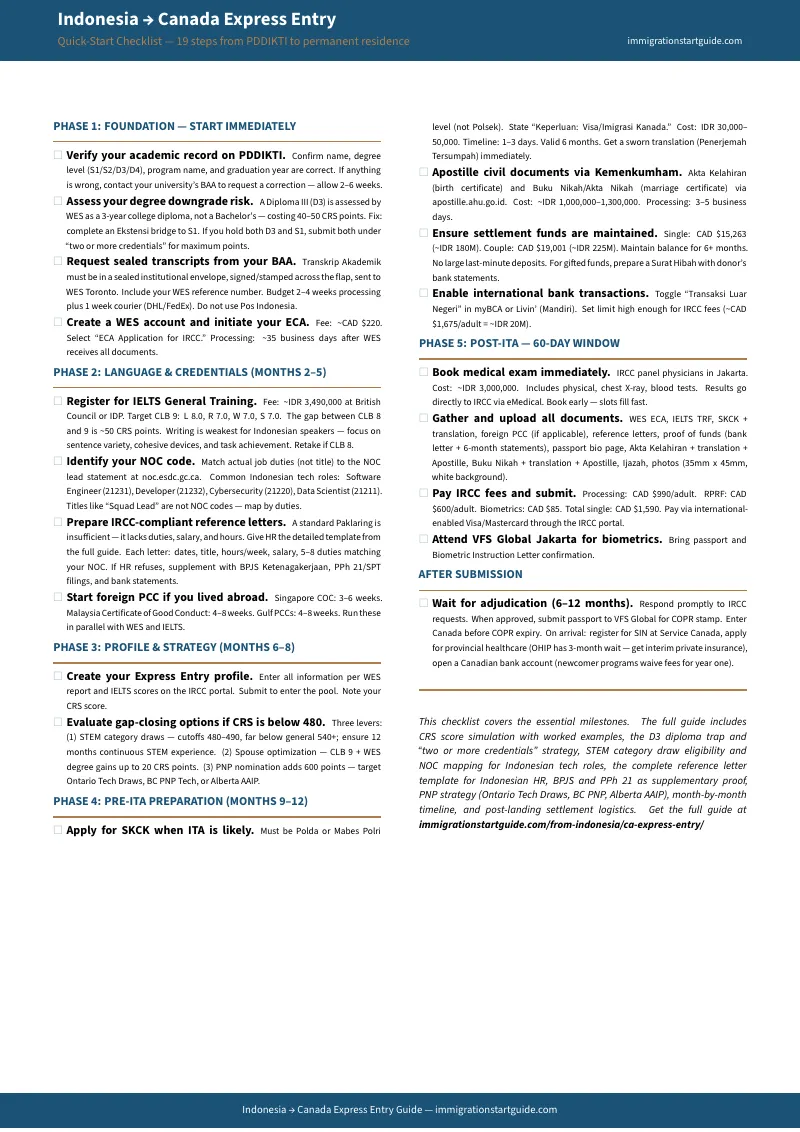
12 chapters and 6 standalone reference cards covering the complete Indonesia-to-Canada Express Entry journey, plus a printable quick-start document checklist:
The Express Entry System — How It Actually Works (Chapter 1)
Express Entry is not a visa — it's a ranking system, and in 2026 the rules have changed. General draws now require CRS scores above 520. Most Indonesian applicants get their ITA through category-based draws (STEM at 480–490, Healthcare at 440–470) or Provincial Nominee Programs (instant 600-point boost). This chapter maps the three federal programs, breaks down the FSWP 67-point eligibility grid versus the CRS ranking system, the NOC code mapping for Indonesian roles, and the 2025/2026 fee structure in both CAD and IDR. Because a typical Indonesian S1 holder with CLB 8 scores approximately 430–450 — below the general cutoff but right in the range where strategic optimization determines whether you get an ITA or watch draws from the pool for another year.
The CRS Score — Where Indonesia Competes (Chapter 2)
A typical Indonesian tech professional with an S1, three years at Gojek or Tokopedia, and IELTS CLB 8 scores approximately 441 CRS. That's below both general draw cutoffs (540+) and STEM draw cutoffs (480–490). This chapter provides two fully worked CRS score breakdowns — Scenario A (standard profile at 441, stuck) versus Scenario B (optimized with CLB 9 at 491, competitive for STEM draws) — showing exactly how the 50-point jump from CLB 8 to CLB 9 unlocks multiplicative Skill Transferability bonuses. It covers the 2025–2026 draw trends by category, the "dead zone" between 430 and 470 where most Indonesian applicants are trapped, and why STEM category-based draws are the primary pathway for Indonesia's tech workforce.
The WES Credential Pipeline — S1, D3, D4, and the PDDIKTI Problem (Chapter 3)
This is the single most consequential chapter for Indonesian applicants. WES evaluates a four-year Sarjana (S1) as a Bachelor's degree — standard CRS baseline. But a three-year Diploma III (D3) is evaluated as a college diploma, costing you 40–50 CRS points. This chapter provides the complete WES document pipeline: how to fix PDDIKTI data mismatches before submitting, how to coordinate with your university's BAA to send sealed transcripts directly to WES (including the specific process for UI, ITB, UGM, ITS, Binus, and private universities), whether your university supports digital transmission or requires sealed-envelope courier, and the two-credentials strategy for D3 holders who completed an Ekstensi to S1 (recovering up to 38 CRS points). Timeline reality: 8–12 weeks total.
Language Proficiency — The Fastest Path to More Points (Chapter 4)
Language scores are your single biggest CRS lever. Going from CLB 8 to CLB 9 triggers Skill Transferability cross-factors worth 25–50 bonus points. But thousands of Indonesian applicants get stuck at IELTS Writing 6.5 — because the scoring rubric penalizes Indonesian writing patterns. This chapter provides the IELTS vs. PTE Core diagnostic, test centre booking strategy for Jakarta, Surabaya, Bandung, Yogyakarta, Bali, Semarang, and Medan, the CLB 9 score thresholds for both tests, and specific Writing preparation strategies for Indonesian speakers where the gap between conversational fluency and Band 7.0 is widest. Because a 0.5 deficit in one module prevents the CLB 9 bonus from being awarded, and that costs you 50+ CRS points.
Police Clearance — The SKCK Process (Chapter 5)
The SKCK is one of the fastest components — Rp 30,000–50,000, issued in 1–3 days at the Polda or Mabes Polri level. But the process has specific requirements: the SKCK must state "Keperluan: Visa/Imigrasi Kanada" and must be accompanied by a Penerjemah Tersumpah certified translation. This chapter covers the complete procurement protocol including online registration via the Polri Super App, the 6-month validity timing strategy, and additional police clearances for Indonesians who've lived abroad (Singapore COC, Malaysia PDRM, Gulf states, Australia AFP).
Employment Documentation — The Reference Letter Challenge (Chapter 6)
IRCC requires reference letters with detailed job duties, weekly hours, salary, and supervisor contact information. Indonesian employers issue a Paklaring with none of this. This chapter provides the complete reference letter template for Indonesian HR departments, the NOC code mapping for Indonesian tech roles (translating "Squad Lead" and "Product Engineer" into Canadian NOC codes), and the supplementary evidence strategy using BPJS Ketenagakerjaan records, PPh 21/SPT tax filings, and bank statements. It includes the critical 80% duty match rule and why copy-pasting NOC language from the IRCC website triggers a credibility red flag.
CRS Gap-Closing Strategies (Chapter 7)
If your CRS is below 480 after optimizing language, three levers remain. STEM category-based draws (cutoffs 480–490 vs. 540+ for general draws) with the complete list of eligible NOC codes and the 12-month continuous experience requirement. Spouse optimization (a spouse with CLB 9 and a WES-evaluated degree adds ~20 CRS points for ~IDR 6.1M investment — but adding a spouse drops your max Core from 500 to 460, so run the math both ways). Provincial Nominee Programs (Ontario Tech Draws targeting 21231/21232 at cutoffs 470–480, BC PNP Tech, Alberta AAIP, and regional pathways with lower thresholds).
Financial Compliance — Settlement Funds and Fee Payment (Chapter 8)
A single applicant needs CAD $15,263 (roughly Rp 180 juta). The problem isn't just the amount — it's that IRCC's definition of "liquid and unencumbered" clashes with how Indonesians save. This chapter covers the IRCC-compliant bank letter template for BCA and Mandiri, the Tabungan Valas strategy for currency management, the Surat Hibah process for parental contributions, the "large deposit" scrutiny threshold, how to enable international transactions on myBCA and Livin', and a complete cost breakdown in both IDR and CAD for single applicants (IDR 27–32M) and couples (IDR 50–58M).
Civil Documents — Apostille and Translation (Chapter 9)
Indonesia joined the Hague Apostille Convention in 2022, replacing the old multi-ministry legalization chain with a single Apostille sticker from Kemenkumham. This chapter covers the AHU portal process (apostille.ahu.go.id) for authenticating your Akta Kelahiran, Buku Nikah, and Ijazah, the specific requirements for Muslim (KUA) versus non-Muslim (Dukcapil) marriage documentation, and Penerjemah Tersumpah sworn translation requirements.
The Month-by-Month Timeline (Chapter 10)
A 12–18 month timeline from initial decision to PR landing, designed to run parallel workstreams and prevent document expiry conflicts. Months 1–2: PDDIKTI check, WES initiation, IELTS registration. Months 3–5: language testing, foreign PCC applications, reference letter coordination. Months 6–8: Express Entry profile creation, CRS assessment, PNP monitoring. Months 9–12: SKCK, Apostille, settlement funds maintenance. The parallel processing strategy that saves months: start WES and language prep simultaneously, begin PDDIKTI verification on day one.
Post-ITA — The 60-Day Window (Chapter 11)
You have exactly 60 days from ITA to submit your complete PR application. No extensions. This chapter provides the week-by-week countdown: medical exam at an IRCC panel physician in Jakarta on day 1, document upload in days 1–14, IRCC fee payment and VFS Global biometrics in days 14–30, and final review by day 55. It includes the complete document upload checklist, common submission errors (expired SKCK, mismatched dates, missing sworn translations, wrong IELTS module), and specific prevention steps for each.
Adjudication, Passport Request, and Landing (Chapter 12)
What happens after you submit: the 6-month processing target, Procedural Fairness Letters (not a refusal — an opportunity to clarify), employer verification through the Canadian embassy in Jakarta, the Passport Request and COPR stamp at VFS Global. Then the first-week landing logistics: SIN registration at Service Canada, provincial healthcare enrolment (OHIP's 3-month wait, BC MSP, Alberta AHCIP), Canadian bank account newcomer programs (RBC, TD, Scotiabank), PR card mailing timeline, and the Indonesian community networks in Toronto, Vancouver, and Calgary.
6 Standalone Reference Cards (printable PDFs)
One-page printable reference cards you can take to your bank, VFS appointment, or HR meeting: WES Document Pipeline (step-by-step process with D3/S1/S2 equivalency table), NOC Code Mapping (Indonesian tech roles to Canadian classifications with STEM eligibility), Bank Letter Template (IRCC-compliant format for BCA and Mandiri), Alternative Evidence Package (reference letter template and BPJS/PPh 21 guidance for Paklaring-only employers), 60-Day Post-ITA Countdown (week-by-week submission checklist), and Cost Breakdown in IDR (complete budget from ECA to COPR).
Quick-Start Document Checklist (free download)
Every Indonesia-specific document you need for your Express Entry application, distilled into a single printable checklist: WES documents (Ijazah, transcripts, PDDIKTI verification), employment evidence (Paklaring, BPJS records, tax filings), proof of funds (BCA/Mandiri bank letters, Surat Hibah), SKCK, Kemenkumham Apostille, VFS appointment items, and medical exam requirements. Enough to start gathering documents tonight.
Who This Guide Is For
This guide is for Indonesian professionals navigating Canada's Express Entry system — whether you're calculating your CRS for the first time or you've been in the pool for months watching draws pass you by:
- You hold an S1 from a major Indonesian university and you've submitted to WES, but the evaluation is stuck because of a PDDIKTI data mismatch — your records were entered in 2014 and nobody at your university knows how to update them, and WES won't proceed until the portal data matches your Ijazah
- You hold a D3 from a polytechnic and you've read that WES will downgrade it to a diploma, costing you 40–50 CRS points — but you also completed an Ekstensi to S1 and you don't know whether claiming two credentials gives you more points than just claiming the S1 alone
- You work for Gojek, Tokopedia, Bukalapak, or another Indonesian tech company that issues a standard Paklaring with no job duties, no salary, and no hours — and you need the exact Alternative Evidence Package format (supervisor letter, BPJS records, SPT filings, Letter of Explanation) that Indonesian professionals have successfully used to get their work experience accepted
- Your CRS is stuck in the 430–470 range and you're watching draw after draw pass you by — you need to know whether improving your IELTS, targeting a STEM draw, learning French, or applying for a PNP nomination is the highest-ROI use of the next six months
- You received an ITA and you have 60 days to submit everything — but your WES evaluation isn't complete, your SKCK needs a sworn translation, your BCA branch manager has never heard of an "IRCC-compliant bank letter," and you need a Kemenkumham Apostille for your Akta Kelahiran
- Your parents are contributing to your settlement funds (Rp 180+ juta for a single applicant) and you need to know how to structure a Surat Hibah, bank-to-bank transfer, and source-of-funds documentation so the money doesn't get flagged as an unexplained large deposit
- You've lived and worked in Singapore or Malaysia before returning to Indonesia, and you need police clearances from multiple countries plus proof of foreign work experience that IRCC will accept alongside your Indonesian employment history
Why Not Free Resources?
Free information about Express Entry is everywhere. Here's what it actually gives you:
- IRCC's website (canada.ca) explains Express Entry eligibility, the CRS formula, and the list of required documents. It says nothing about how to fix a PDDIKTI mismatch, how to build an alternative evidence package when your Indonesian employer will only issue a Paklaring, or how to get an IRCC-compliant bank letter from a BCA branch manager who has issued exactly zero of them.
- Immigration consultants in Indonesia (ICAN Education, Schoters, Live and Work Konsultan) charge Rp 30–70 juta for end-to-end representation. Many focus on the student visa pathway because DLI commissions are more lucrative, and may not disclose that Express Entry is a cheaper, more direct path to PR for professionals who already have degrees and experience. You're paying for comfort and hand-holding. Whether you're paying for the granular strategy that maximizes your specific CRS profile is a different question.
- Facebook groups ("WNI di Kanada," "Express Entry Indonesia") are full of draw results, CRS screenshots, and personal timelines — from 2023, 2024, and 2026, all mixed together with no way to tell which advice applies after the 2026 category-based draw changes. One person says WES evaluated their S1 as a Bachelor's. Another says their D3 was downgraded. Neither mentions whether they had a PDDIKTI mismatch or which university they attended.
- Kaskus forums have long-form threads on the "WNI di Luar Negeri" subforum with detailed personal timelines. The information is scattered across hundreds of posts, contradicts itself between threads from different years, and nobody is accountable for the advice. Following an outdated strategy from a 2023 thread can cost you months and tens of millions of Rupiah.
- Generic Express Entry guides explain the process for applicants from any country. They've never heard of PDDIKTI. They don't know the difference between an S1 and a D4. They think proof of funds means showing a bank balance, not navigating BCA Tabungan Valas accounts and Surat Hibah notarization. They don't cover BPJS Ketenagakerjaan records as employment evidence. And they have no idea that your Paklaring is missing the five fields IRCC requires.
This guide fills the Indonesia documentation gap. It doesn't replace an RCIC or immigration lawyer — it handles the entire Indonesia-specific administrative layer that generic guides ignore and consultants charge Rp 30–70 juta to manage. The WES credential pipeline, the Paklaring workaround, the proof-of-funds architecture, and the SKCK, Apostille, and VFS logistics that only matter when you're filing from Indonesia.
— Less Than a Single WES Evaluation Fee
A WES credential evaluation costs approximately Rp 3.5 juta. Submitting with a PDDIKTI mismatch means your evaluation stalls for weeks while you chase your university's registrar. An immigration consultant charges Rp 30–70 juta for services that include basic form-filling you can do yourself. And if your proof of funds is rejected because you submitted a property valuation instead of liquid assets, or your work experience is rejected because you submitted a bare Paklaring without the alternative evidence package — your Rp 18+ juta IRCC processing fees are gone.
The guide doesn't replace an immigration consultant. It handles the Indonesia-specific documentation strategy that sits between your CRS score and an approved PR application. It turns months of contradictory Facebook group advice and scattered Kaskus threads into a structured playbook built for Indonesian institutions, Indonesian employers, and Indonesian bureaucracy.
Money-back guarantee, no time limit. If the guide doesn't give you clearer control over the Indonesia-side documentation of your Express Entry application, you pay nothing.
Download the free Quick-Start Checklist to see every Indonesia-specific document you need for Express Entry. When you're ready for the WES credential pipeline strategy, the Paklaring workaround, the proof-of-funds architecture, and the complete 60-day post-ITA countdown, the full guide is here.
Your CRS score earns you a place in the pool. Your Indonesian documents determine whether you get out of it.