
Your Employer Has Never Heard of the Portal. Your HR Department Won't Share Revenue Data. You Have 14 Days After the Invitation. This Guide Gets You Through All of It.
You finally got the draw result you've been watching for. After months of refreshing the e-Filing Portal, calculating your Expression of Interest score on napkins, and reading conflicting advice in Reddit threads that were written under rules that no longer exist — Ontario selected you. Or your employer agreed to sponsor you. Or you just walked across the stage with a Masters degree from an Ontario university and realised that your immigration window is measured in weeks, not years.
Then you hit the wall. Your employer needs to register on the Employer Portal and create a digital job offer before you can even register your EOI — but your HR department has never heard of this system and has no intention of disclosing their gross annual revenue to a government website. The OINP scoring grid rewards factors you didn't know existed — regional placement bonuses, bilingual points, wage bracket thresholds — and nobody told you until after you submitted. Reddit tells you to pick the NOC code that matches your job title. Officers evaluate the one that matches your daily duties. These are not the same thing, and the difference is a refusal with a $1,500 non-refundable fee attached to it.
Here's what the official Ontario.ca documentation won't tell you: the OINP is not a form-filling exercise. It is a scoring competition, an employer coordination problem, and a deadline sprint where applications are refused for NOC misalignment, reference letter deficiencies, and document inconsistencies that the applicant never saw coming. Immigration consultants charge $3,750 to $8,000 CAD for full OINP representation — and community forums are full of applicants who paid those fees and still received refusals because the consultant selected a NOC code based on a job title instead of a duty analysis.
The Canada Provincial Nominee Program (Ontario) Guide is a Nomination Strategy System built for the 2026 OINP — not a rehash of government pages or a generic PNP overview that tries to cover ten provinces in sixty pages. This is a single-province deep dive covering the scoring grid optimization that finds five hidden points, the employer portal pitch strategy that gets reluctant HR departments to cooperate, the duty-centric NOC methodology that prevents the leading cause of refusals, the 14-day ITA deadline sprint plan, and the complete post-nomination federal PR process that most OINP resources pretend doesn't exist.
What's Inside the Nomination Strategy System
12 chapters — the complete guide covering every OINP stream, the scoring system, document preparation, the post-nomination federal process, and a quick-start checklist you can print tonight:
EOI Scoring Grid Optimization (Chapter 5)
The OINP Expression of Interest system is a mathematical competition where five points separates an invitation from another six months of waiting. The government publishes the scoring factors but does not explain how to optimise them. A job offer outside the Greater Toronto Area earns 8–10 bonus points — equivalent to an entire TEER level upgrade. The bilingual bonus gives you 10 points for CLB 6 French proficiency that takes 3–4 months to develop. Wage brackets at $20/hour and $40/hour are scoring thresholds that a $1/hour negotiation could push you past. The guide maps every factor, every point value, and the strategic levers you can pull to maximise your position — because in a pool where draw cutoffs fluctuate by single digits, the difference between selection and rejection is knowing where the points are hiding.
The Employer Portal Pitch Strategy (Chapter 3)
Since July 2025, all Employer Job Offer streams require the employer to initiate the process through the digital Employer Portal — creating a job offer before you can even register an EOI. This is the biggest shift in OINP history, and it has rendered every pre-2025 guide obsolete. The problem isn't legal complexity. The problem is that your HR department has to disclose their CRA business number, gross annual revenue, and full-time employee count to a government system they've never seen. Most employers will say no at the first ask. The guide provides the specific talking points, the compliance-framing script, and the one-page employer briefing document that reframes the portal from "invasive audit" to "routine payroll-level disclosure." GTA employers need $1M+ revenue and 5+ full-time employees. Regional employers need $500K+ and 3+. The guide covers both thresholds and why a regional placement might be the scoring decision that gets you nominated.
Human Capital Priorities and the 600-Point Express Entry Boost (Chapter 2)
The Human Capital Priorities stream is the primary pathway for high-skilled workers without a direct employer job offer. Ontario officers scan the federal Express Entry pool and issue Notifications of Interest to candidates matching the province's current priorities — technology, healthcare, trades, and French-language professionals. You cannot apply to this stream directly. You can only position yourself to be selected. The 600-point CRS boost that comes with an OINP nomination virtually guarantees a federal Invitation to Apply, dropping effective CRS requirements to the 110–140 range. The guide covers the profile characteristics Ontario is actively scanning for, the difference between general draws and tech-targeted draws, and why positioning your Express Entry profile correctly matters more than your raw CRS score.
NOC Alignment and the Duty-Centric Reference Letter Framework (Chapter 6)
NOC misalignment is the single leading cause of OINP refusals. Officers do not evaluate your NOC code based on your job title — they compare the specific duties in your reference letter against the lead statement and main duties in the NOC 2021 TEER database. If you claim a TEER 1 classification but your letter describes TEER 3 responsibilities, your application is refused. If you copy NOC descriptions verbatim into your reference letter, officers flag it as potential misrepresentation. The guide provides the duty-mapping methodology: verify your classification based on actual daily tasks, not optimistic self-assessment. Every reference letter must include your legal name, exact employment dates, full-time or part-time status with weekly hours, annual salary, and 5–8 specific daily duties in your employer's own words. The guide includes the complete reference letter framework, the employer negotiation strategy for when HR refuses to cooperate, and the alternative evidence blueprint for when your employer simply will not write the letter.
Masters and PhD Graduate Streams (Chapter 4)
The no-job-offer pathways for advanced degree holders at eligible Ontario universities. These streams use their own EOI scoring system that rewards STEM fields, regional study locations, and earnings history — but face the highest restructuring risk from the May 30, 2026 regulatory overhaul. The guide covers the current eligibility requirements, the field-of-study scoring strategy, and the critical calculus of applying now under existing rules versus waiting for the new "Exceptional Talent" pathway that may replace them — where the risk is that the new system may require active employment rather than academic credentials alone.
The 14-to-17-Day ITA Deadline Sprint (Chapter 7)
Graduate streams give you 14 calendar days. Employer Job Offer streams give the employer 14 days and the applicant 17 days. These deadlines are non-extendable — missing by one hour permanently closes your file and forfeits your $1,500 government fee. The sprint plan breaks the submission window into a day-by-day action sequence with specific deliverables. Cross-check every document against every other document: employment dates in reference letters must match your EOI profile, contracts, and pay stubs. Submit a proactive Letter of Explanation for anything unusual — gaps in employment, changes in NOC codes between jobs, date discrepancies. Explain them before an officer discovers and misinterprets them.
The Post-Nomination Federal PR Process (Chapter 8)
A provincial nomination is not permanent residency — it is the midpoint of a two-stage process. After nomination, you have six months to submit your federal PR application. Express Entry nominees receive the 600-point CRS boost and typically receive a federal ITA within weeks, with five-to-eight-month processing. Non-Express Entry nominees file through the traditional Provincial Nominee Class pathway, where processing can take 16 to 22 months. The guide covers the e-APR submission, medical examinations, biometrics, security clearances, and the Bridging Open Work Permit — the legal mechanism that keeps you working if your work permit expires while IRCC processes your PR application. Timing the BOWP correctly is the difference between maintained legal status and a gap that forces thousands of applicants into illegal work or voluntary departure every year.
Refusal Recovery and Internal Review (Chapter 10)
Most OINP resources end at the nomination stage. This guide covers what happens when things go wrong — the most common refusal reasons, the 30-day internal review window, the judicial review option at Federal Court, and the strategic withdrawal approach that protects your record for re-entry into the EOI pool without a formal refusal on file. A proactively submitted Letter of Explanation that addresses a genuine clerical error can often save an application. The guide provides the framework for assessing whether to fight a refusal through review or withdraw and reapply — and why the answer is usually reapplication, not review.
Ontario vs. British Columbia vs. Alberta Comparison (Chapter 11)
Not sure Ontario is your strongest pathway? The guide includes a strategic comparison of the three largest provincial nominee programs — quota sizes, selection mechanisms, sector priorities, processing timelines, and which province gives you the highest probability of nomination based on your specific NOC code, salary, and location. Alberta routinely selects candidates with CRS scores as low as 300. British Columbia prioritises Care, Build, and Innovate sectors. Ontario has the largest allocation but the highest competition. The comparison helps you decide before you commit twelve months and thousands of dollars to the wrong province.
Complete Cost Mapping (Chapter 9)
Every provincial fee, federal processing fee, language testing cost, ECA, medical examination, biometrics, and translation expense for individuals and families — mapped across the complete timeline from EOI registration through COPR. No hidden costs. No "approximately $X" ranges. The actual 2026 fee schedule so you can budget the full journey before you start.
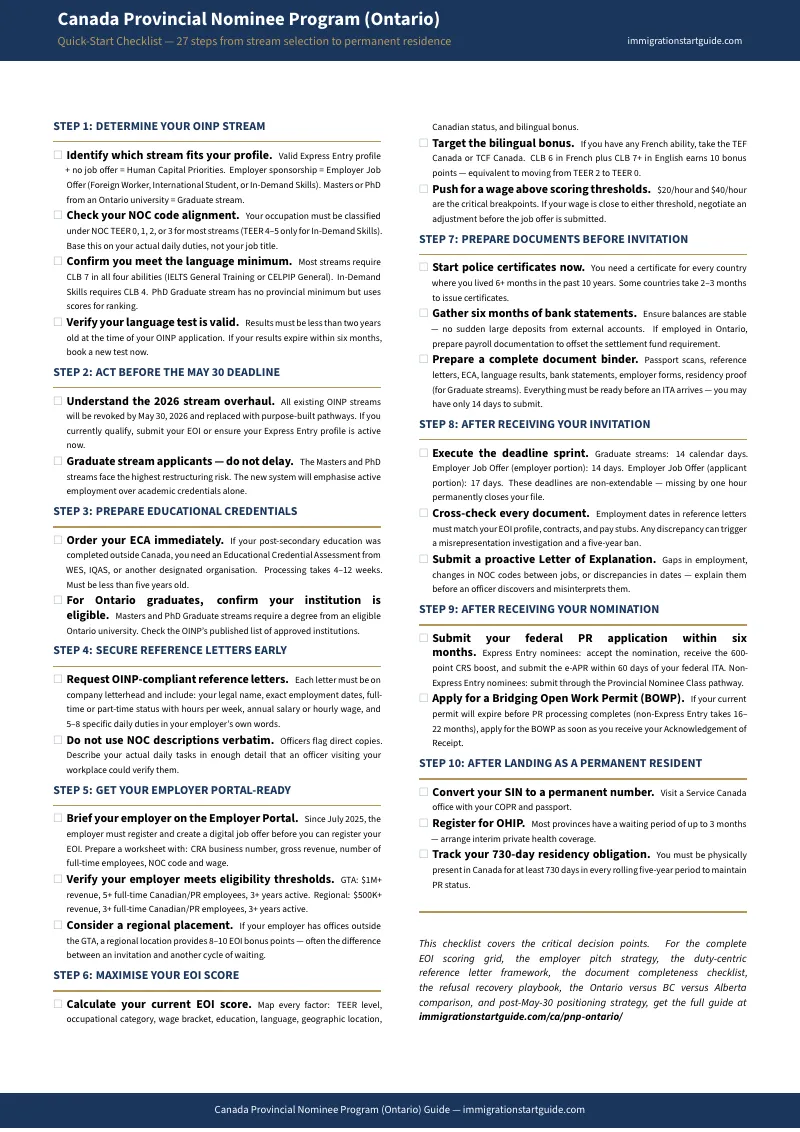
Quick-Start Checklist (free download)
A 20-item action plan covering the essentials: determine your OINP stream, verify your NOC code against actual duties, check language test validity, act before the May 30 regulatory deadline, secure reference letters early, calculate your EOI score, prepare all documents before an invitation arrives. Enough to assess your position and identify your next move tonight.
6 Standalone Printable Tools
The guide includes six standalone PDFs you can print, fill in, and use at your desk — or hand directly to your employer:
- EOI Scoring Worksheet — fill in every factor from the Expression of Interest grid to calculate your score and identify exactly where the hidden points are
- Document Checklist — stream-specific checklist of every required document, format, and language test threshold, with checkboxes to track your progress
- Reference Letter Toolkit — the 7 mandatory elements, the duty-centric approach explained, a good-vs-bad example, and a fillable template you can hand to your employer
- ITA Sprint Plan — the day-by-day action sequence for the 14-to-17-day submission window, from ITA receipt through final submission
- Fee Schedule Reference Card — every provincial, federal, and third-party cost with total budget scenarios for individuals and families
- Province Comparison Card — Ontario vs. British Columbia vs. Alberta at a glance, with quota sizes, CRS ranges, sector priorities, and decision criteria
Who This Guide Is For
This guide is for skilled workers, international graduates, and employer-sponsored candidates who are targeting Ontario as their province of permanent settlement — and who refuse to leave a $1,500 non-refundable application fee and twelve months of their life to chance:
- Workers in the federal Express Entry pool whose CRS score is below general draw cutoffs, targeting Ontario's Human Capital Priorities stream for the 600-point nomination boost that makes the federal stage a formality
- Employer-sponsored candidates whose HR department has never used the Employer Portal and needs the pitch strategy that reframes compliance data as a routine payroll-level disclosure
- Masters and PhD graduates from Ontario universities who need to act before the May 30 stream overhaul eliminates the current academic-credential-based pathway
- Applicants who received an Invitation to Apply and have 14 days to submit a flawless application — with no room for a missing document, an expired test, or an NOC mismatch
- Candidates deciding between Ontario, British Columbia, and Alberta — who want a data-driven comparison rather than guesswork about which province gives them the highest probability
- Applicants who were refused and need to understand whether to pursue internal review, judicial review, or strategic withdrawal and re-entry into the EOI pool
- Anyone deciding between hiring an immigration consultant at $3,750–$8,000 CAD and doing it themselves — and wanting a resource that makes the DIY path strategic rather than reckless
This guide is not for: people looking for a general Canadian immigration overview. If you want to compare all ten provinces at a surface level, this is not that resource. This is an Ontario-only deep dive. Every chapter, every scoring table, and every strategy is specific to the OINP.
Why Not Free Resources?
Free information on the OINP is abundant. Here's what it actually delivers:
- The Ontario.ca website publishes every OINP requirement in dense regulatory language. It tells you that reference letters must include specific duties. It does not tell you what to do when your HR department refuses to write one, or that copying NOC descriptions verbatim into a reference letter is flagged as potential misrepresentation. You get regulations, not execution guidance.
- Immigration consultant blogs publish excellent policy analysis — because their business model is to demonstrate overwhelming complexity, then offer $3,750 to $8,000 full-representation retainers. The blog explains the problem. The solution costs thousands.
- Reddit and CanadaVisa forums are where you find draw score predictions from anonymous users who filed under the pre-July 2025 portal system that no longer exists. You get survivorship bias from strangers in different streams, under different rules, with different NOC codes. The "Ghost Update" threads reflect real anxiety — but the advice reflects outdated experience.
- YouTube walkthroughs show fragments of the process in ten-minute videos. Reconstructing a complete strategy requires dozens of videos from different creators with different accuracy levels. You still don't have a scoring optimizer, a reference letter framework, or an employer pitch script when you're done watching.
This guide fills the execution gap — the space between "I know the OINP rules exist" and "I can navigate the scoring grid, the employer portal, the 14-day deadline, and the post-nomination federal process without a $5,000 consultant." It gives you the same strategic frameworks that immigration professionals charge thousands to apply, structured so you can execute them yourself.
— Less Than a 30-Minute Immigration Consultation
Immigration consultants charge $3,750 to $8,000 CAD for full OINP representation. A single 30-minute strategy session costs $150 to $300 CAD. And in that session, you get thirty minutes of verbal advice that disappears the moment the call ends — no reference letter framework, no scoring optimizer, no employer pitch document, no sprint plan for the 14-day window.
Your total OINP application costs will exceed $3,500 CAD for a single applicant — the $1,500 provincial application fee, federal processing fees, RPRF, biometrics, language tests, medical exams, ECA, and translations. This guide represents a fraction of that total investment, and it is the piece that determines whether the other $3,000+ produces a nomination or a refusal letter.
A refused application doesn't just cost you $1,500 CAD in non-refundable fees. It costs the 12 to 18 months you waited for a draw. It costs the employer who may not go through the portal process again. It costs the regulatory window that may close on May 30 while you refile.
Money-back guarantee, no time limit. If the EOI scoring optimizer, the employer portal pitch strategy, the NOC alignment methodology, and the 14-day ITA sprint plan don't make your application stronger, you pay nothing.
Download the free Quick-Start Checklist to see the 20-item action plan and assess your OINP stream eligibility tonight. When you're ready for the complete scoring grid optimization, the employer portal pitch strategy, the duty-centric reference letter framework, and the full post-nomination federal PR playbook, the guide is here.
Ontario gave you 14,119 chances in 2026. Make sure yours counts.