
Your CRS Score Is Stuck at 430. Your Work Permit Expires in Ten Months. Alberta Sent 6,403 Nominations Last Year — But You Don't Know Which Stream, Which Community, or Which Profile Edits Will Get You Picked. This Guide Fixes All of It.
You did everything right. You moved to Alberta, found a job, passed your language test. You submitted your Express Entry profile and waited. Federal draws kept landing at 520, 530, 540. Your score sat at 430. You started reading about the Alberta Advantage Immigration Program and learned that a provincial nomination adds 600 CRS points — enough to guarantee a federal invitation. So you submitted a Worker Expression of Interest, paid the $135 fee, and waited again.
Then nothing happened. No Notification of Interest. No invitation. No explanation. You checked Reddit — someone in the same NOC code got picked last month. A Canadavisa thread said the Alberta Opportunity Stream is easier, but you're not sure if your occupation qualifies. Another poster mentioned the Rural Renewal Stream in a small town you've never heard of. A YouTube video from 2024 described a "Tech Pilot" that no longer exists. Your employer's HR department asked if "nomination" means they're sponsoring you and went quiet.
Here's what the Alberta.ca website won't tell you: the AAIP is not a queue. It is a sector-driven scoring competition where applications are refused for NOC duty misalignment, "maintained status" instead of valid work permits, employer compliance failures the candidate never saw coming, and profile gaps that made the candidate invisible to Alberta's selection algorithm. Immigration consultants charge $3,000 to $7,000 CAD for AAIP representation — and community forums are full of applicants who paid those fees and still received refusals because the consultant didn't coordinate the employer's compliance documentation on time.
The Canada Provincial Nominee Program (Alberta) Guide is a Stream Selection and Nomination Strategy System built for the 2026 AAIP — not a rehash of government pages or a generic PNP overview. This is a single-province deep dive covering the Worker Expression of Interest points grid and ranking optimization, the Alberta Opportunity Stream eligibility matrix including the "maintained status" trap, the Express Entry NOI optimization that makes Alberta's algorithm find your profile, the Accelerated Tech Pathway with exact NAICS and NOC alignment, the Rural Renewal Stream with contact details for all 31+ designated communities, the employer compliance system that gets reluctant HR departments through the revenue and employee verification, and the complete post-nomination federal PR process that most Alberta PNP resources pretend doesn't exist.
What's Inside the Stream Selection and Nomination Strategy System
14 chapters + the quick-start checklist — the complete guide covering every AAIP worker stream, the WEOI points grid, document preparation, the post-nomination federal process, entrepreneur and farm pathways, plus the Alberta vs. Ontario vs. BC strategic comparison:
The Worker Expression of Interest Points Grid (Chapter 2)
Every AAIP worker stream funnels through the WEOI system — a $135-per-submission merit-based pool where your ranking determines whether you receive an invitation or sit for 12 months watching others get picked. The government publishes the scoring factors but does not explain how to optimise them. In-province work experience is weighted more heavily than any other factor. Language scores above CLB 7 create meaningful separation. French proficiency at NCLC 5+ unlocks 5,000 bonus nomination spaces outside the base allocation of 6,403. The guide maps every factor, every point value, and the strategic levers you can pull — because in a province that receives tens of thousands of EOIs per cycle, the difference between an invitation and expiry is knowing where your unrealised points are.
Alberta Opportunity Stream Eligibility Matrix (Chapter 3)
The AOS is the workhorse of the AAIP, with 53% of the base allocation — 3,425 nominations. It retains temporary foreign workers already living and working in Alberta. But the eligibility rules create a complex logic gate where one wrong assumption kills the application. You must hold a valid work permit — not "maintained status" through a pending IRCC extension. PGWP holders must work in an occupation related to their Alberta field of study. Regular workers need 12 months of Alberta experience in the last 18 months; PGWP holders need 6 months. Dozens of occupations are outright ineligible regardless of experience. The guide provides the complete eligibility decision tree so you know — before paying the $1,500 application fee — whether the AOS is your path or whether another stream gives you better odds.
Express Entry NOI Optimization (Chapter 4)
The Alberta Express Entry stream is invitation-only. You cannot apply directly — Alberta's selection algorithm scans the federal Express Entry pool and issues Notifications of Interest to profiles that match current sector priorities. In 2025-2026, approximately 30-35% of invitations went to construction and trades, 25-30% to healthcare, and 15-20% to tech and IT. If your federal profile doesn't signal the right occupation, the right province preference, or the right family connections, Alberta's algorithm will never find you. The guide provides the NOI optimization playbook: province selection settings, primary NOC alignment with Alberta's in-demand list, family connection highlighting, and the Accelerated Tech Pathway criteria that can drop effective CRS requirements to 300.
Accelerated Tech Pathway and Dedicated Health Care Pathway (Chapter 5)
These are the two fastest routes to an Alberta nomination. The Accelerated Tech Pathway targets software engineers, data scientists, and IT professionals with job offers from Alberta tech employers — defined by specific NAICS codes. Processing is prioritised, and effective CRS thresholds can be as low as 300 if the occupation and employer criteria align. The Dedicated Health Care Pathway provides 500 dedicated nomination spaces for physicians, nurses, pharmacists, and allied health professionals. The guide covers the exact NOC codes, the employer NAICS requirements, the application differences from the standard Express Entry stream, and the positioning strategy for candidates who are close but not yet meeting the criteria.
Rural Renewal Stream and Community Directory (Chapter 6)
The Rural Renewal Stream is the most underutilised pathway in the AAIP — 1,000 nomination spaces with far less competition than the AOS or Express Entry. But it requires a community endorsement before you can even submit an EOI, and every community has its own sub-rules. Innisfail requires 90 days of employment before endorsement. Grande Prairie mandates quarterly settlement surveys. Claresholm caps "Sales and Service" endorsements at six per year. Brooks prioritises agri-food and manufacturing. No existing resource compiles the contact information, industry focus, and hidden rules for all 31+ designated communities in one place. This guide does. If you're willing to work outside Calgary and Edmonton, the Rural Renewal Stream may be the fastest path to PR you haven't considered.
Employer Compliance System (Chapter 8)
Your employer is half of the AAIP application. They must demonstrate minimum $400,000 gross annual revenue, at least 3 full-time permanent employees, 2+ years of active operation in Alberta, and a physical commercial premises. Public sector and non-profit employers have different thresholds. Most employers don't know this when they agree to "support" your application — and the compliance verification failure comes after you've already paid $1,500 in non-refundable application fees. The guide provides the employer pre-screening checklist, the talking points that explain what the AAIP actually requires versus the "sponsorship" myth, and the coordination system that gets HR through the documentation process without triggering withdrawal.
The Dual-Stage Application Lifecycle (Chapter 10)
A provincial nomination is not permanent residency — it is the midpoint of a two-stage process. After nomination, Express Entry nominees receive the 600-point CRS boost and typically process through to PR in four to six months. Non-Express Entry nominees (AOS, Rural Renewal) file through the Provincial Nominee Class pathway where processing takes 13-18 months. During this wait, your work permit may expire. The Bridging Open Work Permit is the legal mechanism that maintains your status — but timing it correctly requires understanding the window between your Acknowledgement of Receipt and your permit expiry. The guide covers both federal pathways, the BOWP sequence, medical exams, biometrics, security clearances, and what to do if your employer changes during federal processing.
Refusal Recovery and Reconsideration (Chapter 12)
The guide covers the most common AAIP refusal triggers — NOC duty mismatch, maintained status instead of valid permit, employer compliance failure, ineligible occupation, language test expiry, and residency documentation gaps for rotational workers. The provincial Request for Reconsideration must be filed within 30 days and requires new evidence demonstrating the original decision was based on an error. The guide provides the strategic assessment for whether to pursue reconsideration, reapply through a different stream, or pivot to another province.
Alberta vs. Ontario vs. British Columbia (Chapter 13)
Not sure Alberta is your strongest pathway? The guide includes a strategic comparison of the three largest PNPs — allocation sizes, selection mechanisms, scoring systems, sector priorities, processing timelines, cost of living, and which province gives you the highest probability of nomination based on your specific NOC code, experience level, and location. Ontario has the largest allocation but the highest competition. BC uses a complex SIRS scoring system with pillar-based draws. Alberta offers the broadest eligibility criteria and the strongest rural pathways. The comparison helps you decide before you commit twelve months and thousands of dollars to the wrong province.
Complete 2026 Cost Architecture (Chapter 11)
Every provincial fee ($135 WEOI, $1,500 application), federal processing fee ($990 + $635 RPRF), biometrics ($85), language testing, ECA, medical exams, police certificates, translations, and the total expenditure projection for individuals and families — mapped across the complete timeline from EOI submission through Confirmation of Permanent Residence. No hidden costs. The actual 2026 fee schedule so you can budget the full journey before you start.
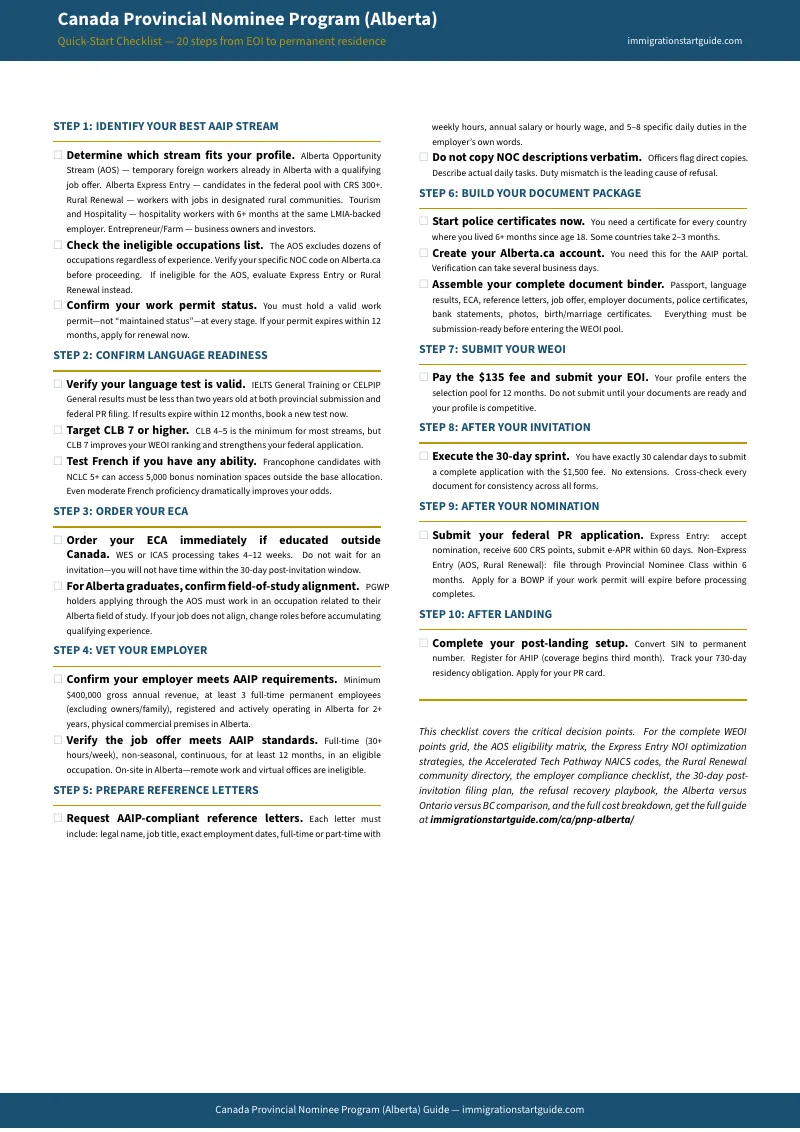
Quick-Start Checklist (free download)
A 20-item action plan covering the essentials: identify your best AAIP stream, check the ineligible occupations list, confirm your work permit status, verify language test validity, vet your employer's compliance, prepare reference letters with NOC duty alignment, and start police certificates before an invitation arrives. Enough to assess your position and identify your next move tonight.
5 Standalone Printable Tools (included with the guide)
In addition to the 14-chapter guide, you receive five ready-to-print standalone PDFs: a WEOI Scoring Worksheet to calculate your points across every factor and find unrealised points, an Employer Compliance Checklist to verify your employer meets the $400,000 revenue and 3-employee thresholds before you pay the $1,500 application fee, a Document Checklist for the 30-day post-invitation filing sprint with every certificate, letter, and form sequenced by lead time, a Fee Schedule Reference mapping every 2026 provincial, federal, and third-party fee from EOI through COPR with family-size projections, and a Province Comparison Card with Alberta versus Ontario versus BC side by side on allocations, scoring systems, processing times, and cost of living.
Who This Guide Is For
This guide is for temporary foreign workers, Express Entry candidates, international graduates, healthcare professionals, tech workers, and entrepreneurs who are targeting Alberta for permanent residency through the AAIP — and who have discovered that meeting the minimum eligibility requirements and actually receiving a nomination are two entirely different challenges:
- Temporary foreign workers in Alberta whose CRS score is stuck below 500 and who need the provincial nomination that adds 600 points — but who first need to determine whether the Alberta Opportunity Stream, the Express Entry stream, or the Rural Renewal Stream gives them the fastest path based on their specific permit type, NOC code, and work experience
- Express Entry candidates sitting in the federal pool with scores between 300 and 450 who need the NOI optimization playbook that makes Alberta's selection algorithm find their profile — province preference settings, primary NOC alignment with Alberta's priority sectors, and family connection signals
- PGWP holders whose three-year permit is their one shot at PR, who must navigate the "dual alignment" requirement (field of study must match current occupation) and the 6-month experience threshold before the permit clock runs out
- Tech professionals who qualify for the Accelerated Tech Pathway but don't know it exists — or who need the NAICS employer verification and NOC alignment strategy that triggers priority processing
- Healthcare workers eligible for the 500 dedicated nomination spaces under the Dedicated Health Care Pathway who are competing through the general streams unnecessarily
- Workers in rural communities who could access the Rural Renewal Stream's 1,000 nominations with far less competition — if they knew which community to contact and what endorsement requirements to meet
- Applicants whose employers are stalling because HR thinks "nomination support" means financial sponsorship — and who need the coordination system that walks a reluctant employer through the compliance requirements without triggering withdrawal
- Anyone deciding between hiring an RCIC at $3,000-$7,000 CAD and doing it themselves — and wanting a resource that makes the DIY path strategic rather than reckless
This guide is not for: people looking for a general Canadian immigration overview. If you want to compare all provinces at a surface level, this is not that resource. This is an Alberta deep dive. Every chapter, every eligibility matrix, and every strategy is specific to the AAIP.
Why Not Free Resources?
Free information on the Alberta PNP is abundant. Here's what it actually delivers:
- The Alberta.ca website publishes the official eligibility criteria across dozens of dense pages using terms like "TEER," "NAICS," and "204(c) Letters" without explaining how these interact in a real application. It tells you the rules exist. It does not tell you which stream gives you the highest probability of nomination based on your specific profile, or how to optimise your WEOI ranking, or what to do when your employer's revenue documentation doesn't match what the AAIP requires. You get regulations, not strategy.
- Immigration consultant blogs publish excellent draw analysis — because their business model is to demonstrate overwhelming complexity, then offer $5,000 full-representation retainers. The blog explains the problem. The solution costs thousands.
- Reddit and CanadaVisa forums are where you find draw predictions from applicants in different streams, under different rules, with different NOC codes. Someone's AOS success story from 2024 references rules that changed when the WEOI system launched. You get survivorship bias from strangers whose situations bear no resemblance to yours.
- YouTube walkthroughs show fragments of the process in ten-minute videos. Some still reference the old AINP naming convention. Reconstructing a complete strategy requires dozens of videos from different creators with different accuracy levels. You still don't have a WEOI scoring optimizer, an employer compliance checklist, or a Rural Renewal community directory when you're done watching.
This guide fills the execution gap — the space between "I know the AAIP rules exist" and "I can determine my best stream, optimise my WEOI ranking, coordinate my employer, navigate the 30-day post-invitation deadline, and complete the federal PR process without a $5,000 consultant." It gives you the same strategic frameworks that immigration professionals charge thousands to apply, structured so you can execute them yourself.
— Less Than a 30-Minute Immigration Consultation
Immigration consultants charge $3,000 to $7,000 CAD for full AAIP representation. A single 30-minute strategy session costs $150 to $325 CAD. And in that session, you get thirty minutes of verbal advice that disappears the moment the call ends — no WEOI points optimizer, no stream selection matrix, no employer compliance system, no Rural Renewal community directory, no 30-day filing plan.
Your total AAIP application costs will exceed $2,700 CAD for a single applicant — the $135 WEOI fee, the $1,500 provincial application fee, federal processing fees ($990 + $635 RPRF), biometrics, language tests, medical exams, ECA, and translations. This guide represents a fraction of that total investment, and it is the piece that determines whether the other $2,500+ produces a nomination or a refusal letter.
A refused application doesn't just cost you $1,500 CAD in non-refundable fees. It costs the twelve months you waited in the WEOI pool. It costs the employer who may not go through the compliance process again. It costs the work permit validity you can never get back.
Money-back guarantee, no time limit. If the stream selection framework, the WEOI scoring optimizer, the employer compliance system, the Rural Renewal community directory, and the NOC duty alignment methodology don't make your application stronger, you pay nothing.
Download the free Quick-Start Checklist to see the 20-item action plan and assess your AAIP stream eligibility tonight. When you're ready for the complete WEOI points optimization, the Express Entry NOI playbook, the Rural Renewal community directory, the employer compliance coordination system, and the full post-nomination federal PR playbook, the guide is here.
Alberta has 6,403 nominations in 2026 — plus 10,000 bonus spaces for physicians and Francophones. Make sure yours is one of them.