
You Left Your Children Behind, Took a Caregiving Job in Canada, Tracked Your Hours for 24 Months, and Then Had Your PR Application Returned Because Your Reference Letter Said "Helped Around the House" Instead of Listing the NOC 44101 Duties Word for Word. The Problem Was Never the Work — It Was the Documentation. This Guide Is the 24-Month Tracking System That Turns Every Pay Stub, T4 Slip, and Reference Letter Into an Audit-Proof PR Application.
You already know the basics. Canada's Home Care Worker Immigration Pilots let caregivers apply for permanent residency after working in a client's private home. You need CLB 4 language scores, a high school equivalency ECA, a valid job offer under NOC 44100 or 44101, and six months of qualifying experience. Your employer needs a Business Number and an approved LMIA. After 24 months of documented work, you submit your PR application.
What you probably did not know: IRCC paused all new applications for the Home Child Care Provider and Home Support Worker pilots on December 19, 2025. No new intake until March 30, 2030. The backlog exceeded 42,000 persons. If you have not already submitted, the federal pathway is closed — but three other doors remain open. The In-Canada Workers Initiative launched May 4, 2026, fast-tracking up to 33,000 temporary workers in rural and smaller communities. Provincial Nominee Programs in Ontario, BC, Saskatchewan, and Alberta all accept NOC 44100 and 44101 applicants with their own criteria. And the Temporary Foreign Worker Program still issues employer-specific work permits through the LMIA process, letting you accumulate the Canadian experience you will need when any pathway reopens.
The Canada Caregiver Program Guide is a 24-Month Tracking System — built for the three problems that separate caregivers who get PR from caregivers who get returned applications: documenting every hour of qualifying work in the exact format IRCC audits for, navigating the 2025–2030 pilot pause by switching to the right alternative pathway before your work permit expires, and protecting yourself from the recruitment fraud and employer abuse that costs caregivers between $2,000 and $9,000 in illegal fees that no legitimate recruiter is allowed to charge you.
What's Inside the 24-Month Tracking System
12 chapters + 8 standalone printable tools — a complete guide covering the current landscape after the pilot pause, the four eligibility pillars (CLB 4, ECA, experience, job offer), NOC 44100 vs. 44101 classification with the institutional-vs-home distinction that trips up PSWs, employer Business Number setup and the full LMIA process with 2026 rule changes, the PR application with the PR-first strategy that locks in your children's ages, the In-Canada Workers Initiative for rural fast-tracking, PNP alternatives in Ontario, BC, Saskatchewan, and Alberta, worker rights and the Vulnerable Open Work Permit, the complete 2026 fee schedule after the April increase, Filipino-specific DMW compliance and OEC requirements, the 24-month document tracking system, and the post-landing roadmap from PR to citizenship.
Standalone Printable Tools (included with the guide)
Quick-Start Checklist, Document Checklist, NOC Classification Card (44100 vs. 44101 side-by-side), Province Comparison Card (Ontario, BC, Saskatchewan, Alberta PNP streams), Reference Letter Templates (fill-in-the-blank for both NOC codes), Hours Tracking Worksheet (weekly log with cumulative totals), Employer LMIA Handout (print and hand to your employer), and 2026 Fee Schedule Card (every cost at a glance). Print the ones you need. Keep them in your application binder.
NOC Classification — The Most Common Failure Point (Chapter 3)
A mismatch between the NOC code on your job offer and your actual duties is the single most common reason applications are returned. NOC 44100 covers Home Child Care Providers. NOC 44101 covers Home Support Workers and Caregivers for seniors and persons with disabilities. Personal Support Workers in hospitals or nursing homes fall under NOC 33102 — a completely different classification that does not qualify for the caregiver pilots. The guide maps every eligible duty under each code and explains the institutional-vs-home distinction, so your reference letter matches the NOC description word for word instead of getting your application returned with a form letter about insufficient evidence of qualifying experience.
The LMIA Process — What Your Employer Needs to Do (Chapter 4)
Most Canadian families hiring a caregiver have never dealt with immigration paperwork. They need a CRA Business Number, an 8-week job advertisement on Job Bank, and a $1,000 LMIA application fee (waived if household income is under $150,000 for child care, or if hiring for medical care needs). Many caregivers end up walking their employer through this process step by step. The guide includes the employer setup sequence and the complete 2026 LMIA advertising requirements, so you can hand your employer a clear roadmap instead of hoping they figure out ESDC's employer-facing portal on their own.
The 24-Month Document Tracking System (Chapter 11)
The PR application requires proof of every qualifying hour of work — pay stubs showing CPP and EI deductions, T4 slips matching your LMIA wage, Notices of Assessment from CRA, and a detailed reference letter on your employer's letterhead listing your name, job title, exact dates of employment, hours per week, and a specific duty list that mirrors the NOC description. Missing a single T4 slip or submitting a vague reference letter triggers a return. The guide gives you the folder structure, the weekly tracking spreadsheet, and the exact language your reference letter must use — starting from Day 1, not Month 23 when it is too late to reconstruct what you should have been saving all along.
The Pilot Pause and What to Do Instead (Chapters 1, 6, 7)
The federal pilots are closed until 2030. If you are already in Canada with a pending application, the In-Canada Workers Initiative may fast-track your PR in 3–6 months if you have lived in a qualifying rural or smaller community for at least two years. If you are not in that category, Provincial Nominee Programs are your primary alternative — Ontario's In-Demand Skills Stream requires 9 months of Ontario experience in NOC 44101, British Columbia's Health Authority Stream targets home support workers, Saskatchewan's Hard-to-Fill Skills Pilot and Alberta's Dedicated Health Care Pathway both accept caregiver NOCs. The guide compares eligibility criteria, processing times, and application mechanics across all four provinces, so you are not guessing which stream you qualify for based on forum posts from 2023.
Worker Rights and the Vulnerable Open Work Permit (Chapter 8)
Caregivers working in private homes are uniquely vulnerable. If your employer withholds your passport, restricts your movement, pays below the agreed wage, or threatens your immigration status — you have the right to leave. The Vulnerable Open Work Permit (VOWP) lets you leave an abusive employer and continue working legally in Canada while you find a new position. The guide covers what counts as abuse, how to file for a VOWP, provincial labour protections by province, and the specific steps to change employers without losing your PR eligibility. Because the worst outcome is not losing a bad employer — it is staying with a bad employer because you think leaving means losing your chance at PR.
Filipino Caregiver Compliance (Chapter 10)
Over 65% of caregivers in Canada are from the Philippines. If you are Filipino, you must clear a completely separate layer of requirements on top of what Canada demands — the Overseas Employment Certificate from DMW (formerly POEA), the NBI clearance (which takes 2–4 weeks longer if there is a "Hit" match on your name), MWO contract verification, the pre-departure orientation seminar, and the direct hire ban that means you cannot apply to a Canadian employer without going through a licensed recruitment agency unless you fall within the "Rule of 5" exception. Missing a DMW requirement can block your exit from the Philippines even after Canada has approved your work permit. The guide maps the entire Philippine exit process alongside the Canadian entry process so nothing falls through the gap between the two bureaucracies.
Quick-Start Checklist (free download)
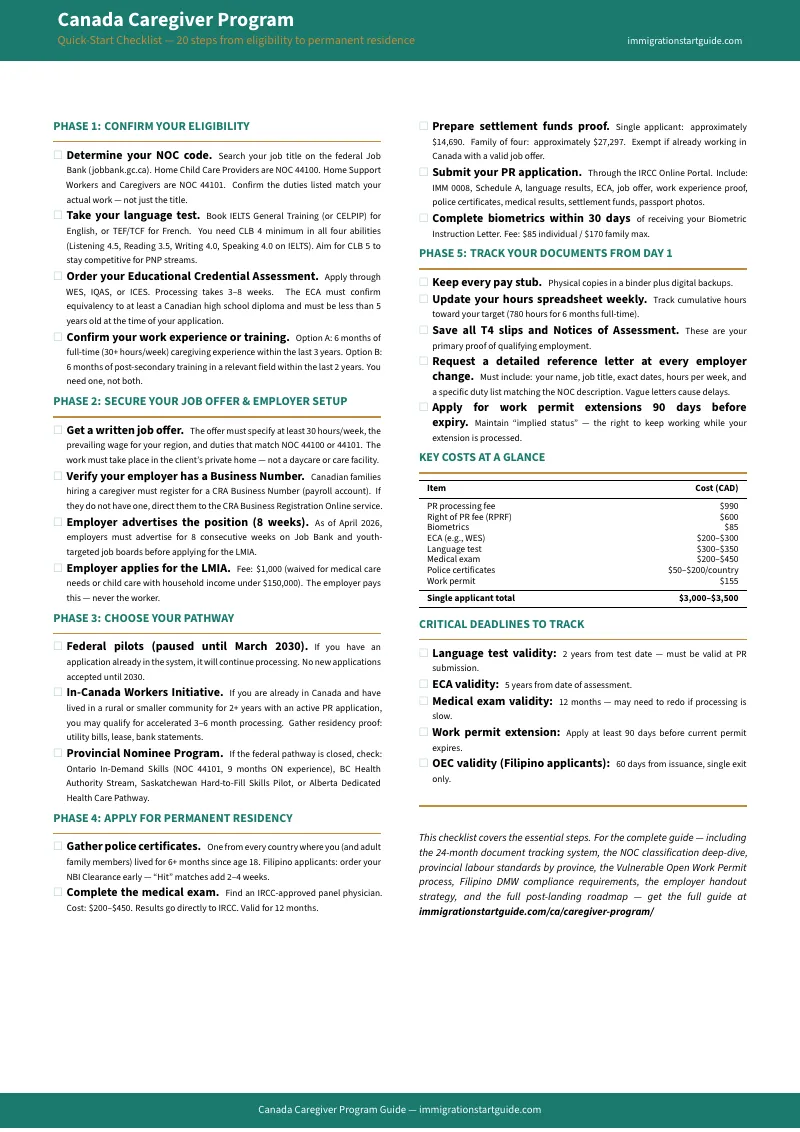
A 5-phase action plan covering eligibility confirmation (NOC code, language test, ECA, work experience), employer setup (job offer, Business Number, LMIA), pathway selection (federal pilots, In-Canada Workers Initiative, PNP), PR application (police certificates, medical exam, settlement funds, biometrics), and Day 1 document tracking. Enough to confirm your eligibility and identify your next move tonight.
Who This Guide Is For
This guide is for caregivers for children, seniors, or persons with disabilities who want to work in Canada and convert that work into permanent residency — who have realised that getting the job offer is the easy part, and building an audit-proof PR application over 24 months is where most people fail:
- You are a caregiver already working in Canada on a work permit and need to understand what the 2025–2030 pilot pause means for your PR timeline — and whether the In-Canada Workers Initiative, a Provincial Nominee Program, or waiting for the pilots to reopen is your best move
- You are preparing to come to Canada as a caregiver and need the complete process from job offer through LMIA through work permit through PR — including how to set up your employer's Business Number and LMIA application when they have never hired a foreign worker before
- You are a Filipino caregiver navigating both the Canadian immigration system and the Philippine DMW exit clearance system — and you need one resource that maps both processes together instead of patching together IRCC guidance and POEA circulars from different years
- You had a PR application returned or delayed because of a vague reference letter, a missing T4 slip, or a NOC code mismatch — and you need the documentation system that prevents the same result when you reapply
- You are a Personal Support Worker considering the transition from institutional care to home-based caregiving and need to understand the NOC 33102 vs. 44100/44101 distinction before committing to a career change
- You are being charged fees by a recruiter and want to know what is legal, what is illegal, and what to do if you have already paid — including how to file a complaint and apply for a Vulnerable Open Work Permit
This guide is not for: people looking for a general Canadian immigration overview, Express Entry applicants who are not in caregiving occupations, or families hiring a caregiver who want an employer-only guide. Every chapter, every checklist, every cost projection is specific to the caregiver pathway and the 2026 regulatory environment.
Why Not Free Resources?
Free information on caregiving in Canada exists everywhere. Here is what it actually delivers:
- The IRCC website (canada.ca) lists the program requirements and forms. It does not explain how to get your employer set up with a Business Number when they are a family who has never run payroll, does not provide a day-by-day document tracking system, and does not compare the In-Canada Workers Initiative against PNP alternatives. You get the requirements. You do not get the system for meeting them across 24 months.
- Facebook caregiver groups (Pinoy Abroad, Filipino-Canadian caregiver communities) have thousands of members sharing anecdotal advice. Research shows 76% of posts provide informational support — but much of that information reflects pre-2025 rules, recommends "flagpoling" that border authorities have curtailed, and cannot account for your specific NOC classification or provincial labour standards. One wrong answer about whether institutional PSW experience counts toward the caregiver pilot can cost you months of work that IRCC will not credit.
- Immigration consultants and lawyers charge $2,000 to $5,000 for standard cases and up to $12,500 for complex ones. They provide legitimate expertise — but caregivers frequently report that consultants become unreachable after the initial fee is paid and lack detailed knowledge of the 24-month tracking requirements that make or break a PR application.
- YouTube channels provide rapid-fire IRCC updates, often with sensational titles about pilot pauses and program closures. They deliver news. They do not deliver the structured document tracking system, the NOC duty-matching templates, or the provincial comparison that turns awareness of the rules into a complete, submission-ready application.
This guide fills the execution gap — the space between "I know I need 24 months of qualifying work" and "I have every pay stub, T4 slip, reference letter, and NOC-matching duty description organised and ready to submit." It gives you the complete system that free resources describe in fragments — structured so you can track your own documents from Day 1, walk your employer through the LMIA process, navigate the pilot pause with a clear alternative pathway, and submit a PR application that does not get returned.
— Less Than Three Hours of Your Work
Immigration consultants charge $2,000 to $5,000 for a standard caregiver case. Lawyers for complex cases — medical inadmissibility, criminal history, multiple employer changes — charge up to $12,500. A one-hour consultation runs $150 to $325, and you walk away with verbal advice that disappears when the call ends. No tracking spreadsheet. No reference letter templates. No provincial comparison chart.
Your total PR application will cost approximately $3,000 to $3,500 in government and ancillary fees — the $990 processing fee, the $600 Right of Permanent Residence Fee, $85 biometrics, a $200–$450 medical exam, $200–$300 for the ECA, $300–$350 for the language test, and $50–$200 per country for police certificates. If you are sponsoring a spouse and children, add another $990 plus $270 per child plus $600 RPRF per adult. That is money you cannot recover if your application is returned because a reference letter used generic language instead of NOC-matching duties.
A returned application does not just cost you in fees. It costs you months of processing time that restart from zero. For caregivers who left their children in the Philippines, India, or Jamaica to pursue PR — it costs the time apart that no amount of money can replace.
Money-back guarantee, no time limit. If the 24-month tracking system, the NOC classification deep-dive, the LMIA employer walkthrough, the pilot-pause alternative pathways, the worker rights chapter, and the Filipino DMW compliance guide do not make your PR application stronger, you pay nothing.
Download the free Quick-Start Checklist to confirm your NOC code, check your language scores against CLB 4, verify your employer setup, and identify which pathway is open to you right now. When you are ready for the complete 24-month tracking system, the full NOC duty-matching guide, the provincial comparison, and the employer LMIA walkthrough, the guide is here.
Canada needs caregivers. You need permanent residency. The federal pilots are paused — but the pathways are not closed, the provincial doors are open, and the 24 months you spend documenting your work are the 24 months that determine whether you reunite your family in Canada or start over from zero. This guide is how you make every month count.