
You Have a BCom From Stellenbosch, Six Years of Software Development Experience, a CRS Score of 453 — and No Idea Whether SAQA Will Classify Your Three-Year Degree as a "Bachelor's" or a "Three-Year Diploma." Your SAPS Clearance Takes Six to Twelve Weeks. Your Invitation to Apply Window Is Sixty Days. And the RCIC Quoting R35,000 Cannot Start Your SAQA Verification, Cannot Sit Your IELTS, and Cannot Make the CRS Draws Come Down to 453.
You have done the research. You know Express Entry has three programs — Federal Skilled Worker, Canadian Experience Class, and Federal Skilled Trades. You know the CRS scoring grid, you have run the calculator on the IRCC website, and you have a number between 440 and 470 that feels close but is not close enough. The draws have been sitting at 515 or higher for general rounds. You have read every MyBroadband thread, every Reddit post on r/ImmigrationCanada, and every InterNations forum reply from someone who "got their ITA in three months." You have bookmarked the IRCC portal. You are ready to commit R50,000 to R150,000 in credential evaluations, language tests, settlement funds proof, and biometrics for your family.
And then the South African side of the process starts.
SAQA verification costs R2,270 and takes twelve to twenty working weeks through the standard route. Your SAQA evaluation feeds into the WES (World Education Services) credential assessment, which costs another CAD $220 and takes seven additional weeks. That is a double-verification pipeline — SAQA first, then WES — that takes four to five months combined before you even have the credential report Express Entry requires. No other English-speaking country imposes this double layer on South African applicants. Australia does not. The UK does not. New Zealand does not. Canada does, and if you start WES before SAQA completes, WES rejects your application and you pay both fees again.
Your three-year Bachelor's degree is NQF Level 7 in South Africa. But WES may evaluate it as a "three-year diploma" rather than a "bachelor's degree" under the Canadian credential framework — because Canada distinguishes between three-year and four-year bachelor's degrees, and the distinction costs you 30 CRS points. Your BTech from a former Technikon is also NQF Level 7. WES evaluates it the same way — as a diploma, not a degree. Thirty CRS points is the difference between a score of 470 and a score of 440, between a realistic Provincial Nominee Program pathway and a profile that sits in the Express Entry pool indefinitely.
Your SAPS police clearance uses the 91(a) application form, costs R190 for the standard route, and is quoted at 15 working days. The Criminal Record Centre backlog pushes it to six to twelve weeks. The clearance is valid for twelve months from issue — but your ITA window is sixty days from the date of invitation. If your SAPS clearance expires during those sixty days, you must restart the entire process. Your medical examination results feed into eMedical and are valid for twelve months. Your IELTS or CELPIP score is valid for two years. Your WES report does not expire but must reflect your highest completed qualification. When you receive an ITA, you have exactly sixty days to upload every document — current, certified, and in the correct format — or the invitation expires and your CRS score drops back into the pool.
The Canadian side of Express Entry is well documented by IRCC. The South African side — the SAQA-to-WES double pipeline, the three-year degree downgrade, the BTech evaluation trap, the SAPS bottleneck, the SARS Tax Clearance Certificate, the SDA limits on transferring settlement funds — is where applications stall, CRS scores collapse, and families lose months they cannot recover.
The South Africa to Canada Express Entry Guide is the SA-to-CA Express Entry Playbook — built specifically for South African professionals navigating the Federal Skilled Worker, Canadian Experience Class, and Provincial Nominee Programs from within the South African administrative system. This is not a translation of the IRCC website. This is the complete filing system covering the SAQA-to-WES double verification pipeline with the exact sequence that prevents rejected applications and double payments, the three-year degree and BTech evaluation traps that cost South African applicants 30 CRS points, the CRS score optimisation strategy for South African profiles including the French language bonus that drops draw thresholds to 379, the spouse CRS optimisation that adds up to 40 points, the Provincial Nominee Program matrix showing which provinces actively nominate offshore South African applicants (Alberta AAIP at 300+ CRS, Ontario OINP, Saskatchewan SINP), the category-based draw strategy for STEM, healthcare, French proficiency, and trades, the SAPS police clearance timing method that prevents expiry during the sixty-day ITA window, the complete cost breakdown in ZAR for singles and families, the 2026 SDA increase to R2 million and SARS TCS requirements, and the post-landing settlement chapter covering dual citizenship considerations, banking transition, and the first ninety days in Canada.
What's Inside the SA-to-CA Express Entry Playbook
Twelve chapters, a quick-start checklist, and eight standalone reference tools — the SAQA-to-WES pipeline sheet, NOC code mapping, PNP province matrix, cost breakdown in ZAR, settlement funds calculator, document validity table, employment reference letter template, and the 60-day post-ITA countdown — covering every step from your first CRS calculation through your first week in Canada:
The CRS Score Strategy for South African Profiles
The Comprehensive Ranking System is not a checklist — it is the algorithm that determines whether you receive an Invitation to Apply or sit in the pool while draws happen around you. The guide breaks down every CRS factor with South African-specific analysis: the education credential trap where a three-year Bachelor's (NQF 7) scores 112 points as a "bachelor's" but only 90 as a "three-year diploma" — a 22-point swing determined entirely by how WES classifies your degree. The age cliff warnings at 30, 35, and 40 where you lose 5 to 6 points per year. The work experience scoring where six years of South African experience scores 80 points but only if your NOC code is correctly mapped and your reference letters meet IRCC requirements. A worked example follows a 29-year-old developer with a BSc from Wits through the scoring — 453 on own profile, not competitive for general draws at 515, but 783 with a PNP nomination. Those 330 points do not appear by accident. They come from knowing exactly which pathway to target.
The SAQA-to-WES Double Verification Pipeline
No other migration resource walks you through the exact sequence. SAQA verification costs R2,270, takes twelve to twenty working weeks through standard processing, and must be completed before you submit to WES. WES credential evaluation costs CAD $220 (approximately R2,900), takes seven weeks after receiving your verified documents, and produces the Educational Credential Assessment (ECA) report that Express Entry requires. Total pipeline: four to five months and R5,170 in combined fees — before you even create your Express Entry profile. The guide covers the SAQA application process step by step, the document requirements including certified copies versus original transcripts, the WES submission portal, the "document by document" versus "course by course" evaluation choice, and the critical error that causes WES to reject your submission and forces you to pay both fees again. It also covers the three-year degree downgrade: if your South African Bachelor's was a three-year program, WES may classify it as a "three-year bachelor's degree" or a "three-year diploma" depending on the institution and program structure — and the classification determines whether you score 112 or 90 CRS education points.
The BTech and Three-Year Degree Evaluation Traps
South Africa's NQF framework does not map cleanly onto the Canadian credential system. A BTech (NQF Level 7) was built on top of a National Diploma and is evaluated by WES as equivalent to a diploma, not a degree — costing you 22 to 30 CRS points. A three-year Bachelor's degree from a traditional university may be evaluated as a "three-year diploma" rather than a "bachelor's degree" depending on the program structure. The guide includes the complete NQF-to-Canadian equivalency mapping, the BTech mitigation strategy using Honours or postgraduate diplomas to upgrade your credential level, and the specific WES evaluation outcomes for degrees from UP, Stellenbosch, Wits, UCT, UNISA, UJ (formerly Technikon Witwatersrand), TUT (formerly Technikon Pretoria), and CPUT. Understanding this before you pay R5,170 in combined SAQA and WES fees prevents discovering the problem after your ECA report arrives and your CRS score is 30 points lower than you calculated.
The French Language CRS Bonus Strategy
This is the single most powerful CRS score improvement available to South African applicants who are willing to invest three to six months of preparation. A CLB 7 in French (TEF Canada or TCF Canada) adds 25 CRS points with strong English, and qualifies you for French-language category-based draws where thresholds drop to 379 — more than 130 points below general draws. South Africa has Alliance Francaise centres in Johannesburg, Cape Town, Pretoria, and Durban. The TEF Canada costs approximately R4,500 and is offered multiple times per year. The guide covers the CLB scoring thresholds, the TEF versus TCF comparison, preparation resources available in South Africa, and the exact CRS point calculations for various French-English score combinations. For an applicant stuck at 450 CRS with no clear path to 515, French proficiency is not a nice-to-have — it is the pathway that transforms an indefinite wait into an ITA within months.
The Spouse and Common-Law Partner CRS Optimisation
If you are applying with a spouse or common-law partner, the CRS system offers cross-over points that most applicants miss entirely. A spouse with CLB 9 English adds 20 points. A spouse with a Canadian credential adds 10 points. A spouse with Canadian work experience adds 10 points. Even for spouses without Canadian ties, optimising their language scores and credential evaluation can add 10 to 40 CRS points to your combined profile. The guide covers whether to include your spouse as an accompanying dependent or as a co-applicant, the breakeven analysis for each configuration, and the specific scenarios where declaring your spouse as non-accompanying actually increases your CRS score. It includes the spouse IELTS preparation strategy and the cost-benefit analysis of getting your spouse's credentials evaluated through SAQA and WES.
The Provincial Nominee Program Matrix for South African Applicants
A PNP nomination adds 600 CRS points — making it effectively a guaranteed ITA. But not all provinces nominate offshore applicants, and the 2025-2026 program year has introduced significant changes. Alberta's AAIP (Alberta Advantage Immigration Program) accepts Express Entry-linked nominations for applicants with CRS scores as low as 300 and targets technology, healthcare, and engineering occupations. Ontario's OINP runs periodic draws for specific NOC codes — if your occupation aligns, you may receive a notification of interest without applying directly. Saskatchewan's SINP has shifted to inland-only for most streams, limiting offshore SA applicants. British Columbia's BC PNP Tech targets technology workers with draw scores well below the federal threshold. The guide provides the province-by-province analysis with draw history, eligible occupations, processing times, and offshore accessibility ratings so you target the provinces where your NOC code and profile have the best chance, not just the provinces you have heard of.
The Category-Based Draw Strategy
Since 2023, IRCC has conducted category-based draws targeting specific economic goals: healthcare, STEM, trades, transport, agriculture, and French language proficiency. These draws have lower CRS thresholds than general rounds — healthcare draws have gone as low as 422, French-language draws as low as 379, STEM draws as low as 481. The guide maps South African occupations to their category-based draw eligibility, identifies which categories your NOC code qualifies for, and provides the historical draw data so you can assess your realistic chances. If you are a nurse, physiotherapist, medical technologist, software developer, civil engineer, or electrician, your occupation likely qualifies for category-based draws where your current CRS score may already be competitive.
The South African Document Extraction Guide
This is the chapter that no Canadian immigration resource covers properly. The SAPS police clearance using the 91(a) application form — the all-previous-surnames requirement that catches married applicants, the difference between applying at your local SAPS station versus the Criminal Record Centre in Pretoria, and the six-to-twelve-week processing reality versus the fifteen-working-day quote. The timing strategy that ensures your clearance does not expire during the sixty-day ITA window. Ordering transcripts from UNISA (four to eight weeks), Wits, UCT, Stellenbosch, and the merger-era institutions where Technikon Witwatersrand became UJ. Document certification — Commissioner of Oaths versus Notary Public, and the colour scan at 300 dpi minimum requirement. The SAQA verification process in detail — application steps, required documents, processing times for standard versus priority, and the apostille requirements for documents destined for WES.
The Complete Cost Breakdown in ZAR
Not in CAD with a footnote about exchange rates. In ZAR, with separate tables for single applicants and families of four. SAQA verification is R2,270. WES credential evaluation is approximately R2,900 (CAD $220). IELTS costs R4,460 per attempt. The IRCC application fee is CAD $1,365 for the primary applicant (approximately R18,000) plus CAD $1,365 per adult dependent and CAD $230 per child. Biometrics cost CAD $85 per person. Settlement funds proof requires approximately CAD $14,000 for a single applicant (R185,000) or CAD $28,000 for a family of four (R370,000) — and you must show these funds are available, not spend them. The guide includes the RCIC versus DIY cost comparison — RCICs charge R25,000 to R60,000, but they cannot start your SAQA verification, cannot sit your IELTS, cannot obtain your SAPS clearance, and cannot draft the employment reference letters that IRCC officers require. The most time-consuming parts of this application fall to you regardless.
Financial Compliance: SDA, SARS TCS, and Settlement Funds
Moving to Canada triggers South African financial obligations that most migration guides ignore entirely. The Single Discretionary Allowance increased to R2 million in 2026 — sufficient for a single applicant's settlement funds but not for a family of four. Amounts above the SDA require a SARS Tax Clearance Certificate (TCS) through the Approval International Transfer (AIT) process, which takes four to six weeks and requires your tax affairs to be fully compliant. The "deemed disposal" exit tax on worldwide assets under Capital Gains Tax rules. The forex transfer strategy — using specialist forex brokers versus your bank's standard forex desk, where the spread difference saves R5,000 to R20,000 on a R370,000 transfer. The guide covers the practical steps so you understand the financial compliance requirements before you need the funds, not after your ITA arrives and you have sixty days to prove settlement funds while simultaneously applying for a TCS.
Post-Landing Settlement Preparation
South African citizenship retention — unlike Australian citizenship, Canadian citizenship does not require renouncing your South African citizenship, but you must understand the dual citizenship implications for tax residency, SARS obligations, and passport travel. SA passport renewal from Canada — budget four to eight months through the High Commission in Ottawa, not the six weeks it takes in South Africa. Banking transition from FNB, Standard Bank, ABSA, Nedbank, or Capitec to the Big Five Canadian banks, several of which allow pre-arrival account opening with your Confirmation of Permanent Residence. SIN application, provincial health card registration, driver's licence exchange (varies by province), and the Canadian resume format that drops the photo, ID number, and marital status your South African CV includes. The first ninety days — what to do in which order, from landing at the port of entry through your first Canadian tax return.
Quick-Start Checklist (free download)
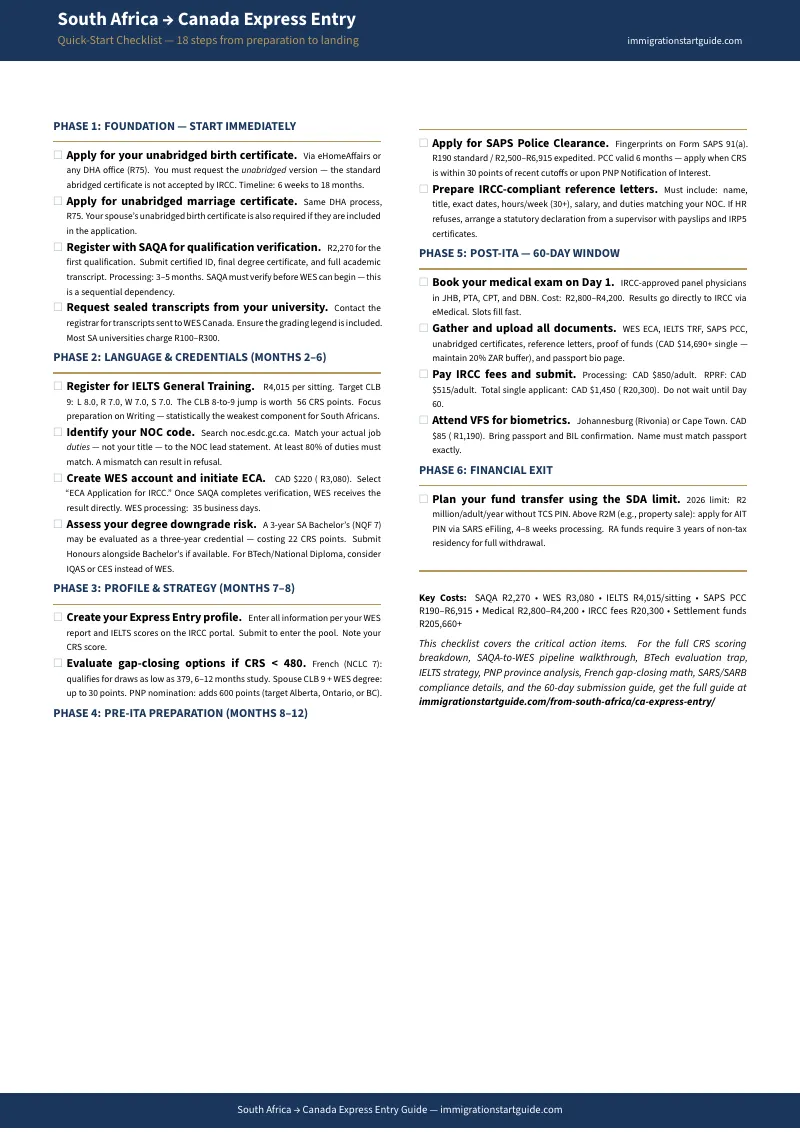
Eighteen critical actions distilled into a single action sheet organised across six phases: Foundation, Language and Credentials, Profile and Strategy, Pre-ITA Preparation, Post-ITA 60-Day Window, and Financial Exit. Enough to calculate your CRS score tonight, identify your NOC code, and determine whether your three-year degree will be evaluated as a bachelor's or a diploma — because the SAQA-to-WES pipeline alone takes four to five months, and every week you delay is a week added to a timeline that already stretches twelve to twenty-four months.
Who This Guide Is For
This guide is for South African skilled professionals applying through Express Entry from within South Africa:
- Software developers, data engineers, and IT professionals in Johannesburg, Pretoria, or Cape Town with CRS scores between 440 and 480 who need the PNP matrix, the category-based STEM draw strategy, and the French language bonus pathway to close the gap to an ITA — because general draws at 515 are out of reach on own profile alone, and the difference between sitting in the pool for two years and receiving an ITA in six months is knowing which alternative pathway to target.
- Engineers, accountants, and healthcare professionals with a three-year Bachelor's or BTech from a South African university who risk losing 22 to 30 CRS points if WES evaluates their credential as a diploma instead of a degree — you need the NQF-to-Canadian equivalency mapping, the BTech mitigation strategy, and the Honours upgrade pathway before you pay R5,170 in combined SAQA and WES fees and discover your education score is 30 points lower than you calculated.
- Nurses, physiotherapists, medical technologists, and other healthcare professionals whose occupations qualify for healthcare category-based draws at CRS thresholds as low as 422 — you need the NOC code mapping, the draw history, and the PNP healthcare stream details for provinces actively recruiting your profession.
- Families facing R50,000 to R150,000 in application costs plus R185,000 to R370,000 in provable settlement funds who need the ZAR cost breakdown, the SDA and SARS TCS requirements for international transfers, and the forex strategy — not a CAD figure with a "check the current exchange rate" footnote.
- Applicants weighing the RCIC question — whether to pay R25,000 to R60,000 for a Regulated Canadian Immigration Consultant — you need to understand that the RCIC does not start your SAQA verification, does not sit your IELTS, does not obtain your SAPS clearance, does not draft the employment reference letters IRCC officers require, and cannot influence CRS draw thresholds. The hardest parts of this application fall to you regardless. The question is whether you have the procedural knowledge to do them correctly and in the right sequence.
This guide is not for: employer-sponsored LMIA applicants (those require a sponsoring Canadian employer and follow a different pathway), international students transitioning to PR after graduating from a Canadian DLI (the Canadian Experience Class onshore pathway has its own dynamics), or investor/entrepreneur visa applicants. If you are considering Australia instead, see the South Africa to Australia Skilled Migration Guide. If you have a UK-born grandparent, see the South Africa to UK Ancestry Visa Guide. If you are considering New Zealand, see the South Africa to New Zealand Skilled Migrant Guide.
Why Not Free Resources or an RCIC?
Free information about Canadian Express Entry exists. Here is what it actually covers:
- canada.ca (IRCC) lists the Express Entry programs, the CRS factors, and the document requirements. It does not explain how SAQA verification feeds into WES, how to prevent the double-payment error when submitting to WES before SAQA completes, how a three-year South African Bachelor's might be downgraded to a diploma, how to time your SAPS clearance so it does not expire before your ITA arrives, or how to transfer settlement funds when the amount exceeds the SDA and requires a SARS TCS. The Canadian government tells you what they need. It does not tell you how to extract it from the South African system.
- MyBroadband, Reddit's r/ImmigrationCanada, and InterNations give you anecdotes. One person's SAQA took twelve weeks. Another waited twenty-four. A third had their three-year degree evaluated as a diploma by WES. Each story is real. None tells you which outcome applies to your qualification, your institution, or your province target. The advice is scattered across hundreds of threads, often years out of date, and written by applicants who may or may not have received an ITA.
- Regulated Canadian Immigration Consultants (RCICs) charge R25,000 to R60,000 on top of R50,000 or more in government and evaluation fees. They review your documents and submit your Express Entry profile. They do not start your SAQA verification — that is between you and SAQA. They do not sit your IELTS. They do not obtain your SAPS clearance. They do not draft the detailed employment reference letters IRCC officers require. They do not learn French for you. The tasks where South African applicants actually stall are credential evaluation sequencing, document timing, and CRS score optimisation. An RCIC adds a review layer, not the procedural knowledge itself.
This guide fills the gap between "I created an Express Entry profile" and "I received an Invitation to Apply" — the space where South African professionals fail because WES classified their three-year degree as a diploma, because their SAPS clearance expired during the sixty-day ITA window, because they did not know about the French language bonus that drops draw thresholds by 130 points, because they submitted to WES before SAQA completed and paid both fees twice, or because they transferred R370,000 through their bank's forex desk at a 3 percent spread and lost R11,000 in hidden costs.
— Less Than One Hour of an RCIC's Time
An RCIC consultation costs R500 to R1,500 per hour. A full-service engagement runs R25,000 to R60,000. The SAQA-to-WES pipeline alone costs R5,170 in combined fees. IELTS costs R4,460 per attempt. Settlement funds proof requires R185,000 for a single applicant or R370,000 for a family of four. For a family of four, total application costs including settlement funds reach R200,000 to R550,000. A mistake — the wrong NOC code, a three-year degree evaluated as a diploma, a SAPS clearance expiring during the ITA window, a WES submission rejected because SAQA was not completed first — does not just delay you. A rejected WES evaluation means paying both fees again. An expired document during the sixty-day ITA window means losing your invitation. A CRS miscalculation means sitting in the pool while draw after draw passes you by.
This guide costs less than one hour of an RCIC's consultation fee, and it covers the complete SA-to-CA pathway: the SAQA-to-WES double verification pipeline, the three-year degree and BTech evaluation traps, the CRS score optimisation strategy, the French language bonus, the spouse optimisation, the Provincial Nominee Program matrix, the category-based draw strategy, the SAPS timing method, the employment reference templates, the complete cost breakdown in ZAR, the SDA and SARS TCS financial compliance, and the post-landing settlement preparation. The credential evaluation chapter alone can save you R5,170 in wasted SAQA and WES fees. The French language strategy can drop your required draw threshold by 130 points. The PNP matrix can add 600 CRS points to a profile that would otherwise sit in the general pool indefinitely.
You have the qualifications. You have the experience. You have the English. You have the professional skills Canada is actively seeking through an immigration program that targets over 110,000 Express Entry admissions per year. What stands between you and permanent residency is not eligibility — it is the gap between the South African administrative system and the Canadian points-based system that will evaluate you. The SAQA-to-WES pipeline. The three-year degree classification. The CRS optimisation. The PNP targeting. The SAPS timing. The sixty-day ITA sprint. Every one of these is solvable. Every one of them, if mishandled, costs you months, tens of thousands of rands, or the ITA itself.
Money-back guarantee, no time limit. If the SAQA-to-WES pipeline walkthrough, the credential evaluation trap analysis, the CRS score optimisation strategy, the PNP matrix, the French language bonus chapter, the sixty-day ITA sprint checklist, and the SDA/SARS financial compliance chapter do not make your Express Entry application stronger than anything you could assemble from IRCC pages, MyBroadband threads, and RCIC consultations, you pay nothing.
Download the free Quick-Start Checklist to calculate your CRS score tonight, identify your NOC occupation code, and understand whether your three-year degree will be evaluated as a bachelor's or a diploma. When you are ready for the complete SA-to-CA Express Entry Playbook — the full guide with the credential evaluation pipeline, the PNP matrix, the French language strategy, the reference letter templates, and the financial compliance planning — the full guide is here.
Your qualifications earned you the right to apply. The CRS score, the credential evaluation, the PNP nomination, and the sixty-day ITA sprint are the only things standing between you and permanent residency in Canada. Start the process today — because every month you wait is a month closer to the next age cliff, the next PNP allocation change, and the next CRS draw that passes you by.