
Your Grandfather Was Born in London. Your Unabridged Birth Certificate Has Been "Processing" at Home Affairs for Five Months. Your TB Test Expires in Six Weeks. And No One Can Tell You Whether These Timelines Actually Line Up — Because No Free Resource Covers the South African Side of This Visa.
You know you qualify. You have the grandparent link, the Commonwealth passport, the professional skills the UK wants. You have read every GOV.UK page on the Ancestry visa. You have bookmarked the VFS appointment system. You are ready to pay the fees — R130,000 for a single adult, over R450,000 for a family of four. This is not a casual decision. This is months of savings at the mercy of the ZAR/GBP exchange rate, a family conversation that took years, and an application that gets one shot.
And then the South African side of the process starts.
Home Affairs quotes 8 weeks for an unabridged birth certificate. The real number in 2026 is 3 to 6 months — and that is if the Pretoria archives can locate the vault copy at all. The SAPS police clearance is supposed to take 15 working days. The Criminal Record Centre backlog pushes it to 2 to 4 months. Your TB test is valid for exactly 6 months from the date it was issued. Your GRO certificate from the UK arrives in 3 weeks. Your bank statements must be no older than 31 days at the time of application. You are managing four different timelines, from four different institutions, in two different countries — and if any one of them expires before the others are ready, you start that leg of the process again.
The UK side of the Ancestry visa is well documented. The South African side is where applications actually fail.
The South Africa to UK Ancestry Visa Guide is the DHA-to-Heathrow Roadmap — built specifically for South Africans navigating the Ancestry visa from within the South African administrative system. This is not a translation of the UKVI guidance notes. This is the integrated filing system covering the DHA unabridged certificate escalation strategy with Pretoria archive hacks, the GRO index search technique for when you only have approximate details about your grandparent's birth, the SAPS police clearance timeline management including the surname history requirement most applicants miss, the TB test scheduling window that keeps your certificate valid through to VFS submission, the VFS self-upload process that saves R1,000 or more per applicant, the SARS tax emigration and SARB allowance implications, the 2025 Constitutional Court dual citizenship ruling and what it means for your SA passport, and the complete 12-month interleaved timeline that synchronizes every document from every agency so nothing expires before you submit.
What's Inside the DHA-to-Heathrow Roadmap
The complete guide, a quick-start checklist, and standalone printable tools — covering every step from eligibility verification through your first week in the UK:
The Pre-Assessment Ancestry Audit
Before you spend a cent on government fees, you need to know whether your claim holds up. The Ancestry visa requires proof that at least one grandparent was born in the UK, the Channel Islands, or the Isle of Man — but the definition is more nuanced than most applicants realise. Grandparents born in the Republic of Ireland before 1 April 1922 qualify. Adopted grandparents only qualify if the adoption is recognised under UK law. Step-grandparents do not qualify at all. The audit chapter walks you through every qualifying scenario, the Section 4L criteria for complex lineage cases that even consultants miss, and the exact documents you need to prove the link. If you do not pass this audit, you have saved yourself R130,000 in visa fees and months of document gathering. If you do pass, you proceed knowing your claim is solid — not hoping it is.
The DHA Document Retrieval Strategy
This is where most South African Ancestry visa applications stall — sometimes for a year. UKVI requires unabridged birth and marriage certificates for you, your parent (the one through whom the claim runs), and in some cases your grandparent's South African records if they lived here. The DHA's official processing time is 8 weeks. The real timeline in 2026 is 3 to 6 months for standard applications, and longer if the Pretoria archives cannot locate the vault copy. The guide covers the eHomeAffairs portal application process and the glitches that cause submissions to silently fail, the in-person DHA office strategy for when the portal does not work, the Pretoria document retrieval agencies that have physical access to Home Affairs staff and can escalate vault searches, the difference between abridged and unabridged certificates and why submitting the wrong one causes summary refusal, and the tracking technique to check whether your certificate has been printed and is sitting in a queue rather than being actively processed. Starting DHA applications 12 months before your intended VFS date is not overly cautious — it is the minimum for applicants whose parents were born before 1990.
The GRO Search and Certificate Ordering System
Your grandparent was born in the UK. You need to prove it with a certified paper certificate from the General Register Office — not the GRO's digital image service, which costs only a few pounds but is explicitly not accepted for visa applications. The challenge for South Africans is that you often have only approximate details: a rough year of birth, a city name, maybe a district. The guide covers the GRO index search technique using FreeBMD and FamilySearch to locate the Volume, Page, and Quarter reference numbers that make ordering straightforward instead of a guessing game, the distinction between the GRO indexes for England and Wales versus the separate registries for Scotland (National Records of Scotland) and Northern Ireland (GRONI), and the international delivery timeline to South Africa. For grandparents born in Scotland, Northern Ireland, or pre-1922 Ireland, the guide provides the parallel ordering instructions for each registry so you do not waste weeks ordering from the wrong office.
The SAPS Police Clearance Timeline Management
The SAPS police clearance is one of the most underestimated steps in the process. Standard processing is quoted at 15 working days but routinely takes 2 to 4 months through the Criminal Record Centre in Pretoria. The certificate is valid for 6 months — which means your scheduling window is tight. Start too early and it expires before your other documents are ready. Start too late and you miss your VFS appointment. The guide covers the standard versus expedited options (including Pretoria-based agents who hand-deliver to the CRC for same-week processing), the critical surname requirement that catches married women and anyone who has changed their name — your PCC must include all previous surnames or UKVI will flag the discrepancy, and the cost-benefit analysis of the R190 standard route versus the R2,500 to R6,900 agent-assisted options. For applicants who have lived in countries other than South Africa, the guide explains the additional police clearances required and the ordering timelines for each.
The TB Test Scheduling Window
South Africa is on the UK's mandatory TB screening list. You must have a clearance certificate from an IOM-approved clinic in Johannesburg, Pretoria, Cape Town, or Durban. The certificate is valid for exactly 6 months. If your chest X-ray is inconclusive, you face a sputum culture test that adds up to 8 weeks. The guide covers the clinic-by-clinic booking situation in 2026 — wait times vary significantly between cities — the scheduling strategy that ensures your TB certificate is still valid on the day of your VFS appointment (not the day you book it, which is a common miscalculation), and the cost breakdown in ZAR at the current IOM exchange rate. This is the easiest document to time incorrectly, and the consequences are a second clinic visit and a second fee.
The VFS Self-Upload and Appointment Strategy
VFS Global manages the biometrics appointment and document submission in Rivonia, Pretoria, Cape Town, and Durban. Their website pushes you toward paid "Value Added Services" including document scanning, premium lounge access, and courier return. Real-world feedback from 2026 confirms that self-uploading your documents through the UKVI portal before your appointment saves R1,000 or more per applicant and reduces the risk of VFS staff misfiling or losing a document. The guide provides the exact upload process, the file naming convention that UKVI officers prefer, the premium versus standard service comparison with honest cost-benefit analysis, and the appointment booking strategy for each centre — because the wait time difference between Rivonia and Cape Town can be the difference between submitting this month and submitting in three months.
The Financial Maintenance and ZAR Planning Chapter
UKVI does not publish a fixed minimum bank balance for Ancestry visa applicants, but caseworker guidance in 2026 emphasises liquid funds held for at least 90 continuous days. Large deposits made just before the application — "bank stuffing" — are flagged as non-genuine and can lead to refusal. The guide covers the practical maintenance threshold based on current caseworker practice, the 90-day bank history strategy using FNB, Standard Bank, ABSA, or Nedbank statements in the format UKVI accepts (not mini-statements, not transaction exports), the ZAR/GBP exchange rate buffer that ensures your balance meets the threshold even if the Rand weakens between your statement date and the date your application is reviewed, and the realistic UK settlement budget including 6 months of upfront rent for new arrivals without a UK credit history.
The SARS and SARB Financial Emigration Chapter
Moving to the UK triggers South African tax and exchange control implications that most immigration guides ignore entirely. The guide covers the SARS Tax Compliance Status process for the Approval for International Transfer (AIT) PIN, the R1 million Single Discretionary Allowance and the R10 million Foreign Capital Allowance and when each applies, the 2025 Circular 15/2025 requirement that even non-resident income from SA property or dividends requires an AIT PIN to transfer abroad, and the practical steps for ceasing South African tax residency. This is not immigration advice — it is the financial planning context that every relocating South African needs and that immigration consultants charge separately for.
The 2025 Constitutional Court Dual Citizenship Ruling
Until May 2025, South Africans who acquired British citizenship automatically lost their SA citizenship unless they had pre-applied for a Retention letter. The Constitutional Court has now declared this provision unconstitutional with retrospective effect back to 1995. The guide explains what this means in practice: whether you still need a Retention letter (the administrative systems are still catching up), how to use the DHA's Citizenship Reinstatement Portal, and how to protect your South African passport validity while pursuing British citizenship after your five-year Ancestry visa period. This single chapter addresses one of the most anxiety-inducing questions in the entire process — and most free resources have not been updated to reflect it.
Quick-Start Checklist (free download)
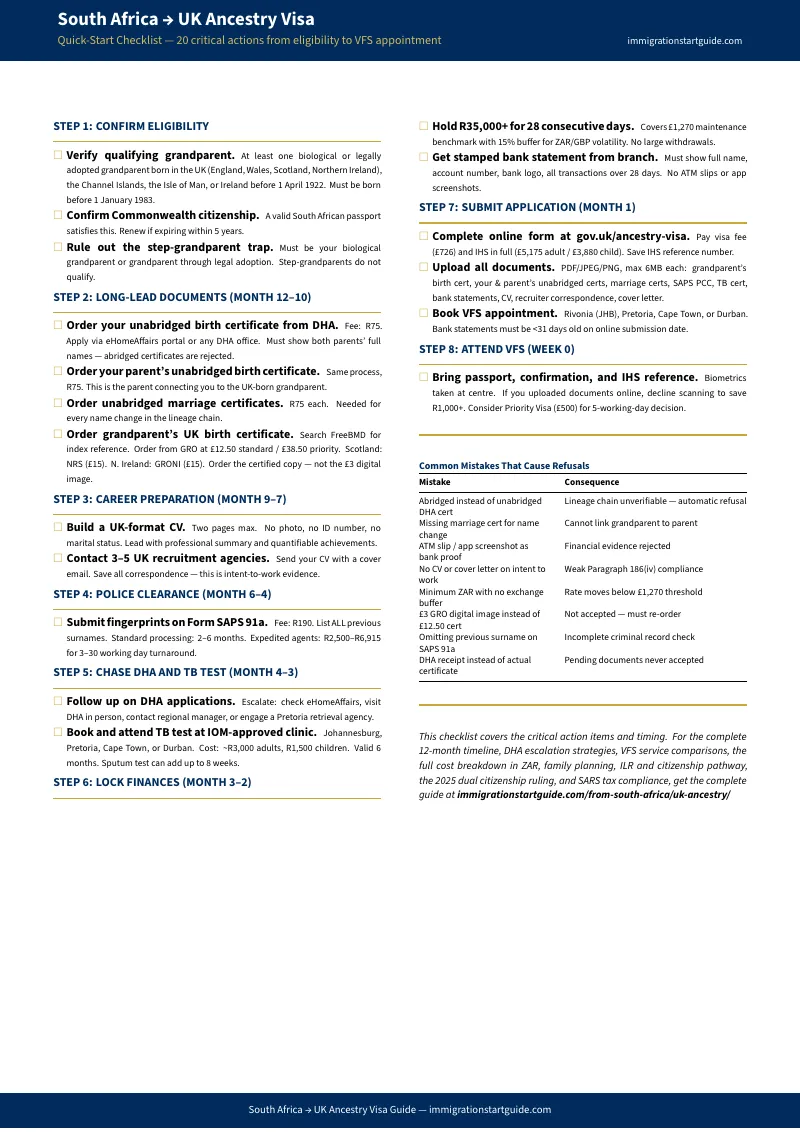
The critical steps distilled into a single action sheet organised by phase: ancestry link verification, DHA document applications, GRO certificate ordering, SAPS clearance, TB test scheduling, financial preparation, and VFS submission. Enough to confirm your eligibility tonight and start your DHA applications this week — because those 3-to-6-month timelines start the day you apply, not the day you decide to emigrate.
Who This Guide Is For
This guide is for South Africans applying for the UK Ancestry visa from VFS centres in South Africa:
- Professionals in Johannesburg, Pretoria, Cape Town, or Durban who know they have a UK-born grandparent and want to file the application themselves — you need the DHA escalation strategy, the GRO search technique, the interleaved timeline, and the VFS self-upload process that saves R1,000 or more per applicant.
- Families relocating together who face R450,000 or more in government fees and need to synchronise multiple passports, multiple IHS payments, and multiple TB tests — you need the family application coordination chapter, the ZAR settlement budget, and the financial maintenance strategy for a family of four.
- Applicants whose unabridged birth certificates have been stuck at Home Affairs for months — you need the DHA escalation paths, the Pretoria document retrieval agencies, and the tracking techniques that get certificates moving again.
- People with complex lineage: adopted grandparents, grandparents born in pre-1922 Ireland, surname changes through marriage, or parents who emigrated from the UK decades ago — you need the Pre-Assessment Ancestry Audit and the Section 4L eligibility criteria for non-standard cases.
- Applicants weighing the consultant question — whether to pay R20,000 to R50,000 for a firm like Sable International or Breytenbachs to manage the filing — you need to understand that the hardest part of this application is gathering the documents from DHA, SAPS, and the GRO, and that no consultant can stand in the Home Affairs queue for you or make the Criminal Record Centre process your fingerprints faster. The consultant adds value in complex legal situations. For a standard Ancestry application with clear lineage, you are paying R30,000 for form-filling you can do yourself.
This guide is not for: applicants already in the UK switching visa categories (see the UK Ancestry Visa Guide for in-country applications), non-South African Commonwealth citizens (the DHA, SAPS, and VFS SA logistics are specific to South Africa), or applicants without a UK-born grandparent (you may qualify for the UK Skilled Worker Visa instead).
Why Not Free Resources or Facebook Groups?
Free information about the UK Ancestry visa exists. Here is what it actually covers:
- GOV.UK lists the eligibility criteria and the documents you must provide. It does not explain how to get an unabridged birth certificate from the DHA when the Pretoria archives cannot find the vault copy, how to time your SAPS clearance so it does not expire before your TB test arrives, or how to self-upload documents at VFS instead of paying for their scanning service. The UK government tells you what they need. It does not tell you how to extract it from the South African system.
- The "Saffas in the UK" Facebook groups and MyBroadband forums give you anecdotes. One person's DHA certificate arrived in 6 weeks. Another waited 11 months. A third was refused because their SAPS clearance did not include a maiden name. Each story is real. None tells you which scenario applies to your DHA office, your surname history, or your specific VFS centre. And the advice is often 2 to 3 years out of date — written before the 2025 ConCourt dual citizenship ruling, before the IHS increase, before the BRP-to-e-Visa transition, and before the SARB's new AIT requirements for non-resident income.
- Reddit's r/ukvisa provides generic UK Ancestry visa advice for all Commonwealth nationalities. It does not cover the DHA unabridged certificate process, the SAPS PCC surname requirement, the VFS South Africa centre differences, or the SARS tax emigration implications. Advice written for Australians or Canadians is irrelevant when your bottleneck is the Pretoria archives.
- Immigration consultants charge R20,000 to R50,000 on top of the government fees. They file the forms and review your documents. They cannot obtain your unabridged birth certificate from the DHA. They cannot get your SAPS clearance processed faster. They cannot take your TB test for you. The hardest parts of this application — the parts where South Africans actually fail — are document gathering and timeline management. A consultant adds a cover letter and a stamp. You still do the work.
This guide fills the gap between "I qualify for the Ancestry visa" and "my vignette is in my passport" — the space where South Africans fail because their DHA certificate took 6 months instead of 8 weeks, because their SAPS clearance expired while waiting for the TB result, because they submitted an abridged certificate instead of an unabridged one, because they paid R12,000 for VFS premium services they did not need, or because they never knew about the SARB rules that froze their rental income after they left the country.
— A Fraction of One Percent of Your Total Visa Costs
The government fees for a single adult Ancestry visa application are approximately R130,000. For a family of four, you are looking at R450,000 to R490,000 depending on the exchange rate. An immigration consultant adds R20,000 to R50,000 on top. A mistake — a missing unabridged certificate, an expired TB test, a SAPS clearance without your maiden name — does not just delay you. A refusal means losing the R16,000 visa fee and waiting months for the R116,000 IHS refund, during which time the exchange rate may move against you by thousands of rands.
This guide costs less than the VFS document scanning fee most applicants pay unnecessarily, and it covers every step, every South African agency, every timeline conflict, and every bureaucratic escalation path between your first eligibility check and your landing at Heathrow. The DHA strategy alone can save you months of waiting. The VFS self-upload instructions save you R1,000 or more. The interleaved timeline prevents the expired-document cycle that forces applicants to restart entire legs of the process.
You have the lineage. You have the Commonwealth passport. You have the professional skills and the financial means to make this move. What stands between you and the UK is not eligibility — it is the gap between the South African bureaucratic system and the UK documentation system that will evaluate you. The DHA processing time. The SAPS clearance timeline. The GRO search. The VFS appointment. The SARS and SARB implications. Every one of these is solvable. Every one of them, if mishandled, costs you months, thousands of rands, or the visa itself.
Money-back guarantee, no time limit. If the DHA escalation strategy, the interleaved document timeline, the VFS self-upload process, the GRO search technique, and the SARS/SARB financial planning chapter do not make your Ancestry visa application stronger than anything you could assemble from Facebook groups, Reddit threads, and outdated blog posts, you pay nothing.
Download the free Quick-Start Checklist to verify your ancestry link tonight, identify which DHA documents you need to apply for first, and understand the 12-month timeline that keeps every certificate valid through to your VFS appointment. When you are ready for the complete DHA-to-Heathrow Roadmap — the full guide with the escalation strategies, the GRO search system, the VFS self-upload instructions, and the SARS/SARB financial planning — the full guide is here.
Your grandfather's birthplace gave you this opportunity. The DHA processing queue, the SAPS backlog, and the TB clinic booking calendar are the only things standing between you and a five-year visa that leads to permanent residency and British citizenship. Start the timeline today — because every month you wait is a month closer to the next IHS increase, the next Rand weakening, and the next DHA backlog surge.