
Your Salary Clears £41,700. The Home Office Still Says No. This Guide Shows You Why — and How to Fix It Before You Apply.
You have a job offer from a UK-licensed sponsor. You check the general salary threshold: £41,700. Your offer is £42,500. Comfortable margin. You pay the £1,618 application fee and £5,175 in Immigration Health Surcharge for a five-year visa. You submit. And then the refusal letter arrives.
Your contract says 39 hours per week. The Home Office calculates every threshold against 37.5 hours. The pro-rata formula inflates your minimum to £42,848. You fell short by £348. The application fee is gone. The IHS refund will take months. And the employer who waited three months for your visa is now questioning whether sponsorship is worth the hassle.
This is not hypothetical. It is the most documented refusal pattern across r/ukvisa and immigration advisory forums in 2025 and 2026. And it is entirely preventable — if you know where to look before you submit.
The problem is not that the rules are secret. They are published on GOV.UK. The problem is that they are scattered across Appendix Skilled Worker, Appendix Skilled Occupations, the Immigration Salary List, the Statement of Changes HC 997, and dozens of nested policy PDFs. Each page assumes you already understand how all the others interact. The salary page mentions the 37.5-hour baseline. It does not warn you that your 39-hour contract inflates the minimum. It does not tell you that your SOC code's going rate might exceed the general threshold. It does not mention the transitional protections that could save pre-April 2024 visa holders over £10,000 in salary requirements.
The UK Skilled Worker Visa Guide is a Threshold Compliance System — the tactical execution framework that sits between GOV.UK's fragmented statutes and a solicitor's £1,000-to-£5,000 retainer. It transforms a high-stakes regulatory maze into a sequenced, verifiable process where every threshold is checked, every fee is budgeted, and every common refusal trigger is neutralised before your application reaches a caseworker.
What's Inside the Threshold Compliance System
The Pro-Rata Salary Defuser — the exact formula the Home Office applies when your contract specifies anything other than 37.5 hours per week. The guide provides the calculation for every common working pattern (35, 37.5, 39, 40, 42.5 hours) against both the general threshold and occupation-specific going rates. You input your contracted hours and your SOC code, and you know instantly whether your salary clears the adjusted minimum. This single check prevents the refusal that catches more applicants than any other factor.
The Dual Threshold Test Matrix — every Skilled Worker application must meet the higher of two numbers: the general salary threshold (£41,700 as of July 2025) or the specific going rate for your SOC code. For a civil engineer, the going rate is £50,400. An offer of £45,000 — well above the general threshold — still triggers automatic refusal. The guide maps both numbers for every major occupation so you verify against the correct target before you accept the offer, not after you've paid thousands in non-refundable fees.
The New Entrant Employer Negotiation Kit — if you are under 26 or switching from a Student or Graduate visa, the threshold drops to £33,400 or 70% of the going rate. Most employers have never heard of this discount and reject graduate applicants because they assume every sponsorship requires meeting the full £41,700. The guide includes ready-to-use email scripts with Home Office policy citations that demonstrate the financial viability of sponsoring you at the reduced threshold — because asking your employer to "look into it" gets you nowhere, but presenting them with the specific regulation and the exact salary figure gets you a CoS.
The Transitional Protection Roadmap — if your first Certificate of Sponsorship was assigned before 4 April 2024, you are not subject to the £41,700 threshold. Your baseline is the legacy £31,300, and your SOC-specific going rates are calculated at lower benchmarks. These protections are valid through April 2030 and apply to extensions, employer changes, and ILR applications. The guide maps every scenario so you do not voluntarily abandon protections that could save you over £10,000 in salary requirements — and so you can verify that your employer correctly codes the transitional exemption on your CoS.
Certificate of Sponsorship Coordination Playbook — what the CoS contains, what your employer controls, what you need to verify before they assign it, the distinction between defined and undefined CoS types, and the five specific fields (SOC code, salary, working hours, job title, start date) that trigger automatic refusals when they contradict your supporting documents. Your employer's immigration team processes CoS applications routinely. They do not process yours routinely — you are the only person whose career depends on every field being correct.
The Complete Fee Architecture — every cost broken down for applicant and employer. The £1,618 visa fee from outside the UK. The £1,865 fee from inside. The IHS at £1,035 per year per adult (£5,175 for a 5-year visa). Children at £776 per year. The Immigration Skills Charge your employer pays. The CoS assignment fee. Priority processing. A single applicant faces a minimum of £6,793 in mandatory government fees. A family of four exceeds £21,000. The guide gives you the realistic total before you commit — including the employer-side costs that determine whether the company agrees to sponsor in the first place.
Country-Specific Document Procurement Guides — police clearance certificates, TB tests, and financial evidence strategies for applicants from India, Nigeria, Pakistan, and the Philippines. The Nigerian POSSAP digital PDF must be physically stamped by the MFA in Abuja. The Pakistani certificate must be attested by MOFA Islamabad. The Filipino NBI Clearance must be Apostilled by the DFA. Each authentication step adds weeks — and discovering this on submission day means your application timeline collapses.
The Earned Settlement Framework — the 2026 overhaul that replaced automatic five-year settlement with a 10-year baseline and income-based time discounts. The guide maps the new system, the income thresholds for the accelerated track, and the continuous residence calculation (no more than 180 days absent in any rolling 12-month period) that governs the entire timeline from day one of your visa through British citizenship. Planning your settlement strategy at the point of your first application is not premature — it is the only way to avoid a travel miscalculation that resets the entire qualifying clock five years from now.
The Refusal Prevention System — the seven most common reasons Skilled Worker applications fail and the specific verification step that prevents each one. SOC code mismatches. Pro-rata salary shortfalls. Incomplete supporting documents. English language evidence gaps. Expired TB certificates. Maintenance fund failures. CoS data inconsistencies. Each failure costs at minimum £1,618 in forfeited fees, months of processing time, and the employer's patience.
Standalone Printable Tools Included
Every paid download includes 8 standalone PDFs designed to be printed and used in the real world — at your desk, in the HR meeting, at the visa application centre, and throughout your settlement journey:
- Salary Threshold Quick Reference — the pro-rata formula with pre-calculated thresholds for every common working pattern, the salary options matrix, and the pay-period compliance rule on a compact reference card
- CoS Verification Checklist — the 5 critical Certificate of Sponsorship fields to verify before your employer assigns it, with fill-in lines for your reference number and salary
- Fee Calculator Worksheet — fill-in worksheet for calculating your total visa costs: applicant fees, IHS, dependant costs, and employer-side charges
- New Entrant Negotiation Scripts — two ready-to-use email templates with Home Office policy citations for presenting the £33,400 discount to your employer
- Document Checklist — the master document requirements for both entry clearance and in-country applications, with checkboxes and status lines
- Refusal Prevention Checklist — the 7 most common failure points as a pre-submission verification checklist with sign-off fields
- Absence Tracker — travel log for tracking the 180-day continuous residence rule from day one of your visa through ILR
- Country Document Guide — police clearance and TB test procurement steps for India, Nigeria, Pakistan, and the Philippines
Who This Guide Is For
This guide is built for skilled professionals with a UK job offer — or the prospect of one — who need to navigate the Skilled Worker visa without paying a solicitor thousands of pounds to explain rules that are publicly available but deliberately scattered across dozens of government pages.
- You have a job offer and HR told you to handle the visa. Many mid-sized UK employers provide the Certificate of Sponsorship but lack in-house immigration counsel. They assign the CoS and tell you to take it from there. You are now solely responsible for verifying the SOC code, running the pro-rata salary check, assembling the document portfolio, and budgeting over £6,700 in government fees — with zero margin for error.
- You are on a Graduate visa with months left. Your employer is open to sponsorship but balks at the £41,700 threshold. You need to demonstrate that the New Entrant discount drops the requirement to £33,400 or 70% of the going rate — with the policy citations and negotiation framework that makes HR say yes instead of "we'll look into it."
- You got your first visa before April 2024 and the headlines terrify you. You have seen the £41,700 figure and assume you need a massive pay rise to extend or change employers. You do not realise that your transitional protections lock in the £31,300 baseline through April 2030 — including for ILR applications.
- You are calculating costs for your family. Application fees, IHS for each family member, biometrics, TB tests, priority processing — the total keeps changing and the government pages never show you the true figure for a couple or a family with children.
- You received a refusal and cannot understand why. Your salary was above £41,700 but the caseworker cited a different number. You did not know that the going rate for your SOC code was higher, or that your contracted hours triggered a pro-rata adjustment.
- You are approaching settlement and the rules just changed. The 2026 Earned Settlement framework introduced a 10-year default. You need to understand whether you qualify for the accelerated track and whether your travel history over the past five years meets the continuous residence requirement.
This guide does not replace a solicitor for complex cases involving criminal history, medical inadmissibility, or asylum interactions. It gives you the tactical execution framework that GOV.UK does not provide and that solicitors charge £1,000 to £5,000 to explain.
Why Not Free Resources?
- GOV.UK publishes every rule. It does not explain how they interact. The salary page mentions the 37.5-hour baseline. It does not warn you that a 39-hour contract automatically inflates the minimum by hundreds of pounds. It expects you to cross-reference Appendix Skilled Occupations, Appendix Skilled Worker, and the Immigration Rules simultaneously — and to catch your own errors before the caseworker does.
- Immigration solicitor blogs publish excellent analysis of every policy change — because their business model is to demonstrate that the system is overwhelmingly complex, then offer £1,000-to-£5,000 retainers. The blog explains the problem. The solution costs thousands.
- Reddit (r/ukvisa) is where someone who filed in 2023 under the old £26,200 threshold tells you that £40,000 is "definitely enough." Someone who applied before the RQF Level 6 change insists your occupation still qualifies. Someone confuses transitional protections with the New Entrant discount. You get crowdsourced anxiety and survivorship bias from strangers who filed under different rules.
- Your employer's solicitor is retained by the employer. Their job is to protect the company's sponsor licence — ensuring the CoS is compliant and the business meets its reporting duties. They will not negotiate a higher salary on your behalf, monitor your personal travel for continuous residence compliance, or advise you that a different SOC code might be more advantageous. The corporate lawyer protects the sponsor. This guide protects you.
This guide fills the execution gap — the space between "I know the rules exist" and "I can verify that my application passes every automated check before I commit £6,793 in non-refundable fees."
— Less Than One Immigration Consultation
A 30-minute phone consultation with an immigration solicitor costs £100 to £300. Full-service Skilled Worker application support runs £1,000 to £5,000. And the applicant still does the actual work — gathering documents, passing the language test, coordinating with their employer on the CoS, calculating the pro-rata threshold.
Your total Skilled Worker visa costs will exceed £6,793 for a single applicant. For a family of four, the mandatory government fees alone exceed £21,000. This guide represents a fraction of that commitment — and it is the piece that determines whether the other £6,000+ produces an approval or a refusal letter and months of wasted time.
Money-back guarantee, no time limit. If the pro-rata salary defuser, employer negotiation scripts, and refusal prevention system do not make your application stronger, you pay nothing.
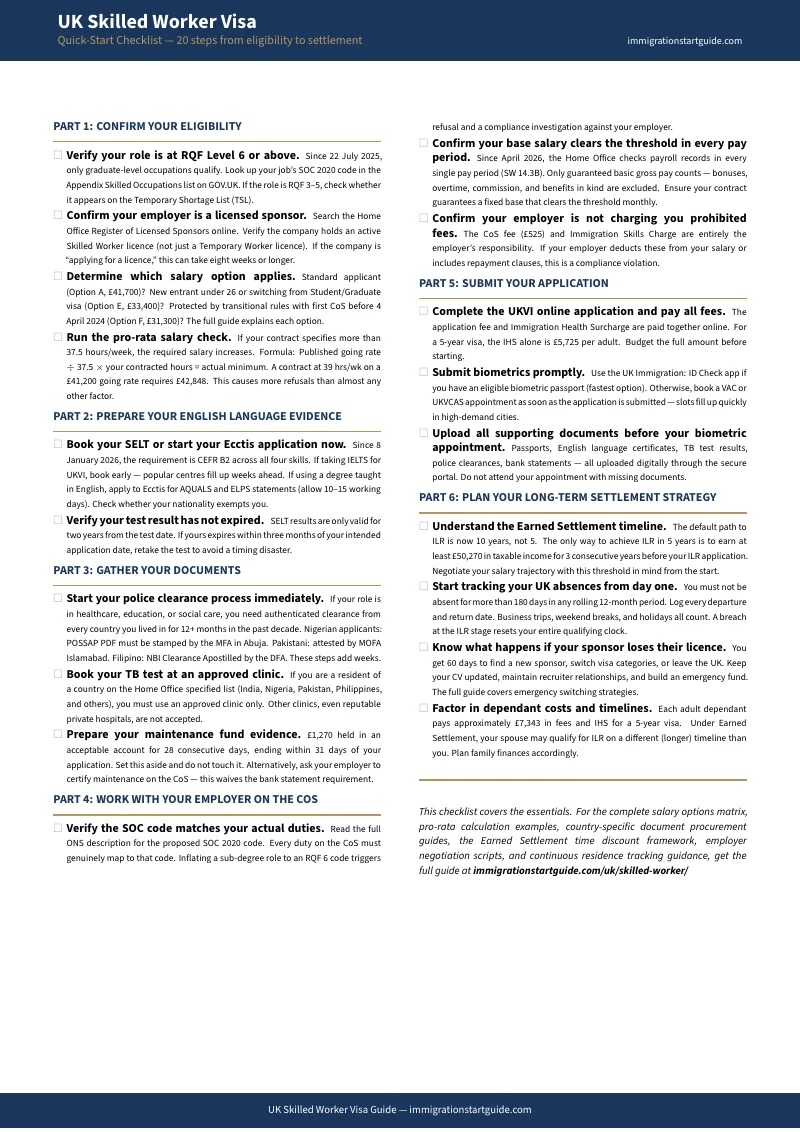
Download the free Quick-Start Checklist to see the 20-item action plan and run your first pro-rata salary check tonight. When you are ready for the complete Threshold Compliance System — the dual threshold matrix, the transitional protection roadmap, the country-specific document guides, and the Earned Settlement framework — the full guide is here.
The UK made the rules hostile. This guide makes them navigable.