
The Home Office Charges £1,846 to Process Your Application, Refuses One in Four Partner Visas, and the Solicitor Wants £3,000 to Review the Same Documents You Gathered Yourself
You built a life with someone across borders. Late-night video calls in different time zones, airport arrivals that never last long enough, the constant arithmetic of when you will finally live in the same country. Now you're staring at Appendix FM of the Immigration Rules — an 80-page document written in bureaucratic legalese for Home Office decision-makers, not for couples trying to be together — and discovering that the United Kingdom requires you to prove your love to a caseworker trained to assume your relationship is not genuine.
You searched online. GOV.UK tells you to submit "specified evidence" without explaining what a convincing evidence package actually looks like. Reddit is full of couples sharing advice from applications filed under completely different financial categories, in different years, from different countries. A spouse who qualified under the old £18,600 threshold with a Category A salaried income tells you their approach worked — and it is dangerously irrelevant to your self-employed Category F situation under the £29,000 rules. At midnight you're deeper into r/ukvisa than you've ever been, and every new refusal story makes you more anxious, not more prepared.
The immigration solicitor you consulted quoted £1,500 to £5,000. For that fee, you still gather every payslip, every bank statement, every photograph, every certified translation yourself — the solicitor reviews what you provide and submits it. Meanwhile, the market leader in DIY spouse visa packs has stopped selling them to focus on full legal representation. The remaining digital guides give you a generic checklist for £59. The Etsy templates for £5 give you a cover letter written for someone else's circumstances.
The UK Spouse/Partner Visa Guide is a Category-Specific Filing System — not a textbook explaining immigration law, but a structured process that routes you into your exact income category (A through G), builds your relationship evidence architecture to the caseworker's own valuation hierarchy, and coordinates the 28-day document freshness window, TB testing, and English language certification into one filing timeline. It replaces weeks of contradictory forum advice with one linear path from eligibility assessment through settlement and British citizenship.
What's Inside the Category-Specific Filing System
A 10-PDF toolkit: the complete 14-chapter guide, a Quick-Start Checklist, and 8 standalone printable worksheets — covering the full partner visa lifecycle from initial eligibility through ILR and British citizenship, with every 2026 fee schedule, threshold, and regulatory citation current as of May 2026:
The £29,000 Financial Requirement Decoded Across All Seven Income Categories
This is not a single generic checklist. It is seven distinct diagnostic pathways. Category A (salaried employment for 6+ months) requires six months of payslips and matching bank statements with a precisely formatted employer letter. Category B (variable income or under 6 months' employment) requires a complex two-part annualised test proving both current salary and £29,000 earned in the prior 12 months. Category F (self-employed sole trader) requires SA302 forms, Tax Year Overviews, and the Accountant's Certificate of Confirmation — a mandatory document that most DIY applicants do not know exists. The guide routes you into your correct category and gives you the exact document list for that category — because submitting Category A evidence when you actually qualify under Category B is one of the fastest paths to refusal.
The Cash Savings Calculation and the Self-Employment Trap
The precise formula: (income shortfall × 2.5) + £16,000 = required savings. To meet £29,000 entirely through savings with zero qualifying income, you need £88,500 held for six continuous months without a single day below the threshold. The guide explains the restriction that catches applicants off-guard at the worst possible moment: self-employment income (Categories F and G) cannot be combined with cash savings under any circumstances. If your self-employment earnings fall short of £29,000, savings cannot bridge the gap. Discovering this after months of preparation costs you more than money — it costs you time you cannot get back.
Transitional Protections for Pre-April 2024 Applicants
If your first partner visa was granted before 11 April 2024 and you are now extending, you may still qualify under the legacy £18,600 threshold with the child add-on formula (£3,800 for the first child, £2,400 per additional child). The distinction between new applicants and extending applicants causes more confusion on community forums than any other single topic. The guide identifies exactly who qualifies for transitional rates and who faces the full £29,000 — so you prepare evidence against the correct threshold, not the wrong one.
The Relationship Evidence Architecture
Caseworkers value evidence in a strict hierarchy. Joint tenancy agreements, council tax bills, and joint bank accounts carry more weight than hundreds of WhatsApp screenshots. The "shock and awe" approach — dumping 400 pages of unorganised chat logs and undated photographs — signals poor preparation and delays processing. The guide provides the caseworker's evidence hierarchy, a chronological structuring framework, and specific strategies for the profiles that attract the most scrutiny: long-distance couples with minimal cohabitation history, arranged marriages with accelerated timelines, and unmarried partners who must prove a relationship akin to marriage for at least two years. Includes the cover letter blueprint that ties your financial evidence and relationship narrative into one coherent submission.
Company Director Compliance Audit
Sponsors who are directors of specified limited companies (fewer than five shareholders) face the highest document-related refusal rate of any financial category. The Home Office cross-references your CT600 Company Tax Return against dividend vouchers and personal bank statements — and a two-day date mismatch between a dividend voucher and the corresponding bank deposit is enough to trigger a refusal. The guide provides a step-by-step auditing checklist so you can verify every date and figure matches before submission.
Country-Specific Document Procurement
TB screening clinic locations and booking strategies for India, Pakistan, the Philippines, Nigeria, and Thailand — with the six-month validity trap that causes certificates to expire while applicants wait for financial documents to mature. The Philippine PSA security paper mandate. Certified translation requirements for non-English documents. English language test selection — why booking standard IELTS Academic or General Training instead of IELTS Life Skills is the single most common testing mistake, costing months of delay and unnecessary fees. The guide includes a coordination timeline to sequence every time-sensitive component so nothing expires before you file.
Refusal Prevention and Recovery
The six most common refusal grounds, the catastrophic consequences of a deception finding (a 10-year reentry ban), and your three options after a negative decision: administrative review, appeal to the First-tier Tribunal, or fresh application. The guide identifies exactly when each option makes strategic sense — because appealing a decision that was correctly made under the rules wastes months, while accepting a refusal caused by missing evidence when you have an appeal right hands the Home Office a win they don't deserve.
The Full Path: Initial Visa → Extension → ILR → British Citizenship
The initial visa is granted for 2.5 years. Before it expires, you file an extension — which requires meeting the financial requirement again at the threshold applicable at that time. After five years, you apply for Indefinite Leave to Remain: Life in the UK test, B1 English (higher than the A1 or A2 required earlier), updated financial evidence. Twelve months after ILR, you become eligible for British citizenship. The guide maps the entire seven-year pathway with every fee, test requirement, and compliance deadline at each stage.
8 Standalone Printable Worksheets
Print and use during your application: the Income Category Diagnostic (decision flowchart to identify your exact category A–G), Document Checklist (tick-off every required document by category), Relationship Evidence Checklist (tiered evidence hierarchy with notes lines), Company Director Compliance Audit (the dividend date-matching verification grid), Fee Calculator Worksheet (fill-in cost breakdown for the full 5-year pathway), 28-Day Filing Timeline (work-backwards planner with document validity tracker), Cover Letter Blueprint (structured template with document index mapping to Immigration Rules), and the Country-Specific Document Reference (TB screening, translations, and authentication for India, Pakistan, Philippines, Nigeria, and Thailand).
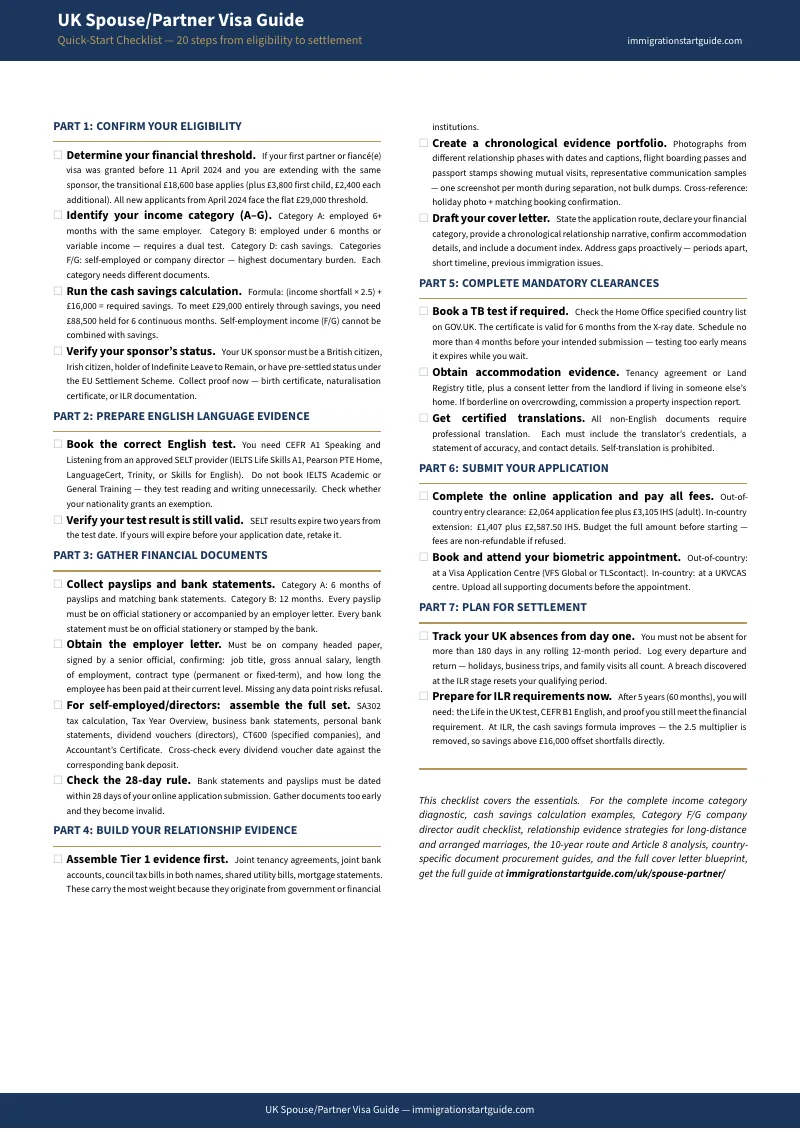
Quick-Start Checklist (free download)
A 20-item action plan covering the essentials: confirm your eligibility and income category, book the correct English test, assemble category-specific financial documents, build your relationship evidence bundle, coordinate the 28-day rule with TB testing and application submission, and plan the settlement pathway. Enough to start tonight — and enough to see whether a structured approach makes the process feel manageable for the first time.
Who This Guide Is For
This guide is for couples navigating the UK spouse or partner visa who:
- Earn £29,000 or more in salaried employment and want to make sure your payslips, bank statements, and employer letter are formatted exactly as the Home Office requires — because you have heard stories of clean-cut applications refused over a missing page number or an undated letter
- Are self-employed, a freelancer, or a company director and are not sure whether you qualify under Category F or Category G, whether your SA302 is sufficient without an Accountant's Certificate, or how to handle dividend income without triggering the date-matching refusal that catches directors who don't know it exists
- Earn less than £29,000 and need to use cash savings to bridge the gap — but are unsure about the formula, the six-month holding period, or whether combining savings with your other income sources is even permitted under the rules
- Applied before April 2024 and are now extending — and are confused about whether the £29,000 threshold applies to your extension or whether you are protected under the transitional £18,600 rules
- Are in a long-distance relationship and worried about proving it is genuine when you have limited cohabitation history — and need to know exactly which evidence carries weight with caseworkers and how to structure the cover letter that addresses the gaps
- Have a partner from India, Pakistan, the Philippines, Nigeria, or Thailand and need country-specific guidance on TB testing, document authentication, and certified translations — not generic UK-centric advice that assumes every applicant's home country operates the same way
- Consulted a solicitor and were quoted £3,000 or more for a case with no criminal complications, no prior refusals, and no exceptional circumstances — and want to file with the same level of strategic guidance, at a fraction of the cost
- Had a previous visa application refused and need to understand whether to appeal, request administrative review, or submit a fresh application — and how to address the refusal grounds without triggering a deception finding
Why Not Free Resources?
Free information exists. Government pages, solicitor blogs, immigration forums, YouTube advisors — all free, all abundant. Here's what they actually deliver:
- GOV.UK publishes Appendix FM-SE — an 80-page document written for Home Office decision-makers in bureaucratic legalese. It tells you to submit "specified evidence" without explaining what a convincing evidence package looks like. It lists seven income categories without telling you which one applies to your situation. You get rules, not strategy.
- Reddit (r/ukvisa) and Facebook groups are invaluable for emotional support and timeline data. But a filing strategy that worked for a Category A salaried employee is fundamentally different from one involving a self-employed sole trader under Category F. Applying another couple's evidence list to your own application — especially when the financial categories, thresholds, and application years differ — is one of the fastest paths to a refusal. Every new horror story about a refused visa makes you more anxious, not more prepared.
- YouTube immigration advisors produce excellent, specific content about financial requirement complexities and refusal risks. Their business model is to demonstrate the terrifying complexity of your situation and then offer a £1,500+ consultation. They explain why you need a solicitor. They never hand you the filing templates or evidence frameworks.
- Compass Immigration offers a DIY guide for £59 — a document checklist, walkthrough, and template letters. Competent for straightforward salaried cases but doesn't cover the self-employment compliance audit, the company director dividend matching trap, cash savings calculation, or the country-specific document procurement that makes the difference for the majority of couples who fall outside a clean Category A profile.
- Etsy and Gumroad templates (£2–£15) help you format a cover letter or organise photographs. They don't teach you which income category applies, how to coordinate the 28-day document freshness rule, or how to structure relationship evidence for a long-distance couple. They organise your evidence without telling you which evidence actually matters.
This guide fills the execution gap — the space between "I understand I need to meet the financial requirement" and "I can identify my exact income category, assemble the category-specific evidence, build a relationship evidence architecture that satisfies the genuine and subsisting test, and coordinate every time-sensitive component into a single filing timeline." The same structured approach an experienced immigration paralegal would use internally, at a fraction of the cost of a single consultation hour.
— Less Than One Hour with a Solicitor
An immigration solicitor charges £1,500 to £5,000 for full representation. The application fee alone is £1,846 from outside the UK. The Immigration Health Surcharge adds £3,105 for 2.5 years. Before you've paid for priority processing, biometrics, translations, or the English language test, the baseline sunk cost exceeds £5,000. A refused application forfeits the £1,846 fee and costs months of separation while you reapply.
This guide doesn't replace a solicitor for cases involving criminal history, deception findings, complex Article 8 human rights arguments, or prior deportation orders. But for the majority of partner visa applications that are procedurally manageable, it provides the same category-specific filing structure — at a cost lower than one hour of a solicitor's time.
Money-back guarantee, no time limit. If the Category-Specific Filing System doesn't make your application stronger, you pay nothing.
Download the free Quick-Start Checklist to see the 20-point action plan. When you're ready for the complete financial requirement diagnostics, relationship evidence architecture, country-specific document procurement, and refusal prevention strategy, the guide is here.
You crossed borders to build a life together. Now build the application that keeps it.