
You've Lived in the UK for Five Years. One Paperwork Mistake Can Erase It All. This Guide Makes Sure It Doesn't.
You have spent five years building a career, paying taxes, raising a family, and putting down roots in the UK. Now you need Indefinite Leave to Remain to make it permanent. You check GOV.UK. You fill in the SET(O) form. You pay the £2,885 application fee plus the biometrics appointment. You submit. And the refusal letter arrives.
You were abroad for 183 days in a rolling 12-month window. Not a calendar year — a rolling window. You counted calendar years because every free guide on the internet told you to count calendar years. The Home Office counted 365 overlapping windows. You exceeded the limit in one of them by three days. Your application fee is gone. Your settlement clock does not reset, but you now face another expensive application, months of uncertainty, and the nagging fear that your employer will question whether you are worth the visa hassle.
This is not hypothetical. It is the single most common refusal pattern documented across immigration forums, advisory services, and legal blogs in 2025 and 2026. And it is entirely preventable — if you audit your travel history against the correct methodology before you submit.
The problem is not that the rules are hidden. They are published across GOV.UK, Appendix Continuous Residence, Appendix Skilled Worker, Appendix KoLL, and dozens of nested policy guidance documents. Each page assumes you already understand how all the others interact. The continuous residence page mentions 180 days. It does not explain how to calculate overlapping 12-month windows. It does not warn you that departure day counts as presence but return day does not in some formulations. It does not mention that the pre-April 2024 rules used a different calculation method and that your qualifying period may straddle both regimes.
The UK Indefinite Leave to Remain (ILR) Guide is a Settlement Compliance System — the end-to-end execution framework that sits between GOV.UK's fragmented statutes and a solicitor's £2,000-to-£4,000 retainer. It transforms a high-stakes bureaucratic maze into a sequenced, verifiable process where every absence is audited, every document is checked against Home Office evidentiary standards, and every common refusal trigger is neutralised before your application reaches a caseworker.
What's Inside the Settlement Compliance System
The Rolling 180-Day Absence Audit Framework — the exact methodology the Home Office uses to calculate continuous residence across every possible 12-month window during your qualifying period. The guide provides worked examples showing how to check each window, how departure and arrival days are counted, and how to identify dangerous windows before they become refusal grounds. This single audit prevents the refusal that catches more self-prepared applicants than any other factor.
The Multi-Route Decision Matrix — many applicants qualify for settlement through multiple routes simultaneously. A Skilled Worker who has also reached 10 years of lawful residence. A spouse who also qualifies through their own work visa. The guide maps processing times, evidentiary burdens, salary requirements, and refusal risks for each route so you choose the path with the highest approval probability — not the one you happened to stumble across first on a forum.
The April 2024 Salary Threshold Navigator — if your Certificate of Sponsorship was assigned before 4 April 2024, your ILR salary threshold is the legacy £29,000 or your occupation's going rate at the 25th percentile. If assigned after, you face £38,700 or the 50th percentile going rate. The guide maps every transitional arrangement so you verify your exact threshold, claim every protection you are entitled to, and do not voluntarily accept a higher bar that does not apply to your cohort.
The "Foreseeable Future" Employer Letter Template — a word-for-word template for the employer confirmation letter that Skilled Worker applicants must submit. The Home Office requires specific phrases — "continued employment for the foreseeable future," the exact salary figure, the SOC code, and the working pattern. One missing phrase triggers a refusal. Most HR departments have never written this letter before. The template gives them the exact format with placeholders for your details — because asking HR to "write a letter confirming your employment" gets you a generic reference, not the document the caseworker needs.
The Good Character Self-Audit — the Home Office does not just check criminal records. It runs automated cross-checks against HMRC tax records for every year of your qualifying period. If your declared income on the visa application does not match your P60, or if salary sacrifice schemes reduced your taxable income below the threshold, you have a problem. The guide includes the exact steps to request your own HMRC Subject Access data and identify discrepancies before a caseworker does — because discovering a £200 tax anomaly during processing costs you £2,885 in a refused application.
The 10-Year Route Hybrid Calculator — for Long Residence applicants, the guide separates your qualifying period into pre-April 11, 2024 (subject to the old 548-day total and 184-day single trip limits) and post-April 11, 2024 (subject to the new rolling 180-day rule). This is the most complex calculation in UK immigration law and no free tool handles the transition correctly. The guide provides the exact methodology for applicants whose 10-year period straddles both regimes.
The Life in the UK Test Strategy — the official test has a 75% pass rate, but failures cluster among applicants who used unofficial study materials or outdated apps. The guide provides a vetted resource list, a study timeline calibrated to the 45-minute test format, and the exact booking procedure — because discovering that your nearest test centre has a 6-week waiting list after you have already submitted your application creates a bottleneck that delays everything.
The Section 3C Leave Protection Briefing — if your current visa expires while your ILR application is being processed, Section 3C of the Immigration Act 1971 extends your leave on the same conditions. But 3C leave does not appear on your BRP. It does not show in employer checking services. The guide explains exactly how to prove your right to work, what documents to carry, and how to handle employer or landlord panic during the processing gap — because losing your job while waiting for a decision converts a routine settlement into a crisis.
The Earned Settlement Roadmap — the 2026 reforms introduced a 10-year baseline with income-based reductions. If you earn above £50,270 for the three years preceding your application, you qualify for a 5-year reduction. If you earn above £125,140, you may settle after just 3 years. The guide maps the new calculation, the evidence required to prove sustained earnings, and the interaction between the Earned Settlement system and your specific route — because the system is designed to reward those who understand it and penalise those who do not.
The Complete Fee Architecture — every cost itemised: the £2,885 standard application fee, the £500 super priority service, the biometrics appointment, the Life in the UK test booking fee. For a family of four, the total settlement cost can exceed £12,000. The guide gives you the realistic total before you commit — and shows you which costs are non-refundable on refusal.
Standalone Printable Tools Included
Every paid download includes standalone PDFs designed to be printed and used throughout your settlement journey:
- Rolling Absence Tracker — travel log with built-in 12-month window calculations for auditing the 180-day rule across your entire qualifying period
- Document Evidence Checklist — the master document requirements for your route, with evidence hierarchy rankings (Council Tax bills rank above mobile phone bills) and checkboxes
- Employer Letter Template — the exact letter format with mandatory phrases for Skilled Worker settlement, ready to hand to your HR department
- HMRC Self-Audit Worksheet — step-by-step guide to requesting your tax records and cross-checking against visa declarations
- Qualifying Date Calculator — fill-in worksheet to determine your exact earliest application date based on visa grant date, entry date, and route-specific rules
- Route Comparison Card — side-by-side comparison of processing times, costs, and evidence requirements for applicants eligible through multiple routes
Who This Guide Is For
This guide is built for visa holders who have invested years building a UK life and need to convert that investment into permanent status — without paying a solicitor thousands of pounds for document gathering they can do themselves with the right framework.
- You are a Skilled Worker approaching your 5-year mark. Your visa expires in 6 months. You need to verify your salary meets the correct threshold (legacy or new), audit your travel history against the rolling 180-day rule, get the employer letter in the right format, and submit at exactly the right time — not one day too early.
- You are on a family route and your relationship has changed. You entered on a spouse visa but separated during the qualifying period. You need to understand whether you still qualify through the domestic violence provisions, or whether switching to the Long Residence route is more viable.
- You have been in the UK for nearly 10 years on various visas. Student, then Graduate, then Skilled Worker. Your continuous residence spans multiple visa types and the pre/post-April 2024 rules. You need the hybrid calculation methodology that accounts for both regimes.
- You earn well above the threshold and the 2026 Earned Settlement system benefits you. You need to understand exactly what evidence proves "sustained earnings" and how to claim the 5-year or 7-year reduction that your income entitles you to.
- You received a refusal and cannot understand why. Your application was refused for a continuous residence breach you did not know existed, or an HMRC discrepancy you were never warned about. You need to understand what went wrong and how to correct it in a fresh application.
- You want to settle but the £2,000-to-£4,000 solicitor fee seems excessive for what is essentially document gathering and form-filling. Your case has no criminal history, no complex human rights issues, no asylum interactions. You just need the correct process, in the correct order, verified against the correct standards.
This guide does not replace a solicitor for cases involving criminal convictions, deportation orders, or complex Article 8 human rights claims. It gives you the systematic verification framework that GOV.UK does not provide and that solicitors charge £2,000+ to deliver.
Why Not Free Resources?
- GOV.UK publishes the rules. It does not explain how they interact. The continuous residence page says "180 days." It does not show you how to audit overlapping 12-month windows. It does not warn you that a 2-week Christmas trip, a 3-week summer holiday, and a work conference can silently breach the limit in a single window. It expects you to cross-reference Appendix Continuous Residence, your route-specific appendix, and the Immigration Rules simultaneously — and to catch your own errors before the caseworker does.
- Reddit (r/ukvisa) is where someone who applied in 2022 under the old absence rules tells you that "180 days per year is fine." Someone who filed before the April 2024 salary changes insists the old threshold still applies. Someone confuses Section 3C leave with Section 3D. You get crowdsourced anxiety and survivorship bias from people who filed under different rules in a different era.
- Immigration solicitor blogs publish excellent analysis of every rule change — because their business model is to demonstrate complexity, then offer retainers. The blog explains the 180-day problem. The solution costs £2,000. The guide gives you the same audit methodology for a fraction of that fee.
- Free absence calculators count total days abroad in a calendar year. The Home Office does not count calendar years. It checks every possible 12-month window across your entire qualifying period. A calendar-year calculator can show "170 days" and give you false confidence while the Home Office finds "184 days" in a rolling window that spans November to October. The guide teaches you the correct methodology.
This guide fills the execution gap — the space between "I know I need ILR" and "I can verify that my application passes every automated Home Office check before I commit £2,885 in non-refundable fees."
Satisfaction Guarantee
If the guide does not give you a clear, actionable path to preparing your ILR application — including the absence audit methodology, document evidence hierarchy, and route-specific verification steps — email us and we will refund you in full. No questions, no time limit. You have spent years qualifying for settlement. The guide either makes that process verifiable and safe, or it has not earned its place on your screen.
Start Your Settlement Application With Confidence
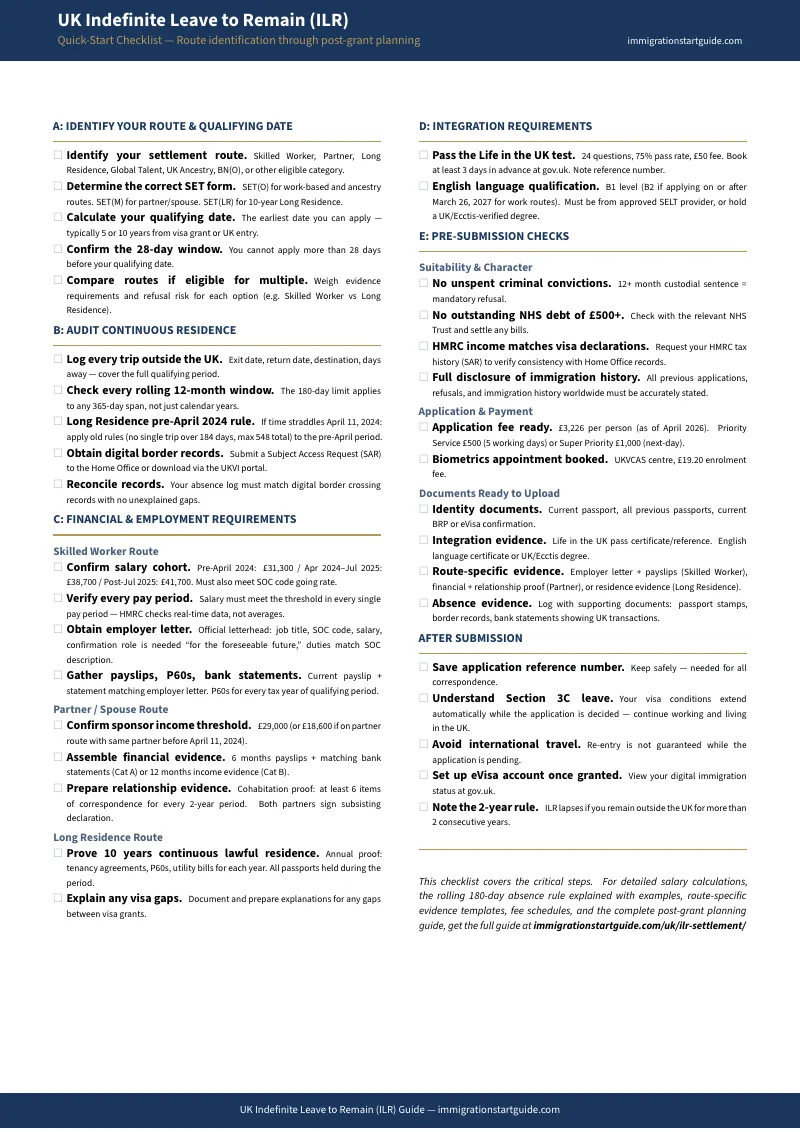
Download the free Quick-Start Checklist to see the document requirements for your route. When you are ready for the full Settlement Compliance System — the absence audit framework, employer letter templates, HMRC self-audit, and route-specific decision tools — get the complete guide for and protect the investment you have spent five years building.