
You Have the Career. The Endorsing Body Has Eight Weeks to Decide If Your Evidence Proves It. This Guide Makes Sure It Does.
You've spent years building something real. Published research that shifted a field. Shipped products used by millions. Performed at festivals that draw international press. You are, by any reasonable definition, a leader in your field — or well on your way to becoming one.
Then you open the Global Talent visa guidance and discover that none of that matters unless you can translate it into a format that an anonymous peer-review panel will endorse in a single pass. The criteria say "demonstrate innovation." They don't define innovation. The guidance says "provide evidence of recognition." It doesn't tell you whether a GitHub repo with 4,000 stars counts, or how to prove that your orchestral premiere was "significant" rather than merely "good." You have 10 evidence slots. Three reference letters. One personal statement. And a £561 endorsement fee that you don't get back if the panel says no.
So you start researching. You read a Reddit thread from 2023 that recommends a mentorship platform that Tech Nation stopped accepting in 2025. You find a lawyer's blog that makes the process sound so complex you'd need their £5,000 retainer to survive it. You email a colleague who got endorsed last year, and their advice boils down to "just be yourself" — helpful for a first date, useless for a high-stakes bureaucratic assessment. Meanwhile, the assessor who will read your portfolio is looking for a very specific kind of story, told in a very specific structure, and you have no idea what it is.
Here's what the free guidance will never tell you: the Global Talent visa is not a credentials check. It's a narrative exercise where the most common failures happen because strong candidates submit evidence that doesn't map to what the panel is actually scoring. Applications are refused because referees praise your personality instead of citing measurable impact. Because 10 evidence items are scattered across four optional criteria instead of building depth in two. Because the personal statement reads like a CV summary instead of answering the three questions every endorsing body wants answered. The 2024 endorsement success rate was 76.9% — which means nearly one in four applications from professionals who believed they were qualified was refused. The difference is not talent. It's strategy.
The UK Global Talent Visa Guide is an Endorsement Strategy System built for the specific problem that every self-applicant faces: converting genuine professional achievement into the structured evidence portfolio that peer-review panels actually endorse. Not a rehash of GOV.UK pages. Not a blog post disguised as a guide. This is a 15-chapter strategic framework covering all six endorsing bodies, the Talent versus Promise decision, the 3-3-4 evidence structure, the reference letter instruction kit, the personal statement architecture, the complete fee schedule including the Immigration Health Surcharge, dependant applications, and the accelerated three-year path to settlement — updated for the 2026 criteria and the March 2027 English language changes.
What's Inside the Endorsement Strategy System
5 PDFs — the complete guide, three standalone tools you can print and use immediately, and a quick-start checklist to work from tonight:
The 3-3-4 Evidence Portfolio Structure (Chapter 4)
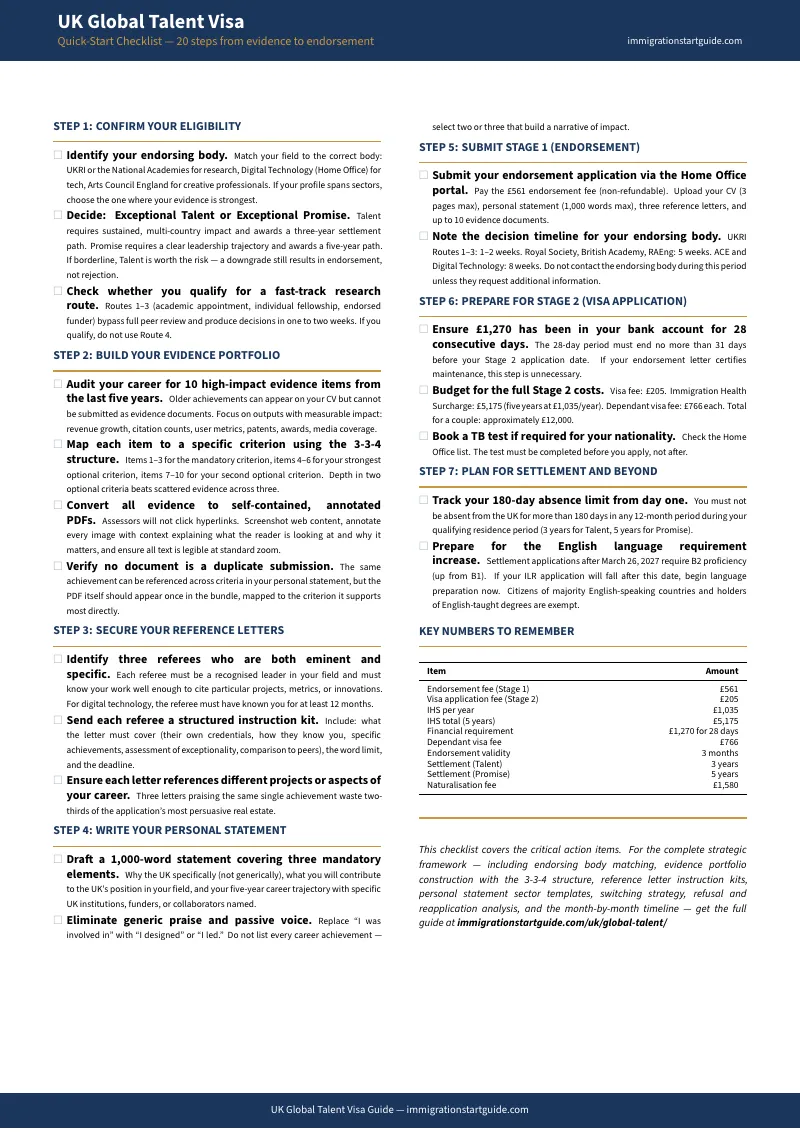
You have 10 evidence slots. The most common mistake is spreading them across three or four optional criteria, producing shallow coverage that the panel reads as "broad but not deep." The 3-3-4 structure assigns items 1–3 to the mandatory criterion, items 4–6 to your strongest optional criterion, and items 7–10 to your second optional criterion. It creates concentrated impact where assessors are actually scoring. The guide provides sector-specific evidence maps for digital technology, STEM research, humanities, and arts — showing what counts, what doesn't, and how to convert raw achievements (GitHub repos, media mentions, citation metrics, revenue figures, exhibition catalogues) into annotated, self-contained PDFs that assessors can evaluate without clicking a single hyperlink.
The Reference Letter Instruction Kit (Chapter 5)
Three reference letters carry more weight than most applicants realise — and they're the component you have least control over. Your referee must be eminent in the field, must know your work specifically (12-month minimum for digital technology), and must address your achievements with metrics, not praise. The problem: most referees have never written a Global Talent reference. Many ask you to draft it yourself — which means the panel may detect a common voice across all three letters. The guide provides a structured instruction kit you send to each referee, covering what the letter must include, the word limit, the mandatory comparison-to-peers element, and how to handle the self-drafting scenario with three different structural approaches so each letter reads as independently authored.
The Talent vs. Promise Decision Framework (Chapter 3)
Choosing wrong costs years. Exceptional Talent leads to settlement in three years. Exceptional Promise requires five. But applying for Talent when your evidence better supports Promise risks outright refusal — you won't be automatically downgraded across all endorsing bodies. The decision framework uses career stage, evidence strength, and settlement urgency to recommend the right track. It explains when the endorsing body can downgrade Talent to Promise (and how that actually works), why borderline candidates in digital technology should lean toward Talent, and why researchers with industry rather than academic profiles need to think differently about which body to approach.
Six Endorsing Bodies, One Guide (Chapter 2)
UKRI, the Royal Society, the British Academy, the Royal Academy of Engineering, Arts Council England, and the Digital Technology route all assess different criteria with different expectations. A GitHub portfolio that wins endorsement in digital technology is irrelevant to the British Academy. An exhibition catalogue that impresses ACE means nothing to the Royal Society. The guide maps each body's specific criteria, the four research routes (including the fast-track mechanisms that bypass peer review), the new Design Industry pathway launched in July 2026, and the sector-specific pitfalls that catch applicants who follow generic advice. If you're a researcher who qualifies for Route 1, 2, or 3, the guide tells you to use it — and not waste weeks preparing a Route 4 portfolio.
The Personal Statement Architecture (Chapter 6)
1,000 words. Three questions the panel needs answered: Why the UK (specifically — not generically). What you will contribute to the UK's position in your field. Where your career is going over the next five years. Most applicants write a career summary. The panel wants a forward-looking strategy. The guide provides structural frameworks tailored to each sector: tech founders need to explain the UK venture ecosystem advantage, researchers need to name specific UK institutions and funders, and artists need to articulate how the UK's creative infrastructure enables work they can't do elsewhere. The common mistakes section covers the passive-voice trap, the generic-London-is-great paragraph, and the CV-as-statement failure mode.
The Complete Fee Schedule and Financial Planning (Chapters 8–9)
The costs add up faster than most applicants expect. Stage 1 endorsement: £561. Stage 2 visa: £205. Immigration Health Surcharge: £1,035 per year for five years (£5,175 total). Each dependant adds another visa fee (£766) and their own IHS (£5,175). A couple applying together will pay approximately £12,000 before they set foot in the UK. The guide itemises every fee, maps the payment timeline, explains when the IHS is calculated (based on visa length, not settlement date), and compares the total cost to the Skilled Worker route — where the employer pays the Certificate of Sponsorship fee but you're locked to one job.
Settlement, Switching, and the Path to Citizenship (Chapters 12–13)
The Global Talent visa doesn't end at Stage 2. It's the beginning of a pathway — Indefinite Leave to Remain in three years (Talent) or five years (Promise), then British citizenship twelve months later. The guide covers the 180-day absence rule that catches frequent travellers, the March 2027 English language requirement increase to B2, how to switch from Skilled Worker or Graduate routes without losing qualifying residence time, and the earnings evidence requirements for settlement. If you're already in the UK on another visa, the switching chapter tells you exactly when to apply, how combined leave periods work, and why timing an in-country switch incorrectly can cost you an extra two years on the settlement clock.
Evidence Mapping Worksheet (standalone printable)
A fillable one-page worksheet that maps your 10 evidence items to the 3-3-4 structure — three items for the mandatory criterion, three for your strongest optional criterion, four for your second. Includes a strength rating guide and a pre-submission checklist so you catch formatting errors before they become technical rejections.
Reference Letter Instruction Kit (standalone printable)
A one-page brief you send directly to each referee. Lists every mandatory element the panel requires, provides a planning table for all three referees, includes three structural approaches for the self-drafting scenario, and covers format requirements. Print it, fill in your referee details, and hand it over — no more back-and-forth emails explaining what the letter needs to say.
Fee Calculator Worksheet (standalone printable)
A two-page fee reference card with the complete 2026 fee schedule for single applicants, dependant partners, and families — plus a fillable personal cost calculator and a side-by-side comparison showing why Global Talent saves over £5,600 versus Skilled Worker sponsorship in government fees alone.
Quick-Start Checklist (free download)
A 20-item action plan covering the essentials: identify your endorsing body, choose Talent or Promise, audit your evidence portfolio, secure your referees, draft your personal statement, and prepare for Stage 2 costs. Enough to assess your position and identify your next move tonight.
Who This Guide Is For
This guide is for leaders and emerging leaders in science, engineering, humanities, medicine, digital technology, and the arts who want to live and work in the UK without employer sponsorship:
- Tech founders, CTOs, and senior engineers who want professional autonomy — the ability to freelance, consult, or launch a startup without a Certificate of Sponsorship tying them to a single employer
- Postdoctoral researchers and academics whose salaries fall below the £38,700 Skilled Worker threshold, making the merit-based Global Talent route their only viable entry point
- Artists, writers, musicians, and designers who need a visa that accommodates project-based income and multi-employer creative work
- Mid-career professionals in the UK on Skilled Worker or Graduate visas who want to switch to Global Talent for the faster settlement pathway and employer independence
- Applicants with 3 to 6 years of experience who are unsure whether to apply as Exceptional Talent or Exceptional Promise — and need a decision framework, not a guess
- Anyone who has been refused endorsement and wants to understand whether the problem was evidence quality, narrative structure, or the wrong endorsing body — and how to fix it for a reapplication
This guide is not for: applicants seeking employer-sponsored work visas. If you have a UK job offer and your employer will sponsor you, the Skilled Worker route is your pathway. This guide covers the self-sponsored Global Talent route exclusively.
Why Not Free Resources?
Free information on the Global Talent visa is everywhere. Here's what it actually delivers:
- GOV.UK guidance tells you to "demonstrate innovation" and "provide evidence of recognition." It does not define what level of innovation qualifies, how many users your product needs, whether your citation count is high enough, or what "recognition" means in the arts versus digital technology. You get the rules of the game without the strategy to win.
- Immigration solicitor blogs publish detailed analysis of criteria changes — because their business model requires you to believe the process is so complex that only their £3,000 to £8,000 retainer can protect you. The blog explains the danger. The solution costs thousands.
- Reddit and the Tech Nation Visa Forum are where you find advice from someone who got endorsed in 2022 using mentorship evidence that was devalued in the 2025 criteria update. You get survivorship bias from strangers who applied under different rules, to different endorsing bodies, with different evidence thresholds.
- Gumroad checklists and Notion trackers range from free to £100. The cheap ones organise your documents without telling you what should be in them. The expensive ones cover digital technology specifically — if you're a researcher, artist, or humanities professional, you're reading advice that doesn't apply to your endorsing body.
- YouTube videos cover one fragment of the process in 10 minutes. To reconstruct a complete strategy across six endorsing bodies, you'd need dozens of videos from different creators with different accuracy levels — and you'd still lack the evidence mapping framework, the referee instruction kit, and the personal statement architecture.
This guide fills the strategy gap — the space between "I know the criteria" and "I can present my career in the structure that peer-review panels actually endorse." It delivers the same evidence strategy and portfolio architecture that immigration consultants charge thousands to apply, organised so you can execute it yourself across all six endorsing bodies.
— Less Than One Solicitor Consultation
Immigration solicitors charge £3,000 to £8,000 for full Global Talent visa representation. A 30-minute initial consultation costs £200 to £500. And here's the part they don't advertise: the Global Talent visa is assessed by a peer-review panel of professionals in your field, not immigration judges. Your assessor is another tech founder, another research scientist, another artist. They don't want a legal brief — they want to see professional impact presented in the language of your industry. You are the domain expert. The guide gives you the framework to present that expertise without the solicitor markup.
Your total Global Talent application costs will exceed £6,000 for a single applicant — endorsement fee, visa fee, and five years of Immigration Health Surcharge. Add a dependant and you're above £12,000. This guide represents a fraction of that total investment, and it's the component that determines whether the other £5,000+ produces an endorsement or a refusal letter and eight weeks wasted.
A refused endorsement doesn't just cost you £561. It costs the months of evidence preparation. It costs the career momentum you planned around a UK move. It costs the settlement clock that starts ticking the day your visa is granted — every month of delay is a month added to your path to Indefinite Leave to Remain.
Money-back guarantee, no time limit. If the 3-3-4 evidence structure, the reference letter instruction kit, and the Talent-versus-Promise decision framework don't make your application stronger, you pay nothing.
Download the free Quick-Start Checklist to see the 20-item action plan and assess your eligibility tonight. When you're ready for the full evidence portfolio strategy, the referee instruction kit, the personal statement architecture, and the complete six-body endorsement framework, the full guide is here.
You've already built the career. Now build the case that proves it.