
Stop Gambling £5,900 on a Certificate Format
The UK Ancestry Visa should be the simplest high-value immigration route in the world. Your grandparent was born in the UK. You are a Commonwealth citizen. The visa gives you five years of unrestricted work, a direct path to permanent residency, and eventually a British passport.
But the Home Office does not reject people for being ineligible. It rejects them for submitting the wrong type of certificate.
An Australian "extract" certificate instead of a "full" certificate. A South African birth certificate that took eleven months to arrive — and does not contain the parental details caseworkers require. A Canadian short-form provincial certificate instead of the "certified copy of a record" that is the only format accepted. Every one of these mistakes costs the full application fee: non-refundable.
The Lineage Chain System
Free checklists tell you what to submit. This guide gives you the Lineage Chain System — the step-by-step procurement strategy for building an unbroken documentary link from you to your UK-born grandparent, using the exact certificate formats, registry processes, and wait times that caseworkers actually accept.
The system works because it solves the real problem: the Home Office does not publish how to get the documents it demands. GOV.UK says "provide your grandparent's birth certificate." It does not say which registry to contact in which country, which form to request, how long it actually takes versus the official estimate, or what to do when a name changed between generations and the certificate trail breaks.
Immigration solicitors charge £1,200 to £3,000 for this route. For cases with genuine legal complexity — criminal records, deception findings, disputed nationality — that fee is justified. For the majority of Ancestry Visa applicants whose challenge is documentary logistics, not legal strategy, you need a procurement roadmap, not a retainer.
What's Inside
- The documentary chain explained — what "proof of lineage" means in caseworker terms, which fields they check on each certificate, and why a single missing parental detail triggers refusal even when your eligibility is obvious
- Country-specific certificate procurement — step-by-step ordering instructions for the UK General Register Office, every Australian state registry (NSW, Victoria, Queensland, WA, SA, Tasmania), the South African Department of Home Affairs, Canadian provincial vital statistics, and the Jamaican Registrar General's Department. Current fees, real-world wait times, and the exact format to request
- The South African DHA strategy — why unabridged certificates take 6 to 18 months, the vault copy question, backup documentation when your timeline cannot absorb the wait, and the expediting options that actually work
- Edge case decision trees — pre-1922 Irish births, adopted grandparents, illegitimate lineage, maternal name changes through multiple marriages, grandparents born at sea or on military bases, and composite evidence strategies when the original record is lost or destroyed
- Financial adequacy and work intent evidence — the maintenance threshold, which bank statement formats and employment documents caseworkers accept, how self-employed applicants present income, and the heightened scrutiny for applicants over 60
- The complete 2026 fee schedule — every cost for single applicants and families: visa fee, Immigration Health Surcharge, biometrics, certificate procurement per country, translation fees. Total realistic budget by family size so you can plan the true cost before you begin
- Online application and biometrics walkthrough — the GOV.UK form section by section, how to handle questions about travel history and previous applications, the visa application centre booking process worldwide, and document upload standards that prevent technical rejections
- Post-arrival setup guide — eVisa activation and UKVI account setup, generating Share Codes for employers and landlords (BRP cards are being phased out), National Insurance registration, UK bank account opening as a new migrant, and GP registration
- Five-year path to settlement — the Indefinite Leave to Remain rules, the 180-day annual absence limit and how to track it from day one so you do not accidentally disqualify yourself years into the process
- ILR to British passport — the one-year waiting period, Life in the UK test, citizenship ceremony, passport application, and dual nationality rules for Australians, New Zealanders, Canadians, and South Africans
- Refusal prevention checklist — the seven most common reasons Ancestry Visa applications are refused, drawn from immigration advisory forums and caseworker decision patterns, with specific fixes for each. Printable one-page reference to review before you submit
- Total cost planner — every fee itemised in GBP, AUD, NZD, ZAR, and CAD for single applicants, dependants, and optional costs like priority processing. One printable page so you know the true total before you begin
- Timeline planner — month-by-month application countdown plus a week-by-week first 30 days in the UK checklist. Pin it to your wall and track your progress
- Printable 5-year compliance tracker — a day-by-day absence log for the full qualifying period, plus employment continuity and Life in the UK test tracking, because miscounting days outside the UK is the single most common reason people fail the ILR application five years later
Who This Is For
- Australians and New Zealanders approaching or past the Youth Mobility age cap — the Ancestry Visa is your only route to long-term UK work rights without employer sponsorship. You know you are eligible but you have never ordered a GRO certificate or navigated the Australian state registry system for visa-grade documents
- South African professionals planning a permanent move — the DHA will take months to produce your unabridged certificate. You need a strategy that sequences every document request in parallel so you are not still waiting a year from now
- Canadians who discovered eligibility through genealogy research — your grandmother was born in Scotland and you have never dealt with UK immigration. The official guidance reads like it was written for people who already know the system
- Caribbean and African applicants with complex family records — name changes through informal unions, unregistered adoptions, certificates that contradict each other. You need the alternative evidence strategies that do not appear on any free checklist
- Previously refused applicants — your decision letter cited insufficient lineage evidence. You need to understand exactly what was missing and how to rebuild the chain for a successful reapplication
- Anyone comparing solicitor quotes of £1,500 to £3,000 — your case is straightforward (clear grandparent link, standard documents, no criminal record). You want to understand whether this is genuinely something you can handle yourself with the right roadmap
Why Free Resources Are Not Enough
The information exists. Reddit threads, Facebook groups, GOV.UK pages, immigration forum posts. The problem is not access — it is reliability and completeness.
A single wrong tip from a well-meaning stranger on r/ukvisa about which certificate format to order costs you the document fee, weeks of waiting for the wrong document to arrive, and potentially the entire application fee if you submit without realising the error. The advice might have been correct two years ago. Immigration rules change. Certificate formats change. Fee structures change.
Free checklists on Etsy provide aesthetic organisation. They tell you "birth certificate" without specifying which type from which registry in which format. The Lineage Chain System gives you the procurement instructions that free tools treat as someone else's problem.
The Cost of Getting It Wrong
A single GRO priority certificate costs £38.50. Ordering the wrong one — or ordering the right one from the wrong service level when you are on a deadline — costs you the fee plus the waiting time. Scale this across five to seven certificates from registries in multiple countries, and the financial exposure from documentation mistakes exceeds the cost of this guide several times over.
The visa application fee is £841. The Immigration Health Surcharge is £5,175 for five years. These are non-refundable on refusal. A guide that prevents a single documentary error from reaching a caseworker is not an expense — it is insurance on a £5,900+ investment.
Satisfaction Guarantee
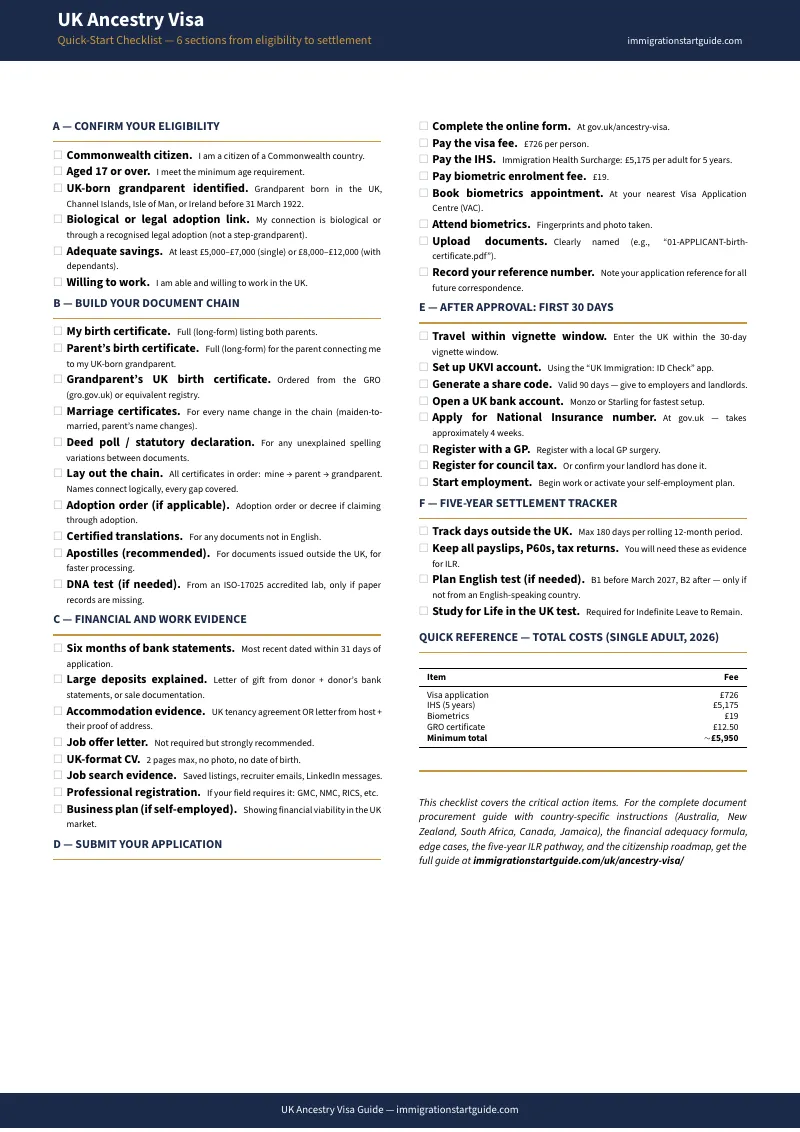
If this guide does not give you a clear, actionable path from your first certificate order to your application submission, email us at any time for a full refund. No questions, no conditions.
— Less Than a Single Priority Certificate
For less than the cost of one rushed document order from the GRO, you get 6 PDFs: the complete procurement strategy for every registry in every Commonwealth country, the refusal prevention checklist, the total cost planner, the timeline planner, and the 5-year compliance tracker. Download the free Quick-Start Checklist to see the structure, then upgrade to the full Lineage Chain System when you are ready to start ordering documents.